PUBLISHER: Mordor Intelligence | PRODUCT CODE: 2099855

PUBLISHER: Mordor Intelligence | PRODUCT CODE: 2099855
North America Monk Fruit Sweeteners - Market Share Analysis, Industry Trends & Statistics, Growth Forecasts (2026 - 2031)
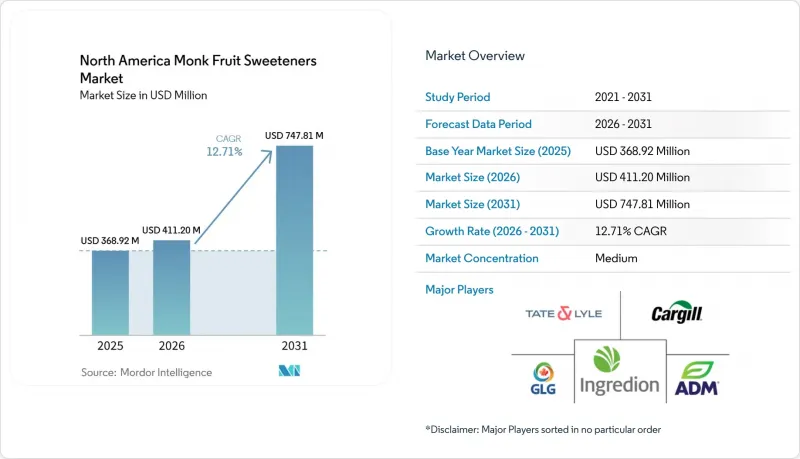
According to Mordor Intelligence, the North America monk fruit sweeteners market size is projected to grow from USD 368.92 million in 2025 and USD 411.20 million in 2026 to USD 747.81 million by 2031, registering a CAGR of 12.71% during 2026-2031.
This report is Segmented by Form (Liquid and Dry), Category (Conventional and Organic), Application (Beverages, Dairy Products, Nutritional Supplements, Bakery Products, Confectionery, Sauces and Dressings, and Other Applications), and Geography (United States, Canada, Mexico, and Rest of North America). The Market Forecasts are Provided in Terms of Value (USD).
North America Monk Fruit Sweeteners Market Trends and Insights
Clean-label sugar reduction in food and beverage reformulation
Regulatory pressure on added sugars, including the FDA's updated Nutrition Facts labeling requirements and increasing state-level discussions on sugar taxes, has created a structural shift in ingredient procurement priorities for large food and beverage companies. Mogroside V contains no carbohydrates associated with traditional sugars, allowing formulators to make zero-calorie claims without using artificial additives. Stevia offers a similar positioning advantage, but monk fruit often benefits from a more favorable consumer taste perception. Cargill's October 2025 consumer research found that buyers are willing to pay 10% more for beverages labeled "naturally sweetened," signaling a premium opportunity that is encouraging brands to reformulate with monk fruit and stevia combinations. This regulatory driver affects both the FDA and the Canadian Food Inspection Agency, as Canada's Food Labeling Modernization Regulations are increasing scrutiny of added sugar declarations and creating parallel compliance pressure across the two primary North American markets.
Adoption in keto, low-carb, and diabetic-friendly products
The keto and low-carb dietary segment maintains a demand floor for monk fruit sweeteners that differs qualitatively from broader health-and-wellness trends. It drives repeat purchases among a loyal, higher-spending consumer cohort that makes dietary choices with near-clinical precision around glycemic impact. Monk fruit's zero glycemic index, validated under the FDA GRAS framework and supported by its non-glycemic mogroside V profile, makes it well-suited for diabetic-friendly and keto formulations, as it does not trigger an insulin response. Lakanto is expected to launch a proprietary golden monk fruit sweetener with allulose in 2025, specifically engineered for browning and caramelization in commercial bakery and home cooking applications. A peer-reviewed study scheduled for publication in the Journal of Drug Delivery and Therapeutics in February 2026 is expected to demonstrate the successful formulation of a monk fruit extract-based zero-calorie electrolyte replenisher powder for diabetic, keto, and athletic users, highlighting the expanding application range beyond tabletop sweeteners.
Concentrated raw material supply chain tied to southern China cultivation
Monk fruit cultivation remains structurally limited to a narrow geographic belt centered in the Guangxi Zhuang Autonomous Region of southern China, which accounts for over 90% of global raw fruit production. The crop requires a 3-5-year maturation cycle, preventing growers from rapidly expanding cultivation acreage in response to demand spikes and creating supply-side inelasticity that contractual hedging cannot fully offset. A peer-reviewed analysis in Foods (MDPI, 2025) notes that this geographic concentration exposes North American buyers to phytosanitary disruptions and geopolitical trade interventions at a severity level not seen in any other major high-intensity sweetener. Guilin-based extractors reported in 2025 that they had independently developed advanced extraction technologies and held over 130 global patents to maintain export competitiveness despite trade uncertainties between China and the United States. The USDA organic and NSF International supply-chain certification frameworks further increase audit costs and lead times for importers sourcing from this geographically concentrated supply base.
Other drivers and restraints analyzed in the detailed report include:
- Monk fruit use in beverages, dairy, and nutritional supplements
- High-performance blends with allulose, stevia, and soluble fiber
- High ingredient cost versus mainstream sugar and some alternative sweeteners
For complete list of drivers and restraints, kindly check the Table Of Contents.
Segment Analysis
The dry form is expected to account for 63.71% of the North America monk fruit sweeteners market in 2025, reflecting its dominance across tabletop sweeteners, dry-mix protein supplements, baked goods, and bakery formats, where flowability and shelf stability are critical. Dry monk fruit, typically spray-dried mogroside V powder blended with a carrier such as erythritol or inulin, supports easy handling and precise dosimetry in high-throughput manufacturing. Although liquid monk fruit is expected to hold a smaller share, it is projected to register a CAGR of 13.96% from 2026 to 2031. Beverage manufacturers are driving this growth due to their preference for aqueous concentrates in RTD teas, flavored waters, and carbonated soft drinks, where dissolution uniformity and real-time sweetness adjustment are essential production requirements. Layn Natural Ingredients' planned 2026 expansion into monk fruit decoction in liquid format, standardized to 1%-3% mogroside V, directly addresses global brand demand for fruit-derived sweetening solutions that offer formulation flexibility beyond high-purity extraction premiums. As the beverage industry moves toward personalized sugar-reduction targets and continuous dosing technology, the liquid form is likely to progressively reduce the dry segment's share through 2031.
A less-examined dynamic within form segmentation is that liquid monk fruit formats generate higher margins for ingredient suppliers despite representing lower-purity grades than concentrated dry extracts. Beverage co-manufacturers that standardize liquid dosing systems create equipment-calibrated switching costs within their procurement structures, resulting in long-term supplier relationships that bulk dry-powder distributors struggle to replicate. The FDA's GRAS classification applies equally to aqueous and powdered monk fruit extracts, providing the regulatory certainty manufacturers need to transition between forms without triggering new compliance reviews. This distinction is practically important as supply chain optimization drives format switching.
Complete Report Scope:
- Form
- Liquid
- Dry
- Category
- Conventional
- Organic
- Application
- Beverages
- Dairy Products
- Nutritional Supplements
- Bakery Products
- Confectionery
- Sauces and Dressings
- Other Applications
- Geography
- United States
- Canada
- Mexico
- Rest of North America
List of Companies Covered in this Report:
- Archer Daniels Midland Company
- Cargill, Incorporated
- Ingredion Incorporated
- Tate & Lyle PLC
- GLG Life Tech Corporation
- Guilin Layn Natural Ingredients Corp.
- Monk Fruit Corp.
- Apura Ingredients
- Sweegen Inc.
- Whole Earth Brands, Inc.
- Lakanto
- NOW Health Group, Inc.
- Pyure Brands LLC
- Steviva Brands, Inc.
- Hunan Huacheng Biotech, Inc.
- Guilin Sanpower Bio-Tech Co., Ltd.
- Naturally Sweet Ventures Inc.
- The NutraSweet Company
- PureCircle
- Hunan Nutramax Inc.
Additional Benefits:
- The market estimate (ME) sheet in Excel format
- 3 months of analyst support
TABLE OF CONTENTS
1 INTRODUCTION
- 1.1 Study Assumptions and Market Definition
- 1.2 Scope of the Study
2 RESEARCH METHODOLOGY
3 EXECUTIVE SUMMARY
4 MARKET LANDSCAPE
- 4.1 Market Overview
- 4.2 Market Drivers
- 4.2.1 Clean-label sugar reduction in food and beverage reformulation
- 4.2.2 Premium natural zero-calorie sweeteners in North American retail and b2b formulations
- 4.2.3 High-performance blends with allulose, stevia, and soluble fiber
- 4.2.4 Adoption in keto, low-carb, and diabetic-friendly products
- 4.2.5 Monk fruit use in beverages, dairy, and nutritional supplements
- 4.2.6 Technical service, application support, and custom sweetening systems
- 4.3 Market Restraints
- 4.3.1 Concentrated raw material supply chain tied to southern China cultivation
- 4.3.2 High ingredient cost versus mainstream sugar and some alternative sweeteners
- 4.3.3 Batch-to-batch taste and Mogroside profile variability
- 4.3.4 Limited consumer familiarity compared with better-known sweetener alternatives
- 4.4 Supply Chain Analysis
- 4.5 Regulatory Landscape
- 4.6 Technological Outlook
- 4.7 Porter's Five Forces
- 4.7.1 Threat of New Entrants
- 4.7.2 Bargaining Power of Buyers
- 4.7.3 Bargaining Power of Suppliers
- 4.7.4 Threat of Substitutes
- 4.7.5 Intensity of Competitive Rivalry
5 MARKET SIZE AND GROWTH FORECASTS (VALUE)
- 5.1 Form
- 5.1.1 Liquid
- 5.1.2 Dry
- 5.2 Category
- 5.2.1 Conventional
- 5.2.2 Organic
- 5.3 Application
- 5.3.1 Beverages
- 5.3.2 Dairy Products
- 5.3.3 Nutritional Supplements
- 5.3.4 Bakery Products
- 5.3.5 Confectionery
- 5.3.6 Sauces and Dressings
- 5.3.7 Other Applications
- 5.4 Geography
- 5.4.1 United States
- 5.4.2 Canada
- 5.4.3 Mexico
- 5.4.4 Rest of North America
6 COMPETITIVE LANDSCAPE
- 6.1 Market Concentration
- 6.2 Strategic Moves
- 6.3 Market Ranking Analysis
- 6.4 Company Profiles
- 6.4.1 Archer Daniels Midland Company
- 6.4.2 Cargill, Incorporated
- 6.4.3 Ingredion Incorporated
- 6.4.4 Tate & Lyle PLC
- 6.4.5 GLG Life Tech Corporation
- 6.4.6 Guilin Layn Natural Ingredients Corp.
- 6.4.7 Monk Fruit Corp.
- 6.4.8 Apura Ingredients
- 6.4.9 Sweegen Inc.
- 6.4.10 Whole Earth Brands, Inc.
- 6.4.11 Lakanto
- 6.4.12 NOW Health Group, Inc.
- 6.4.13 Pyure Brands LLC
- 6.4.14 Steviva Brands, Inc.
- 6.4.15 Hunan Huacheng Biotech, Inc.
- 6.4.16 Guilin Sanpower Bio-Tech Co., Ltd.
- 6.4.17 Naturally Sweet Ventures Inc.
- 6.4.18 The NutraSweet Company
- 6.4.19 PureCircle
- 6.4.20 Hunan Nutramax Inc.
7 MARKET OPPORTUNITIES AND FUTURE OUTLOOK

