PUBLISHER: Mordor Intelligence | PRODUCT CODE: 2072591

PUBLISHER: Mordor Intelligence | PRODUCT CODE: 2072591
Dermal Toxicity Testing - Market Share Analysis, Industry Trends & Statistics, Growth Forecasts (2026 - 2031)
According to Mordor Intelligence, the dermal toxicity testing market size is projected to be USD 2.05 billion in 2025, USD 2.16 billion in 2026, and reach USD 2.82 billion by 2031, growing at a CAGR of 5.47% from 2026 to 2031.
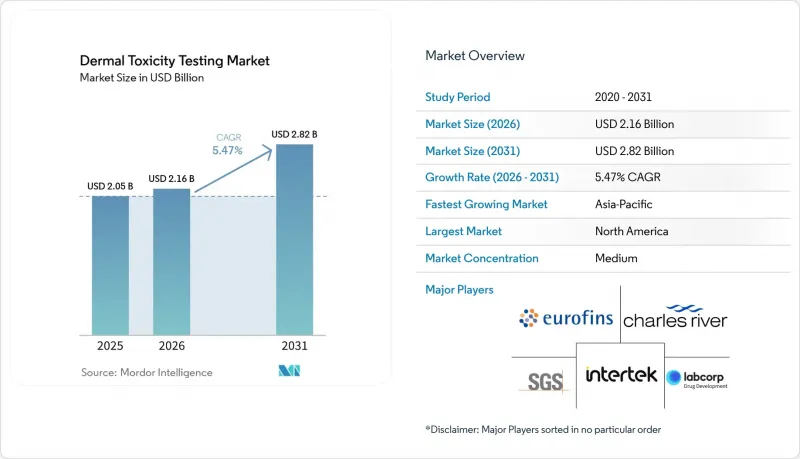
This report is Segmented by Test Type (In-Vitro, In-Silico, Ex-Vivo, In-Vivo), Toxicity Endpoint (Skin Irritation, Corrosion, Sensitization, Absorption, Phototoxicity), End User (Cosmetics, Pharmaceutical, Chemical, Cros, Academic), and Geography (North America, Europe, Asia-Pacific, Middle East & Africa, South America). Market Forecasts are Provided in Terms of Value (USD).
Global Dermal Toxicity Testing Market Trends and Insights
Regulatory Bans on Animal Testing in Cosmetics
Multiple jurisdictions codified animal-testing prohibitions, creating a structural demand shift favoring the dermal toxicity testing market. Twelve U.S. states enforced comprehensive bans by 2024, echoing the European Union's decade-old marketing restriction. Canada's December 2023 law extended the momentum across North America. Regulatory focus now spans chemicals and pharmaceuticals; the U.S. EPA had cleared 140 alternative methods for dermal endpoints by late 2024, and the FDA's 2025 roadmap formally encourages NAMs within Investigational New Drug filings. Japan issued guidance on non-animal protocols in 2024, confirming Asia-Pacific alignment. Collectively, these actions elevate compliance risk for companies lacking NAM data and redirect testing budgets toward validated in-vitro and in silico services.
Accelerated FDA & OECD Acceptance of In-Vitro & In-Silico Assays
The FDA's April 2025 "Roadmap to Reducing Animal Testing in Preclinical Safety Studies" endorses organ-on-chip, AI-based modeling, and virtual-patient simulations, granting early-adopter firms a streamlined review pathway. OECD fast-tracked updates to Test Guidelines 497 and 496 in 2024, integrating omics-based readouts and data-sharing frameworks. Canada released a complementary draft strategy under CEPA in September 2024, targeting full transition to NAMs by 2035. Faster acceptance removes a historic bottleneck-regulatory uncertainty-and magnifies return on R&D for platform providers entrenched in the dermal toxicity testing market.
Limited Predictive Correlation of Some In-Vitro Assays with Human Outcomes
Regulators remain cautious when assay outputs diverge from clinical observations, especially for complex endpoints like dermal sensitization that involve innate and adaptive immunity. Human predictive patch-test datasets reveal variability that current RHE models struggle to reproduce. OECD requires multi-laboratory ring trials prior to guideline approval, prolonging commercialization timelines. Smaller developers face steep funding hurdles to finance these studies. Integrating omics-level analytics with 3-D tissues promises richer mechanistic insight, yet standard protocols are still being harmonized.
Other drivers and restraints analyzed in the detailed report include:
- Growth of Bioprinted 3-D Human Skin Models
- AI-Enabled High-Content Imaging for Irritation Screens
- High Capital Cost of 3-D Tissue Culture Platforms
For complete list of drivers and restraints, kindly check the Table Of Contents.
Segment Analysis
In-vitro RHE systems held the largest 49.19% slice of the dermal toxicity testing market share in 2025, anchored by OECD TG 439 and TG 431 acceptance. The dermal toxicity testing market size for RHE platforms is projected to advance steadily as validation pipelines for vascularized constructs finalize. In-silico assays record the fastest 5.62% CAGR through 2031, fueled by AI libraries ingesting millions of cheminformatics records.
RHE maturity partly stems from its replicable barrier-function metrics and ease of transfer into GLP labs. Iterative improvements-such as iPSC-derived keratinocyte sourcing-reduce donor-variability risks and secure unlimited cell banks. Hybrid strategies that pair quick in-silico screens with confirmatory RHE tests compress development cycles and trim reagent costs, an attractive proposition for firms scaling global portfolios. Yet, 3-D bioprinted skin still faces throughput bottlenecks, limiting its near-term share expansion despite superior physiological relevance.
OECD endorsement of ex-vivo skin (MUG-hOSEC) solidifies niche adoption for immuno-competent assays. Incorporation of hypodermal adipose layers elevates metabolic fidelity, revealing surfactant-induced lipid disturbances undetectable in simpler tissues. Chem-informatics algorithms, in parallel, unlock predictive toxicology for new-to-market UV filters where empirical data are scarce. This dual trajectory-biological sophistication and digital simulation-positions the dermal toxicity testing market as an integrated testing ecosystem rather than a binary choice between wet and dry labs.
Complete Report Scope:
- By Test Type
- In-vitro (2-D & 3-D reconstructed human epidermis)
- In-silico / Computational
- Ex-vivo Human Skin
- In-vivo Animal
- By Toxicity Endpoint
- Skin Irritation
- Skin Corrosion
- Dermal Sensitization
- Percutaneous Absorption
- Phototoxicity & Photo-allergy
- By End User
- Cosmetics & Personal-Care Companies
- Pharmaceutical & Biotech Firms
- Chemical & Agro-chemical Manufacturers
- CROs & Independent Toxicology Labs
- Academic & Government Research Institutes
- By Geography
- North America
- United States
- Canada
- Mexico
- Europe
- Germany
- United Kingdom
- France
- Italy
- Spain
- Rest of Europe
- Asia-Pacific
- China
- Japan
- India
- South Korea
- Australia
- Rest of Asia-Pacific
- Middle East and Africa
- GCC
- South Africa
- Rest of Middle East and Africa
- South America
- Brazil
- Argentina
- Rest of South America
- North America
Geography Analysis
North America's 42.68% 2025 share reflects a mature CRO landscape, proactive FDA stances, and ample venture capital. The region also hosts the densest cluster of bioprinting start-ups, feeding a continuous pipeline of advanced tissue formats. U.S. tech hubs leverage AI talent to refine toxicity algorithms, while Canada's 2023 cosmetics ban further entrenches NAM demand.
Europe sustains robust growth through collaborative industry-academic consortia under Horizon grants. France anchors much of the tissue-engineering supply chain, with EPISKIN's Lyon facility exporting SkinEthic RHE kits worldwide. The dermal toxicity testing market benefits from the EU's mutual recognition regime, enabling test portability across member states and lowering duplicate-testing expenditures.
Asia-Pacific posts the fastest 6.20% CAGR through 2031 as regulators converge on alternative-testing norms. China's February 2025 provisions streamline ingredient registration via non-animal data, while its May 2025 comprehensive safety rules and July implementation timetables spur domestic labs to upgrade their capabilities. Japan solicits public feedback on Chemical Substances Control Law updates due by late-2025, aligning with OECD TG revisions. Capacity constraints persist; training programs for cell-culture toxicologists lag demand, creating openings for Western CRO joint ventures. Nonetheless, rising local manufacturing of RHE kits is set to moderate import dependency and deepen the dermal toxicity testing market footprint across Asia.
South America and the Middle East & Africa remain nascent. Brazil pushes regional adoption through ANVISA alignment with OECD TG 439, but fragmented regulations impede uniform adoption. Gulf Cooperation Council countries display interest, especially where luxury-cosmetic imports require cruelty-free certification. Technology transfer partnerships and mobile testing units could bridge infrastructure gaps and drive incremental revenues.
- Eurofins
- SGS
- Charles River
- LabCorp
- Intertek Group
- In-Vitro International
- MatTek Corporation
- IIVS -Institute for In-Vitro Sciences
- SenzaGen AB
- XCellR8 Ltd
- MB Research Laboratories
- BioReliance (Merck KGaA)
- Cyprotex (Evotec)
- WuXi App Tec
- Pacific BioLabs
- CellSystems Biotechnologie
- Epithelix Sarl
- SkinEthic (L'Oreal)
- CELLnTec Advanced Cell Systems
- Phenion
Additional Benefits:
- The market estimate (ME) sheet in Excel format
- 3 months of analyst support
TABLE OF CONTENTS
1 Introduction
- 1.1 Study Assumptions & Market Definition
- 1.2 Scope of the Study
2 Research Methodology
3 Executive Summary
4 Market Landscape
- 4.1 Market Overview
- 4.2 Market Drivers
- 4.2.1 Regulatory Bans on Animal Testing in Cosmetics
- 4.2.2 Accelerated FDA & OECD Acceptance of In-Vitro & In-Silico Assays
- 4.2.3 Growth of Bioprinted 3-D Human Skin Models
- 4.2.4 AI-Enabled High-Content Imaging for Irritation Screens
- 4.2.5 Rising Dermatological Drug Pipeline Needs Early Dermal Safety
- 4.2.6 ESG-Driven Demand for Cruelty-Free Product Claims
- 4.3 Market Restraints
- 4.3.1 Limited Predictive Correlation of Some In-Vitro Assays with Human Outcomes
- 4.3.2 High Capital Cost of 3-D Tissue Culture Platforms
- 4.3.3 Scarcity of Skilled Cell-Culture Toxicologists in Emerging Markets
- 4.3.4 Absence of Harmonized Global Regulatory Guidelines
- 4.4 Supply-Chain Analysis
- 4.5 Regulatory Landscape
- 4.6 Technological Outlook
- 4.7 Porter's Five Forces Analysis
- 4.7.1 Bargaining Power of Suppliers
- 4.7.2 Bargaining Power of Buyers
- 4.7.3 Threat of New Entrants
- 4.7.4 Threat of Substitutes
- 4.7.5 Competitive Rivalry
5 Market Size & Growth Forecasts (Value, USD)
- 5.1 By Test Type
- 5.1.1 In-vitro (2-D & 3-D reconstructed human epidermis)
- 5.1.2 In-silico / Computational
- 5.1.3 Ex-vivo Human Skin
- 5.1.4 In-vivo Animal
- 5.2 By Toxicity Endpoint
- 5.2.1 Skin Irritation
- 5.2.2 Skin Corrosion
- 5.2.3 Dermal Sensitization
- 5.2.4 Percutaneous Absorption
- 5.2.5 Phototoxicity & Photo-allergy
- 5.3 By End User
- 5.3.1 Cosmetics & Personal-Care Companies
- 5.3.2 Pharmaceutical & Biotech Firms
- 5.3.3 Chemical & Agro-chemical Manufacturers
- 5.3.4 CROs & Independent Toxicology Labs
- 5.3.5 Academic & Government Research Institutes
- 5.4 By Geography
- 5.4.1 North America
- 5.4.1.1 United States
- 5.4.1.2 Canada
- 5.4.1.3 Mexico
- 5.4.2 Europe
- 5.4.2.1 Germany
- 5.4.2.2 United Kingdom
- 5.4.2.3 France
- 5.4.2.4 Italy
- 5.4.2.5 Spain
- 5.4.2.6 Rest of Europe
- 5.4.3 Asia-Pacific
- 5.4.3.1 China
- 5.4.3.2 Japan
- 5.4.3.3 India
- 5.4.3.4 South Korea
- 5.4.3.5 Australia
- 5.4.3.6 Rest of Asia-Pacific
- 5.4.4 Middle East and Africa
- 5.4.4.1 GCC
- 5.4.4.2 South Africa
- 5.4.4.3 Rest of Middle East and Africa
- 5.4.5 South America
- 5.4.5.1 Brazil
- 5.4.5.2 Argentina
- 5.4.5.3 Rest of South America
- 5.4.1 North America
6 Competitive Landscape
- 6.1 Market Concentration
- 6.2 Market Share Analysis
- 6.3 Company Profiles {(includes Global level Overview, Market level overview, Core Segments, Financials as available, Strategic Information, Market Rank/Share for key companies, Products & Services, and Recent Developments)}
- 6.3.1 Eurofins Scientific
- 6.3.2 SGS SA
- 6.3.3 Charles River Laboratories
- 6.3.4 Labcorp Drug Development (Covance)
- 6.3.5 Intertek Group
- 6.3.6 In-Vitro International
- 6.3.7 MatTek Corporation
- 6.3.8 IIVS -Institute for In-Vitro Sciences
- 6.3.9 SenzaGen AB
- 6.3.10 XCellR8 Ltd
- 6.3.11 MB Research Laboratories
- 6.3.12 BioReliance (Merck KGaA)
- 6.3.13 Cyprotex (Evotec)
- 6.3.14 WuXi AppTec
- 6.3.15 Pacific BioLabs
- 6.3.16 CellSystems Biotechnologie
- 6.3.17 Epithelix Sarl
- 6.3.18 SkinEthic (L'Oreal)
- 6.3.19 CELLnTec Advanced Cell Systems
- 6.3.20 Phenion
7 Market Opportunities & Future Outlook
- 7.1 White-space & Unmet-Need Assessment

