PUBLISHER: Mordor Intelligence | PRODUCT CODE: 2072618

PUBLISHER: Mordor Intelligence | PRODUCT CODE: 2072618
Battery Backup - Market Share Analysis, Industry Trends & Statistics, Growth Forecasts (2026 - 2031)
According to Mordor Intelligence, the battery backup market size is projected to be USD 15.39 billion in 2025, USD 16.43 billion in 2026, and reach USD 22.30 billion by 2031, growing at a CAGR of 6.30% from 2026 to 2031.
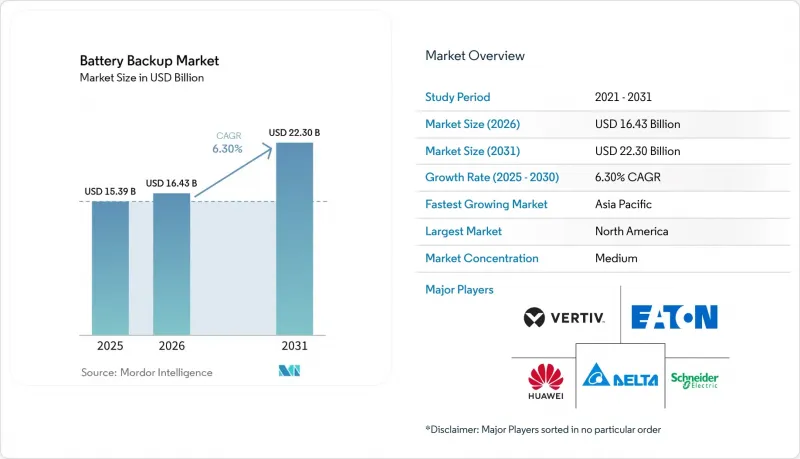
This report is Segmented by Battery Type (Lead-Acid, Lithium-Ion, and More), Power Rating (Below 10 KVA, and More), Product (UPS, Standalone Inverters, and More), Application (Residential, Manufacturing, and More), End-Use (Residential, Commercial, and More), and Geography (North America, Europe, Asia-Pacific, South America, Middle East and Africa). Market Forecasts are Provided in Terms of Value (USD).
Global Battery Backup Market Trends and Insights
Data-Center Proliferation
Hyperscale operators now require backup systems capable of two- to four-hour support to ensure uninterrupted operation of AI inference clusters, which cannot tolerate even short disruptions. Data center capacity in the United States is projected to reach 7.7 GW by 2025, with Northern Virginia accounting for over 2.8 GW. Google's work with Form Energy on a 300 MW iron-air system signals a willingness to diversify beyond lithium-ion for multi-day protection.Microsoft and Meta's capital spending surpassed USD 23 billion during 2024-2025, establishing higher density benchmarks achievable only through lithium-ion or hybrid flow solutions. Downtime costs exceeding USD 10,000 per minute have justified the adoption of premium chemistries, prompting insurance companies to require compliance with NFPA 855 and UL 9540A standards. This compliance adds 8-12% to installation costs. Consequently, the battery backup market has become more robust and resilient, supported by software that enhances cycling efficiency, thermal management, and cell matching.
Rising Grid-Instability Outages
Severe weather conditions and aging transmission infrastructure have led to frequent service interruptions, driving businesses to reevaluate the economic impact of outages. According to ERCOT data, installed battery capacity increased from less than 0.5 GW in 2021 to an expected 17 GW by 2025, accounting for 9% of peak demand during extreme events.California recorded over 25,000 power-quality incidents in 2024, leading to new utility mandates requiring critical sites to maintain self-sufficient battery reserves. Rapid sales growth in India and ongoing load shedding in South Africa highlight the increasing need for reliable backup solutions in emerging markets. Customers are increasingly prioritizing grid-forming and black-start capabilities, driving demand for hybrid inverter-UPS platforms. These requirements broaden the functional scope of the battery backup market and benefit vendors that integrate power electronics, software, and storage chemistry effectively.
Price Volatility of Lithium Raw Materials
Spot prices for lithium carbonate increased to USD 20-22.50 per kg in February 2026, representing a 264% rise from the June 2025 low. This price surge has driven lithium-ion UPS costs to USD 400-500 per kWh, further widening the cost gap compared to lead-acid batteries and complicating budgets for projects awarded under fixed-price contracts. With futures markets remaining limited, suppliers have incorporated escalation clauses into purchase agreements, transferring the risk to buyers. Utility-scale procurements face the greatest challenges, as they require thousands of modules to be delivered over multiple quarters. While long-term offtake agreements with miners offer cost stability, they also commit manufacturers to volumes that may not align with short-term demand fluctuations.
Other drivers and restraints analyzed in the detailed report include:
- Telecom 5G Roll-Out Densification
- AI-Based Predictive BMS Adoption
- Lead-Acid Disposal Regulations Tightening
For complete list of drivers and restraints, kindly check the Table Of Contents.
Segment Analysis
In 2025, lead-acid technology accounted for 53.5% of revenue, supported by established supply chains and recycling channels that kept acquisition costs low. Lithium-ion batteries, projected to grow at a CAGR of 10.6% through 2031, are increasingly favored in hyperscale data centers and telecom towers due to their higher energy density and longer cycle life, despite higher initial costs. This trend is driving growth in the battery backup market at the chemistry level. Flow batteries, such as Rongke Power's 200 MW/1 GWh system commissioned in 2026, address utility requirements for extended durations exceeding four hours, presenting a growing alternative for resilience.
However, battery preferences vary by application. Manufacturing facilities with infrequent power outages continue to opt for lead-acid batteries, as their total cost of ownership remains advantageous with shallow discharge cycles. In contrast, residential solar installers in India increasingly integrate lithium-ion modules, facilitated by ten-year financing options that distribute the higher upfront costs and meet rooftop weight constraints. Emerging technologies like zinc-ion and sodium-ion batteries are under pilot testing, signaling ongoing diversification, though commercial scalability is still several years away. With multiple chemistries competing, the battery backup market accommodates both cost-effective incumbents and high-performance alternatives.
Systems smaller than 10 kVA accounted for a 47.9% value share in 2025 and are projected to grow at a 7.1% CAGR through 2031, driven by the increasing adoption of 5G small cells, retail point-of-sale networks, and micro-branches. These compact systems typically integrate 48-V lithium battery packs with inverter-charger electronics within a single chassis, reducing installation time and simplifying maintenance. In contrast, 10-100 kVA systems cater to mid-size offices and clinics that require higher ride-through capabilities while remaining cost-conscious. Systems above 100 kVA are predominantly used in hyperscale data centers, where hot-swappable power blocks are essential.
Procurement criteria differ based on system ratings. Buyers of sub-10 kVA systems prioritize lightweight designs that comply with pole-mounting load limits, focusing on volumetric density rather than modularity. On the other hand, megawatt-scale purchasers emphasize N+1 redundancy and often use mixed battery chemistries within the same facility to optimize performance for different rack groups. In the mid-tier range, line-interactive topologies compete on efficiency, while double-conversion architectures remain the standard for mission-critical environments. These variations across power bands ensure diverse revenue streams for the battery backup market, reducing dependency on any single segment.
Complete Report Scope:
- By Battery Type
- Lead-acid Battery
- Lithium-ion Battery
- Nickel-based Battery
- Flow Battery & Other Advanced Batteries
- By Power Rating
- Below 10kVA
- 10 kVA to 100 kVA
- Above 100 kVA
- By Product
- Uninterruptible Power Supply (UPS)
- Standalone Inverters
- Portable Power Stations
- Others
- By Application
- Residential
- Manufacturing Facilities
- Commercial Buildings
- Data Centers
- Healthcare
- Telecom Infrastructure
- Government and Public Infrastructure
- Others
- By End-Use
- Residential
- Commercial
- Industrial
- Municipal/Government
- By Geography
- North America
- United States
- Canada
- Mexico
- Europe
- Germany
- United Kingdom
- France
- Italy
- NORDIC Countries
- Russia
- Rest of Europe
- Asia-Pacific
- China
- India
- Japan
- South Korea
- ASEAN Countries
- Rest of Asia-Pacific
- South America
- Brazil
- Argentina
- Rest of South America
- Middle East and Africa
- Saudi Arabia
- United Arab Emirates
- South Africa
- Egypt
- Rest of Middle East and Africa
- North America
Geography Analysis
In 2025, North America retained a 36.1% market share and continued to host the largest installed base of hyperscale data centers. However, Asia-Pacific is advancing rapidly with a compound annual growth rate (CAGR) of 7.8%, as Beijing targets 180 GW of storage capacity by 2027. In the United States, federal tax credits now extend to standalone storage systems, further encouraging utility procurement. Meanwhile, Canada's telecom and mining sectors are investing in ruggedized lithium-ion cabinets designed for sub-zero climates, emphasizing the importance of geographic-specific product adaptations.
In Europe, Germany and the United Kingdom are leading residential battery adoption. German households are projected to add 500,000 battery systems in 2025, supported by KfW subsidies that reduce capital costs by nearly one-third. The European Battery Regulation is increasing compliance costs for lead-acid battery suppliers, indirectly steering buyers toward lithium-ion or flow battery alternatives. In Southern Europe, commercial solar-plus-storage systems are gaining traction as climate-induced heat waves place additional strain on power grids.
Asia-Pacific's growth is driven by China's provincial subsidies, South Korea's 2.22 GW mandate for critical reserves, and India's 4 GW solar-storage auctions. Domestic cell manufacturers, such as CATL and LG Energy Solution, are reallocating electric vehicle production capacity to stationary storage formats to achieve higher margins. Additionally, Southeast Asian data hubs in Singapore and Indonesia are issuing tenders that reference UL 9540A testing standards, even before local regulatory codes are formalized.
Latin America is experiencing uneven but improving adoption of energy storage solutions. In Brazil, grid volatility in the Northeast is driving demand for residential inverters, while in Argentina, currency fluctuations are prompting businesses to invest in self-generation and storage as a hedge against tariff increases. In the Middle East and Africa, Saudi Arabia's USD 50 billion Vision 2030 program and the UAE's 1 GW storage tender are anchoring regional opportunities. South Africa's ongoing load shedding is acting as a short-term catalyst, accelerating the commercial deployment of lithium-ion hybrid systems designed to operate in extreme thermal conditions.
- Schneider Electric SE
- Eaton Corporation plc
- Vertiv Holdings Co.
- Huawei Technologies Co., Ltd.
- Delta Electronics, Inc.
- ABB Ltd.
- Emerson Electric Co.
- Toshiba Corporation
- Panasonic Holdings Corporation
- Legrand SA
- CyberPower Systems, Inc.
- Riello UPS S.p.A.
- Kstar Science & Technology
- Kehua Tech Co., Ltd.
- EnerSys
- Exide Technologies
- Amara Raja Batteries Ltd.
- APC by Schneider Electric
- Natron Energy
- ZincFive, Inc.
Additional Benefits:
- The market estimate (ME) sheet in Excel format
- 3 months of analyst support
TABLE OF CONTENTS
1 Introduction
- 1.1 Study Assumptions & Market Definition
- 1.2 Scope of the Study
2 Research Methodology
3 Executive Summary
4 Market Landscape
- 4.1 Market Overview
- 4.2 Market Drivers
- 4.2.1 Data-center proliferation
- 4.2.2 Rising grid-instability outages
- 4.2.3 Telecom 5G roll-out densification
- 4.2.4 AI-based predictive BMS adoption
- 4.2.5 Corporate Scope-3 supply-chain mandates
- 4.3 Market Restraints
- 4.3.1 Lead-acid disposal regulations tightening
- 4.3.2 Price volatility of lithium raw materials
- 4.3.3 Cyber-risk to smart-UPS firmware
- 4.3.4 Insurance premium hikes for indoor Li-ion storage
- 4.4 Supply-Chain Analysis
- 4.5 Regulatory Landscape
- 4.6 Technological Outlook
- 4.7 Porter's Five Forces
- 4.7.1 Threat of New Entrants
- 4.7.2 Bargaining Power of Buyers
- 4.7.3 Bargaining Power of Suppliers
- 4.7.4 Threat of Substitutes
- 4.7.5 Competitive Rivalry
5 Market Size & Growth Forecasts
- 5.1 By Battery Type
- 5.1.1 Lead-acid Battery
- 5.1.2 Lithium-ion Battery
- 5.1.3 Nickel-based Battery
- 5.1.4 Flow Battery & Other Advanced Batteries
- 5.2 By Power Rating
- 5.2.1 Below 10kVA
- 5.2.2 10 kVA to 100 kVA
- 5.2.3 Above 100 kVA
- 5.3 By Product
- 5.3.1 Uninterruptible Power Supply (UPS)
- 5.3.2 Standalone Inverters
- 5.3.3 Portable Power Stations
- 5.3.4 Others
- 5.4 By Application
- 5.4.1 Residential
- 5.4.2 Manufacturing Facilities
- 5.4.3 Commercial Buildings
- 5.4.4 Data Centers
- 5.4.5 Healthcare
- 5.4.6 Telecom Infrastructure
- 5.4.7 Government and Public Infrastructure
- 5.4.8 Others
- 5.5 By End-Use
- 5.5.1 Residential
- 5.5.2 Commercial
- 5.5.3 Industrial
- 5.5.4 Municipal/Government
- 5.6 By Geography
- 5.6.1 North America
- 5.6.1.1 United States
- 5.6.1.2 Canada
- 5.6.1.3 Mexico
- 5.6.2 Europe
- 5.6.2.1 Germany
- 5.6.2.2 United Kingdom
- 5.6.2.3 France
- 5.6.2.4 Italy
- 5.6.2.5 NORDIC Countries
- 5.6.2.6 Russia
- 5.6.2.7 Rest of Europe
- 5.6.3 Asia-Pacific
- 5.6.3.1 China
- 5.6.3.2 India
- 5.6.3.3 Japan
- 5.6.3.4 South Korea
- 5.6.3.5 ASEAN Countries
- 5.6.3.6 Rest of Asia-Pacific
- 5.6.4 South America
- 5.6.4.1 Brazil
- 5.6.4.2 Argentina
- 5.6.4.3 Rest of South America
- 5.6.5 Middle East and Africa
- 5.6.5.1 Saudi Arabia
- 5.6.5.2 United Arab Emirates
- 5.6.5.3 South Africa
- 5.6.5.4 Egypt
- 5.6.5.5 Rest of Middle East and Africa
- 5.6.1 North America
6 Competitive Landscape
- 6.1 Market Concentration
- 6.2 Strategic Moves (M&A, Partnerships, PPAs)
- 6.3 Market Share Analysis (Market Rank/Share for key companies)
- 6.4 Company Profiles (includes Global level Overview, Market level overview, Core Segments, Financials as available, Strategic Information, Products & Services, and Recent Developments)
- 6.4.1 Schneider Electric SE
- 6.4.2 Eaton Corporation plc
- 6.4.3 Vertiv Holdings Co.
- 6.4.4 Huawei Technologies Co., Ltd.
- 6.4.5 Delta Electronics, Inc.
- 6.4.6 ABB Ltd.
- 6.4.7 Emerson Electric Co.
- 6.4.8 Toshiba Corporation
- 6.4.9 Panasonic Holdings Corporation
- 6.4.10 Legrand SA
- 6.4.11 CyberPower Systems, Inc.
- 6.4.12 Riello UPS S.p.A.
- 6.4.13 Kstar Science & Technology
- 6.4.14 Kehua Tech Co., Ltd.
- 6.4.15 EnerSys
- 6.4.16 Exide Technologies
- 6.4.17 Amara Raja Batteries Ltd.
- 6.4.18 APC by Schneider Electric
- 6.4.19 Natron Energy
- 6.4.20 ZincFive, Inc.
7 Market Opportunities & Future Outlook
- 7.1 White-space & Unmet-Need Assessment

