PUBLISHER: Mordor Intelligence | PRODUCT CODE: 2072644

PUBLISHER: Mordor Intelligence | PRODUCT CODE: 2072644
United States Life Science Tools - Market Share Analysis, Industry Trends & Statistics, Growth Forecasts (2026 - 2031)
According to Mordor Intelligence, the united states life science tools market size is projected to expand from USD 52.51 billion in 2025 and USD 54.65 billion in 2026 to USD 70.19 billion by 2031, registering a CAGR of 5.13% between 2026 to 2031.
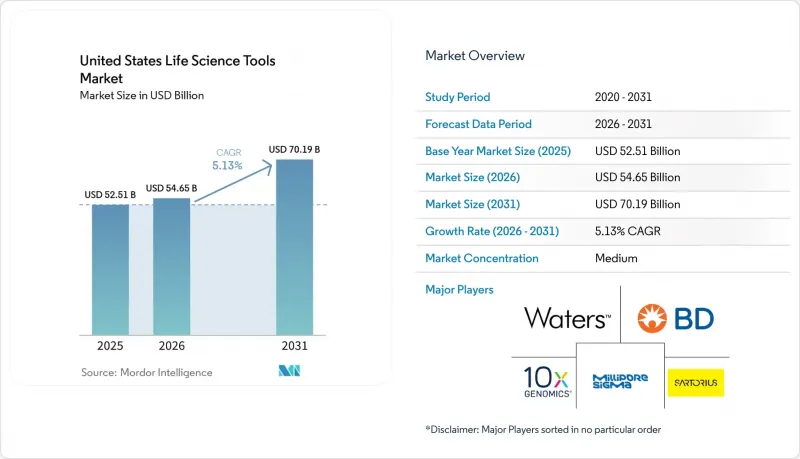
This report is Segmented by Product (Instruments, Consumables and Reagents, Software and Services), Technology (Genomic, Proteomic, Cell Biology, Multi-Omics and Spatial Biology, Analytical and Separation), Application (Drug Discovery and Development, and More), and End User (Pharma and Biotech Companies, and More). The Market Forecasts are Provided in Terms of Value (USD).
United States Life Science Tools Market Trends and Insights
United States Biopharma R&D Intensity and Pipeline Complexity
The United States life science tools market is seeing more analytically demanding biopharma programs than it did in 2024, especially in oncology, rare disease, and advanced modality development. Companion diagnostic co-development, multi-omics patient stratification, and deeper CMC characterization are now common requirements for many programs, which raises the number of tools used per asset. Rare disease work adds further pressure because smaller patient cohorts require high-sensitivity proteomic and genomic workflows where data quality per sample carries greater weight than simple throughput. Cost pressure in drug development is also reinforcing demand for higher-throughput and more automatable platforms that can compress timelines and reduce workflow repetition. The rise of bispecific antibodies, antibody-drug conjugates, and other complex modalities is widening the use of orthogonal analytical methods such as native mass spectrometry, mass photometry, and microfluidic capillary electrophoresis across the United States life science tools market.
Precision Medicine Scaling Across Oncology and Rare Disease
The commercial expansion of precision medicine is creating durable demand for clinical genomic and proteomic workflows beyond discovery laboratories in the United States life science tools market. Broader use of companion diagnostics is helping diagnostic developers and biopharma companies align regulatory and development pathways more efficiently. A peer-reviewed study on FDA oncology approvals found that companion diagnostic use was associated with a mean reduction of 379.5 days in clinical development time, which supports faster program execution and raises the value of integrated diagnostic toolsets. Medicare coverage is also widening for highly sensitive molecular testing, including the May 2026 coverage expansion for Personalis NeXT Personal in Stage II-III triple-negative and HER2-positive breast cancer treatment monitoring. As laboratories layer liquid biopsy workflows onto existing sequencing platforms, the United States life science tools market is gaining a second stream of reagent demand from the same clinical site.
Advanced Instrument CAPEX and Recurring Consumables Burden
Capital budget pressure is slowing instrument refresh cycles across academic core facilities, hospital laboratories, and mid-sized biotech buyers in the United States life science tools market. A fall 2025 laboratory purchasing survey showed that 81.1% of labs entered 2026 with cost reduction as a primary operating mandate, while 81.9% said they were willing to abandon brand loyalty for the lowest total cost of ownership. This behavior is increasing hardware price pressure and making lower-CAPEX or instrument-free workflows more attractive in some use cases. Fully integrated automation systems also carry long installation and validation periods, which makes adoption harder for sites that cannot justify extended procurement cycles or temporary workflow disruption. Financing structures such as instrument-as-a-service and reagent rental are helping at the high end, but they remain concentrated among larger vendor relationships rather than broadly available across the United States life science tools market.
Other drivers and restraints analyzed in the detailed report include:
- NGS Cost Compression and Multi-Omics Throughput Gains
- Spatial Biology and Single-Cell Workflow Adoption
- Specialist Talent Shortages in Bioinformatics and Field Service
For complete list of drivers and restraints, kindly check the Table Of Contents.
Segment Analysis
Instruments held 48.87% of the United States life science tools market share in 2025, which kept them as the largest product category by revenue. This position was supported by high-value placements of chromatography systems, mass spectrometry platforms, sequencing systems, and flow cytometers across biopharma R&D and pharmaceutical manufacturing sites. Within this product tier, mass spectrometry and sequencing systems are seeing the strongest unit revenue momentum as clinical laboratories upgrade platforms and CGT manufacturing expands analytical buildout. Liquid handling and lab automation systems are also gaining ground in high-throughput discovery settings where precision and reproducibility requirements are pushing smaller biotech firms toward automation.
Consumables and reagents are projected to grow at a 6.98% CAGR through 2031, making them the fastest-growing product type in the United States life science tools market. This pattern reflects the compounding effect of recurring demand once instruments are already installed and running more frequently across oncology testing, cell therapy, and multi-omics workflows. Sequencing reagents and library preparation kits, antibodies and immunoreagents, and cell culture media remain the strongest sub-categories because they are tied directly to run volume rather than placement cycles. Software and services are also expanding steadily as bioinformatics, LIMS, and workflow informatics become more important to data-heavy programs, and Illumina highlighted this direction with BioInsight in its first-quarter 2026 results commentary.
Proteomic technology accounted for 33.83% of the United States life science tools market size in 2025, reflecting the central role of mass spectrometry, chromatography, and immunoassay platforms in biologics development and quality control. Biologics, bispecific antibodies, and cell therapy products all require high-resolution characterization across development and manufacturing stages, which sustains both capital placements and recurring consumable pull-through. Protein microarrays and immunoassays also remain widely used across pharma R&D and clinical laboratories, giving this segment a stable installed base and repeat purchasing pattern. The segment, therefore, remains foundational to the United States life science tools market even as newer genomic workflows expand faster.
Genomic technology is projected to expand at a 7.46% CAGR through 2031, which makes it the fastest-growing technology segment. Falling sequencing costs and wider use of clinical NGS in oncology and genetic disease testing are broadening the customer base from research settings into more routine clinical use. Cell biology technology is also benefiting from cell and gene therapy development, especially in flow cytometry, imaging, and high-content screening platforms used by CDMOs and specialty pharma groups. Multi-omics and spatial biology remain smaller in revenue terms, but they are evolving quickly as single-cell and spatial transcriptomics move from academic research into more structured pharma R&D workflows.
Complete Report Scope:
- By Product
- Instruments
- Chromatography Systems
- Mass Spectrometry Systems
- Flow Cytometers and Cell Sorters
- Sequencing Systems
- Microscopy and Imaging Systems
- PCR and qPCR Systems
- Liquid Handling and Lab Automation Systems
- Electrophoresis and Separation Systems
- Centrifuges and Sample Preparation Systems
- Consumables and Reagents
- Assay Kits
- Antibodies and Immunoreagents
- Cell Culture Media and Sera
- Sequencing Reagents and Library Preparation Kits
- PCR Reagents and Enzymes
- Chromatography Columns and Solvents
- Sample Preparation and Purification Kits
- Microplates, Tubes, Tips and Lab Plastics
- Software and Services
- Bioinformatics and Data Analysis Software
- LIMS and Workflow Informatics
- Instrument Service and Maintenance
- Contract Assay and Research Services
- Instruments
- By Technology
- Genomic Technology
- Next-Generation Sequencing
- Sanger Sequencing
- PCR and qPCR
- Microarrays
- Digital PCR
- Proteomic Technology
- Mass Spectrometry
- Protein Microarrays
- Chromatography
- Immunoassays
- Cell Biology Technology
- Cell Culture
- Flow Cytometry
- High-Content Screening
- Imaging and Microscopy
- Cell Line Development Tools
- Multi-omics and Spatial Biology
- Single-Cell Omics
- Spatial Transcriptomics
- Spatial Proteomics
- Integrated Multi-omics Informatics
- Analytical and Separation Technology
- Spectroscopy
- Electrophoresis
- Centrifugation
- Liquid Handling and Automation
- Genomic Technology
- By Application
- Drug Discovery and Development
- Target Identification and Validation
- Hit Discovery and Screening
- Preclinical Translational Research
- CMC and Process Development Analytics
- Clinical Diagnostics and Precision Medicine
- Oncology Testing
- Rare Disease and Inherited Disease Testing
- Infectious Disease Testing
- Companion Diagnostics Development
- Academic and Government Research
- Basic Research
- Translational Research
- Core Facilities
- Bioprocessing and Advanced Therapies
- Cell Therapy Development
- Gene Therapy Development
- Biologics and Biosimilars Analytics
- Vaccine Research and Manufacturing Support
- Drug Discovery and Development
- By End User
- Pharmaceutical and Biotechnology Companies
- Academic and Research Institutes
- Hospitals and Diagnostic Laboratories
- Contract Research Organizations and CDMOs
List of Companies Covered in this Report:
- Agilent Technologies
- Beckton Dickinson
- Bio-Rad Laboratories
- Bio-Techne
- Bruker
- Danaher
- Eppendorf
- Illumina
- Merck KGaA (MilliporeSigma)
- Oxford Nanopore Technologies
- Pacific Biosciences
- QIAGEN
- Revvity
- Roche
- Sartorius
- Standard BioTools
- Thermo Fisher Scientific
- Waters Corporation
- ZEISS
- 10x Genomics
Additional Benefits:
- The market estimate (ME) sheet in Excel format
- 3 months of analyst support
TABLE OF CONTENTS
1 Introduction
- 1.1 Study Assumptions & Market Definition
- 1.2 Scope of the Study
2 Research Methodology
3 Executive Summary
4 Market Landscape
- 4.1 Market Overview
- 4.2 Market Drivers
- 4.2.1 United States Biopharma R&D Intensity and Pipeline Complexity
- 4.2.2 NIH Extramural Funding and Translational Program Spend
- 4.2.3 Precision Medicine Scaling Across Oncology and Rare Disease
- 4.2.4 NGS Cost Compression and Multi-Omics Throughput Gains
- 4.2.5 Spatial Biology and Single-Cell Workflow Adoption
- 4.2.6 Trusted-Source Procurement Shifts After Biosecurity Scrutiny
- 4.3 Market Restraints
- 4.3.1 Advanced Instrument CAPEX and Recurring Consumables Burden
- 4.3.2 LDT Regulatory Phaseout Raises Validation and Compliance Costs
- 4.3.3 NIH Grant Timing Volatility for Academia-Led Purchases
- 4.3.4 Specialist Talent Shortages in Bioinformatics and Field Service
- 4.4 Value / Supply-Chain Analysis
- 4.5 Regulatory Landscape
- 4.6 Technological Outlook
- 4.7 Porter's Five Forces Analysis
- 4.7.1 Threat of New Entrants
- 4.7.2 Bargaining Power of Suppliers
- 4.7.3 Bargaining Power of Buyers
- 4.7.4 Threat of Substitutes
- 4.7.5 Industry Rivalry
5 Market Size & Growth Forecasts
- 5.1 By Product
- 5.1.1 Instruments
- 5.1.1.1 Chromatography Systems
- 5.1.1.2 Mass Spectrometry Systems
- 5.1.1.3 Flow Cytometers and Cell Sorters
- 5.1.1.4 Sequencing Systems
- 5.1.1.5 Microscopy and Imaging Systems
- 5.1.1.6 PCR and qPCR Systems
- 5.1.1.7 Liquid Handling and Lab Automation Systems
- 5.1.1.8 Electrophoresis and Separation Systems
- 5.1.1.9 Centrifuges and Sample Preparation Systems
- 5.1.2 Consumables and Reagents
- 5.1.2.1 Assay Kits
- 5.1.2.2 Antibodies and Immunoreagents
- 5.1.2.3 Cell Culture Media and Sera
- 5.1.2.4 Sequencing Reagents and Library Preparation Kits
- 5.1.2.5 PCR Reagents and Enzymes
- 5.1.2.6 Chromatography Columns and Solvents
- 5.1.2.7 Sample Preparation and Purification Kits
- 5.1.2.8 Microplates, Tubes, Tips and Lab Plastics
- 5.1.3 Software and Services
- 5.1.3.1 Bioinformatics and Data Analysis Software
- 5.1.3.2 LIMS and Workflow Informatics
- 5.1.3.3 Instrument Service and Maintenance
- 5.1.3.4 Contract Assay and Research Services
- 5.1.1 Instruments
- 5.2 By Technology
- 5.2.1 Genomic Technology
- 5.2.1.1 Next-Generation Sequencing
- 5.2.1.2 Sanger Sequencing
- 5.2.1.3 PCR and qPCR
- 5.2.1.4 Microarrays
- 5.2.1.5 Digital PCR
- 5.2.2 Proteomic Technology
- 5.2.2.1 Mass Spectrometry
- 5.2.2.2 Protein Microarrays
- 5.2.2.3 Chromatography
- 5.2.2.4 Immunoassays
- 5.2.3 Cell Biology Technology
- 5.2.3.1 Cell Culture
- 5.2.3.2 Flow Cytometry
- 5.2.3.3 High-Content Screening
- 5.2.3.4 Imaging and Microscopy
- 5.2.3.5 Cell Line Development Tools
- 5.2.4 Multi-omics and Spatial Biology
- 5.2.4.1 Single-Cell Omics
- 5.2.4.2 Spatial Transcriptomics
- 5.2.4.3 Spatial Proteomics
- 5.2.4.4 Integrated Multi-omics Informatics
- 5.2.5 Analytical and Separation Technology
- 5.2.5.1 Spectroscopy
- 5.2.5.2 Electrophoresis
- 5.2.5.3 Centrifugation
- 5.2.5.4 Liquid Handling and Automation
- 5.2.1 Genomic Technology
- 5.3 By Application
- 5.3.1 Drug Discovery and Development
- 5.3.1.1 Target Identification and Validation
- 5.3.1.2 Hit Discovery and Screening
- 5.3.1.3 Preclinical Translational Research
- 5.3.1.4 CMC and Process Development Analytics
- 5.3.2 Clinical Diagnostics and Precision Medicine
- 5.3.2.1 Oncology Testing
- 5.3.2.2 Rare Disease and Inherited Disease Testing
- 5.3.2.3 Infectious Disease Testing
- 5.3.2.4 Companion Diagnostics Development
- 5.3.3 Academic and Government Research
- 5.3.3.1 Basic Research
- 5.3.3.2 Translational Research
- 5.3.3.3 Core Facilities
- 5.3.4 Bioprocessing and Advanced Therapies
- 5.3.4.1 Cell Therapy Development
- 5.3.4.2 Gene Therapy Development
- 5.3.4.3 Biologics and Biosimilars Analytics
- 5.3.4.4 Vaccine Research and Manufacturing Support
- 5.3.1 Drug Discovery and Development
- 5.4 By End User
- 5.4.1 Pharmaceutical and Biotechnology Companies
- 5.4.2 Academic and Research Institutes
- 5.4.3 Hospitals and Diagnostic Laboratories
- 5.4.4 Contract Research Organizations and CDMOs
6 Competitive Landscape
- 6.1 Market Concentration
- 6.2 Market Share Analysis
- 6.3 Company Profiles (includes Global level Overview, Market-level Overview, Core Segments, Financials, Strategic Information, Market Rank/Share, Products & Services, Recent Developments)
- 6.3.1 Agilent Technologies
- 6.3.2 Becton, Dickinson and Company
- 6.3.3 Bio-Rad Laboratories
- 6.3.4 Bio-Techne
- 6.3.5 Bruker Corporation
- 6.3.6 Danaher Corporation
- 6.3.7 Eppendorf
- 6.3.8 Illumina
- 6.3.9 Merck KGaA (MilliporeSigma)
- 6.3.10 Oxford Nanopore Technologies
- 6.3.11 Pacific Biosciences
- 6.3.12 QIAGEN N.V.
- 6.3.13 Revvity
- 6.3.14 Roche
- 6.3.15 Sartorius AG
- 6.3.16 Standard BioTools
- 6.3.17 Thermo Fisher Scientific Inc.
- 6.3.18 Waters Corporation
- 6.3.19 ZEISS
- 6.3.20 10x Genomics
7 Market Opportunities & Future Outlook
- 7.1 White-space & Unmet-need Assessment

