PUBLISHER: Mordor Intelligence | PRODUCT CODE: 2072673

PUBLISHER: Mordor Intelligence | PRODUCT CODE: 2072673
U.S. Dental Practice Management Software - Market Share Analysis, Industry Trends & Statistics, Growth Forecasts (2026 - 2031)
According to Mordor Intelligence, the u.S. dental practice management software market size is projected to be USD 0.99 billion in 2025, USD 1.09 billion in 2026, and reach USD 1.69 billion by 2031, growing at a CAGR of 9.25% from 2026 to 2031.
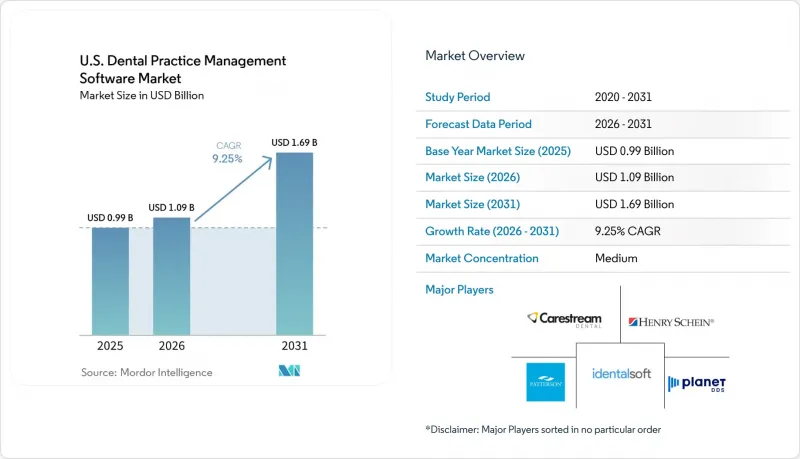
This report is Segmented by Deployment Mode (Web-Based, Cloud-Based, On-Premise), Subscription Model (Perpetual License, SaaS), Application (Communication, Scheduling, Billing, Insurance, Treatment Planning, Imaging, Analytics), End-User (Dental Clinics, Hospitals & Specialty Centers, Academic Institutes, Others), and Practice Size (Solo, Small Group, Large Group, Dsos). Forecast in Value (USD)
U.S. Dental Practice Management Software Market Trends and Insights
Cloud Migration from Server-Based to Browser and Cloud Platforms
Cloud migration from traditional server setups to cloud-based platforms is transforming software purchasing in the United States dental practice management software market. Organizations using modern cloud PMS infrastructure report a 40-55% drop in IT support tickets, an hour less weekly system downtime, and 83% fewer critical IT incidents. Legacy server setups can cost dental organizations 8-12% of annual revenue due to disconnected systems, outdated hardware, and IT inconsistencies. Cloud vendors are gaining traction by simplifying updates, standardizing workflows, and reducing technical reliance, especially for multi-site groups requiring centralized operations.
DSO Standardization and Multi-Location Platform Visibility
DSO standardization is driving repeated migrations in the United States dental practice management software market. Data shows 29% of DSO-affiliated dentists plan to invest in new software in 2026, compared to 16.3% of non-DSO dentists. Planet DDS supported 14,500 practices by 2025, expanding its presence in 100+-location DSOs through partnerships with Sage Dental, Coast Dental, Altius Dental, and Choice Healthcare. Preferred platforms enable DSOs to consolidate operations, offering unified views of collections, utilization, and provider performance, creating a concentrated growth path for enterprise vendors.
Data Privacy, HIPAA, and Right-of-Access Compliance Costs
Data privacy and compliance costs remain a significant barrier to adoption in the United States dental practice management software market, particularly for solo and small-group practices without dedicated IT or compliance teams. Older systems often require additional investments in encryption, access controls, audit logs, and workflow adjustments to securely handle sensitive patient and claims data. Large DSOs can distribute these costs across multiple sites, while independent offices must absorb them within smaller revenue bases. A single healthcare data breach averages USD 10.93 million, keeping cybersecurity a top priority for dental organizations. Compliance pressures drive long-term replacement demand but delay near-term purchases for budget-constrained practices.
Other drivers and restraints analyzed in the detailed report include:
- AI-Enabled Verification, Analytics, and Workflow Automation
- Revenue-Cycle Optimization Under Reimbursement Pressures
- Legacy Data Migration, Retraining, and Workflow Disruption
For complete list of drivers and restraints, kindly check the Table Of Contents.
Segment Analysis
In 2025, on-premise systems accounted for 43.65% of the United States dental practice management software market, reflecting their entrenched presence rather than future demand for server architecture. Cloud deployments are projected to grow at an 11.95% CAGR through 2031, outpacing the overall market. Practices and DSOs prefer cloud models for reduced server maintenance, simplified remote access, and integrated workflows. Organizations adopting cloud PMS environments report fewer IT incidents, supporting the operational benefits of migration.
While on-premise systems will decline gradually, enterprise rollouts increasingly favor cloud solutions for streamlined onboarding and consistent workflows. In 2025, major additions like Sage Dental (140 locations) and Coast Dental (88 locations) highlighted the scale of cloud conversions. Web-based systems occupy a shrinking middle ground as buyers commit to full cloud platforms or retain older setups. Over the forecast period, replacement cycles and uptime needs will drive demand toward cloud-first platforms.
Subscription and SaaS models captured 59.76% of 2025 revenue in the United States dental practice management software market, with a projected 10.25% CAGR through 2031. Vendors now bundle updates, analytics, and AI tools into recurring plans, as seen in Henry Schein One's 2026 launch of Dentrix Ascend packages. Subscription plans reduce upfront costs for practices and increase lifetime contract value for vendors by layering additional features over time. SaaS models also enable steady delivery of updates and new functionalities, making them the primary revenue model.
Complete Report Scope:
- By Deployment Mode
- Web-based
- Cloud-based
- On-premise
- By Subscription Model
- Perpetual License
- Subscription / SaaS
- By Application
- Patient Communication & Engagement
- Appointment Scheduling & Calendar
- Billing & Invoicing
- Insurance & Claims Management
- Treatment Planning & Charting
- Imaging & Diagnostics Integration
- Analytics & Business Intelligence
- By End-user
- Dental Clinics
- Hospitals & Specialty Dental Centers
- Academic & Research Institutes
- Others
- By Practice Size
- Solo Practices (1-2 ops)
- Small Group Practices (3-9 ops)
- Large Group Practices (10+ ops)
- Dental Service Organizations (DSOs)
List of Companies Covered in this Report:
- ABELDent Inc.
- ACE Dental Software
- Carestream Dental
- CD Newco, LLC
- Datacon Dental Systems, Inc.
- DentiMax LLC
- Dentisoft Technologies
- Exan Software ULC
- Good Methods Global Inc.
- Henry Schein One, LLC
- iDentalSoft, Inc.
- MacPractice, Inc.
- MOGO, Inc.
- NextGen Healthcare
- Open Dental Software, Inc.
- Oryx Dental Software LLC
- Patterson Companies
- Planet DDS, Inc.
- Practice-Web, Inc.
- tab32
Additional Benefits:
- The market estimate (ME) sheet in Excel format
- 3 months of analyst support
TABLE OF CONTENTS
1 Introduction
- 1.1 Study Assumptions & Market Definition
- 1.2 Scope of the Study
2 Research Methodology
3 Executive Summary
4 Market Landscape
- 4.1 Market Overview
- 4.2 Market Drivers
- 4.2.1 Cloud Migration from Server-Based to Browser-Native Platforms
- 4.2.2 DSO Standardization and Multi-Location Visibility Needs
- 4.2.3 AI-Enabled Verification, Analytics, and Workflow Automation
- 4.2.4 Revenue-Cycle Optimization Under Reimbursement Pressure
- 4.2.5 Medical-Dental Data Exchange Needs for Medically Complex Patients
- 4.2.6 Tech-Stack Standardization as A Valuation Lever in DSO Roll-Ups
- 4.3 Market Restraints
- 4.3.1 Data Privacy, HIPAA, and Right-of-Access Compliance Exposure
- 4.3.2 Legacy Data Migration, Retraining, and Workflow Disruption
- 4.3.3 Fragmented Interoperability with Medical Records and Payer Workflows
- 4.3.4 Small-Practice ROI Friction and Subscription-Stack Fatigue
- 4.4 Value / Supply-Chain Analysis
- 4.5 Regulatory Landscape
- 4.6 Technological Outlook
- 4.7 Porter's Five Forces
- 4.7.1 Threat of New Entrants
- 4.7.2 Bargaining Power of Suppliers
- 4.7.3 Bargaining Power of Buyers
- 4.7.4 Threat of Substitutes
- 4.7.5 Industry Rivalry
5 Market Size & Growth Forecasts (Value, USD)
- 5.1 By Deployment Mode
- 5.1.1 Web-based
- 5.1.2 Cloud-based
- 5.1.3 On-premise
- 5.2 By Subscription Model
- 5.2.1 Perpetual License
- 5.2.2 Subscription / SaaS
- 5.3 By Application
- 5.3.1 Patient Communication & Engagement
- 5.3.2 Appointment Scheduling & Calendar
- 5.3.3 Billing & Invoicing
- 5.3.4 Insurance & Claims Management
- 5.3.5 Treatment Planning & Charting
- 5.3.6 Imaging & Diagnostics Integration
- 5.3.7 Analytics & Business Intelligence
- 5.4 By End-user
- 5.4.1 Dental Clinics
- 5.4.2 Hospitals & Specialty Dental Centers
- 5.4.3 Academic & Research Institutes
- 5.4.4 Others
- 5.5 By Practice Size
- 5.5.1 Solo Practices (1-2 ops)
- 5.5.2 Small Group Practices (3-9 ops)
- 5.5.3 Large Group Practices (10+ ops)
- 5.5.4 Dental Service Organizations (DSOs)
6 Competitive Landscape
- 6.1 Market Concentration
- 6.2 Market Share Analysis
- 6.3 Company Profiles (includes Global level Overview, Market level overview, Core Segments, Financials as available, Strategic Information, Market Rank/Share for key companies, Products & Services, and Recent Developments)
- 6.3.1 ABELDent Inc.
- 6.3.2 ACE Dental Software
- 6.3.3 Carestream Dental LLC
- 6.3.4 CD Newco, LLC
- 6.3.5 Datacon Dental Systems, Inc.
- 6.3.6 DentiMax LLC
- 6.3.7 Dentisoft Technologies
- 6.3.8 Exan Software ULC
- 6.3.9 Good Methods Global Inc.
- 6.3.10 Henry Schein One, LLC
- 6.3.11 iDentalSoft, Inc.
- 6.3.12 MacPractice, Inc.
- 6.3.13 MOGO, Inc.
- 6.3.14 NextGen Healthcare, Inc.
- 6.3.15 Open Dental Software, Inc.
- 6.3.16 Oryx Dental Software LLC
- 6.3.17 Patterson Companies, Inc.
- 6.3.18 Planet DDS, Inc.
- 6.3.19 Practice-Web, Inc.
- 6.3.20 tab32
7 Market Opportunities & Future Outlook
- 7.1 White-space & Unmet-need Assessment

