PUBLISHER: Mordor Intelligence | PRODUCT CODE: 2122578

PUBLISHER: Mordor Intelligence | PRODUCT CODE: 2122578
Dental Practice Management Software - Market Share Analysis, Industry Trends & Statistics, Growth Forecasts (2026 - 2031)
According to Mordor Intelligence, the dental practice management software market size is projected to be USD 2.36 billion in 2025, USD 2.62 billion in 2026, and reach USD 4.44 billion by 2031, growing at a CAGR of 11.12% from 2026 to 2031.
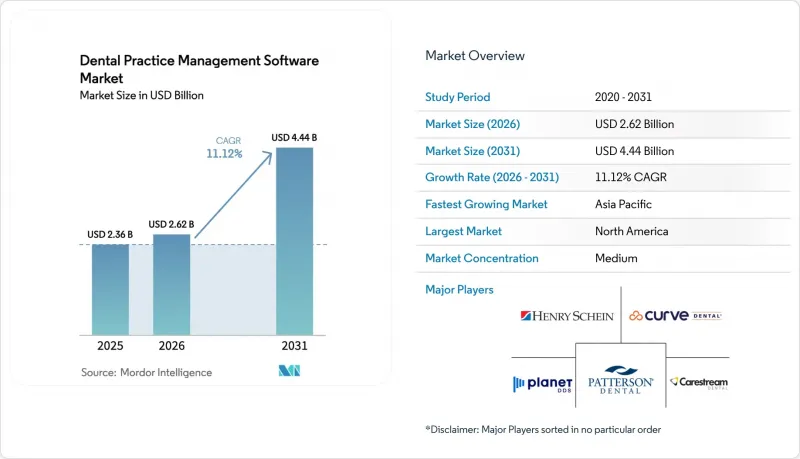
This report is Segmented by Delivery Mode (On-Premises, and More), Subscription Model (Perpetual License and Subscription / SaaS), Functionality (Patient Communication & Engagement, and More), Practice Size (Solo Practices (1-2 Ops), and More), End User (Dental Clinics, Hospitals, and More), and Geography (North America, and More). The Market Forecasts are Provided in Terms of Value (USD).
Global Dental Practice Management Software Market Trends and Insights
Rising Global Burden of Oral Diseases
Untreated dental caries affects 2.5 billion adults worldwide, while periodontal disease impacts 1 billion people, yet only 23% of low- and middle-income countries integrate oral health into primary care. Governments now tie reimbursement to electronic dental records, illustrated by India's mandate that all district hospitals adopt digital charting by March 2025. U.S. practices use embedded screening protocols to bill chronic-care codes worth USD 340 per patient annually. Teledentistry visits rose from under 50,000 in 2019 to 4.1 million in 2024, helped by payers reimbursing virtual assessments at 85% of the in-office rate. Demand for remote triage elevates patient-communication modules from optional add-ons to core purchase criteria. Vendors that embed risk-assessment workflows gain preference among value-based care contracts.
Adoption of Digital Health Records & Interoperability Standards
Civil monetary penalties of up to USD 1 million for blocking data exchange took effect in October 2023. By mid-2025, 68% of U.S. dental practices could transmit structured treatment plans to medical EHRs, up from 12% in 2022. Acceptance of SNODENT-coded claims by Medicare Advantage from 2027 removes translation friction and pushes vendors to support the expanded terminology set. Europe's GDPR reinforces the need for regional data residency, making certified cloud providers the default for multi-site groups. Interoperability has shifted from technical nicety to existential requirement, dictating vendor roadmaps and purchase decisions.
Data-Privacy & Cyber-Security Compliance Complexities
Dental breaches exposed 1.2 million records in 2024, with average HIPAA settlements of USD 475,000. Ransomware incidents rose sharply; 41% of affected practices paid attackers due to inadequate backups. EU GDPR fines can reach 4% of global turnover, demonstrated by a EUR 1.2 million penalty issued in 2024 for misconfigured cloud storage. Draft FDA guidance now requires multi-factor authentication and six-year audit logs for diagnostic software, squeezing small vendors without security engineering depth. Compliance burdens push clinics toward certified cloud providers but force retraining and workflow redesign.
Other drivers and restraints analyzed in the detailed report include:
- Expansion of Cloud-Based SaaS Models with Lower CapEx
- Integration with Imaging, CAD/CAM & Chair-Side Systems
- Lack of Standardized Clinical Coding & Workflow Harmonization
For complete list of drivers and restraints, kindly check the Table Of Contents.
Segment Analysis
On-premises deployments retained 45.56% revenue in 2025, largely from clinics that purchased perpetual licenses before 2020. Migrating this installed base can cost a five-operatory practice USD 18,000 in data conversion and training. Yet cloud solutions are projected to grow 14.25% annually, propelled by dental service organizations standardizing multi-tenant architectures for centralized billing and analytics. Subscription economics appeal to solo practices lacking IT staff because cybersecurity, redundancy, and updates are bundled. The HHS multi-factor authentication deadline made modernization urgent, accelerating conversions in 2024-2025. Rural bandwidth constraints are easing as federal infrastructure funds extend >100 Mbps access to 94% of clinics. Automatic update cycles mitigate vulnerabilities within 72 hours of disclosure, a level unattainable for most on-premises users. While a minority of practices still cite internet outages and subscription fatigue, the total cost of ownership has tilted decisively toward cloud platforms.
Web-based hybrids that run in browsers without dedicated installers fill a transitional niche but lack offline resilience. Vendors position edge-caching or local-sync features to win cautious adopters. As feature parity improves, the dental practice management software market size for cloud offerings is set to surpass on-premises revenue before 2029, driven by regulatory compliance and lower CapEx. Competitive strategies now focus on migration tools and white-glove onboarding to minimize clinic downtime. Vendors that streamline legacy database conversion and staff training gain accelerated share.
SaaS captured 60.53% revenue in 2025 and is forecast to rise at 13.85% CAGR as practices favor predictable monthly spending aligned with cash flow. Perpetual licenses once priced at USD 8,000-15,000 plus 18-22% maintenance are declining because CFOs discount the value of slower innovation and higher upgrade friction. Patterson Companies reported 27% subscription revenue growth in fiscal 2024 while perpetual sales dropped 11%, prompting a pivot to subscription-only pricing for Eaglesoft beginning 2026.
Tiered SaaS packaging lets vendors upsell AI analytics, imaging integration, and API access. Open Dental's USD 199-399 per-provider tiers illustrate how clinics self-select functionality without lengthy sales cycles. For enterprise DSOs, volume pricing unlocks 22% software savings and centralizes data lakes for benchmarking. As subscription renewals concentrate bargaining power, vendors emphasize customer success teams and low churn. Analysts expect the dental practice management software market size stemming from perpetual licenses to fall below USD 1 billion by 2030, signaling structural revenue model realignment.
Complete Report Scope:
- By Delivery Mode
- On-premises
- Web-based
- Cloud-based
- By Subscription Model
- Perpetual License
- Subscription / SaaS
- By Functionality
- Patient Communication & Engagement
- Appointment Scheduling & Calendar
- Billing & Invoicing
- Insurance & Claims Management
- Treatment Planning & Charting
- Imaging & Diagnostics Integration
- Analytics & Business Intelligence
- By Practice Size
- Solo Practices (1-2 ops)
- Small Group Practices (3-9 ops)
- Large Group Practices (10+ ops)
- Dental Service Organizations (DSOs)
- By End User
- Dental Clinics
- Hospitals & Specialty Dental Centers
- Academic & Research Institutes
- Geography
- North America
- United States
- Canada
- Mexico
- Europe
- Germany
- United Kingdom
- France
- Italy
- Spain
- Rest of Europe
- Asia-Pacific
- China
- Japan
- India
- South Korea
- Australia
- Rest of Asia-Pacific
- Middle East & Africa
- GCC
- South Africa
- Rest of Middle East & Africa
- South America
- Brazil
- Argentina
- Rest of South America
- North America
Geography Analysis
North America contributed 45.13% of global revenue in 2025, supported by Medicare Advantage reimbursement for teledentistry and state Medicaid e-prior authorization mandates. HIPAA security updates requiring encryption and multi-factor authentication accelerated cloud migrations across clinics. Canada's phased dental-care expansion obliges electronic claims via the national EDI standard, spurring adoption among 11,000 practices. Mexico's social-security network added 340 clinics in 2024, with MXN 1.2 billion (USD 70 million) earmarked for software subsidies. Broadband penetration exceeding 100 Mbps coverage for 94% of U.S. dental offices removes a lingering technical barrier.
Asia-Pacific is the fastest-growing region at 15.52% CAGR through 2031, anchored by China's CNY 12 billion (USD 1.7 billion) rural-clinic digitization fund and India's 340 million-citizen digital-health identifier rollout. Japan's mandate for 100% electronic dental claims accelerated digitization among holdouts, while South Korea reimburses AI-assisted caries detection at 90% of manual rates, incentivizing software upgrades. Australia's My Health Record grants of AUD 5,000 (USD 3,300) per clinic reduce integration costs. Regional localization, including multi-language SNOMED extensions and cloud data-sovereignty zones, is critical for vendor success.
Europe advances at a steadier pace due to Medical Device Regulation hurdles, which add up to two years to product certification and concentrate share among vendors with seasoned regulatory teams. Germany enforces reimbursement penalties for non-compliant clinics, prompting rapid software upgrades. The United Kingdom funds GBP 120 million (USD 150 million) to digitize 11,000 NHS dental practices, covering training and migration costs. Mobile-first solutions gain traction in Middle East, Africa, and South America, where tablet-based workflows bypass desktop infrastructure. Vendors that localize Arabic, Portuguese, and Swahili interfaces capture early-mover advantage.
- ABELDent Inc.
- ACE Dental Software
- CareStack (Good Methods Global)
- Carestream Dental
- ClearDent
- Curve Dental
- DentiMax LLC
- Dovetail Dental Software
- Exan Software (axiUm)
- iDentalSoft
- MOGO
- NextGen Healthcare
- Open Dental Software
- Patterson Companies Inc. (Eaglesoft)
- Planet DDS Inc. (Denticon)
- Practice-Web Inc.
- RxNT Inc.
- Software of Excellence Intl.
- tab32
- Henry Schein Inc. (Dentrix)
Additional Benefits:
- The market estimate (ME) sheet in Excel format
- 3 months of analyst support
TABLE OF CONTENTS
1 Introduction
- 1.1 Study Assumptions & Market Definition
- 1.2 Scope of the Study
2 Research Methodology
3 Executive Summary
4 Market Landscape
- 4.1 Market Overview
- 4.2 Market Drivers
- 4.2.1 Rising global burden of oral diseases
- 4.2.2 Adoption of digital health records & interoperability standards
- 4.2.3 Expansion of cloud-based SaaS models with lower CapEx
- 4.2.4 Integration with imaging, CAD/CAM & chair-side systems
- 4.2.5 AI-powered clinical decision add-ons & predictive analytics
- 4.2.6 API marketplaces enabling third-party app ecosystems
- 4.3 Market Restraints
- 4.3.1 Data-privacy & cyber-security compliance complexities
- 4.3.2 Lack of standardized clinical coding & workflow harmonization
- 4.3.3 Rising vendor lock-in risk as ecosystems consolidate
- 4.3.4 Limited IT budgets among small independent practices
- 4.4 Technological Outlook
- 4.5 Porter's Five Forces
- 4.5.1 Threat of New Entrants
- 4.5.2 Bargaining Power of Buyers
- 4.5.3 Bargaining Power of Suppliers
- 4.5.4 Threat of Substitutes
- 4.5.5 Intensity of Competitive Rivalry
5 Market Size & Growth Forecasts (Value, USD)
- 5.1 By Delivery Mode
- 5.1.1 On-premises
- 5.1.2 Web-based
- 5.1.3 Cloud-based
- 5.2 By Subscription Model
- 5.2.1 Perpetual License
- 5.2.2 Subscription / SaaS
- 5.3 By Functionality
- 5.3.1 Patient Communication & Engagement
- 5.3.2 Appointment Scheduling & Calendar
- 5.3.3 Billing & Invoicing
- 5.3.4 Insurance & Claims Management
- 5.3.5 Treatment Planning & Charting
- 5.3.6 Imaging & Diagnostics Integration
- 5.3.7 Analytics & Business Intelligence
- 5.4 By Practice Size
- 5.4.1 Solo Practices (1-2 ops)
- 5.4.2 Small Group Practices (3-9 ops)
- 5.4.3 Large Group Practices (10+ ops)
- 5.4.4 Dental Service Organizations (DSOs)
- 5.5 By End User
- 5.5.1 Dental Clinics
- 5.5.2 Hospitals & Specialty Dental Centers
- 5.5.3 Academic & Research Institutes
- 5.6 Geography
- 5.6.1 North America
- 5.6.1.1 United States
- 5.6.1.2 Canada
- 5.6.1.3 Mexico
- 5.6.2 Europe
- 5.6.2.1 Germany
- 5.6.2.2 United Kingdom
- 5.6.2.3 France
- 5.6.2.4 Italy
- 5.6.2.5 Spain
- 5.6.2.6 Rest of Europe
- 5.6.3 Asia-Pacific
- 5.6.3.1 China
- 5.6.3.2 Japan
- 5.6.3.3 India
- 5.6.3.4 South Korea
- 5.6.3.5 Australia
- 5.6.3.6 Rest of Asia-Pacific
- 5.6.4 Middle East & Africa
- 5.6.4.1 GCC
- 5.6.4.2 South Africa
- 5.6.4.3 Rest of Middle East & Africa
- 5.6.5 South America
- 5.6.5.1 Brazil
- 5.6.5.2 Argentina
- 5.6.5.3 Rest of South America
- 5.6.1 North America
6 Competitive Landscape
- 6.1 Market Concentration
- 6.2 Market Share Analysis
- 6.3 Company Profiles (includes Global level Overview, Market level overview, Core Segments, Financials as available, Strategic Information, Market Rank/Share for key companies, Products & Services, and Recent Developments)
- 6.3.1 ABELDent Inc.
- 6.3.2 ACE Dental Software
- 6.3.3 CareStack (Good Methods Global)
- 6.3.4 Carestream Dental LLC
- 6.3.5 ClearDent
- 6.3.6 Curve Dental Inc.
- 6.3.7 DentiMax LLC
- 6.3.8 Dovetail Dental Software
- 6.3.9 Exan Software (axiUm)
- 6.3.10 iDentalSoft
- 6.3.11 MOGO Inc.
- 6.3.12 NextGen Healthcare Inc.
- 6.3.13 Open Dental Software
- 6.3.14 Patterson Companies Inc. (Eaglesoft)
- 6.3.15 Planet DDS Inc. (Denticon)
- 6.3.16 Practice-Web Inc.
- 6.3.17 RxNT Inc.
- 6.3.18 Software of Excellence Intl.
- 6.3.19 tab32
- 6.3.20 Henry Schein Inc. (Dentrix)
7 Market Opportunities & Future Outlook
- 7.1 White-space & Unmet-need Assessment

