PUBLISHER: Mordor Intelligence | PRODUCT CODE: 2072770

PUBLISHER: Mordor Intelligence | PRODUCT CODE: 2072770
Italy Cartonboard - Market Share Analysis, Industry Trends & Statistics, Growth Forecasts (2026 - 2031)
According to Mordor Intelligence, the italy cartonboard market size is expected to increase from USD 1.65 billion in 2025 to USD 1.76 billion in 2026 and reach USD 2.43 billion by 2031, growing at a CAGR of 6.63% over 2026-2031.
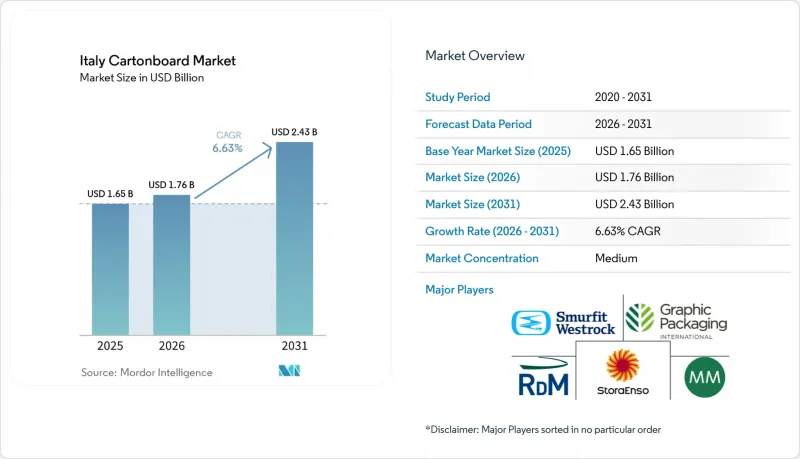
This report is Segmented by Product Grade (Solid Bleached Board, Solid Unbleached Board, Folding Boxboard, White-Lined Chipboard, Liquid Packaging Board, and Food Service Board), Packaging Format (Folding Cartons, Liquid Packaging, Sleeve and Tray, and More), and End-User Industry (Food, Beverage, Pharma and Healthcare, Tobacco, Cosmetics, and More). The Market Forecasts are Provided in Terms of Value (USD).
Italy Cartonboard Market Trends and Insights
Plastic-To-Paper Substitution Across Consumer Packaging
Plastic-to-paper substitution remains the strongest near-term demand driver for the Italy cartonboard market. The PPWR entered into force in February 2025 and will apply broadly from August 12, 2026, which makes recyclable fiber-based formats easier to position under the new EU packaging framework than many plastic alternatives. Consumer attitudes are also moving in the same direction, with Pro Carton reporting in 2025 that 89% of surveyed adults across 5 European countries preferred cartonboard to plastic packaging, while Italian and German respondents were among the most willing to pay more for sustainable packaging. That change matters because demand is no longer limited to corrugated shipping packs and is moving deeper into folding cartons for frozen food, cosmetics, and other shelf-facing consumer products. As converters make lighter coated grades work in applications once dominated by plastic blisters or flexible formats, the Italy cartonboard market is gaining both volume and value opportunities. The effect is strongest where brand owners need recyclability, print quality, and premium presentation in the same pack.
PPWR-Driven Packaging Redesign And Void-Space Reduction
PPWR-led redesign is creating a second layer of demand for the Italy cartonboard market beyond simple material substitution. The regulation introduces common EU rules on packaging design and waste reduction, pushing brand owners to reduce space and reassess the structure of consumer-facing packs before the application date in August 2026. For Italy's export-oriented food and pharmaceutical converters, that pressure is especially relevant because non-compliant designs can restrict access across the full EU single market. This is increasing demand for lighter but stiffer folding boxboard grades that can preserve pack strength while trimming basis weight and pack dimensions. It also favors converters with deeper design, testing, and documentation capabilities, since customers increasingly want a packaging partner that can help them move through redesign work with less disruption. In practice, the Italian cartonboard market is benefiting not only from more board demand but also from a shift toward higher-specification grades and better-engineered packs.
Virgin Pulp And Electricity Cost Volatility
Cost volatility remains the clearest operating restraint for the Italy cartonboard market. Mayr-Melnhof stated in its first-quarter 2026 trading update that recent escalations in the Middle East increased pressure on energy, transportation, and chemicals from March 2026 onward. In its April 2026 investor presentation, the company also said that weak market conditions and structural overcapacity persisted, which means producers have limited room to pass higher costs through the chain without risking volume loss. That combination creates a difficult environment for both virgin-fiber and recycled-board producers, as mills need to recover costs while converters remain highly price-sensitive. Financial stress at major recycled-board players adds to the caution, as RDM entered a forbearance agreement in March 2026 even though production and deliveries continued normally. Until energy, freight, and raw-material conditions stabilize, the Italy cartonboard market will continue to face margin pressure, even as underlying demand remains healthy.
Other drivers and restraints analyzed in the detailed report include:
- Premiumization In Food, Beauty, And OTC Packaging
- High Italian Paper And Board Recycling Performance
- Competition From Plastic And Alternative Liquid-Pack Formats
For complete list of drivers and restraints, kindly check the Table Of Contents.
Segment Analysis
Folding boxboard held 34.21% of the Italy cartonboard market share in 2025, making it the largest product grade by value. Its lead came from broad use across food, OTC pharmaceuticals, cosmetics, and tobacco cartons, where stiffness, print quality, and surface finish matter as much as basic protection. White-lined chipboard remained important in mass-market packs and shelf-ready retail formats, where recycled fiber content and cost control are central to buying decisions. Solid bleached board and solid unbleached board continued to serve narrower premium niches, especially where appearance, strength, or specialty conversion requirements were more demanding.
The Italy cartonboard market size for liquid packaging board is projected to expand at a 7.31% CAGR through 2031, the fastest pace among product grades. Tetra Pak's April 2026 launch with Sterilgarda Alimenti showed that paper-based barrier technology has moved into commercial aseptic cartons and is no longer limited to development work. Tetra Pak's earlier January 2026 decision to invest EUR 60 million (USD 71.2 million) in a pilot plant for paper-based barrier development also points to sustained investment behind this grade transition. Across the Italy cartonboard industry, grade competition is shifting toward lighter structures, simpler barriers, and higher performance at lower material weight.
Complete Report Scope:
- By Product Grade
- Solid Bleached Board
- Solid Unbleached Board
- Folding Boxboard
- White-Lined Chipboard
- Liquid Packaging Board
- Food Service Board
- By Packaging Format
- Folding Cartons
- Liquid Packaging
- Sleeve and Tray
- Other Packaging Formats (Cups, Foodservice Containers)
- By End-User Industry
- Food
- Beverage
- Pharmaceutical and Healthcare
- Tobacco
- Cosmetics and Toiletries
- Other End-User Industries (Toy, Apparel, Automotive, Household, Electrical, Foodservice)
List of Companies Covered in this Report:
- Mayr-Melnhof Karton AG
- Reno De Medici S.p.A.
- Stora Enso Oyj
- Smurfit Westrock plc
- Graphic Packaging International, LLC
- Fedrigoni S.p.A.
- Seda International Packaging Group S.p.A.
- Tetra Pak Italiana S.p.A.
- SIG Combibloc Italia S.r.l.
- Elopak Italia S.r.l.
- Palladio Group S.p.A.
- DS Smith Packaging Italia S.p.A.
- Pozzoli S.p.A.
- Lucaprint S.p.A.
- BOX MARCHE S.P.A.
- Eurpack S.r.l.
- CM Cartotecnica Moderna S.r.l. Benefit
- Industria Grafica Umbra s.r.l.
- Eurographic s.r.l.
Additional Benefits:
- The market estimate (ME) sheet in Excel format
- 3 months of analyst support
TABLE OF CONTENTS
1 INTRODUCTION
- 1.1 Study Assumptions and Market Definition
- 1.2 Scope of the Study
2 RESEARCH METHODOLOGY
3 EXECUTIVE SUMMARY
4 MARKET LANDSCAPE
- 4.1 Market Overview
- 4.2 Impact of Macroeconomic Factors on the Market
- 4.3 Market Drivers
- 4.3.1 Plastic-to-Paper Substitution Across Consumer Packaging
- 4.3.2 Premiumization in Food, Beauty, and OTC Packaging
- 4.3.3 Retail-Ready and Shelf-Ready Carton Demand
- 4.3.4 High Italian Paper and Board Recycling Performance
- 4.3.5 PPWR-Driven Packaging Redesign and Void-Space Reduction
- 4.3.6 PFAS-Free and Simpler Food-Contact Barrier Structures
- 4.4 Market Restraints
- 4.4.1 Virgin Pulp and Electricity Cost Volatility
- 4.4.2 Competition From Plastic and Alternative Liquid-Pack Formats
- 4.4.3 PPWR Documentation and Conformity Burden for SMEs
- 4.4.4 Food-Contact Reformulation and Testing Costs After PFAS and BPA Changes
- 4.5 Industry Value Chain Analysis
- 4.6 Regulatory Landscape
- 4.7 Technological Outlook
- 4.8 Porter's Five Forces Analysis
- 4.8.1 Bargaining Power of Buyers
- 4.8.2 Bargaining Power of Suppliers
- 4.8.3 Threat of New Entrants
- 4.8.4 Threat of Substitutes
- 4.8.5 Intensity of Competitive Rivalry
5 MARKET SIZE AND GROWTH FORECASTS (VALUE)
- 5.1 By Product Grade
- 5.1.1 Solid Bleached Board
- 5.1.2 Solid Unbleached Board
- 5.1.3 Folding Boxboard
- 5.1.4 White-Lined Chipboard
- 5.1.5 Liquid Packaging Board
- 5.1.6 Food Service Board
- 5.2 By Packaging Format
- 5.2.1 Folding Cartons
- 5.2.2 Liquid Packaging
- 5.2.3 Sleeve and Tray
- 5.2.4 Other Packaging Formats (Cups, Foodservice Containers)
- 5.3 By End-User Industry
- 5.3.1 Food
- 5.3.2 Beverage
- 5.3.3 Pharmaceutical and Healthcare
- 5.3.4 Tobacco
- 5.3.5 Cosmetics and Toiletries
- 5.3.6 Other End-User Industries (Toy, Apparel, Automotive, Household, Electrical, Foodservice)
6 COMPETITIVE LANDSCAPE
- 6.1 Market Concentration
- 6.2 Strategic Moves
- 6.3 Market Share Analysis
- 6.4 Company Profiles (includes Global Level Overview, Market Level Overview, Core Segments, Financials as available, Strategic Information, Market Rank/Share, Products and Services, Recent Developments)
- 6.4.1 Mayr-Melnhof Karton AG
- 6.4.2 Reno De Medici S.p.A.
- 6.4.3 Stora Enso Oyj
- 6.4.4 Smurfit Westrock plc
- 6.4.5 Graphic Packaging International, LLC
- 6.4.6 Fedrigoni S.p.A.
- 6.4.7 Seda International Packaging Group S.p.A.
- 6.4.8 Tetra Pak Italiana S.p.A.
- 6.4.9 SIG Combibloc Italia S.r.l.
- 6.4.10 Elopak Italia S.r.l.
- 6.4.11 Palladio Group S.p.A.
- 6.4.12 DS Smith Packaging Italia S.p.A.
- 6.4.13 Pozzoli S.p.A.
- 6.4.14 Lucaprint S.p.A.
- 6.4.15 BOX MARCHE S.P.A.
- 6.4.16 Eurpack S.r.l.
- 6.4.17 CM Cartotecnica Moderna S.r.l. Benefit
- 6.4.18 Industria Grafica Umbra s.r.l.
- 6.4.19 Eurographic s.r.l.
7 MARKET OPPORTUNITIES AND FUTURE OUTLOOK
- 7.1 White-Space and Unmet-Need Assessment

