
PUBLISHER: Mordor Intelligence | PRODUCT CODE: 2072815

PUBLISHER: Mordor Intelligence | PRODUCT CODE: 2072815
United States Hemorrhoid Treatment Devices - Market Share Analysis, Industry Trends & Statistics, Growth Forecasts (2026 - 2031)
According to Mordor Intelligence, the united states hemorrhoid treatment devices market size was valued at USD 311.08 million in 2025 and is estimated to grow from USD 327.85 million in 2026 to reach USD 437.06 million by 2031, at a CAGR of 5.92% during the forecast period (2026-2031).
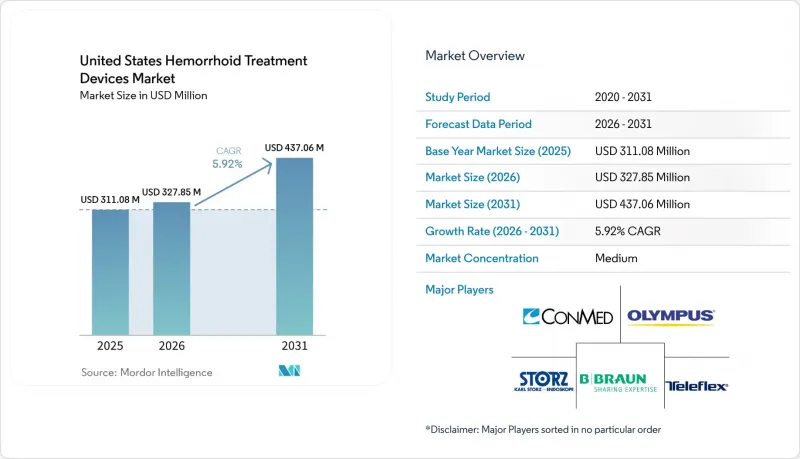
This report is Segmented by Product Type (Band Ligators, Infrared Coagulators, Sclerotherapy Injectors, Bipolar Probes, Cryotherapy Devices, Laser Probes), Procedure Type (Non-Surgical Procedures, Minimally Invasive Surgical Procedures, Conventional Hemorrhoidectomy), and End User (Hospitals, and More). The Market Forecasts are Provided in Terms of Value (USD).
United States Hemorrhoid Treatment Devices Market Trends and Insights
Rising Incidence of Symptomatic Hemorrhoids in Adults Over 50
The United States hemorrhoid treatment devices market continues to draw support from age-linked disease prevalence and a large untreated patient base. Current guidance states that nearly half of Americans develop symptomatic hemorrhoids by age 50, and the condition affects 10.4 million people in the country at any given time. The same source indicates that 1 million new cases arise each year, and 10% to 20% of those patients require procedural treatment. Medicare fee-for-service data also show hemorrhoid-associated diagnoses in 4.2% of beneficiaries aged 65 to 84, with the highest burden in the 70 to 74 group, which keeps the age-driven demand base intact for the United States hemorrhoid treatment devices market. This means future volume in the United States hemorrhoid treatment devices market depends not only on prevalence, but also on how effectively office procedures can convert symptomatic patients into treated cases.
Shift Toward Minimally Invasive and Outpatient Treatment Pathways
The United States hemorrhoid treatment devices market is moving further toward minimally invasive care because current ASCRS guidance identifies rubber band ligation as the most effective office-based option for symptomatic grade I to grade III internal hemorrhoids. The guideline review cites an 86.7% asymptomatic rate at 8 weeks in a 2,635-patient retrospective series, which reinforces the appeal of office procedures that avoid operating room use for a large share of patients. This treatment pattern is redirecting procurement toward band ligators, anoscopes, and sclerotherapy injector kits rather than hospital-centered surgical instrumentation. Sclerotherapy is also gaining ground, because polidocanol foam has shown 98% symptom resolution at 4 weeks in a prospective 2,000-patient series and 95.6% success at 1 year in a phase II multicenter trial. As a result, the United States hemorrhoid treatment devices market is broadening beyond banding alone and is creating room for newer office-ready injector platforms.
Limited Specialist Access in Rural and Underserved Areas
The United States hemorrhoid treatment devices market continues to face a structural access constraint in countries with limited specialist coverage. A 2026 study in Digestive Diseases and Sciences found that more than two-thirds of 3,149 US counties lacked a gastroenterologist, and 49 million to 50 million Americans lived more than 25 miles from GI specialty care. In 2025, non-metropolitan areas had a gastroenterologist workforce adequacy of only 29.7%, compared with 106% in metropolitan areas, and the South remained the weakest region, even within metro geographies, at 87% adequacy. The same access problem is likely to persist because more than two-thirds of rural GI specialists were older than 55, and nearly half were older than 65, which points to additional retirement pressure on procedural capacity. Rural primary care constraints reinforce the same issue, as 66.3% of all primary care Health Professional Shortage Areas were in rural locations as of September 2024.
Other drivers and restraints analyzed in the detailed report include:
- Expansion of Outpatient Procurement, Reimbursement Support, and Single-Use Formats
- Patient Preference for Home Recovery and Lower-Discomfort Treatment
- OTC Substitution, Reimbursement Friction, and Sustainability Pressure
For complete list of drivers and restraints, kindly check the Table Of Contents.
Segment Analysis
Band ligators held 34.48% of the United States hemorrhoid treatment devices market share in 2025, which kept them in the leading product position. Their position reflects continued endorsement in ASCRS guidance, a well-defined office procedure role, and established reimbursement support for routine banding. The product class also benefits from continued movement toward disposable and pre-loaded systems, with platforms such as the CRH O'Regan System built around office and outpatient workflow efficiency. Infrared coagulators, sclerotherapy injectors, and bipolar probes remain clinically relevant in grade I to grade II disease, in anticoagulated patients, and in adjunctive procedural settings where banding is not the only preferred choice.
Cryotherapy devices are the fastest-growing product segment, and this part of the United States hemorrhoid treatment devices market size is projected to rise at a 7.36% CAGR through 2031. The CYPHER trial gave this category stronger clinical support by showing lower early postoperative pain after grade III hemorrhoidectomy when intra-anal cryotherapy was used. FDA 510(k) clearances for the XSense Cryoablation System and the Co-Ablation System in 2024 showed that the regulatory channel remains open for newer cryotherapy options in proctology. Laser probes still hold a smaller current position, but they are gaining interest as hospitals and advanced outpatient centers adopt consoles that address grade II to grade IV disease with a lower pain profile than conventional excisional approaches in selected cases.
Complete Report Scope:
- By Product Type
- Band Ligators
- Infrared Coagulators
- Sclerotherapy Injectors
- Bipolar Probes
- Cryotherapy Devices
- Laser Probes
- By Procedure Type
- Non-Surgical Procedures
- Minimally Invasive Surgical Procedures
- Conventional Hemorrhoidectomy
- By End User
- Hospitals
- Ambulatory Surgical Centers
- Specialty Clinics and Colorectal Centers
List of Companies Covered in this Report:
- A.M.I. Agency for Medical Innovations GmbH
- B. Braun
- Boston Scientific
- Conmed
- Cook Group
- Ethicon, Inc.
- Halyard Health, Inc.
- Integra LifeSciences
- Johnson & Johnson
- Karl Storz SE and Co. KG
- Medtronic
- OBP Surgical
- Olympus
- Privi Medical Pte. Ltd.
- Redfield Corporation
- Sklar Surgical Instruments
- Smiths Group
- Surkon Medical Co. Ltd.
- Teleflex
- Ultroid Technologies, LLC
Additional Benefits:
- The market estimate (ME) sheet in Excel format
- 3 months of analyst support
TABLE OF CONTENTS
1 Introduction
- 1.1 Study Assumptions & Market Definition
- 1.2 Scope of the Study
2 Research Methodology
3 Executive Summary
4 Market Landscape
- 4.1 Market Overview
- 4.2 Market Drivers
- 4.2.1 Rising Incidence of Symptomatic Hemorrhoids in Adults Over 50
- 4.2.2 Shift Toward Minimally Invasive and Outpatient Treatment Pathways
- 4.2.3 Expansion of Ambulatory Surgical Center Utilization for Proctology Procedures
- 4.2.4 Medicare Reimbursement Support for Rubber Band Ligation and Related Procedures
- 4.2.5 Rising Demand for Single-Use, Infection-Control-Focused Devices
- 4.2.6 Growth in Patient Preference for Home Recovery and Low-Discomfort Treatment Options
- 4.3 Market Restraints
- 4.3.1 Limited Specialist Access in Rural and Underserved Areas
- 4.3.2 OTC Topical and Home Remedy Substitution Delaying Device Adoption
- 4.3.3 Reimbursement Friction for Newer or Higher-Cost Device Platforms
- 4.3.4 Sustainability Pressure on Disposable Device Plastics and Packaging
- 4.4 Value / Supply-Chain Analysis
- 4.5 Regulatory Landscape
- 4.6 Technological Outlook
- 4.7 Porter's Five Forces Analysis
- 4.7.1 Threat of New Entrants
- 4.7.2 Bargaining Power of Suppliers
- 4.7.3 Bargaining Power of Buyers
- 4.7.4 Threat of Substitutes
- 4.7.5 Industry Rivalry
5 Market Size & Growth Forecasts
- 5.1 By Product Type
- 5.1.1 Band Ligators
- 5.1.2 Infrared Coagulators
- 5.1.3 Sclerotherapy Injectors
- 5.1.4 Bipolar Probes
- 5.1.5 Cryotherapy Devices
- 5.1.6 Laser Probes
- 5.2 By Procedure Type
- 5.2.1 Non-Surgical Procedures
- 5.2.2 Minimally Invasive Surgical Procedures
- 5.2.3 Conventional Hemorrhoidectomy
- 5.3 By End User
- 5.3.1 Hospitals
- 5.3.2 Ambulatory Surgical Centers
- 5.3.3 Specialty Clinics and Colorectal Centers
6 Competitive Landscape
- 6.1 Market Concentration
- 6.2 Market Share Analysis
- 6.3 Company Profiles (includes Global level Overview, Market-level Overview, Core Segments, Financials, Strategic Information, Market Rank/Share, Products & Services, Recent Developments)
- 6.3.1 A.M.I. Agency for Medical Innovations GmbH
- 6.3.2 B. Braun Melsungen AG
- 6.3.3 Boston Scientific Corporation
- 6.3.4 CONMED Corporation
- 6.3.5 Cook Medical
- 6.3.6 Ethicon, Inc.
- 6.3.7 Halyard Health, Inc.
- 6.3.8 Integra LifeSciences Holdings Corporation
- 6.3.9 Johnson and Johnson
- 6.3.10 Karl Storz SE and Co. KG
- 6.3.11 Medtronic plc
- 6.3.12 OBP Medical Corporation
- 6.3.13 Olympus Corporation
- 6.3.14 Privi Medical Pte. Ltd.
- 6.3.15 Redfield Corporation
- 6.3.16 Sklar Surgical Instruments
- 6.3.17 Smith and Nephew plc
- 6.3.18 Surkon Medical Co. Ltd.
- 6.3.19 Teleflex Incorporated
- 6.3.20 Ultroid Technologies, LLC
7 Market Opportunities & Future Outlook
- 7.1 White-space & Unmet-need Assessment

