PUBLISHER: Mordor Intelligence | PRODUCT CODE: 2123718

PUBLISHER: Mordor Intelligence | PRODUCT CODE: 2123718
Hemorrhoid Treatment Devices - Market Share Analysis, Industry Trends & Statistics, Growth Forecasts (2026 - 2031)
According to Mordor Intelligence, the hemorrhoid treatment devices market size is projected to expand from USD 1.06 billion in 2025 and USD 1.12 billion in 2026 to USD 1.5 billion by 2031, registering a CAGR of 6.09% between 2026 to 2031.
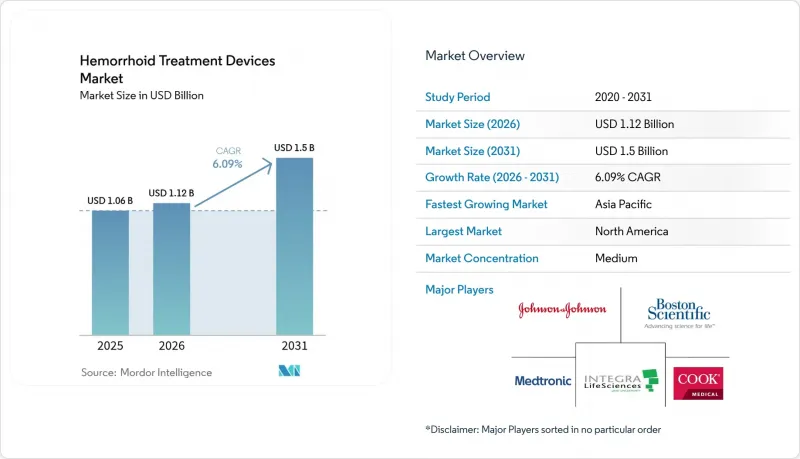
This report is Segmented by Product Type (Band Ligators, Infrared Coagulators, Proctoscopes & Anoscopes, Bipolar Probes, and More), Technology Platform (Energy-Based Devices, and More), Hemorrhoid Grade (Grade I, and More), Procedure (Rubber Band Ligation, and More), End User (Hospitals, and More), and Geography (North America, and More). The Market Forecasts are Provided in Terms of Value (USD).
Global Hemorrhoid Treatment Devices Market Trends and Insights
Rising Prevalence of Hemorrhoidal Disease
Up to 50% of adults older than 50 experience symptomatic hemorrhoids, and growing life expectancy is pushing absolute case numbers higher. China alone is bracing for 1.4 million annual colorectal cancer cases by 2040; national screening rollouts mean more incidental hemorrhoid diagnoses that move quickly to procedural care. Similar screening acceleration is visible in India, Japan, and South Korea. The clinical community now favors earlier device intervention for Grades II-III to prevent progression, anchoring a long-term tailwind for the hemorrhoid treatment devices market.
Growing Adoption of Minimally Invasive Outpatient Procedures
Payers continue to steer patients away from inpatient excisional surgery toward office or ASC-based ligation. Medicare reimburses rubber band ligation (CPT 46221) at USD 158.85 per facility case in 2026, a level that supports high-volume practice economics. Vizient forecasts a 19% jump in total U.S. outpatient surgery between 2024 and 2034, with gastrointestinal work leading the rise. The convenience of 15-minute visits and same-day discharge aligns with patient preference, accelerating device throughput and revenue.
High Cost of Stapling and Laser Systems
Capital outlays above USD 50,000 for a single laser console discourage adoption in resource-constrained hospitals despite clinical benefits. Deferred purchases are common in sub-Saharan Africa and lower-tier Chinese cities where budget committees favor mechanical ligators that cost one-tenth as much. Financing programs and leasing models are emerging, yet payback timelines stretch beyond five years for many facilities, slowing energy platform penetration.
Other drivers and restraints analyzed in the detailed report include:
- Technological Advances in Ligation and Energy Devices
- Expanding Healthcare Infrastructure in Emerging Economies
- Stringent FDA/CE Regulatory Pathways
For complete list of drivers and restraints, kindly check the Table Of Contents.
Segment Analysis
Band ligators owned 41.55% of 2025 revenue, underpinning the mechanical core of the hemorrhoid treatment devices market. High throughput, CPT-linked reimbursement, and a five-minute room turnaround keep demand brisk in physician offices and ASCs. The segment also benefits from infection-control upgrades as manufacturers roll out single-use variants. Laser probes, however, are set for a 9.01% CAGR, driven by compelling randomized evidence of superior pain relief and quicker return to work. Hospitals looking to differentiate colorectal programs are acquiring laser consoles, and private insurers in Germany and Japan now reimburse laser hemorrhoidoplasty, further lifting penetration.
Mechanical systems generated 53.74% of the hemorrhoid treatment devices market size in 2025 thanks to band ligator ubiquity and their minimal learning curve. Budget-sensitive public hospitals in Latin America and Africa still prioritize these platforms. Energy-based devices are catching up at an 8.92% CAGR, led by bipolar and infrared coagulators that eliminate costly endoscope reprocessing. ASCs in the U.S. often bundle a disposable probe into the procedure fee, easing capital constraints and smoothing the upgrade path for surgeons.
Complete Report Scope:
- By Product Type
- Band Ligators
- Infrared Coagulators
- Proctoscopes & Anoscopes
- Bipolar Probes
- Doppler-Guided Ligators
- Cryotherapy Devices
- Laser Probes
- Stapling Devices
- Other Emerging Devices
- By Technology Platform
- Energy-based Devices
- Mechanical Devices
- Hybrid/ Combination Devices
- By Hemorrhoid Grade
- Grade I
- Grade II
- Grade III
- Grade IV
- By Procedure
- Rubber Band Ligation
- Sclerotherapy
- Infrared Coagulation
- Laser Therapy
- Doppler-Guided Artery Ligation (DG-HAL)
- Stapled Hemorrhoidopexy
- Conventional Hemorrhoidectomy
- Other Procedures
- By End User
- Hospitals
- Clinics & Physician Offices
- Ambulatory Surgery Centers
- Home-Care Settings
- Others
- By Geography
- North America
- United States
- Canada
- Mexico
- Europe
- Germany
- France
- United Kingdom
- Italy
- Spain
- Rest of Europe
- Asia-Pacific
- China
- Japan
- India
- South Korea
- Australia
- Rest of Asia-Pacific
- Middle East & Africa
- GCC
- South Africa
- Rest of Middle East & Africa
- South America
- Brazil
- Argentina
- Rest of South America
- North America
Geography Analysis
North America generated 33.43% of 2025 revenue, underpinned by 6,300 Medicare-certified ASCs and clear procedural reimbursement. FDA device-intensive policies continue to influence purchasing, and infection-control rules make single-use ligators standard in many U.S. hospitals. Canada shows similar patterns, though provincial budgets extend capital cycles by one to two years longer than U.S. averages.
Asia-Pacific is the fastest-growing arena at 8.43% CAGR through 2031. China is scaling colorectal screening, and provincial insurance now covers laser hemorrhoidoplasty in several pilot provinces. India's private hospital chains are opening dedicated day-surgery wings, equipping them with bipolar and infrared platforms to differentiate from public facilities. Southeast Asian markets such as Indonesia are piggybacking on endoscopy infrastructure funded for gastric cancer programs, creating incremental device demand.
Europe represents a mature but technology-hungry region. Germany and France reimburse energy-based procedures at higher tariffs than mechanical ligation, encouraging steady console refresh cycles every five to seven years. The United Kingdom is channeling National Health Service capital toward infection-risk reduction, pushing single-use devices to the fore. In Southern Europe, lingering budget limits lengthen adoption timelines, though EU-wide infection directives are narrowing the gap.
The Middle East & Africa and South America together account for a modest share but are important long-run contributors. Gulf Cooperation Council hospitals have moved rapidly into Doppler-guided and laser techniques to attract medical tourists, while Brazil and Colombia are expanding public coverage of outpatient ligation. Persistent shortages of colorectal surgeons and capital constraints temper growth, yet tele-endoscopy pilots and private specialty clinics are beginning to unlock latent demand.
- A.M.I.
- B. Braun
- Bluesail Surgical
- Boston Scientific
- Conmed
- Cook Group
- Integra LifeSciences
- Johnson & Johnson
- Medline Industries
- Medtronic
- Micro-tech
- Olympus
- Privi Medical
- Sapi Med
- Sklar Surgical Instruments
- Smiths Group
- Surkon Medical
- Teleflex
- THD S.p.A.
- Victor Medical Instruments
Additional Benefits:
- The market estimate (ME) sheet in Excel format
- 3 months of analyst support
TABLE OF CONTENTS
1 Introduction
- 1.1 Study Assumptions & Market Definition
- 1.2 Scope of the Study
2 Research Methodology
3 Executive Summary
4 Market Landscape
- 4.1 Market Overview
- 4.2 Market Drivers
- 4.2.1 Rising Prevalence of Hemorrhoidal Disease
- 4.2.2 Growing Adoption of Minimally-Invasive Outpatient Procedures
- 4.2.3 Technological Advancements in Ligation and Energy-Based Devices
- 4.2.4 Expanding Healthcare Infrastructure & Expenditure in Emerging Economies
- 4.2.5 Tele-Endoscopy & Remote Guidance Enabling Rural Reach
- 4.2.6 Infection-Control Push Toward Single-Use Ligators
- 4.3 Market Restraints
- 4.3.1 High Cost of Advanced Stapling & Laser Systems
- 4.3.2 Stringent FDA/CE Regulatory Pathways
- 4.3.3 Competition from Topical Pharmacotherapy
- 4.3.4 Shortage of Colorectal Specialists in Developing Regions
- 4.4 Value / Supply-Chain Analysis
- 4.5 Regulatory Landscape
- 4.6 Technological Outlook
- 4.7 Porter's Five Forces Analysis
- 4.7.1 Bargaining Power of Suppliers
- 4.7.2 Bargaining Power of Buyers
- 4.7.3 Threat of New Entrants
- 4.7.4 Threat of Substitutes
- 4.7.5 Intensity of Competitive Rivalry
5 Market Size & Growth Forecasts (Value in USD)
- 5.1 By Product Type
- 5.1.1 Band Ligators
- 5.1.2 Infrared Coagulators
- 5.1.3 Proctoscopes & Anoscopes
- 5.1.4 Bipolar Probes
- 5.1.5 Doppler-Guided Ligators
- 5.1.6 Cryotherapy Devices
- 5.1.7 Laser Probes
- 5.1.8 Stapling Devices
- 5.1.9 Other Emerging Devices
- 5.2 By Technology Platform
- 5.2.1 Energy-based Devices
- 5.2.2 Mechanical Devices
- 5.2.3 Hybrid/ Combination Devices
- 5.3 By Hemorrhoid Grade
- 5.3.1 Grade I
- 5.3.2 Grade II
- 5.3.3 Grade III
- 5.3.4 Grade IV
- 5.4 By Procedure
- 5.4.1 Rubber Band Ligation
- 5.4.2 Sclerotherapy
- 5.4.3 Infrared Coagulation
- 5.4.4 Laser Therapy
- 5.4.5 Doppler-Guided Artery Ligation (DG-HAL)
- 5.4.6 Stapled Hemorrhoidopexy
- 5.4.7 Conventional Hemorrhoidectomy
- 5.4.8 Other Procedures
- 5.5 By End User
- 5.5.1 Hospitals
- 5.5.2 Clinics & Physician Offices
- 5.5.3 Ambulatory Surgery Centers
- 5.5.4 Home-Care Settings
- 5.5.5 Others
- 5.6 By Geography
- 5.6.1 North America
- 5.6.1.1 United States
- 5.6.1.2 Canada
- 5.6.1.3 Mexico
- 5.6.2 Europe
- 5.6.2.1 Germany
- 5.6.2.2 France
- 5.6.2.3 United Kingdom
- 5.6.2.4 Italy
- 5.6.2.5 Spain
- 5.6.2.6 Rest of Europe
- 5.6.3 Asia-Pacific
- 5.6.3.1 China
- 5.6.3.2 Japan
- 5.6.3.3 India
- 5.6.3.4 South Korea
- 5.6.3.5 Australia
- 5.6.3.6 Rest of Asia-Pacific
- 5.6.4 Middle East & Africa
- 5.6.4.1 GCC
- 5.6.4.2 South Africa
- 5.6.4.3 Rest of Middle East & Africa
- 5.6.5 South America
- 5.6.5.1 Brazil
- 5.6.5.2 Argentina
- 5.6.5.3 Rest of South America
- 5.6.1 North America
6 Competitive Landscape
- 6.1 Market Concentration
- 6.2 Market Share Analysis
- 6.3 Company Profiles (includes Global level Overview, Market level overview, Core Segments, Financials as available, Strategic Information, Market Rank/Share for key companies, Products and Services, and Recent Developments)
- 6.3.1 A.M.I. GmbH
- 6.3.2 B. Braun Melsungen
- 6.3.3 Bluesail Surgical
- 6.3.4 Boston Scientific Corporation
- 6.3.5 CONMED Corporation
- 6.3.6 Cook Medical
- 6.3.7 Integra LifeSciences
- 6.3.8 Johnson & Johnson (Ethicon)
- 6.3.9 Medline Industries
- 6.3.10 Medtronic plc
- 6.3.11 Micro-Tech Endoscopy
- 6.3.12 Olympus Corporation
- 6.3.13 Privi Medical
- 6.3.14 Sapi Med
- 6.3.15 Sklar Surgical Instruments
- 6.3.16 Smith & Nephew
- 6.3.17 Surkon Medical
- 6.3.18 Teleflex
- 6.3.19 THD S.p.A.
- 6.3.20 Victor Medical Instruments
7 Market Opportunities & Future Outlook
- 7.1 White-space & Unmet-Need Assessment

