PUBLISHER: Mordor Intelligence | PRODUCT CODE: 2072827

PUBLISHER: Mordor Intelligence | PRODUCT CODE: 2072827
Skin Graft - Market Share Analysis, Industry Trends & Statistics, Growth Forecasts (2026 - 2031)
According to Mordor Intelligence, the skin graft market size is expected to grow from USD 2.24 billion in 2025 to USD 2.41 billion in 2026 and is forecast to reach USD 3.46 billion by 2031 at 7.5% CAGR over 2026-2031.
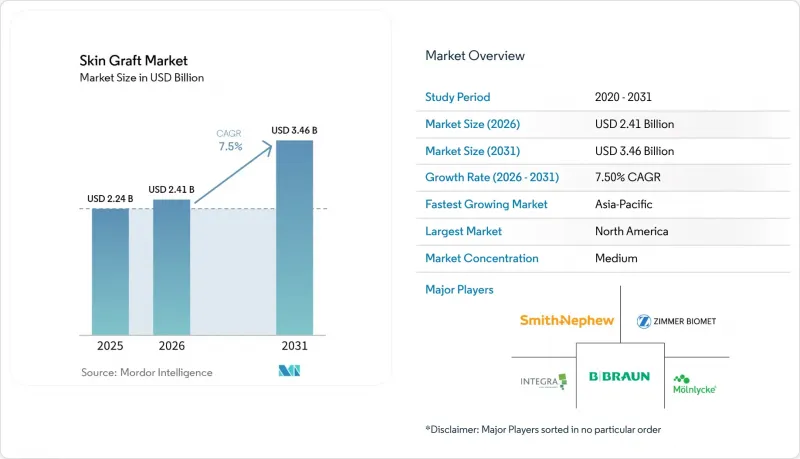
This report is Segmented by Graft Type (Autograft, Allograft, and More), Source (Human Skin, Animal-Derived, Cell-Based and Tissue-Engineered, Synthetic Matrix-Based), Application (Burns, Chronic Wounds, Traumatic, Surgical Wounds, Skin Cancer), End User (Hospitals, Ascs, Specialty Wound Care, Dermatology Clinics), and Geography (North America, Europe, Asia-Pacific, MEA, South America). Forecasts in Value (USD).
Global Skin Graft Market Trends and Insights
Rising Burn And Trauma Case Loads Sustain Baseline Demand
The skin graft market continues to rely on burn care as a stable volume base, with 6.19 million new burn cases and 104.76 million prevalent cases recorded globally in 2024. Prevalent cases were 11.38% higher than in 1990. Projections indicate burn cases will reach 10.3 million by 2030, with burn-related disability burden rising from 11.5 million DALYs in 2030 to 14.1 million by 2050. India remains a key demand center, with burn incident cases increasing by 23.88% between 1990 and 2024, supported by improved treatment access through national insurance programs. Advanced grafting is gaining traction due to its cost-effectiveness, as seen in reduced hospital stays for patients treated with fish-skin grafts compared to synthetic alternatives.
Expanding Skin Substitutes Use In Chronic Wounds Opens A Parallel Growth Channel
Chronic wounds, such as diabetic foot ulcers and venous leg ulcers, are expanding the skin graft market, influencing procedure frequency and product mix. Over 75 skin substitute products cater to chronic wound indications, with 102 products priced above USD 1,000 entering the U.S. market between January 2024 and October 2025. Clinical trials show fish-skin grafts outperform standard care in wound closure for diabetic foot ulcers. The 2026 reimbursement reset is shifting chronic wound cases to hospital outpatient centers, favoring products with consistent evidence and standardized protocols.
High Procedure And Product Costs Limit Addressable Reach
Affordability remains a significant challenge in the skin graft market, particularly in healthcare systems unable to absorb the costs of advanced wound products and multistep procedures. Cell-based and tissue-engineered constructs, while clinically appealing, often have acquisition costs beyond what many public systems or cost-sensitive providers can afford. This issue is more pronounced outside the U.S., where reimbursement systems are stricter and much of the global burn burden is concentrated. Cost pressures increase further when dermal matrices require staged procedures or when allografts rely on cold-chain logistics, adding complexity to handling and storage. In the U.S., administrative measures like the WISeR prior authorization model, introduced in January 2026 across six pilot states, have added scrutiny to skin substitute use for diabetic foot ulcers and venous leg ulcers. As a result, the market may see faster product rationalization, with lower-priced products gaining share in cost-conscious hospital settings.
Other drivers and restraints analyzed in the detailed report include:
- Shift Toward Evidence-Based, Reimbursable Products Reshapes Competitive Positioning
- Under-Penetration Of Novel Biological Graft Sources Offers Incremental Opportunity
- Reimbursement Uncertainty Creates Near-Term Demand Volatility
For complete list of drivers and restraints, kindly check the Table Of Contents.
Segment Analysis
In 2025, Autograft held a 46.76% revenue share, reaffirming its leadership in the graft type segment and its critical role in the skin graft market. Surgeons prefer autograft for acute burns and traumatic wounds due to its native tissue integration, durability, and immunity to rejection. It remains the gold standard when donor-site harvesting is feasible and definitive closure is required. Allograft and xenograft serve as temporary biological coverage, with cadaveric allograft stabilizing critically ill patients and porcine xenograft preparing wound beds for interim coverage needs.
Synthetic and biosynthetic grafts are projected to grow at a 7.95% CAGR from 2026 to 2031, making them the fastest-growing segment. These products reduce donor-site burden and expand coverage options, especially in cases where repeated harvesting is not viable. Innovations like biodegradable scaffolds, electrospun PLGA platforms, and hybrid matrices such as PermeaDerm are driving differentiation in the market. While dermal matrices have not replaced split-thickness skin grafting in routine burn care, they show promise in specific applications like contracture reconstruction and combined cellular use. The market is shifting toward a hybrid treatment model where biosynthetic products complement traditional surgical standards.
In 2025, human skin accounted for 67.88% of revenue, maintaining its central role in the skin graft market. This dominance reflects its use in autologous and allograft applications, supported by established burn care infrastructure and regulatory familiarity. Surgeons trust human-derived products due to their proven performance in handling, integration, and outcomes, particularly in severe burn cases. Animal-derived products, such as porcine and bovine scaffolds, retain a niche role as temporary coverage and wound bed preparation tools.
Cell-based and tissue-engineered skin is expected to grow at an 8.45% CAGR from 2026 to 2031, making it the fastest-growing source segment. These products offer enhanced biological activity without relying on donor supply. Studies have demonstrated the potential of iPSC-derived mesenchymal stem cells and multicellular bioprinted skin, paving the way for next-generation engineered skin. China's expanding manufacturing capabilities and evolving regulatory pathways are also driving growth in this segment, with initial adoption likely in high-value use cases.
Complete Report Scope:
- By Graft Type
- Autograft
- Allograft
- Xenograft
- Synthetic and Biosynthetic Graft
- By Source
- Human Skin
- Animal-Derived Skin
- Cell-Based and Tissue-Engineered Skin
- Synthetic Matrix-Based Skin
- By Application
- Burns
- Chronic Wounds
- Traumatic Wounds
- Surgical Wounds
- Skin Cancer Reconstruction
- By End User
- Hospitals
- Ambulatory Surgical Centers
- Specialty Wound Care Centers
- Dermatology and Plastic Surgery Clinics
- By Geography
- North America
- United States
- Canada
- Mexico
- Europe
- Germany
- United Kingdom
- France
- Italy
- Spain
- Rest of Europe
- Asia-Pacific
- China
- India
- Japan
- Australia
- South Korea
- Rest of Asia-Pacific
- Middle East and Africa
- GCC
- South Africa
- Rest of Middle East and Africa
- South America
- Brazil
- Argentina
- Rest of South America
- North America
Geography Analysis
In 2025, North America held 39.52% of the global skin graft market revenue, maintaining its leadership due to high procedural volumes, extensive burn center networks, and a robust reimbursement system for advanced skin substitutes. The U.S. led regional demand, with Medicare Part B processing USD 9.9 billion in skin substitute claims in 2024 across codes Q4100 to Q4367. Canada and Mexico contributed to growth through chronic wound management and burn care. However, the 2026 reimbursement reset is expected to shift cases from physician offices to hospital outpatient settings, increasing prior authorization requirements in pilot states.
Europe ranked as the second-largest regional contributor to the skin graft market, driven by Germany, the U.K., and France. Burn care adoption outpaces chronic wounds due to stricter reimbursement standards in major health systems. Germany funds advanced grafts more readily for burns, while France requires stronger health-economic evidence for broader product listings. Italy and Spain add to demand, though access varies by procurement and payer processes. MDR-related evidence requirements are narrowing product registrations, favoring larger companies with stronger clinical documentation. Kerecis is working to expand its European presence but acknowledges slower adoption compared to the U.S.
Asia-Pacific is projected to grow at an 8.88% CAGR from 2026 to 2031, making it the fastest-growing regional market. Growth is driven by rising healthcare investments, increasing diabetes prevalence, and expanded local manufacturing in China, where artificial skin production rose from 9 million units in 2020 to 12.3 million by 2025. India remains significant due to its growing burn burden. Global suppliers are focusing on China, as seen in Molnlycke's joint venture with Zhende Medical in May 2026. AVITA Medical also strengthened its regional regulatory position in April 2026 with TGA certification in Australia and Medsafe WAND listing in New Zealand. The Middle East, Africa, and South America contribute less revenue but show potential through GCC infrastructure investments and broader healthcare coverage in Brazil.
- AlloSource
- AVITA Medical, Inc.
- B. Braun
- Convatec
- De Soutter Medical Ltd.
- Exsurco Medical
- Humeca BV
- Integra LifeSciences
- Kerecis ehf.
- LifeNet Health
- MIMEDX Group
- Molnlycke Health Care
- MTF Biologics
- Organogenesis
- Smiths Group
- Stryker
- Surtex Instruments
- TELA Bio, Inc.
- Tissue Regenix Group PLC
- Zimmer Biomet
Additional Benefits:
- The market estimate (ME) sheet in Excel format
- 3 months of analyst support
TABLE OF CONTENTS
1 INTRODUCTION
- 1.1 Study Assumptions and Market Definition
- 1.2 Scope of the Study
2 RESEARCH METHODOLOGY
3 EXECUTIVE SUMMARY
4 MARKET LANDSCAPE
- 4.1 Market Overview
- 4.2 Market Drivers
- 4.2.1 Rising Burn and Trauma Case Loads Requiring Surgical Coverage
- 4.2.2 Expanding Use of Skin Substitutes in Chronic Wound Management
- 4.2.3 Broader Adoption of Outpatient Grafting and Ambulatory Wound Care
- 4.2.4 Shift Toward Evidence-Based, Reimbursable Advanced Wound Products
- 4.2.5 Under-penetration of Fish-Skin, Placental, and Biosynthetic Grafts in Emerging Care Pathways
- 4.2.6 Operating Room Efficiency Gains from Prefabricated and Easy-To-Handle Graft Systems
- 4.3 Market Restraints
- 4.3.1 High Procedure and Product Cost Relative to Standard Wound Closure Methods
- 4.3.2 Reimbursement Uncertainty and Coverage Tightening in Wound Care Markets
- 4.3.3 Donor-Site Morbidity, Infection Risk, and Graft Failure Concerns
- 4.3.4 Limited Availability of High-Quality Cadaveric and Specialty Biological Graft Supply
- 4.4 Supply/Value Chain Analysis
- 4.5 Regulatory Landscape
- 4.6 Technological Outlook
- 4.7 Porter's Five Forces Analysis
- 4.7.1 Bargaining Power of Suppliers
- 4.7.2 Bargaining Power of Buyers
- 4.7.3 Threat of New Entrants
- 4.7.4 Threat of Substitutes
- 4.7.5 Competitive Rivalry
5 MARKET SIZE AND GROWTH FORECASTS (VALUE, USD)
- 5.1 By Graft Type
- 5.1.1 Autograft
- 5.1.2 Allograft
- 5.1.3 Xenograft
- 5.1.4 Synthetic and Biosynthetic Graft
- 5.2 By Source
- 5.2.1 Human Skin
- 5.2.2 Animal-Derived Skin
- 5.2.3 Cell-Based and Tissue-Engineered Skin
- 5.2.4 Synthetic Matrix-Based Skin
- 5.3 By Application
- 5.3.1 Burns
- 5.3.2 Chronic Wounds
- 5.3.3 Traumatic Wounds
- 5.3.4 Surgical Wounds
- 5.3.5 Skin Cancer Reconstruction
- 5.4 By End User
- 5.4.1 Hospitals
- 5.4.2 Ambulatory Surgical Centers
- 5.4.3 Specialty Wound Care Centers
- 5.4.4 Dermatology and Plastic Surgery Clinics
- 5.5 By Geography
- 5.5.1 North America
- 5.5.1.1 United States
- 5.5.1.2 Canada
- 5.5.1.3 Mexico
- 5.5.2 Europe
- 5.5.2.1 Germany
- 5.5.2.2 United Kingdom
- 5.5.2.3 France
- 5.5.2.4 Italy
- 5.5.2.5 Spain
- 5.5.2.6 Rest of Europe
- 5.5.3 Asia-Pacific
- 5.5.3.1 China
- 5.5.3.2 India
- 5.5.3.3 Japan
- 5.5.3.4 Australia
- 5.5.3.5 South Korea
- 5.5.3.6 Rest of Asia-Pacific
- 5.5.4 Middle East and Africa
- 5.5.4.1 GCC
- 5.5.4.2 South Africa
- 5.5.4.3 Rest of Middle East and Africa
- 5.5.5 South America
- 5.5.5.1 Brazil
- 5.5.5.2 Argentina
- 5.5.5.3 Rest of South America
- 5.5.1 North America
6 COMPETITIVE LANDSCAPE
- 6.1 Market Concentration
- 6.2 Market Share Analysis
- 6.3 Company Profiles (includes Global Level Overview, Market Level Overview, Core Segments, Financials as available, Strategic Information, Market Rank/Share, Products and Services, Recent Developments)
- 6.3.1 AlloSource
- 6.3.2 AVITA Medical, Inc.
- 6.3.3 B. Braun SE
- 6.3.4 Convatec Group PLC
- 6.3.5 De Soutter Medical Ltd.
- 6.3.6 Exsurco Medical, Inc.
- 6.3.7 Humeca BV
- 6.3.8 Integra LifeSciences Holdings Corporation
- 6.3.9 Kerecis ehf.
- 6.3.10 LifeNet Health
- 6.3.11 MiMedx Group, Inc.
- 6.3.12 Molnlycke Health Care AB
- 6.3.13 MTF Biologics
- 6.3.14 Organogenesis Holdings Inc.
- 6.3.15 Smith & Nephew plc
- 6.3.16 Stryker Corporation
- 6.3.17 Surtex Instruments Limited
- 6.3.18 TELA Bio, Inc.
- 6.3.19 Tissue Regenix Group PLC
- 6.3.20 Zimmer Biomet Holdings, Inc.
7 MARKET OPPORTUNITIES AND FUTURE OUTLOOK
- 7.1 White-Space and Unmet-Need Assessment

