PUBLISHER: Mordor Intelligence | PRODUCT CODE: 2116543

PUBLISHER: Mordor Intelligence | PRODUCT CODE: 2116543
Transplantation - Market Share Analysis, Industry Trends & Statistics, Growth Forecasts (2026 - 2031)
According to Mordor Intelligence, the transplantation market size is expected to grow from USD 13.59 billion in 2025 to USD 14.88 billion in 2026 and is forecast to reach USD 23.39 billion by 2031 at 9.47% CAGR over 2026-2031.
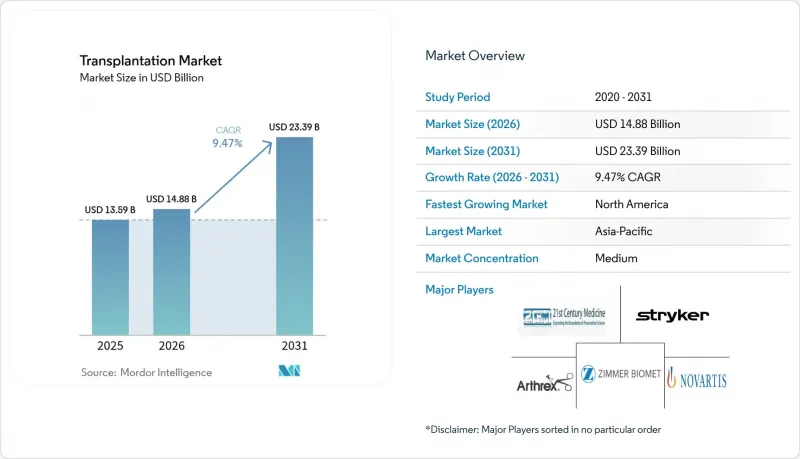
This report is Segmented by Product (Tissue Products [Allograft Tissues, and More], Immunosuppressive Drugs [Calcineurin Inhibitors, and More], and More), Application (Organ Transplantation [Kidney, Liver, and More] and Tissue Transplantation), End Use (Hospitals, Transplant Centers, and More), and Geography (North America, Europe, and More). The Market Forecasts are Provided in Terms of Value (USD).
Global Transplantation Market Trends and Insights
Increasing Burden of Chronic Diseases
Rising prevalence of diabetes-related kidney failure, hepatitis-driven liver cirrhosis, and cardiovascular disorders enlarges the candidate pool for solid-organ procedures. In the United States, end-stage renal disease now affects over 750,000 individuals, driving kidney transplant demand at ratios exceeding 4:1 against donor availability. Aging populations in Western economies intensify chronic disease incidence, while healthcare systems expand transplant-center networks to manage rising caseloads. Nevertheless, structural supply constraints within the transplantation market persist despite incremental gains in donor registration.
Technological Advancements In Transplantation Techniques
Robotic-assisted surgeries reduce peri-operative complications, broadening eligibility to higher-risk recipients. Machine perfusion technologies stretch organ preservation from 6 hours to more than 20 hours, improving inter-regional sharing efficiency. Meanwhile, biomarker-guided immunosuppression minimizes rejection risk and improves long-term graft survival. These advances collectively strengthen patient outcomes and support wider adoption across the transplantation market.
Shortage of Organ Donors
Only 3 out of every 1,000 deaths meet donation criteria, limiting available grafts even as waiting lists exceed 103,000 patients in the United States. Variability in consent rates and cultural barriers suppress donor pools in emerging economies, constraining the transplantation market despite technological advances.
Other drivers and restraints analyzed in the detailed report include:
- AI-Driven Donor-Recipient Matching Algorithms
- Ex-Vivo Organ Perfusion Extending Preservation Windows
- Antibiotic-Resistant Infections Raising Post-Transplant Risk
For complete list of drivers and restraints, kindly check the Table Of Contents.
Segment Analysis
Immunosuppressive drugs accounted for 38.92% of the transplantation market size in 2025, reflecting their indispensable role in preventing graft rejection. Tacrolimus and mycophenolate retain physician preference even as generic uptake remains cautious because of narrow-therapeutic-index concerns. Supply disruptions-such as the FDA downgrade of Accord Healthcare's tacrolimus bioequivalence status-spotlight vulnerabilities that can ripple across the transplantation market. Preservation devices, while still a smaller revenue pool, are the fastest-growing category at a 11.86% CAGR, underscoring strong clinician demand for longer organ storage and improved peri-operative outcomes.
Breakthrough platforms like Paragonix PancreasPak and SherpaPak differentiate on thermal control and real-time monitoring, encouraging broader adoption beyond leading academic centers. Tissue-engineering scaffolds are gaining clinical traction, expanding surgical options for corneal, bone, and cartilage repair. These dynamics suggest a gradual broadening of revenue sources within the transplantation industry as device-led innovations converge with long-established pharmacotherapy.
Complete Report Scope:
- By Product
- Tissue Products
- Allograft Tissues
- Xenograft Tissues
- Synthetic Scaffolds & Matrices
- Immunosuppressive Drugs
- Calcineurin Inhibitors
- mTOR Inhibitors
- Antiproliferative Agents
- Monoclonal Antibodies
- Steroids & Others
- Preservation Solutions & Systems
- Static Cold Storage Solutions
- Hypothermic Machine Perfusion Solutions
- Normothermic Perfusion Systems
- Tissue Products
- By Application
- Organ Transplantation
- Kidney
- Liver
- Heart
- Lung
- Pancreas & Islet Cell
- Tissue Transplantation
- Cornea
- Bone & Cartilage
- Skin & Vascular Tissues
- Organ Transplantation
- By End User
- Hospitals
- Transplant Centres
- Ambulatory Surgical Centres
- Research & Academic Institutes
- Geography
- North America
- United States
- Canada
- Mexico
- Europe
- Germany
- United Kingdom
- France
- Italy
- Spain
- Rest of Europe
- Asia-Pacific
- China
- Japan
- India
- South Korea
- Australia
- Rest of Asia-Pacific
- Middle East and Africa
- GCC
- South Africa
- Rest of Middle East and Africa
- South America
- Brazil
- Argentina
- Rest of South America
- North America
Geography Analysis
North America held a 37.35% revenue share in 2025, supported by mature reimbursement frameworks, donor-registry optimization, and adoption of ex-vivo perfusion technologies. The United States perennially conducts more than 40,000 transplants per year under OPTN stewardship and continues to refine allocation policies that integrate AI-based scoring for equitable distribution. Canada's cross-border cooperation and Mexico's medical-tourism offerings contribute incremental procedure volumes, reinforcing regional leadership within the transplantation market.
Asia-Pacific is projected to post an 11.25% CAGR to 2031, driven by regulatory harmonization and expanding private investment in transplant infrastructure. China, India, and Japan collectively accelerate installation of perfusion equipment and launch public-awareness drives aimed at raising donor consent rates. Regional governments adopt frameworks echoing European SoHO regulation standards, a move expected to improve quality assurance and cross-border tissue circulation. As disposable incomes climb and insurance coverage widens, procedural volumes surge, positioning Asia-Pacific as the fastest-growing cluster of the transplantation market.
Europe maintains steady growth on the back of harmonized procurement protocols and high donor rates in Spain, Portugal, and Croatia. Implementation of EU SoHO rules is set to further streamline tissue and cell movement across member states, benefiting multi-center research collaborations. Innovations in blockchain-based traceability and AI-enabled matching are tested through EU-funded pilot programs, reinforcing Europe's influential role in shaping global best practices across the transplantation market.
- Abbvie
- Novartis
- Pfizer
- Astellas Pharma
- Bristol-Myers Squibb
- Sandoz Group
- Medtronic
- Zimmer Biomet
- Stryker
- Arthrex
- Teva Pharmaceutical Industries
- Veloxis Pharmaceuticals
- BioLife Solutions
- 21st Century Medicine
- CryoLife
- Thermo Fisher Scientific
- Illumina
- Immucor
- CareDx
- OrganOx
- Transmedics
- Xenothera
Additional Benefits:
- The market estimate (ME) sheet in Excel format
- 3 months of analyst support
TABLE OF CONTENTS
1 Introduction
- 1.1 Study Assumptions & Market Definition
- 1.2 Scope of the Study
2 Research Methodology
3 Executive Summary
4 Market Landscape
- 4.1 Market Overview
- 4.2 Market Drivers
- 4.2.1 Increasing Burden of Chronic Diseases
- 4.2.2 Increasing Burden of Organ Failure
- 4.2.3 Technological Advancements In Transplantation Techniques
- 4.2.4 AI-Driven Donor-Recipient Matching Algorithms
- 4.2.5 Ex-Vivo Organ Perfusion Extending Preservation Windows
- 4.2.6 Tokenised Blockchain Donor-Registry Incentives
- 4.3 Market Restraints
- 4.3.1 Shortage Of Organ Donors
- 4.3.2 Ethical & Cultural Objections
- 4.3.3 Antibiotic-Resistant Infections Raising Post-Transplant Risk
- 4.3.4 Supply-Chain Fragility For Tacrolimus & Other APIs
- 4.4 Porter's Five Forces
- 4.4.1 Threat of New Entrants
- 4.4.2 Bargaining Power of Buyers/Consumers
- 4.4.3 Bargaining Power of Suppliers
- 4.4.4 Threat of Substitute Products
- 4.4.5 Intensity of Competitive Rivalry
5 Market Size & Growth Forecasts (Value, USD)
- 5.1 By Product
- 5.1.1 Tissue Products
- 5.1.1.1 Allograft Tissues
- 5.1.1.2 Xenograft Tissues
- 5.1.1.3 Synthetic Scaffolds & Matrices
- 5.1.2 Immunosuppressive Drugs
- 5.1.2.1 Calcineurin Inhibitors
- 5.1.2.2 mTOR Inhibitors
- 5.1.2.3 Antiproliferative Agents
- 5.1.2.4 Monoclonal Antibodies
- 5.1.2.5 Steroids & Others
- 5.1.3 Preservation Solutions & Systems
- 5.1.3.1 Static Cold Storage Solutions
- 5.1.3.2 Hypothermic Machine Perfusion Solutions
- 5.1.3.3 Normothermic Perfusion Systems
- 5.1.1 Tissue Products
- 5.2 By Application
- 5.2.1 Organ Transplantation
- 5.2.1.1 Kidney
- 5.2.1.2 Liver
- 5.2.1.3 Heart
- 5.2.1.4 Lung
- 5.2.1.5 Pancreas & Islet Cell
- 5.2.2 Tissue Transplantation
- 5.2.2.1 Cornea
- 5.2.2.2 Bone & Cartilage
- 5.2.2.3 Skin & Vascular Tissues
- 5.2.1 Organ Transplantation
- 5.3 By End User
- 5.3.1 Hospitals
- 5.3.2 Transplant Centres
- 5.3.3 Ambulatory Surgical Centres
- 5.3.4 Research & Academic Institutes
- 5.4 Geography
- 5.4.1 North America
- 5.4.1.1 United States
- 5.4.1.2 Canada
- 5.4.1.3 Mexico
- 5.4.2 Europe
- 5.4.2.1 Germany
- 5.4.2.2 United Kingdom
- 5.4.2.3 France
- 5.4.2.4 Italy
- 5.4.2.5 Spain
- 5.4.2.6 Rest of Europe
- 5.4.3 Asia-Pacific
- 5.4.3.1 China
- 5.4.3.2 Japan
- 5.4.3.3 India
- 5.4.3.4 South Korea
- 5.4.3.5 Australia
- 5.4.3.6 Rest of Asia-Pacific
- 5.4.4 Middle East and Africa
- 5.4.4.1 GCC
- 5.4.4.2 South Africa
- 5.4.4.3 Rest of Middle East and Africa
- 5.4.5 South America
- 5.4.5.1 Brazil
- 5.4.5.2 Argentina
- 5.4.5.3 Rest of South America
- 5.4.1 North America
6 Competitive Landscape
- 6.1 Market Concentration
- 6.2 Market Share Analysis
- 6.3 Company Profiles (includes Global level Overview, Market level overview, Core Segments, Financials as available, Strategic Information, Market Rank/Share for key companies, Products & Services, and Recent Developments)
- 6.3.1 AbbVie Inc.
- 6.3.2 Novartis AG
- 6.3.3 Pfizer Inc
- 6.3.4 Astellas Pharma
- 6.3.5 Bristol-Myers Squibb
- 6.3.6 Sandoz AG
- 6.3.7 Medtronic plc
- 6.3.8 Zimmer Biomet
- 6.3.9 Stryker
- 6.3.10 Arthrex
- 6.3.11 Teva Pharmaceuticals
- 6.3.12 Veloxis Pharmaceuticals
- 6.3.13 BioLife Solutions
- 6.3.14 21st Century Medicine
- 6.3.15 CryoLife
- 6.3.16 Thermo Fisher Scientific
- 6.3.17 Illumina Inc
- 6.3.18 Immucor
- 6.3.19 CareDx
- 6.3.20 OrganOx
- 6.3.21 TransMedics
- 6.3.22 Xenothera
7 Market Opportunities & Future Outlook
- 7.1 White-space & Unmet-Need Assessment

