PUBLISHER: Mordor Intelligence | PRODUCT CODE: 2072835

PUBLISHER: Mordor Intelligence | PRODUCT CODE: 2072835
Germany Defense Logistics - Market Share Analysis, Industry Trends & Statistics, Growth Forecasts (2026 - 2031)
According to Mordor Intelligence, the germany defense logistics market size is projected to expand from USD 4.61 billion in 2025 and USD 4.86 billion in 2026 to USD 6.27 billion by 2031, registering a CAGR of 5.21% between 2026 to 2031.
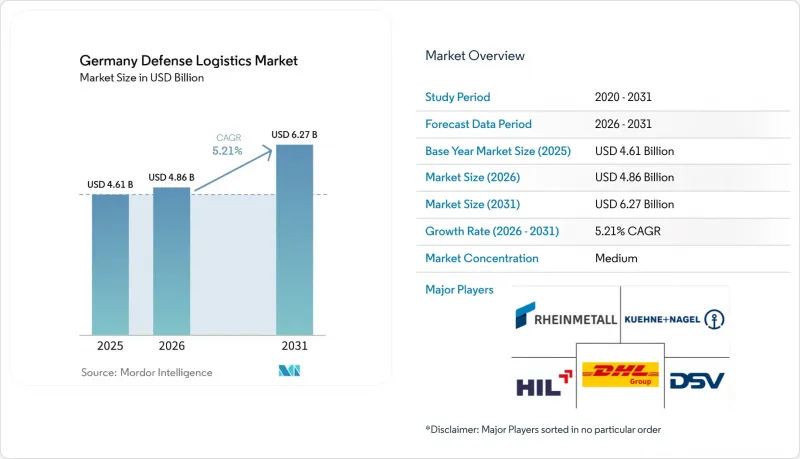
This report is Segmented by Service Type (Armament, Troop Movement, Technical Support and Maintenance, Medical Aid & Health Services, and More), by Logistics Function (Transportation, Warehousing, and Distribution, and More), by End User (Army, Navy, Air Force, and More), and by Region (North Rhine-Westphalia, Bavaria, Baden-Wurttemberg, and More). The Forecasts are Provided in Terms of Value (USD).
Germany Defense Logistics Market Trends and Insights
Bundeswehr's EUR 100 Billion (USD 116.0 billion) Sondervermogen Accelerates Multi-Modal Logistics Modernization.
Germany's defense budget structure now works through both the regular budget and the special fund, which has materially increased the scale and visibility of logistics demand in Germany's defense logistics market. The combined 2026 defense budget of EUR 108.2 billion (USD 125.4 billion), including EUR 25.5 billion (USD 29.6 billion) from the Sondervermogen fund, is the clearest sign that logistics planning is now tied to sustained military readiness rather than limited replacement cycles. One of the strongest signals came from the call-off for more than 2,000 RMMV HX military transport vehicles under the broader framework agreement, which sharply lifts Germany's organic movement capacity for fuel, ammunition, and engineering equipment. The vehicle mix matters because the heavier variants support pre-positioning and force sustainment rather than just routine domestic movement. The Bundestag's accelerated planning and procurement law, effective from January 2026, also reduces earlier bottlenecks in defense contracting, thereby supporting faster execution of logistics infrastructure, fleet support, and related services. As a result, the Germany defense logistics market is seeing a stronger pipeline of contracts that link procurement volumes directly to transport readiness, depot activity, and maintenance support.
NATO Deterrence Requirements Drive Rapid-Deployment Stockpiles Along the Rhine Corridor
Germany's role inside NATO logistics has become more central as alliance planning increasingly depends on the country's rail, road, port, and staging infrastructure. OPLAN DEU identifies Germany as the hub for moving up to 800,000 allied troops and 200,000 vehicles within 6 months of crisis activation, thereby lifting baseline demand for stockpiling, convoy support, and transit coordination in the German defense logistics market. This demand is not limited to state-owned capacity because commercial contracts alone cannot absorb a surge of that scale without added integration across service providers and military planners. Rheinmetall's February 2025 framework agreement for force redeployment support shows how broader logistics tasks, such as convoy services, housing, catering, refueling, and waste management, are increasingly being bundled into larger contracts. That shift favors operators that can manage field support and movement services together rather than compete only as freight carriers. The Germany defense logistics market therefore benefits not only from higher military traffic volumes, but also from a wider transfer of operational responsibilities into integrated logistics contracts.
Slower Puma IFV Retrofit Cycle Ties Up Warehouse Capacity
The Puma modernization cycle is constraining operational flexibility in the Germany defense logistics market because maintenance space and spare parts handling capacity remain tied up for long periods. The S1-standard upgrade of 297 Puma vehicles has a completion target of 2029, ensuring key depot and workshop resources remain committed while other land systems also require support. The upgrade scope includes missile integration, improved sensors, and digital radio equipment, and each layer adds testing and acceptance work that extends normal throughput times. The December 2025 agreement for 200 additional Puma vehicles also lengthens the period during which the most capable maintenance cells remain heavily focused on this platform. This creates a sequencing problem because fleet expansion and fleet support are rising simultaneously across the Army portion of the Germany defense logistics market. Commercial contractors can absorb part of that pressure, but current footprints limit how much overflow work can move out of the core network.
Other drivers and restraints analyzed in the detailed report include:
- Digital-Twin Roll-Out for Military Depots Cuts Inventory Lead-Times
- Civil-Military Logistics Integration with DB Cargo Unlocks Rail Capacity
- Tight MoD Cyber-Security Rules Delay Third-Party Cloud Onboarding
For complete list of drivers and restraints, kindly check the Table Of Contents.
Segment Analysis
Armament accounted for 41.07% of revenue in 2025, making it the largest service segment in the German defense logistics market. This segment remains the core demand center because it covers munitions handling, weapons-related storage, specialized transport, procurement coordination, and documentation under strict military compliance rules. The January 2026 IRIS-T contracts signed by Diehl Defense and BAAINBw reinforce this pattern because missile production growth directly increases the need for secure warehousing, controlled handling, and tightly managed supply chains.
Technical support and maintenance is the fastest-growing service area, and the segment is projected to expand at 8.05% CAGR from 2026 to 2031. Growth comes from larger fleets, longer sustainment cycles, and the steady spread of outsourced or performance-linked support models across land and air systems. Rolls-Royce Power Systems' March 2026 contract for around 200 MTU Powerpacks for Puma vehicles shows how propulsion support is becoming a larger part of the aftermarket workload.
Complete Report Scope:
- By Service Type
- Armament
- Military Troops Movement Support
- Technical Support & Maintenance
- Medical Aid & Health Services
- Fire-fighting Protection
- Other Services
- By Logistics Function
- Transportation
- Road
- Air
- Sea and Inland Waterways
- Rail
- Warehousing & Distribution
- Value-added Services (Labelling, Kitting, Consulting)
- Transportation
- By End User
- Army
- Navy
- Air Force
- Others
- By Region
- North Rhine-Westphalia
- Bavaria (Bayern)
- Baden-Wurttemberg
- Rest of States
List of Companies Covered in this Report:
- Rheinmetall AG
- HIL Heeresinstandsetzungslogistik GmbH
- DHL Group
- Kuehne+Nagel
- DSV (incl. DB Schenker)
- Airbus Defence and Space
- MBDA Deutschland GmbH
- KNDS Deutschland (formerly Krauss-Maffei Wegmann)
- Diehl Defence
- Hensoldt
- Leonardo Germany GmbH
- BAE Systems Deutschland
- MTU Aero Engines
- Lufthansa Technik Defense
- CEVA Logistics (CMA CGM)
- Hellmann Worldwide Logistics
- Rohlig Logistics
- GEODIS Germany
- DACHSER Defence & Aerospace Logistics
- Elbit Systems Deutschland
Additional Benefits:
- The market estimate (ME) sheet in Excel format
- 3 months of analyst support
TABLE OF CONTENTS
1 Introduction
- 1.1 Study Assumptions & Market Definition
- 1.2 Scope of the Study
2 Research Methodology
3 Executive Summary
4 Market Landscape
- 4.1 Market Overview & Role of Logistics in Modern Warfare
- 4.2 Defense Spending Trends
- 4.3 Market Drivers
- 4.3.1 Bundeswehr's EUR 100 Billion Sondervermogen Accelerates Multi-Modal Logistics Modernization
- 4.3.2 NATO Deterrence Requirements Drive Rapid-Deployment Stockpiles Along The Rhine Corridor
- 4.3.3 Digital-Twin Roll-Out for Military Depots Cuts Inventory Lead-Times by More than 15 %
- 4.3.4 Civil-Military Logistics Integration with DB Cargo Unlocks Rail Capacity
- 4.3.5 Hydrogen-Powered Tactical Vehicle Pilots Demand New Fuel-Chain Services
- 4.3.6 EU Military Mobility Funding Boosts Cross-Border Corridor Upgrades
- 4.4 Market Restraints
- 4.4.1 Slower Puma IFV Retrofit Cycle Ties Up Warehouse Capacity
- 4.4.2 Tight Mod Cyber-Security Rules Delay Third-Party Cloud Onboarding
- 4.4.3 Skilled Logistics Personnel Shortage in Bundeswehr Civilian Corps
- 4.4.4 Environmental Approval Delays for New Ammunition Storage Sites
- 4.5 Regulatory Framework
- 4.6 Value Chain and Distribution Channel Architecture Analysis
- 4.7 Technology Innovations Outlook
- 4.8 Porter's Five Forces
- 4.8.1 Threat of New Entrants
- 4.8.2 Bargaining Power of Suppliers
- 4.8.3 Bargaining Power of Buyers
- 4.8.4 Threat of Substitutes
- 4.8.5 Rivalry Among Competitors
- 4.9 Evolution of Defense Logistics Requirements
- 4.10 Impact of Geo-Political Events on Supply Chain Shifts
5 Market Size & Growth Forecasts (Value, 2026-2031)
- 5.1 By Service Type
- 5.1.1 Armament
- 5.1.2 Military Troops Movement Support
- 5.1.3 Technical Support & Maintenance
- 5.1.4 Medical Aid & Health Services
- 5.1.5 Fire-fighting Protection
- 5.1.6 Other Services
- 5.2 By Logistics Function
- 5.2.1 Transportation
- 5.2.1.1 Road
- 5.2.1.2 Air
- 5.2.1.3 Sea and Inland Waterways
- 5.2.1.4 Rail
- 5.2.2 Warehousing & Distribution
- 5.2.3 Value-added Services (Labelling, Kitting, Consulting)
- 5.2.1 Transportation
- 5.3 By End User
- 5.3.1 Army
- 5.3.2 Navy
- 5.3.3 Air Force
- 5.3.4 Others
- 5.4 By Region
- 5.4.1 North Rhine-Westphalia
- 5.4.2 Bavaria (Bayern)
- 5.4.3 Baden-Wurttemberg
- 5.4.4 Rest of States
6 Competitive Landscape
- 6.1 Market Concentration
- 6.2 Key Strategic Moves
- 6.3 Market Share Analysis
- 6.4 Company Profiles (includes Global level Overview, Market level overview, Core Segments, Financials as available, Strategic Information, Market Rank/Share for key companies, Products & Services, and Recent Developments)
- 6.4.1 Rheinmetall AG
- 6.4.2 HIL Heeresinstandsetzungslogistik GmbH
- 6.4.3 DHL Group
- 6.4.4 Kuehne+Nagel
- 6.4.5 DSV (incl. DB Schenker)
- 6.4.6 Airbus Defence and Space
- 6.4.7 MBDA Deutschland GmbH
- 6.4.8 KNDS Deutschland (formerly Krauss-Maffei Wegmann)
- 6.4.9 Diehl Defence
- 6.4.10 Hensoldt
- 6.4.11 Leonardo Germany GmbH
- 6.4.12 BAE Systems Deutschland
- 6.4.13 MTU Aero Engines
- 6.4.14 Lufthansa Technik Defense
- 6.4.15 CEVA Logistics (CMA CGM)
- 6.4.16 Hellmann Worldwide Logistics
- 6.4.17 Rohlig Logistics
- 6.4.18 GEODIS Germany
- 6.4.19 DACHSER Defence & Aerospace Logistics
- 6.4.20 Elbit Systems Deutschland
7 Market Opportunities & Future Outlook
- 7.1 White-space & Unmet-Need Assessment

