PUBLISHER: Mordor Intelligence | PRODUCT CODE: 2072892

PUBLISHER: Mordor Intelligence | PRODUCT CODE: 2072892
Vietnam Cross-Border B2C E-Commerce - Market Share Analysis, Industry Trends & Statistics, Growth Forecasts (2026 - 2031)
According to Mordor Intelligence, the vietnam cross-border B2C e-commerce market size was valued at USD 4.45 billion in 2025 and estimated to grow from USD 5.50 billion in 2026 to reach USD 13.39 billion by 2031, at a CAGR of 19.49% during the forecast period (2026-2031).
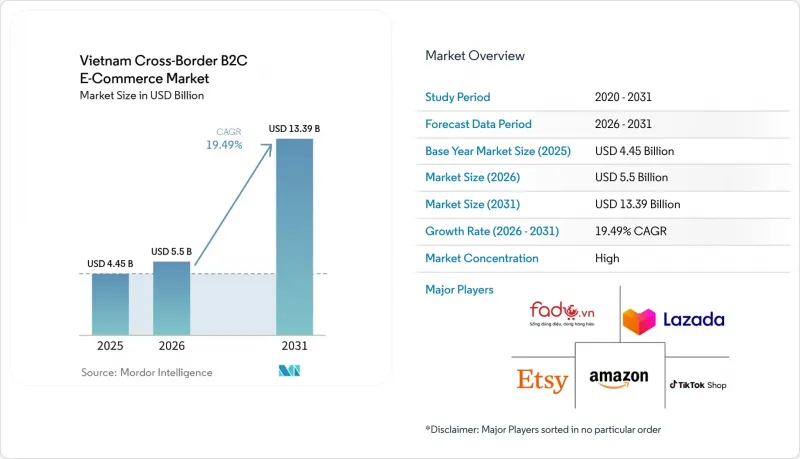
The Vietnam cross-border B2C e-commerce market is still small relative to the country's total import and export turnover of USD 930 billion in 2025, indicating that digital trade remains underpenetrated within Vietnam's broader trade base. This report is Segmented by Product Category (Fashion, Footwear, and Apparel, Health and Beauty; Home and Office, Hobbies and Toys, Electronics, and More), by Sales Channel (Online Marketplaces, Direct-To-Consumer, and Social Commerce), by Delivery Speed (Express, and Standard), and by Country and Flow Direction (Outbound, Inbound). The Market Forecasts are Provided in Terms of Value (USD).
Vietnam Cross-Border B2C E-Commerce Market Trends and Insights
Marketplace-Led Shopper Acquisition and Social Commerce Scale
The Vietnam cross-border B2C e-commerce market is being shaped by the way shoppers now discover products inside content feeds rather than through direct search. TikTok Shop's revenue in Vietnam grew 93% in 2025, and its platform share rose from 26.90% to 39.60%, which showed how quickly social discovery moved into actual purchase behavior. In Q1 2026, the 4 largest platforms generated VND 148.60 trillion (USD 5.70 billion), up 46.60% year on year, confirming that platform traffic was still translating into strong transaction growth. Fashion alone generated VND 23.40 trillion (USD 0.90 billion) on TikTok Shop in Q1 2025, which underlined how visual categories benefit from short-video and live-selling formats. The same concentration that helps the Vietnam cross-border B2C e-commerce market scale also leaves sellers more exposed to fee changes, ranking changes, and platform rules, as Shopee and TikTok Shop together accounted for 97% of platform GMV in 2025.
Smartphone-First Checkout and Wallet Adoption
Vietnam's mobile-first consumer base continues to lower payment friction for cross-border shopping. The country had 127 million mobile connections in early 2025, exceeding the population, because dual-SIM use remained common and helped keep digital access widespread. QR code payments rose 61.63% in volume and 150.67% in value in the first 9 months of 2025, which showed that digital checkout behavior had become far more normal across user groups. The Mobile Money pilot also expanded into rural and remote areas, and by 2025, 10.89 million accounts were active, with 70% of them outside urban centers. The Vietnam cross-border B2C e-commerce market benefits directly from this shift because smartphone penetration reached 84%, 4G coverage extended to 99.80% of communes, and more sellers were required to adopt digital invoicing and formal payment tools from June 2025 onward.
Low-Value Import VAT and Tax-Compliance Burden
The tax treatment of small imported parcels changed materially in 2025, removing one of the long-standing cost advantages of inbound cross-border trade. Decision No. 01/2025/QD-TTg ended the VAT exemption for low-value imported goods sent by express delivery from February 18, 2025, which increased the landed cost of many small orders. The same year also brought tighter invoicing and withholding obligations, so the Vietnam cross-border B2C e-commerce market now carries a heavier compliance load for smaller merchants using thin-margin parcel models. Vietnam Customs reported that the policy shift generated more than VND 1 trillion (USD 40 million) in additional tax revenue by mid-September 2025, confirming that the fiscal effect was meaningful and that part of the burden had shifted onto sellers and end prices. For high-frequency, low-ticket imports, this raises the risk that compliance costs grow faster than transaction value.
Other drivers and restraints analyzed in the detailed report include:
- Export-Push Policies and Trade Agreements
- Rising Demand for Foreign Beauty, Fashion, and Electronics
- Counterfeit Risk and Reverse-Logistics Friction
For complete list of drivers and restraints, kindly check the Table Of Contents.
Segment Analysis
Fashion, footwear, and apparel accounted for 26.47% of the Vietnam cross-border B2C e-commerce market share in 2025, keeping the category in the lead, as Vietnam already has a strong garment base and platforms can merchandise fashion efficiently through image-led and video-led formats. The category also benefits from cross-border models, which allow consumers to access international labels without relying on traditional retail distribution. VCCI and Access Partnership indicated that cross-border fashion exports from Vietnam are projected to grow 26% annually through 2029, which is far faster than legacy export channels and supports a larger direct-to-consumer route for sellers. Home and office, hobbies and toys, and automotive parts continue to serve narrower but steady use cases, including furniture exports, imported branded collectibles, and vehicle accessories that are not easily available in local retail.
Health and beauty/personal care is the fastest-growing product segment, with the Vietnam cross-border B2C e-commerce market size for this segment projected to grow at a 20.72% CAGR through 2031. The segment draws strength from 2 directions at once: imported Korean and Japanese skincare on the inbound side, and rising export potential for Vietnamese wellness and herbal products on the outbound side. Cosmetics revenue rose in 2025, which supports the case that beauty is moving from a niche import play into a broader recurring purchase category across platforms. The Vietnam cross-border B2C e-commerce industry also sees increasing compliance differentiation in health supplements, cosmetics, and electronics, because documented and brand-verified sellers are better placed to absorb product checks and consumer protection rules under the new law.
Online marketplaces accounted for 72.64% of the Vietnam cross-border B2C e-commerce market size in 2025, supported by buyer trust in escrow tools, platform-led logistics, and the concentration of transaction volume around Shopee and TikTok Shop. The 4 largest platforms posted VND 148.60 trillion (USD 5.70 billion) in sales in Q1 2026, up 46.60% from a year earlier, which showed that infrastructure scale is still rising faster than the consumer base alone would suggest. That same scale also creates system-wide dependence, because platform decisions on commissions, visibility rules, and seller onboarding can shift the economics of a large share of the market almost immediately. The May 2026 scrutiny of Shopee's fee approach reinforced that this concentration is now important enough to attract public-interest attention, even if the marketplace model remains dominant.
Social commerce is the fastest-growing channel and is forecast to expand at a 24.91% CAGR through 2031 as video, live selling, and chat-based conversion continue to pull discovery and purchase into the same session. TikTok Shop's fast rise is the clearest proof of this model, but Shopee's investment in Shopee Video also shows that incumbent platforms are adapting rather than yielding the space. Direct-to-consumer webstores still hold the smallest share, yet they are gaining more relevance among exporters in furniture, fashion, and artisan goods where storytelling and brand identity matter more than pure price comparison. Amazon's 2026 rollout of AI-based tools for market research, demand analysis, and product development in Vietnam supports that move by helping sellers build more independent demand-generation capabilities. The Vietnam cross-border B2C e-commerce industry may therefore remain marketplace-led, but channel mix is likely to become more balanced as social conversion deepens and stronger exporters invest in owned storefronts.
Complete Report Scope:
- By Product Category
- Fashion, Footwear and Apparel
- Health and Beauty / Personal Care
- Home and Office
- Hobbies and Toys
- Consumer Electronics and Appliances
- Automotive Parts
- Rest of the Product Categories
- By Sales Channel
- Online Marketplaces
- Direct-to-Consumer (Webstores)
- Social Commerce (Live, Chat)
- By Delivery Speed
- Express
- Standard
- By Country and Flow Direction
- Outbound (Exports)
- United States
- China
- Japan
- South Korea
- Germany
- Australia
- United Kingdom
- Netherlands
- Thailand
- Singapore
- Rest of the Countries
- Inbound (Imports)
- China
- South Korea
- Japan
- United States
- Thailand
- Indonesia
- Hong Kong
- Singapore
- India
- Australia
- Rest of the Countries
- Outbound (Exports)
List of Companies Covered in this Report:
- Shopee
- Lazada
- TikTok Shop Vietnam
- SHEIN
- Amazon, Inc.
- Taobao Global
- Tiki
- eBay, Inc.
- JD Worldwide
- Alibaba Group (Including AliExpress)
- DHgate
- Sendo
- Ubuy Vietnam
- Fado.vn
- Etsy
- iHerb
- Rakuten Global Market
- Qoo10
- YesStyle
- PDD Holdings (Including Temu)
- Coupang Global
Additional Benefits:
- The market estimate (ME) sheet in Excel format
- 3 months of analyst support
TABLE OF CONTENTS
1 Introduction
- 1.1 Study Assumptions and Market Definition
- 1.2 Scope of the Study
2 Research Methodology
3 Executive Summary
4 Market Landscape
- 4.1 Market Overview and Role of Cross-border B2C E-commerce in E-commerce Market
- 4.2 Trends in E-Commerce Industry
- 4.3 Consumer Behavior Analysis
- 4.4 Regulatory Framework
- 4.5 Value Chain and Distribution Channel Analysis
- 4.6 Market Drivers
- 4.6.1 Marketplace-Led Shopper Acquisition and Social Commerce Scale
- 4.6.2 Smartphone-First Checkout and Wallet Adoption
- 4.6.3 Export-Push Policies and Trade Agreements
- 4.6.4 Rising Demand for Foreign Beauty, Fashion, and Electronics
- 4.6.5 Customs-Platform-Logistics Data Linkage
- 4.6.6 Seller Formalization Improves Cross-Border Readiness
- 4.7 Market Restraints
- 4.7.1 Low-Value Import VAT and Tax-Compliance Burden
- 4.7.2 Counterfeit Risk and Reverse-Logistics Friction
- 4.7.3 Data Localization and Real-ID Verification Overhead
- 4.7.4 Platform Fee Inflation and Algorithm Dependence
- 4.8 Technology Innovations Outlook
- 4.9 Porter's Five Forces Analysis
- 4.9.1 Threat of New Entrants
- 4.9.2 Bargaining Power of Suppliers
- 4.9.3 Bargaining Power of Buyers
- 4.9.4 Threat of Substitutes
- 4.9.5 Rivalry Among Competitors
- 4.10 Evolution of Cross-border B2C E-commerce Requirements
- 4.11 Impact of Geo-Political Events on Supply Chain Shifts
5 Market Size and Growth Forecasts (Value and Volume, 2020-2031)
- 5.1 By Product Category
- 5.1.1 Fashion, Footwear and Apparel
- 5.1.2 Health and Beauty / Personal Care
- 5.1.3 Home and Office
- 5.1.4 Hobbies and Toys
- 5.1.5 Consumer Electronics and Appliances
- 5.1.6 Automotive Parts
- 5.1.7 Rest of the Product Categories
- 5.2 By Sales Channel
- 5.2.1 Online Marketplaces
- 5.2.2 Direct-to-Consumer (Webstores)
- 5.2.3 Social Commerce (Live, Chat)
- 5.3 By Delivery Speed
- 5.3.1 Express
- 5.3.2 Standard
- 5.4 By Country and Flow Direction
- 5.4.1 Outbound (Exports)
- 5.4.1.1 United States
- 5.4.1.2 China
- 5.4.1.3 Japan
- 5.4.1.4 South Korea
- 5.4.1.5 Germany
- 5.4.1.6 Australia
- 5.4.1.7 United Kingdom
- 5.4.1.8 Netherlands
- 5.4.1.9 Thailand
- 5.4.1.10 Singapore
- 5.4.1.11 Rest of the Countries
- 5.4.2 Inbound (Imports)
- 5.4.2.1 China
- 5.4.2.2 South Korea
- 5.4.2.3 Japan
- 5.4.2.4 United States
- 5.4.2.5 Thailand
- 5.4.2.6 Indonesia
- 5.4.2.7 Hong Kong
- 5.4.2.8 Singapore
- 5.4.2.9 India
- 5.4.2.10 Australia
- 5.4.2.11 Rest of the Countries
- 5.4.1 Outbound (Exports)
6 Competitive Landscape
- 6.1 Market Concentration
- 6.2 Key Strategic Moves
- 6.3 Market Share Analysis
- 6.4 Company Profiles (Includes Global Level Overview, Market Level Overview, Core Segments, Financials as Available, Strategic Information, Market Rank/Share for Key Companies, Products and Services, and Recent Developments)
- 6.4.1 Shopee
- 6.4.2 Lazada
- 6.4.3 TikTok Shop Vietnam
- 6.4.4 SHEIN
- 6.4.5 Amazon, Inc.
- 6.4.6 Taobao Global
- 6.4.7 Tiki
- 6.4.8 eBay, Inc.
- 6.4.9 JD Worldwide
- 6.4.10 Alibaba Group (Including AliExpress)
- 6.4.11 DHgate
- 6.4.12 Sendo
- 6.4.13 Ubuy Vietnam
- 6.4.14 Fado.vn
- 6.4.15 Etsy
- 6.4.16 iHerb
- 6.4.17 Rakuten Global Market
- 6.4.18 Qoo10
- 6.4.19 YesStyle
- 6.4.20 PDD Holdings (Including Temu)
- 6.4.21 Coupang Global
7 Market Opportunities and Future Outlook
- 7.1 White-space and Unmet-Need Assessment

