PUBLISHER: Mordor Intelligence | PRODUCT CODE: 2072920

PUBLISHER: Mordor Intelligence | PRODUCT CODE: 2072920
China-to-Europe Cross-Border B2C E-commerce - Market Share Analysis, Industry Trends & Statistics, Growth Forecasts (2026 - 2031)
According to Mordor Intelligence, the china-to-Europe cross-border B2C e-commerce market size is projected to be USD 150.20 billion in 2025, USD 167.43 billion in 2026, and USD 280.54 billion by 2031, growing at a CAGR of 10.87% from 2026 to 2031.
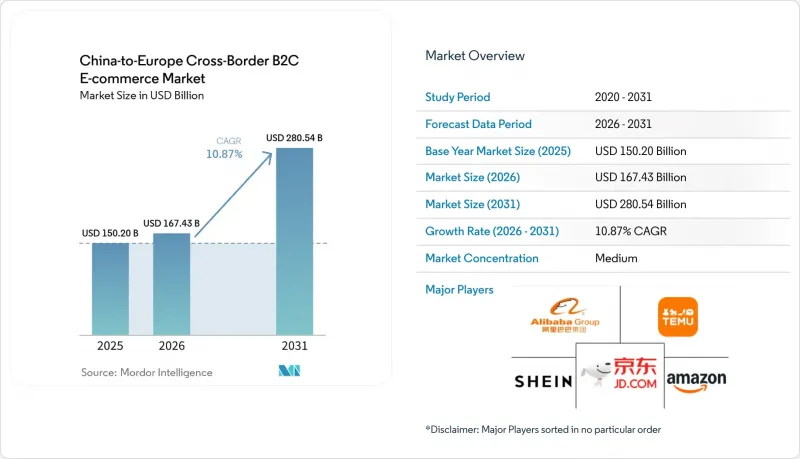
This report is Segmented by Product Category (Consumer Electronics, Apparel and Footwear, Outdoors and Sports, and More), by Sales Channel (Online Marketplaces, Direct-To-Consumer, and Social Commerce), by Delivery Speed (Express and Standard), and by Country (Western Europe, Eastern Europe, and Northern Europe). The Market Forecasts are Provided in Terms of Value (USD).
China-to-Europe Cross-Border B2C E-commerce Market Trends and Insights
Ultra-Value Pricing and Endless Assortment
Price remains a primary draw for shoppers using Chinese platforms across Europe, and that continues to support the China-to-Europe cross-border B2C e-commerce market. The advantage comes from a supply base that can launch large SKU ranges quickly and at low unit cost. Apparel, accessories, home items, and small electronics fit this model well because they combine trend turnover with manageable shipping economics. The model is now under more pressure because the new EU parcel duty reduces the landed price edge on direct shipments. Even so, platforms that can hold inventory within Europe are better placed to maintain the value proposition while weaker sellers lose pricing flexibility.
Marketplace-Led Cross-Border Discovery
Online marketplaces remain the main discovery layer for cross-border shopping, which gives the China-to-Europe cross-border B2C e-commerce market a broad traffic base. Consumers often enter through familiar platform search, recommendations, and promotion slots rather than through independent brand sites. This structure benefits platforms that can combine catalog depth with localized service rules, payments, and returns. It also means branded Chinese sellers can scale faster because marketplaces reduce the cost of finding new customers in each country. The model is likely to stay important even as direct-to-consumer and social channels grow, because marketplaces still aggregate trust, visibility, and repeat demand at a larger scale.
EU Duty-Free Threshold Removal and Parcel Fees
The removal of the EUR 150 (USD 163) customs duty exemption for small parcels is the most direct near-term headwind for the China-to-Europe cross-border B2C e-commerce market. The EU Council approved a flat EUR 3 (USD 3.3) per-item charge for parcels valued at EUR 150 or less (USD 163), effective from July 1, 2026. This directly weakens the economics of low-ticket direct shipping from China into Europe. It also pushes sellers toward consolidation of their assortments because multi-item orders can incur greater duty exposure. The policy favors operators that have already moved toward European warehousing and will be hardest on smaller merchants that still depend on individual parcel flows.
Other drivers and restraints analyzed in the detailed report include:
- EU-Local Warehousing and Faster Delivery
- Faster Growth in Eastern Europe and Nordics
- DSA, GPSR, and VAT Compliance Pressure
For complete list of drivers and restraints, kindly check the Table Of Contents.
Segment Analysis
Apparel and footwear accounted for 40.31% of the China-to-Europe cross-border B2C e-commerce market in 2025 and is also the fastest-growing product segment, with a 13.94% CAGR through 2031. That combination is unusual because the largest segment is also the one expanding the quickest. The category aligns well with cross-border economics because products are light, margins can absorb promotional pricing, and trend cycles are short. It also aligns with the strengths of Chinese manufacturing, where fast design turnover and a broad assortment support repeat purchase behavior.
The segment is benefiting further from the move toward European warehousing because faster regional fulfillment reduces fit-related friction and makes returns more manageable. This is especially important for fashion orders, where size variation and multi-item baskets are common. The broader China-to-Europe cross-border B2C e-commerce industry also offers apparel sellers a path to premiumization once customer acquisition is established, rather than forcing them to compete solely on entry price.
Complete Report Scope:
- By Product Category
- Consumer Electronics
- Apparel and Footwear
- Furniture, Home Decor, and Household Products
- Outdoors and Sports
- Other Product Categories
- By Sales Channel
- Online Marketplaces
- Direct-to-Consumer (Webstores)
- Social Commerce (Live, Chat)
- By Delivery Speed
- Express
- Standard
- By Destination Country
- Western Europe
- Germany
- France
- UK
- BENELUX
- Spain
- Italy
- Rest of Western Europe
- Eastern Europe
- Poland
- Czech Republic
- Hungary
- Romania
- Rest of Eastern Europe
- Northern Europe (Nordics and Baltic Countries)
- Western Europe
List of Companies Covered in this Report:
- Alibaba Group
- Temu (PDD Holdings Inc.)
- SHEIN
- Amazon
- JD.com
- TikTok Shop
- DHgate
- eBay
- LightInTheBox
- Banggood
- Pinduoduo
- Tmall Global
- Taobao Global
- Joybuy
- Cider
- Zaful
- Romwe
- Tomtop
- DX.com
- Allegro
- Kaufland Global Marketplace
Additional Benefits:
- The market estimate (ME) sheet in Excel format
- 3 months of analyst support
TABLE OF CONTENTS
1 Introduction
- 1.1 Study Assumptions and Market Definition
- 1.2 Scope of the Study
2 Research Methodology
3 Executive Summary
4 Market Landscape
- 4.1 Market Overview & Role of Cross-border B2C E-commerce in E-commerce Market
- 4.2 Trends in E-Commerce Industry
- 4.3 Consumer Behavior Analysis
- 4.4 Regulatory Framework
- 4.5 Value Chain and Distribution Channel Analysis
- 4.6 Market Drivers
- 4.6.1 Ultra-Value Pricing and Endless Assortment
- 4.6.2 Marketplace-Led Cross-Border Discovery
- 4.6.3 EU-Local Warehousing and Faster Delivery
- 4.6.4 Faster Growth in Eastern Europe and Nordics
- 4.6.5 AI-Shopping Rewards Delivery-Data Transparency
- 4.6.6 Returns-Fee Normalization Supports Cross-Border Conversion
- 4.7 Market Restraints
- 4.7.1 EU Duty-Free Threshold Removal and Parcel Fees
- 4.7.2 DSA, GPSR and VAT Compliance Pressure
- 4.7.3 PPWR and EPR Packaging Redesign Burden
- 4.7.4 Local Creator-Commerce Execution Costs
- 4.8 Technology Innovations Outlook
- 4.9 Porter's Five Forces
- 4.9.1 Threat of New Entrants
- 4.9.2 Bargaining Power of Suppliers
- 4.9.3 Bargaining Power of Buyers
- 4.9.4 Threat of Substitutes
- 4.9.5 Rivalry Among Competitors
- 4.10 Evolution of Cross-border B2C E-commerce Requirements
- 4.11 Impact of Geo-Political Events on Supply Chain Shifts
5 Market Size and Growth Forecasts (Value)
- 5.1 By Product Category
- 5.1.1 Consumer Electronics
- 5.1.2 Apparel and Footwear
- 5.1.3 Furniture, Home Decor, and Household Products
- 5.1.4 Outdoors and Sports
- 5.1.5 Other Product Categories
- 5.2 By Sales Channel
- 5.2.1 Online Marketplaces
- 5.2.2 Direct-to-Consumer (Webstores)
- 5.2.3 Social Commerce (Live, Chat)
- 5.3 By Delivery Speed
- 5.3.1 Express
- 5.3.2 Standard
- 5.4 By Destination Country
- 5.4.1 Western Europe
- 5.4.1.1 Germany
- 5.4.1.2 France
- 5.4.1.3 UK
- 5.4.1.4 BENELUX
- 5.4.1.5 Spain
- 5.4.1.6 Italy
- 5.4.1.7 Rest of Western Europe
- 5.4.2 Eastern Europe
- 5.4.2.1 Poland
- 5.4.2.2 Czech Republic
- 5.4.2.3 Hungary
- 5.4.2.4 Romania
- 5.4.2.5 Rest of Eastern Europe
- 5.4.3 Northern Europe (Nordics and Baltic Countries)
- 5.4.1 Western Europe
6 Competitive Landscape
- 6.1 Market Concentration
- 6.2 Key Strategic Moves
- 6.3 Market Share Analysis
- 6.4 Company Profiles (includes Global level Overview, Market level overview, Core Segments, Financials as available, Strategic Information, Market Rank/Share for key companies, Products & Services, and Recent Developments)
- 6.4.1 Alibaba Group
- 6.4.2 Temu (PDD Holdings Inc.)
- 6.4.3 SHEIN
- 6.4.4 Amazon
- 6.4.5 JD.com
- 6.4.6 TikTok Shop
- 6.4.7 DHgate
- 6.4.8 eBay
- 6.4.9 LightInTheBox
- 6.4.10 Banggood
- 6.4.11 Pinduoduo
- 6.4.12 Tmall Global
- 6.4.13 Taobao Global
- 6.4.14 Joybuy
- 6.4.15 Cider
- 6.4.16 Zaful
- 6.4.17 Romwe
- 6.4.18 Tomtop
- 6.4.19 DX.com
- 6.4.20 Allegro
- 6.4.21 Kaufland Global Marketplace
7 Market Opportunities and Future Outlook
- 7.1 White-space and Unmet-Need Assessment

