
PUBLISHER: Mordor Intelligence | PRODUCT CODE: 2072904

PUBLISHER: Mordor Intelligence | PRODUCT CODE: 2072904
Vacuum Blood Collection Tubes - Market Share Analysis, Industry Trends & Statistics, Growth Forecasts (2026 - 2031)
According to Mordor Intelligence, the vacuum blood collection tubes market size was valued at USD 1.48 billion in 2025 and is estimated to grow from USD 1.59 billion in 2026 to reach USD 2.26 billion by 2031, at a CAGR of 7.25% during the forecast period (2026-2031).
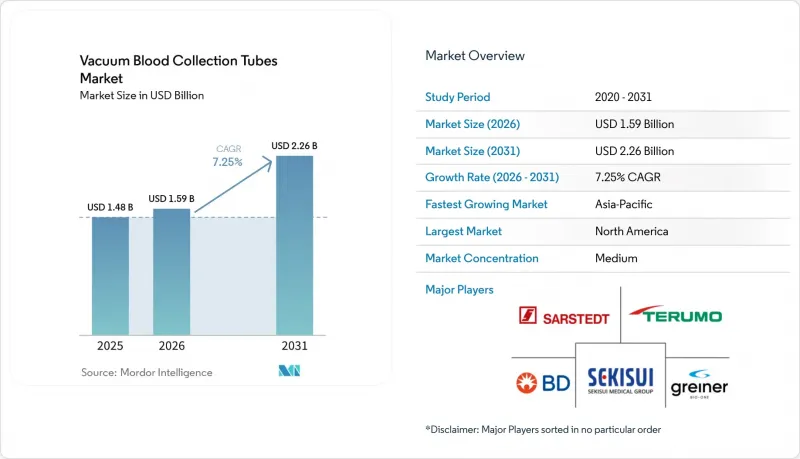
This report is Segmented by Product Type (Serum Separating, Plasma Separation, EDTA, Rapid Serum, Coagulation, Others), Material (Plastic, Glass), Application (Serology, Blood Routine, Coagulation, Genetics, Blood Sugar, Others), End User (Hospitals, Pathology Labs, Blood Banks, POC/Home-Care, Others), and Geography (North America, Europe, Asia-Pacific, and More). Forecasts in Value (USD).
Global Vacuum Blood Collection Tubes Market Trends and Insights
Rising Chronic Disease Monitoring Volumes
Chronic non-communicable diseases remain the main engine of recurring demand in the vacuum blood collection tubes market. The World Health Organization stated in its 2025 monitor that noncommunicable diseases account for over 74% of all global deaths. Diabetes screening and follow-up are especially important because 589 million adults were living with diabetes in 2024, and 43% of people with diabetes remained undiagnosed. These testing patterns create repeat use across HbA1c, lipid, and complete blood count panels and keep demand steady even when provider budgets are under pressure. This demand base supports faster growth in blood sugar assay use across the vacuum blood collection tubes market.
Expansion Of High-Throughput Diagnostic Testing
High-throughput laboratories are reshaping product requirements in the vacuum blood collection tubes market. Centralized labs need precise fill volumes, consistent dimensions, and labels that work inside automated tracks. A 2025 analysis in Clinical Chemistry and Laboratory Medicine identified total lab automation and process consolidation as core drivers of workflow standardization in reference laboratories. That shift favors tubes that reduce manual intervention and support reliable analyzer loading. Plasma separation tubes are benefiting most because faster chemistry workflows often prefer plasma formats that shorten turnaround times.
Single-Use Plastic Waste And Disposal Burden
Single-use plastic waste is becoming a tighter constraint on the vacuum blood collection tubes market. Germany's DIN Institute launched a 2025 committee focused on lifecycle assessment for medical devices and pharmaceutical products, which shows sustainability criteria are moving closer to procurement practice in Europe. Buyers are paying closer attention to packaging, recyclability, and disposal obligations for high-volume consumables. That pressure raises compliance work on materials, labeling, and end-of-life communication. The effect is strongest for PET and PP tube lines because routine collection depends on these formats.
Other drivers and restraints analyzed in the detailed report include:
- Safety-Engineered Closed Collection Protocols
- Decentralized And At-Home Sample Collection
- Skilled Phlebotomist Shortages And Pre-Analytical Error Risk
For complete list of drivers and restraints, kindly check the Table Of Contents.
Segment Analysis
Serum separating tubes held 38.31% of vacuum blood collection tubes market share in 2025, and plasma separation tubes are projected to expand at 8.38% CAGR from 2026 to 2031. Serum separating tubes stay central to chemistry, immunology, and infectious disease testing because these panels move through high daily volumes in hospitals and pathology laboratories. Their gel barrier improves serum separation after centrifugation and reduces manual handling steps, which helps standardized laboratory throughput. Plasma separation tubes are gaining faster because automated chemistry workflows often prefer heparinized plasma when laboratories want shorter turnaround times.
EDTA tubes remain important across hematology and molecular workflows, including complete blood counts and PCR-based testing. Rapid serum tubes and coagulation tubes serve smaller but important use cases in emergency medicine and hemostasis monitoring. A February 2025 study in Scientific Reports found that K2EDTA tubes performed well for automated cell-free DNA extraction when samples were processed fresh, while specialized preservative tubes performed better when processing was delayed. That difference supports steady demand for both routine and specialized formats as the vacuum blood collection tubes market expands into oncology-adjacent workflows.
Plastic tubes held 55.24% of the material segment in 2025, while glass tubes are forecast to grow at 8.52% CAGR from 2026 to 2031. Plastic remains the main choice in the vacuum blood collection tubes market because PET and PP tubes reduce breakage risk and fit automated transport and decapping systems. Those benefits matter most in hospitals and large laboratories that process high specimen counts every day. Glass is growing faster in selected workflows where inertness and low contamination matter more than handling convenience.
Toxicology, trace element analysis, and some cytogenetic procedures still favor glass because polymer interaction or trace contamination can affect result quality. That keeps glass relevant even as plastic dominates routine testing volumes. Material selection also shapes margin stability because petroleum-derived polymers and rubber additives expose suppliers to input cost swings and procurement pressure. Producers with stronger sourcing discipline are better placed to protect continuity when the vacuum blood collection tubes market faces raw material volatility.
Complete Report Scope:
- By Product Type
- Serum Separating Tubes
- Plasma Separation Tubes
- EDTA Tubes
- Rapid Serum Tubes
- Coagulation Tubes
- Other Product Types
- By Material
- Plastic Tubes
- Glass Tubes
- By Application
- Serology and Immunology
- Blood Routine Examination
- Coagulation Tests
- Genetic Studies
- Blood Sugar Assay
- Other Applications
- By End User
- Hospitals and Clinics
- Pathology Laboratories
- Blood Banks
- Point-of-Care and Home-Care Settings
- Other End Users
- By Geography
- North America
- United States
- Canada
- Mexico
- Europe
- Germany
- United Kingdom
- France
- Italy
- Spain
- Rest of Europe
- Asia-Pacific
- China
- Japan
- India
- Australia
- South Korea
- Rest of Asia-Pacific
- Middle East and Africa
- GCC
- South Africa
- Rest of Middle East and Africa
- South America
- Brazil
- Argentina
- Rest of South America
- North America
Geography Analysis
North America held 36.22% of vacuum blood collection tubes market share in 2025, and Asia-Pacific is forecast to expand at 8.65% CAGR from 2026 to 2031. North America stayed ahead because it has the largest installed base of automated clinical laboratories and high per-capita testing volumes. Consolidation across hospital systems and reference laboratories is concentrating specimen flow into fewer large hubs, which supports demand for standardized and automation-compatible tubes. The United States remains the main regional demand center, while Canada and Mexico add stable volumes through public and private diagnostic networks. This makes North America the key market for suppliers that compete on documentation, quality consistency, and approved procurement status.
Asia-Pacific is growing faster because India, Southeast Asia, China, Japan, and South Korea are expanding testing access, private laboratory chains, and hospital infrastructure. The region is also adding new demand from populations that previously had limited access to formal diagnostic monitoring, especially in chronic disease care. Europe remains technically sophisticated and highly regulated, which favors established suppliers with deep documentation and quality systems. Germany's DIN Institute launched a 2025 committee on lifecycle assessment for medical devices and pharmaceutical products, which signals that sustainability criteria are becoming more relevant in procurement discussions.
South America and the Middle East and Africa remain smaller in absolute value, but they are becoming more structured through laboratory accreditation, health screening programs, and hospital capacity additions. Brazil leads South America by diagnostic volume, and South Africa continues to act as a distribution gateway for Sub-Saharan Africa. Price sensitivity stays high across these regions, which gives Chinese and Indian suppliers an opening in standard tube categories even as global incumbents retain an edge in premium and regulated channels. Regional demand therefore splits between mature markets that reward compliance depth and emerging markets that respond more quickly to price and local distribution reach.
- AdvaCare
- Beckton Dickinson
- Cardinal Health
- CML Biotech Pvt. Ltd.
- F.L. Medical S.r.l.
- Gong Dong Medical Technology Co., Ltd.
- Greiner Bio One International
- Hindustan Syringes and Medical Devices Ltd
- Improve Medical Instruments Co., Ltd.
- MB Plastic Industries
- Narang Medical
- Nipro
- QIAGEN
- Q-Sera Pty Ltd
- Sarstedt AG and Co. KG
- Sekisui Medical Co., Ltd.
- Streck, Inc.
- Tasso Inc.
- Terumo
Additional Benefits:
- The market estimate (ME) sheet in Excel format
- 3 months of analyst support
TABLE OF CONTENTS
1 Introduction
- 1.1 Study Assumptions & Market Definition
- 1.2 Scope of the Study
2 Research Methodology
3 Executive Summary
4 Market Landscape
- 4.1 Market Overview
- 4.2 Market Drivers
- 4.2.1 Rising Chronic Disease Monitoring Volumes
- 4.2.2 Expansion of High-Throughput Diagnostic Testing
- 4.2.3 Safety-Engineered Closed Collection Protocols
- 4.2.4 Decentralized and At-Home Sample Collection
- 4.2.5 Liquid Biopsy and Precision Medicine Sample Stability Needs
- 4.2.6 Reusable Workflow Data Traceability Requirements in Labs
- 4.3 Market Restraints
- 4.3.1 Single-Use Plastic Waste and Disposal Burden
- 4.3.2 Skilled Phlebotomist Shortages and Pre-Analytical Error Risk
- 4.3.3 Raw Material Volatility for Polymer, Rubber, and Additives
- 4.3.4 Tube Overdraw and Iatrogenic Blood Loss Concerns
- 4.4 Supply-Chain Analysis
- 4.5 Regulatory Landscape
- 4.6 Technological Outlook
- 4.7 Porter's Five Forces Analysis
- 4.7.1 Threat of New Entrants
- 4.7.2 Bargaining Power of Suppliers
- 4.7.3 Bargaining Power of Buyers
- 4.7.4 Threat of Substitutes
- 4.7.5 Competitive Rivalry
5 Market Size & Growth Forecasts (Value, USD)
- 5.1 By Product Type
- 5.1.1 Serum Separating Tubes
- 5.1.2 Plasma Separation Tubes
- 5.1.3 EDTA Tubes
- 5.1.4 Rapid Serum Tubes
- 5.1.5 Coagulation Tubes
- 5.1.6 Other Product Types
- 5.2 By Material
- 5.2.1 Plastic Tubes
- 5.2.2 Glass Tubes
- 5.3 By Application
- 5.3.1 Serology and Immunology
- 5.3.2 Blood Routine Examination
- 5.3.3 Coagulation Tests
- 5.3.4 Genetic Studies
- 5.3.5 Blood Sugar Assay
- 5.3.6 Other Applications
- 5.4 By End User
- 5.4.1 Hospitals and Clinics
- 5.4.2 Pathology Laboratories
- 5.4.3 Blood Banks
- 5.4.4 Point-of-Care and Home-Care Settings
- 5.4.5 Other End Users
- 5.5 By Geography
- 5.5.1 North America
- 5.5.1.1 United States
- 5.5.1.2 Canada
- 5.5.1.3 Mexico
- 5.5.2 Europe
- 5.5.2.1 Germany
- 5.5.2.2 United Kingdom
- 5.5.2.3 France
- 5.5.2.4 Italy
- 5.5.2.5 Spain
- 5.5.2.6 Rest of Europe
- 5.5.3 Asia-Pacific
- 5.5.3.1 China
- 5.5.3.2 Japan
- 5.5.3.3 India
- 5.5.3.4 Australia
- 5.5.3.5 South Korea
- 5.5.3.6 Rest of Asia-Pacific
- 5.5.4 Middle East and Africa
- 5.5.4.1 GCC
- 5.5.4.2 South Africa
- 5.5.4.3 Rest of Middle East and Africa
- 5.5.5 South America
- 5.5.5.1 Brazil
- 5.5.5.2 Argentina
- 5.5.5.3 Rest of South America
- 5.5.1 North America
6 Competitive Landscape
- 6.1 Market Concentration
- 6.2 Market Share Analysis
- 6.3 Company Profiles (includes Global Level Overview, Market Level Overview, Core Segments, Financials as available, Strategic Information, Market Rank/Share, Products and Services, Recent Developments)
- 6.3.1 AdvaCare Pharma
- 6.3.2 Becton, Dickinson and Company
- 6.3.3 Cardinal Health, Inc.
- 6.3.4 CML Biotech Pvt. Ltd.
- 6.3.5 F.L. Medical S.r.l.
- 6.3.6 Gong Dong Medical Technology Co., Ltd.
- 6.3.7 Greiner Bio-One International GmbH
- 6.3.8 Hindustan Syringes and Medical Devices Ltd
- 6.3.9 Improve Medical Instruments Co., Ltd.
- 6.3.10 MB Plastic Industries
- 6.3.11 Narang Medical Limited
- 6.3.12 Nipro Corporation
- 6.3.13 Qiagen N.V.
- 6.3.14 Q-Sera Pty Ltd
- 6.3.15 Sarstedt AG and Co. KG
- 6.3.16 Sekisui Medical Co., Ltd.
- 6.3.17 Streck, Inc.
- 6.3.18 Tasso Inc.
- 6.3.19 Terumo Corporation
7 Market Opportunities & Future Outlook
- 7.1 White-Space and Unmet-Need Assessment

