PUBLISHER: Mordor Intelligence | PRODUCT CODE: 2072937

PUBLISHER: Mordor Intelligence | PRODUCT CODE: 2072937
Amino Acid Assay Kit - Market Share Analysis, Industry Trends & Statistics, Growth Forecasts (2026 - 2031)
According to Mordor Intelligence, the amino acid assay kit market size is projected to be USD 1.41 billion in 2025, USD 1.52 billion in 2026, and reach USD 2.30 billion by 2031, growing at a CAGR of 8.5% from 2026 to 2031.
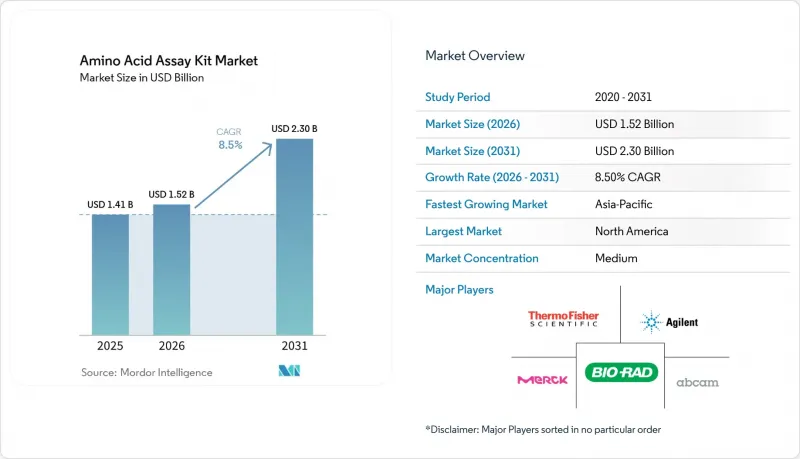
This report is Segmented by Kit Type (Colorimetric Assay Kits, Fluorometric Assay Kits, and More), Application (Protein Quantification, Amino Acid Profiling, and More), End User (Pharmaceuticals, Biotechnology, and More), and Geography (North America, Europe, Asia-Pacific, and More). The Market Forecasts are Provided in Terms of Value (USD).
Global Amino Acid Assay Kit Market Trends and Insights
Rising Need for Quantitative Amino Acid Research Across Life Sciences
Metabolomics has transitioned from an exploratory tool to a critical component in pharmaceutical research, translational medicine, and disease screening, driving the amino acid assay kit market toward routine applications. Validated amino acid panels are now integral to workflows requiring repeatable and scalable testing. A 2025 study demonstrated that plasma amino acid concentration signatures detected four major cancer types with 78% sensitivity and a 0% false positive rate, achieving an AUROC of 0.95 in a validation cohort of 97 samples. The study's elimination of common sample pre-treatment steps enhances the feasibility of amino acid testing in frontline screening, creating opportunities in oncology testing programs and emphasizing the need for clinical-grade consistency in research and diagnostics.
Expanding Proteomics and Biomarker Discovery Programmes
Proteomics programs are increasingly incorporating amino acid quantification into drug discovery workflows, boosting demand in the amino acid assay kit market. Thermo Fisher Scientific's acquisition of Olink in 2024 linked amino acid profiling to the UK Biobank Pharma Proteomics Project, which analyzes over 5,400 proteins from 600,000 samples for biomarker discovery. This expansion drives the need for calibration-grade quantification kits and supports growth in enzymatic and chromatographic formats, as consistent protein quantification remains essential before advanced analyses. The market benefits from both upstream standardization and downstream validation, supporting volume growth across workflows.
Instrument-Dependent Performance and Integration Challenges
Instrument compatibility remains a significant limitation in the amino acid assay kit market, as many kits are optimized for specific fluorometric readers, ion-exchange analyzers, or LC-MS configurations. Laboratories with diverse instrument fleets face challenges in validating new kits on existing hardware, delaying adoption despite strong technical performance. The process requires substantial time and resources for method transfer, documentation, and staff training. Mid-tier institutions, with limited resources, are particularly affected, often favoring familiar, validated kits over superior alternatives. Suppliers offering integrated workflows across instruments and reagents hold a competitive edge by reducing implementation uncertainties.
Other drivers and restraints analyzed in the detailed report include:
- Food Authentication and Protein Label Verification Requirements
- Higher Adoption of Multiplex and High-Throughput Screening Platforms
- Short Shelf Life and Cold-Chain Dependence
For complete list of drivers and restraints, kindly check the Table Of Contents.
Segment Analysis
In 2025, colorimetric assay kits accounted for 35.13% of the amino acid assay kit market, maintaining their leading position among kit types. Their popularity stems from compatibility with standard microplate readers, simple workflows, and ease of use in quality control labs across food, beverage, and pharmaceutical industries. These kits utilize enzyme-catalyzed oxidation methods, offering linear detection ranges from 3.3 µM to 500 µM for samples like serum, urine, and tissue homogenates. Enzymatic assay kits cater to substrate-specific selectivity needs, while chromatographic kits, though costlier, are gaining traction in regulated environments requiring robust analytical validation.
The market is increasingly segmented between routine volume formats and high-performance specialty formats. Fluorometric assay kits, projected to grow at a 10.25% CAGR through 2031, are the fastest-growing segment. Their superior detection limits, 10 to 25 times better than many colorimetric alternatives, make them ideal for low-abundance samples like dried blood spots and microbioreactor media. These kits also align well with multiplexing and automated workflows, strengthening their role in pharmaceutical automation cycles.
Complete Report Scope:
- By Assay Kit Type
- Colorimetric Assay Kits
- Fluorometric Assay Kits
- Chromatographic Assay Kits
- Enzymatic Assay Kits
- By Application
- Protein Quantification
- Amino Acid Profiling
- Nutritional Analysis
- Medical Diagnostics
- Research Purposes
- By End User
- Pharmaceuticals
- Biotechnology
- Food and Beverage
- Diagnostic Centers
- Others
- By Geography
- North America
- United States
- Canada
- Mexico
- Europe
- Germany
- United Kingdom
- France
- Italy
- Spain
- Rest of Europe
- Asia-Pacific
- China
- India
- Japan
- Australia
- South Korea
- Rest of Asia-Pacific
- Middle East and Africa
- GCC
- South Africa
- Rest of Middle East and Africa
- South America
- Brazil
- Argentina
- Rest of South America
- North America
Geography Analysis
In 2025, North America led the amino acid assay kit market with a 39.56% share, driven by strong pharmaceutical R&D, a large biopharmaceutical manufacturing base, and stringent protein labeling regulations in the U.S. The U.S. dominated regional demand, while Canada contributed through academic and government research, and Mexico gained prominence with near-shoring in pharmaceutical manufacturing. Europe ranked as the second-largest market, supported by Germany, France, and the U.K., where university-linked proteomics centers and established food safety testing systems sustained demand. Merck KGaA emphasized Europe's importance with its Irish expansion, including a EUR 150 million (USD 165 million) facility at Blarney Business Park and a EUR 440 million (USD 484 million) investment.
Asia-Pacific is projected to grow at a 10.12% CAGR through 2031, making it the fastest-growing region. Growth is driven by rising healthcare spending, expanding pharmaceutical manufacturing, and government-backed newborn screening initiatives. China plays a central role due to biotechnology policy support and cost-effective MS/MS-based newborn screening. Japan and South Korea, as advanced sub-markets, utilize established analyzers and automated systems, while India's contract research base and Australia's active university research network further boost demand.
MEA and South America are emerging markets for amino acid assay kits, progressing toward formal testing infrastructure. In MEA, Saudi Arabia and the UAE are investing in hospital-based newborn screening, while South Africa maintains demand through academic medical centers. In South America, Brazil and Argentina anchor demand, with Brazil's pharmaceutical and food testing sectors leading purchases. Price sensitivity and inconsistent cold-chain systems in these regions favor colorimetric and enzymatic kits, resulting in a distinct product mix compared to North America, Europe, and advanced parts of Asia-Pacific.
- Abcam
- Agilent Technologies
- BioAssay Systems
- Bio-Rad Laboratories
- Biovision
- Cell Biolabs
- Creative Enzymes
- CUSABIO Technology LLC
- Danaher
- Elabscience Biotechnology
- Roche
- Genscript
- Merck
- Promega
- Randox Laboratories
- RayBiotech, Inc.
- Revvity, Inc.
- Thermo Fisher Scientific
Additional Benefits:
- The market estimate (ME) sheet in Excel format
- 3 months of analyst support
TABLE OF CONTENTS
1 Introduction
- 1.1 Study Assumptions & Market Definition
- 1.2 Scope of the Study
2 Research Methodology
3 Executive Summary
4 Market Landscape
- 4.1 Market Overview
- 4.2 Market Drivers
- 4.2.1 Rising Need for Quantitative Amino Acid Readouts in Clinical Metabolic Workflows
- 4.2.2 Expanding Proteomics and Biomarker Discovery Pipelines in Biopharma
- 4.2.3 Food Authentication and Protein Label Verification Requirements
- 4.2.4 Point-of-Care And Low-Volume Workflow Preference for Rapid Colorimetric and Fluorometric Kits
- 4.2.5 Higher Adoption of Multiplex and High-Throughput Assays in Research Labs
- 4.2.6 Regulatory and Quality-Control Push for Standardized Amino Acid Quantification in Diagnostics and Nutrition
- 4.3 Market Restraints
- 4.3.1 Instrument-Dependent Performance and Interference Sensitivity Across Sample Matrices
- 4.3.2 Limited Differentiation in Commodity Assay Formats Pressuring Pricing
- 4.3.3 Fragmented Validation Standards Across End Uses Slowing Routine Clinical Uptake
- 4.3.4 Short Shelf Life and Cold-Chain Dependence for Certain Reagents and Enzymatic Kits
- 4.4 Supply/Value Chain Analysis
- 4.5 Regulatory Landscape
- 4.6 Technological Outlook
- 4.7 Porter's Five Forces Analysis
- 4.7.1 Threat of New Entrants
- 4.7.2 Bargaining Power of Buyers
- 4.7.3 Bargaining Power of Suppliers
- 4.7.4 Threat of Substitutes
- 4.7.5 Intensity of Competitive Rivalry
5 Market Size & Growth Forecasts (Value, USD)
- 5.1 By Assay Kit Type
- 5.1.1 Colorimetric Assay Kits
- 5.1.2 Fluorometric Assay Kits
- 5.1.3 Chromatographic Assay Kits
- 5.1.4 Enzymatic Assay Kits
- 5.2 By Application
- 5.2.1 Protein Quantification
- 5.2.2 Amino Acid Profiling
- 5.2.3 Nutritional Analysis
- 5.2.4 Medical Diagnostics
- 5.2.5 Research Purposes
- 5.3 By End User
- 5.3.1 Pharmaceuticals
- 5.3.2 Biotechnology
- 5.3.3 Food and Beverage
- 5.3.4 Diagnostic Centers
- 5.3.5 Others
- 5.4 By Geography
- 5.4.1 North America
- 5.4.1.1 United States
- 5.4.1.2 Canada
- 5.4.1.3 Mexico
- 5.4.2 Europe
- 5.4.2.1 Germany
- 5.4.2.2 United Kingdom
- 5.4.2.3 France
- 5.4.2.4 Italy
- 5.4.2.5 Spain
- 5.4.2.6 Rest of Europe
- 5.4.3 Asia-Pacific
- 5.4.3.1 China
- 5.4.3.2 India
- 5.4.3.3 Japan
- 5.4.3.4 Australia
- 5.4.3.5 South Korea
- 5.4.3.6 Rest of Asia-Pacific
- 5.4.4 Middle East and Africa
- 5.4.4.1 GCC
- 5.4.4.2 South Africa
- 5.4.4.3 Rest of Middle East and Africa
- 5.4.5 South America
- 5.4.5.1 Brazil
- 5.4.5.2 Argentina
- 5.4.5.3 Rest of South America
- 5.4.1 North America
6 Competitive Landscape
- 6.1 Market Concentration
- 6.2 Market Share Analysis
- 6.3 Company Profiles (includes Global level Overview, Market-level Overview, Core Segments, Financials, Strategic Information, Market Rank/Share, Products & Services, Recent Developments)
- 6.3.1 Abcam plc
- 6.3.2 Agilent Technologies, Inc.
- 6.3.3 BioAssay Systems
- 6.3.4 Bio-Rad Laboratories, Inc.
- 6.3.5 BioVision, Inc.
- 6.3.6 Cell Biolabs, Inc.
- 6.3.7 Creative Enzymes
- 6.3.8 CUSABIO Technology LLC
- 6.3.9 Danaher Corporation
- 6.3.10 Elabscience Biotechnology Inc.
- 6.3.11 F. Hoffmann-La Roche AG
- 6.3.12 GenScript Biotech Corporation
- 6.3.13 Merck KGaA
- 6.3.14 Promega Corporation
- 6.3.15 Randox Laboratories Ltd.
- 6.3.16 RayBiotech, Inc.
- 6.3.17 Revvity, Inc.
- 6.3.18 Thermo Fisher Scientific Inc.
7 Market Opportunities & Future Outlook
- 7.1 White-space & Unmet-Need Assessment

