PUBLISHER: Mordor Intelligence | PRODUCT CODE: 2072982

PUBLISHER: Mordor Intelligence | PRODUCT CODE: 2072982
United States Hot Sauce - Market Share Analysis, Industry Trends & Statistics, Growth Forecasts (2026 - 2031)
According to Mordor Intelligence, the united states hot sauce market size was valued at USD 1.25 billion in 2025 and is estimated to grow from USD 1.29 billion in 2026 to reach USD 1.57 billion by 2031, at a CAGR of 4.0% during the forecast period 2026-2031.
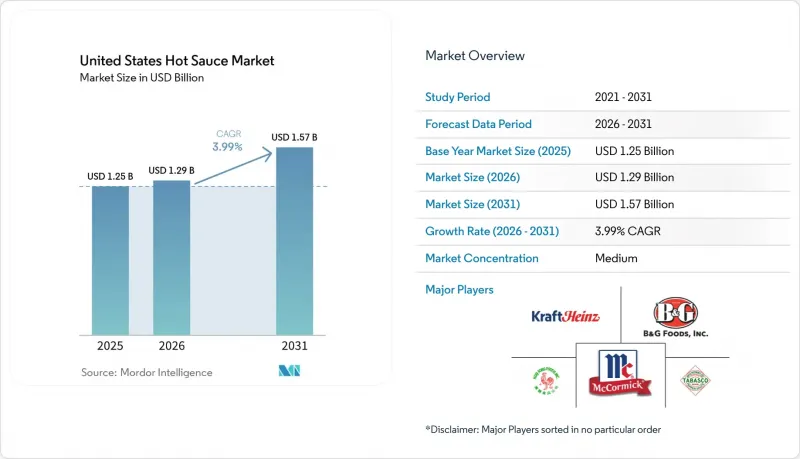
This report is Segmented by Product Type (Red Hot Sauce, Green Hot Sauce, Yellow Hot Sauce, Others), Flavor (Plain, Flavored), Packaging (Bottles, Sachets and Pouches, Others), Distribution Channel (HoReCa/Foodservice, Retail), and Geography (United States). The Market Forecasts are Provided in Terms of Value (USD), Based On Availability.
United States Hot Sauce Market Trends and Insights
Mainstream Adoption of Spicy Condiments in Everyday Meals
In the U.S., hot sauce is evolving from an occasional condiment to a staple in meals, both at home and when dining out. Early 2025 disclosures from McCormick revealed a significant shift: Gen Z and millennials are now spending more on hot sauce than ketchup, indicating a lasting change in preferences rather than a fleeting trend. Restaurants further bolster this shift; diners who sample branded sauces in quick-service and casual settings often seek them out in retail stores, showcasing the growing influence of foodservice on retail demand. McCormick highlighted that Frank's RedHot expanded its reach to over 6 million U.S. households in fiscal 2024, attributing the surge to partnerships with quick-service restaurants (QSRs) and heightened in-store visibility. These partnerships not only increased brand exposure but also encouraged trial among new consumers, converting them into repeat buyers. This underscores the trend of turning foodservice trials into consistent household demand in the U.S. hot sauce market, reflecting the category's growing integration into everyday consumption habits.
Premiumization Through Craft, Artisanal, and Small-Batch Formulations
As consumers in the U.S. increasingly scrutinize ingredient lists, pepper origins, and flavor complexity, the country's hot sauce market is witnessing a notable value uptick. Research from McIlhenny, highlighted in 2025, revealed that the Mexican-style hot sauce subcategory surged by 20% in the year ending June 2024. This trend underscores the notion that premium flavored variants are outpacing the broader hot sauce category. Instead of relying on mass advertising, this segment of the U.S. hot sauce market is being shaped by small-batch production, fermentation-driven profiles, and transparent ingredient labeling. TRUFF's leap to over 17,000 retail outlets underscores the potential of premium positioning, especially when bolstered by robust branding and widespread store access. The trend of premiumization is not only expanding price ranges within the U.S. hot sauce market but also providing established brands the opportunity to defend their market share through line extensions. Simultaneously, it paves the way for craft labels to cultivate loyalty via unique tastes and distinctive packaging.
Sodium, Sugar, and Capsaicin Health Concerns
Nutrition labeling and health concerns are increasingly scrutinizing the U.S. hot sauce market. On January 16, 2025, the FDA proposed a front-of-package rule that could label many standard hot sauces as high in sodium. A typical teaspoon serving of these sauces contains between 100 mg to 210 mg of sodium, surpassing the 140 mg limit set for low-sodium claims under federal guidelines. While this labeling won't necessarily dampen overall demand, it may steer choices for consumers vigilant about their sodium intake. This regulatory shift could also prompt manufacturers to innovate and develop healthier alternatives to retain market share. Mid-tier brands feel the brunt of this pressure. Reformulating for lower sodium often means sourcing pricier ingredients, which can also shorten shelf life. This scenario poses a margin challenge in the U.S. hot sauce market, particularly for brands unable to command a premium yet needing to cater to health-conscious consumers.
Other drivers and restraints analyzed in the detailed report include:
- QSR and Fast-Casual Menu Integration of Signature Hot Sauces
- E-Commerce and Direct-to-Consumer Expansion for Niche Brands
- Raw Material Volatility in Peppers, Vinegar, and Specialty Inputs
For complete list of drivers and restraints, kindly check the Table Of Contents.
Segment Analysis
In 2025, red hot sauce captured 58.2% of the U.S. hot sauce market, solidifying its status as the top choice. This dominance stems from its household familiarity, extensive retail presence, and deep-rooted brand loyalty. Major U.S. hot sauce brands lean on red sauce as their primary draw, given its versatility across daily meals, restaurant tables, and cooking scenarios, all with minimal consumer education. In August 2024, TABASCO expanded its reach by introducing Salsa Picante at Walmart and Amazon. This move transitions its legacy pepper brand into a thicker, Tex-Mex style, underscoring the industry's strategy: evolving familiar brands into adjacent formats to bolster the leading red segment rather than relying solely on the original.
Green hot sauce is set to be the fastest-growing segment in the U.S. hot sauce market, with a projected CAGR of 6.5% from 2026 to 2031. This surge is attributed to jalapeno- and serrano-based formulations, which offer a fresher, herb-forward heat. Such profiles resonate with premium retailers, chef-driven menus, and younger consumers seeking nuanced flavors. The U.S. hot sauce market is increasingly accommodating this segment, as green sauces complement avocado-centric meals, bowls, tacos, and other dishes where consumers desire brightness alongside heat. McIlhenny's January 2026 announcement, revealing a portfolio of over 20 core and extended SKUs, highlights how major manufacturers are diversifying to capture these swiftly rising subtypes, preempting smaller niche brands from seizing the opportunity.
In 2025, plain hot sauce commanded a dominant 69.2% share of the U.S. hot sauce market, outpacing all other flavor segments. This stronghold is no accident; plain red sauce has cemented its status as a pantry essential, seamlessly complementing a wide array of meals. Moreover, its prominence in U.S. dining is underscored by its frequent appearance in restaurants, where many dishes lean towards the classic vinegar-pepper taste, eschewing more complex flavor profiles. While this entrenched position underscores the sauce's habitual purchase, it also highlights a reliance on routine buying, contrasting with the novelty trends capturing attention in other segments.
From 2026 to 2031, flavored hot sauces are projected to outpace their peers, with a robust 6.0% CAGR, making them the fastest-growing segment in the U.S. market. This surge is largely attributed to hybrid flavors like mango habanero, garlic chipotle, and sweet-spicy blends, which are redefining hot sauce's role from mere heat to a versatile flavor enhancer. Notably, Kraft Heinz's 2025 Flavor Tour line and Frank's RedHot's quartet of new flavored sauces in January 2026 underscore the trend, highlighting major food corporations' pivot towards globally inspired and occasion-centric profiles. As a result, flavored hot sauces are not only claiming premium shelf space but also carving out new culinary uses, even if this expansion is partly at the expense of plain-sauce consumers trading up rather than increasing overall consumption.
Complete Report Scope:
- By Product Type
- Red Hot Sauce
- Green Hot Sauce
- Yellow Hot Sauce
- Others
- By Flavor
- Plain
- Flavored
- By Packaging
- Bottles
- Sachets and Pouches
- Others
- By Distribution Channel
- HoReCa/Foodservice
- Retail
- Supermarkets/Hypermarkets
- Convenience Stores/Grocery Stores
- Online Retail Stores
- Other Retail Stores
List of Companies Covered in this Report:
- McIlhenny Company
- McCormick and Company, Incorporated
- Huy Fong Foods, Inc.
- The Kraft Heinz Company
- B and G Foods, Inc.
- Baumer Foods, Inc.
- TW Garner Food Company
- Conagra Brands, Inc.
- Hormel Foods Corporation
- The Campbell's Company
- Kikkoman Sales USA, Inc.
- Unilever PLC
- PepsiCo, Inc.
- Grupo Herdez, S.A.B. de C.V.
- La Costeja, S.A. de C.V.
- Tapatio Hot Sauce, Inc.
- Marie Sharp's Fine Foods Ltd.
- Pepper Palace, Inc.
- Yellowbird Foods, LLC
- Torchbearer Sauces, LLC
- TRUFF
Additional Benefits:
- The market estimate (ME) sheet in Excel format
- 3 months of analyst support
TABLE OF CONTENTS
1 INTRODUCTION
- 1.1 Study Assumptions and Market Definition
- 1.2 Scope of the Study
2 RESEARCH METHODOLOGY
3 EXECUTIVE SUMMARY
4 MARKET LANDSCAPE
- 4.1 Market Overview
- 4.2 Market Drivers
- 4.2.1 Mainstream adoption of spicy condiments in everyday meals
- 4.2.2 Premiumization through craft, artisanal, and small-batch formulations
- 4.2.3 QSR and fast-casual menu integration of signature hot sauces
- 4.2.4 E-commerce and direct-to-consumer expansion for niche brands
- 4.2.5 Functional, clean-label, and low-calorie positioning
- 4.2.6 Social media, challenge culture, and influencer-led discovery
- 4.3 Market Restraints
- 4.3.1 Sodium, sugar, and capsaicin health concerns
- 4.3.2 Raw material volatility in peppers, vinegar, and specialty inputs
- 4.3.3 Shelf-space concentration and intensifying brand fragmentation
- 4.3.4 Food safety, labeling, and traceability compliance burden
- 4.4 Consumer Behavior Analysis
- 4.5 Regulatory Outlook
- 4.6 Technological Outlook
- 4.7 Porter's Five Forces Analysis
- 4.7.1 Threat of New Entrants
- 4.7.2 Bargaining Power of Buyers
- 4.7.3 Bargaining Power of Suppliers
- 4.7.4 Threat of Substitutes
- 4.7.5 Competitive Rivalry
5 MARKET SIZE AND GROWTH FORECASTS (VALUE )
- 5.1 By Product Type
- 5.1.1 Red Hot Sauce
- 5.1.2 Green Hot Sauce
- 5.1.3 Yellow Hot Sauce
- 5.1.4 Others
- 5.2 By Flavor
- 5.2.1 Plain
- 5.2.2 Flavored
- 5.3 By Packaging
- 5.3.1 Bottles
- 5.3.2 Sachets and Pouches
- 5.3.3 Others
- 5.4 By Distribution Channel
- 5.4.1 HoReCa/Foodservice
- 5.4.2 Retail
- 5.4.2.1 Supermarkets/Hypermarkets
- 5.4.2.2 Convenience Stores/Grocery Stores
- 5.4.2.3 Online Retail Stores
- 5.4.2.4 Other Retail Stores
6 COMPETITIVE LANDSCAPE
- 6.1 Market Concentration
- 6.2 Strategic Moves
- 6.3 Market Share Analysis
- 6.4 Company Profiles {(includes Global level Overview, Market level overview, Core Segments, Financials as available, Strategic Information, Market Rank/Share for key companies, Products and Services, and Recent Developments)}
- 6.4.1 McIlhenny Company
- 6.4.2 McCormick and Company, Incorporated
- 6.4.3 Huy Fong Foods, Inc.
- 6.4.4 The Kraft Heinz Company
- 6.4.5 B and G Foods, Inc.
- 6.4.6 Baumer Foods, Inc.
- 6.4.7 TW Garner Food Company
- 6.4.8 Conagra Brands, Inc.
- 6.4.9 Hormel Foods Corporation
- 6.4.10 The Campbell's Company
- 6.4.11 Kikkoman Sales USA, Inc.
- 6.4.12 Unilever PLC
- 6.4.13 PepsiCo, Inc.
- 6.4.14 Grupo Herdez, S.A.B. de C.V.
- 6.4.15 La Costeja, S.A. de C.V.
- 6.4.16 Tapatio Hot Sauce, Inc.
- 6.4.17 Marie Sharp's Fine Foods Ltd.
- 6.4.18 Pepper Palace, Inc.
- 6.4.19 Yellowbird Foods, LLC
- 6.4.20 Torchbearer Sauces, LLC
- 6.4.21 TRUFF
7 MARKET OPPORTUNITIES AND FUTURE OUTLOOK

