PUBLISHER: Mordor Intelligence | PRODUCT CODE: 2073034

PUBLISHER: Mordor Intelligence | PRODUCT CODE: 2073034
Organic Food - Market Share Analysis, Industry Trends & Statistics, Growth Forecasts (2026 - 2031)
According to Mordor Intelligence, the organic food market size is expected to grow from USD 160.55 billion in 2025 to USD 170.22 billion in 2026 and is forecast to reach USD 228.03 billion by 2031 at 6.02% CAGR over 2026-2031.
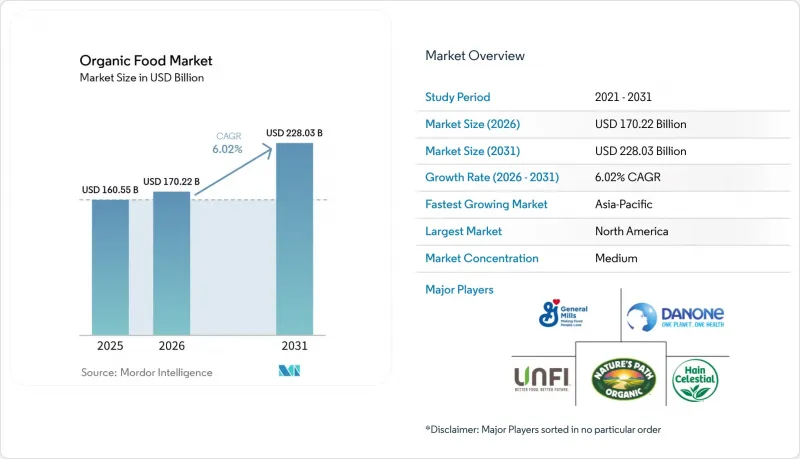
This report is Segmented by Product Type (Fruits and Vegetables, Meat/Fish/Poultry, Dairy Products, Frozen and Processed Foods, Other), Form (Fresh/Chilled, Canned, Frozen), Distribution Channel (Supermarkets/Hypermarkets, Specialty Stores, Online Retail, and More), and Geography (North America, Europe, Asia-Pacific, South America, Middle East and Africa). The Market Forecasts are Provided in Terms of Value (USD).
Global Organic Food Market Trends and Insights
Growing demand for chemical-free and pesticide-free food products
The rising preference for food products produced without synthetic chemicals and pesticide residues is significantly contributing to the growth of the organic food market. Consumers are becoming increasingly aware of the links between dietary choices, health outcomes, and food safety, prompting a shift toward organically grown fruits, vegetables, dairy products, and packaged foods. Concerns over exposure to artificial fertilizers, pesticides, and genetically modified ingredients have further strengthened demand for certified organic alternatives. This trend is particularly evident among health-conscious consumers seeking clean-label and naturally sourced food options. At the same time, greater access to organic products through supermarkets, specialty stores, and online platforms is supporting wider adoption. According to the Organic Trade Association, U.S. organic product sales reached an all-time high of USD 76.6 billion in 2025, reflecting a 6.8% increase compared to the previous year. The strong sales growth underscores the expanding consumer willingness to invest in food products perceived as safer, more natural, and environmentally responsible.
Increasing preference for natural, clean-label products
Consumers are increasingly scrutinizing ingredient lists and seeking food products that are free from artificial additives, preservatives, synthetic colors, and genetically modified ingredients. This shift is being fueled by rising health awareness, demand for transparency, and a desire for minimally processed foods that align with healthier lifestyles. Organic food products naturally fit within the clean-label movement due to their strict production standards and limited use of synthetic inputs. Food manufacturers and retailers are responding by expanding their organic and clean-label product portfolios to meet evolving consumer expectations. According to research by the CBI Ministry of Foreign Affairs, clean-label products are expected to account for more than 70% of product portfolios in 2025 and 2026, up significantly from 52% in 2021. This substantial increase highlights the growing influence of clean-label trends on purchasing behavior, creating favorable conditions for continued growth in the organic food market.
Higher production and raw material costs leading to premium shelf prices
Higher production and raw material costs pose a notable challenge to the growth of the organic food market. Organic farming practices often require greater labor input, natural pest management techniques, and adherence to stringent certification requirements, resulting in higher operational expenses than conventional farming. In addition, lower agricultural yields, limited supplies of certified organic ingredients, and higher processing and distribution costs contribute to increased overall production expenditures. These added costs are typically reflected in the final retail price of organic products, making them significantly more expensive than conventional alternatives. The premium pricing can limit accessibility for budget-conscious consumers and reduce purchase frequency, especially in price-sensitive markets. Economic pressures such as inflation and declining disposable incomes can further influence consumers to opt for lower-cost conventional products.
Other drivers and restraints analyzed in the detailed report include:
- Rising prevalence of lifestyle-related diseases
- Supportive government initiatives promoting organic farming and products
- Stringent organic certification, labeling rules, and compliance overheads
For complete list of drivers and restraints, kindly check the Table Of Contents.
Segment Analysis
Fruits and Vegetables accounted for the largest share of the organic food market, representing 34.78% of total revenue in 2025. The segment's dominance is primarily driven by strong consumer preference for fresh organic produce, which is often perceived as healthier and safer than conventionally grown alternatives. Rising awareness regarding pesticide residues and chemical fertilizers has encouraged consumers to increase their purchases of organic fruits and vegetables. In addition, expanding retail availability through supermarkets, specialty stores, and online channels has improved product accessibility across both developed and emerging markets. Government initiatives supporting organic farming and sustainable agricultural practices have further strengthened supply within this category.
Meat, Fish, and Poultry is projected to be the fastest-growing product type segment, registering a CAGR of 7.21% during 2026-2031. Growth is being fueled by increasing consumer demand for ethically sourced and chemical-free animal protein products. Consumers are becoming more conscious about animal welfare standards, antibiotic usage, and feed quality, which is driving interest in certified organic meat and seafood offerings. Rising disposable incomes in emerging economies are also supporting premium food purchases, including organic protein products. Furthermore, retailers and foodservice operators are expanding their organic meat, fish, and poultry portfolios to meet evolving consumer preferences.
Complete Report Scope:
- By Product Type
- Fruits and Vegetables
- Meat, Fish and Poultry
- Dairy Products
- Frozen and Processed Foods
- Other Foods
- By Form
- Fresh/Chilled
- Canned
- Frozen
- By Distribution Channel
- Supermarkets/Hypermarkets
- Convenience Stores
- Specialty Stores
- Online Retail Stores
- Other Distribution Channels
- By Region
- Noth America
- United States
- Canada
- Mexico
- Rest of North America
- Europe
- United Kingdom
- Germany
- France
- Spain
- Italy
- Netherlands
- Poland
- Belgium
- Sweden
- Rest of Europe
- Asia-Pacific
- China
- Japan
- India
- Australia
- Indonesia
- South Korea
- Thailand
- Singapore
- Rest of Asia-Pacific
- South America
- Brazil
- Argentina
- Chile
- Peru
- Colombia
- Rest of South America
- Middle East and Africa
- Saudi Arabia
- United Arab Emirates
- South Africa
- Nigeria
- Egypt
- Morocco
- Turkey
- Rest of Middle East and Africa
- Noth America
Geography Analysis
North America dominated the global organic food market, accounting for 38.45% of total revenue in 2025. The region's leadership is supported by high consumer awareness regarding health, nutrition, and sustainable food consumption. Strong demand for organic fruits, vegetables, dairy products, and packaged foods continues to drive market expansion across the United States and Canada. Well-established certification systems, extensive retail networks, and widespread availability of organic products have further strengthened market penetration. In addition, rising consumer preference for clean-label and non-GMO products has encouraged manufacturers to expand their organic product portfolios.
Asia-Pacific is projected to be the fastest-growing regional market, registering a CAGR of 7.64% during 2026-2031. Growth is being driven by rapid urbanization, rising disposable incomes, and increasing awareness of the health benefits associated with organic food consumption. Consumers across countries such as China, India, Japan, South Korea, and Australia are increasingly seeking food products that are free from synthetic chemicals and pesticides. Expanding middle-class populations and changing dietary preferences are creating significant opportunities for organic food manufacturers and retailers. Governments across the region are also promoting organic farming practices through policy support, certification programs, and agricultural development initiatives.
Europe, South America, and the Middle East & Africa continue to play important roles in the development of the global organic food market. Europe remains one of the most mature markets, supported by strong environmental awareness, stringent organic certification standards, and high consumer demand for sustainably sourced food products. Countries such as Germany, France, Italy, and the United Kingdom maintain substantial consumption of organic products across multiple categories. In South America, increasing organic agricultural production and rising export opportunities are supporting market growth, particularly in countries such as Brazil and Argentina. Meanwhile, the Middle East & Africa region is witnessing gradual expansion due to improving consumer awareness, rising health consciousness, and increasing availability of organic products through modern retail channels.
- Danone S.A.
- General Mills, Inc.
- The Hain Celestial Group, Inc.
- United Natural Foods, Inc.
- Organic Valley (CROPP Cooperative)
- Nature's Path Foods Inc.
- Amy's Kitchen, Inc.
- SunOpta Inc.
- Eden Foods, Inc.
- Organic India Pvt. Ltd.
- Whole Earth Brands, Inc.
- Arla Foods amba
- Yeo Valley Organic Limited
- HiPP GmbH & Co. Vertrieb KG
- Alce Nero S.p.A.
- Riverford Organic Farmers Ltd.
- Bionaturae LLC
- Clif Bar & Company
- Straus Family Creamery
- Bio Company SE
Additional Benefits:
- The market estimate (ME) sheet in Excel format
- 3 months of analyst support
TABLE OF CONTENTS
1 INTRODUCTION
- 1.1 Study Assumptions and Market Definition
- 1.2 Scope of the Study
2 RESEARCH METHODOLOGY
3 EXECUTIVE SUMMARY
4 MARKET LANDSCAPE
- 4.1 Market Overview
- 4.2 Market Drivers
- 4.2.1 Growing demand for chemical-free and pesticide-free food products
- 4.2.2 Increasing preference for natural, clean-label products
- 4.2.3 Rising prevalence of lifestyle-related diseases
- 4.2.4 Supportive government initiatives promoting organic farming and products
- 4.2.5 Strong marketing, social media influence, and brand positioning around organic and natural
- 4.2.6 Increasing environmental and sustainability concerns
- 4.3 Market Restraints
- 4.3.1 Higher production and raw material costs leading to premium shelf prices
- 4.3.2 Stringent organic certification, labeling rules, and compliance overheads
- 4.3.3 Limited consumer awareness in developing regions
- 4.3.4 Supply chain and distribution challenges for organic products
- 4.4 Consumer Behavior Analysis
- 4.5 Regulatory Landscape
- 4.6 Technological Outlook
- 4.7 Porter's Five Forces
- 4.7.1 Bargaining Power of Buyers/Consumers
- 4.7.2 Bargaining Power of Suppliers
- 4.7.3 Threat of New Entrants
- 4.7.4 Threat of Substitute Products
- 4.7.5 Intensity of Competitive Rivalry
5 MARKET SIZE AND GROWTH FORECASTS (VALUE)
- 5.1 By Product Type
- 5.1.1 Fruits and Vegetables
- 5.1.2 Meat, Fish and Poultry
- 5.1.3 Dairy Products
- 5.1.4 Frozen and Processed Foods
- 5.1.5 Other Foods
- 5.2 By Form
- 5.2.1 Fresh/Chilled
- 5.2.2 Canned
- 5.2.3 Frozen
- 5.3 By Distribution Channel
- 5.3.1 Supermarkets/Hypermarkets
- 5.3.2 Convenience Stores
- 5.3.3 Specialty Stores
- 5.3.4 Online Retail Stores
- 5.3.5 Other Distribution Channels
- 5.4 By Region
- 5.4.1 Noth America
- 5.4.1.1 United States
- 5.4.1.2 Canada
- 5.4.1.3 Mexico
- 5.4.1.4 Rest of North America
- 5.4.2 Europe
- 5.4.2.1 United Kingdom
- 5.4.2.2 Germany
- 5.4.2.3 France
- 5.4.2.4 Spain
- 5.4.2.5 Italy
- 5.4.2.6 Netherlands
- 5.4.2.7 Poland
- 5.4.2.8 Belgium
- 5.4.2.9 Sweden
- 5.4.2.10 Rest of Europe
- 5.4.3 Asia-Pacific
- 5.4.3.1 China
- 5.4.3.2 Japan
- 5.4.3.3 India
- 5.4.3.4 Australia
- 5.4.3.5 Indonesia
- 5.4.3.6 South Korea
- 5.4.3.7 Thailand
- 5.4.3.8 Singapore
- 5.4.3.9 Rest of Asia-Pacific
- 5.4.4 South America
- 5.4.4.1 Brazil
- 5.4.4.2 Argentina
- 5.4.4.3 Chile
- 5.4.4.4 Peru
- 5.4.4.5 Colombia
- 5.4.4.6 Rest of South America
- 5.4.5 Middle East and Africa
- 5.4.5.1 Saudi Arabia
- 5.4.5.2 United Arab Emirates
- 5.4.5.3 South Africa
- 5.4.5.4 Nigeria
- 5.4.5.5 Egypt
- 5.4.5.6 Morocco
- 5.4.5.7 Turkey
- 5.4.5.8 Rest of Middle East and Africa
- 5.4.1 Noth America
6 COMPETITIVE LANDSCAPE
- 6.1 Market Concentration
- 6.2 Strategic Moves
- 6.3 Market Share Analysis
- 6.4 Company Profiles (includes Company Highlights, Core Segments, Financials, Strategic Information, Market Rank/Share, Products & Services, Recent Developments)
- 6.4.1 Danone S.A.
- 6.4.2 General Mills, Inc.
- 6.4.3 The Hain Celestial Group, Inc.
- 6.4.4 United Natural Foods, Inc.
- 6.4.5 Organic Valley (CROPP Cooperative)
- 6.4.6 Nature's Path Foods Inc.
- 6.4.7 Amy's Kitchen, Inc.
- 6.4.8 SunOpta Inc.
- 6.4.9 Eden Foods, Inc.
- 6.4.10 Organic India Pvt. Ltd.
- 6.4.11 Whole Earth Brands, Inc.
- 6.4.12 Arla Foods amba
- 6.4.13 Yeo Valley Organic Limited
- 6.4.14 HiPP GmbH & Co. Vertrieb KG
- 6.4.15 Alce Nero S.p.A.
- 6.4.16 Riverford Organic Farmers Ltd.
- 6.4.17 Bionaturae LLC
- 6.4.18 Clif Bar & Company
- 6.4.19 Straus Family Creamery
- 6.4.20 Bio Company SE
7 MARKET OPPORTUNITIES AND FUTURE OUTLOOK

