PUBLISHER: Mordor Intelligence | PRODUCT CODE: 2115800

PUBLISHER: Mordor Intelligence | PRODUCT CODE: 2115800
Europe Organic Food And Beverages - Market Share Analysis, Industry Trends & Statistics, Growth Forecasts (2026 - 2031)
According to Mordor Intelligence, the Europe organic food and beverages market size is valued at USD 75.28 billion in 2026, growing from the 2025 value of USD 72.15 billion, and is forecast to climb to USD 85.91 billion by 2031, advancing at a 5.27% CAGR.
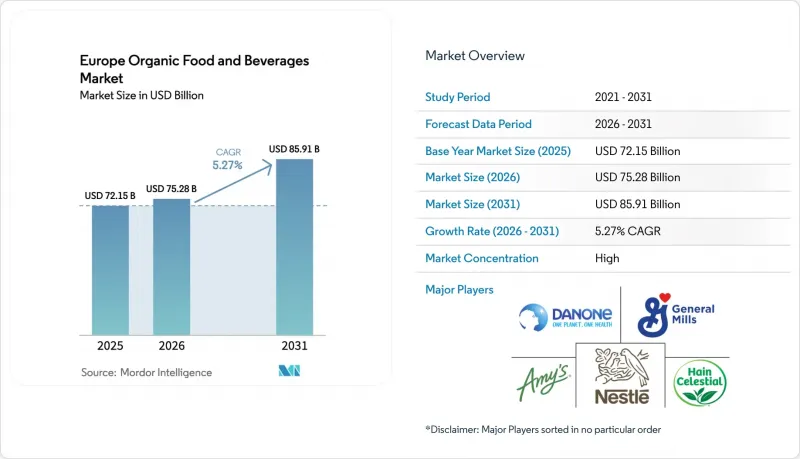
This report is Segmented by Product Type (Organic Food and Organic Beverages), Form (Fresh/Chilled, Canned, Frozen), Distribution Channel (Supermarkets/Hypermarkets, Convenience Stores, Specialty Stores, Online Stores, Other Distribution Channels), and Geography. Market Forecasts are Provided in Value (USD).
Europe Organic Food And Beverages Market Trends and Insights
Plant-Based Trend Fuels Organic Dairy Alternatives and Vegan Beverages
In 2024 and 2025, the demand for oat milk in Germany and the United Kingdom was expected to grow significantly, with sales projected to increase by double digits. This growth is driven by manufacturers improving formulations to achieve barista-grade foam stability and fortifying products with calcium and B12 to closely match the nutritional profile of dairy. Oatly's strategic decision in 2024 to source oats locally from British farms not only reduced logistics-related emissions by an estimated 15% but also mitigated risks associated with weather volatility in Eastern Europe. This move aligned well with the sustainability goals of United Kingdom retailers, particularly those focused on meeting Scope 3 carbon reduction targets. However, plant-based options continue to gain traction among flexitarian consumers, who often prioritize animal welfare considerations over carbon footprint alone. Additionally, the functional beverage segment is experiencing rapid innovation. Brands such as Minor Figures are introducing organic oat drinks infused with adaptogens and nootropics, targeting cognitive performance and mental well-being. These value-added products are positioned as premium offerings, enabling them to command price premiums of 40 to 60% compared to standard oat milk.
Urban Millennials Prioritize Organic for Immunity and Wellness
In Berlin, Paris, Amsterdam, and London, urban consumers are increasingly perceiving organic food as a proactive investment in their health rather than merely a lifestyle choice. According to survey data from 2025, 62% of urban millennials identify immunity support as their primary motivation for purchasing organic products, surpassing environmental concerns. This demographic shows a strong preference for organic produce with high ORAC scores-such as blueberries, kale, and turmeric-and demonstrates a willingness to pay a premium of 35 to 50% for cold-chain systems that maintain the phytonutrient content of these products. Retailers with robust last-mile logistics have significantly benefited from this behavior, as it aligns with consumer demand for quality and freshness. E-commerce platforms have effectively leveraged this trend by bundling organic staples with value-added services, including telehealth consultations and personalized nutrition plans. This approach has successfully converted one-time buyers into loyal subscription customers, who exhibit a lifetime value 70% higher than that of traditional walk-in shoppers.
Supply Shortages from Weather Events and Limited Farmland
In 2024, extreme rainfall wreaked havoc on wheat and vegetable harvests in France, Germany, and Poland. This led to a year-over-year 12% drop in organic cereal availability, compelling processors to resort to non-EU imports to fulfill their contracted volumes. In Western Europe, the conversion rates for organic farmland have hit a plateau. The prime parcels have already made the switch, leaving only marginal lands that yield less and incur higher input costs. This scenario deters new entrants, especially in the absence of direct subsidies. Owing to the co-financing from the European Union's Common Agricultural Policy (CAP), Poland saw an 8% increase in organic acreage in 2024. However, due to first-year yield penalties and knowledge gaps among newly converted farmers, the total output only rose by 4%. In 2024, a shortage of organic livestock feed drove up costs by 15 to 20%. This surge in expenses squeezed margins for organic dairy and meat producers, who found it challenging to pass the full cost increase onto their price-sensitive consumers in Southern and Eastern Europe, according to the European Trade.
Other drivers and restraints analyzed in the detailed report include:
- Sustainability Certifications Align with Scope 3 Emissions Goals
- Premiumisation of High-Penetration Categories
- Higher Prices Limit Low-Income Consumer Access
For complete list of drivers and restraints, kindly check the Table Of Contents.
Segment Analysis
Organic Beverages recorded a 6.78% CAGR outlook, well above the European organic food and beverages market average. Venture-backed players deploy probiotics and adaptogens that allow 40-60% mark-ups, and profitability gains appear as Oatly lowered per-liter costs 18% via regional oat sourcing. Direct-trade coffee and tea models pay farmers 20-30% premiums over Fair-Trade minima, aligning with ethically minded consumers and accelerating specialty-cafe demand. Within Organic Food, fruit and vegetables dominate volumes because of strong pesticide-avoidance associations, while meat, fish, and poultry remain niche at under 10% of sales due to limited certified capacity and steep premiums.
Value creation continues as dairy bifurcates. Organic milk volumes ease in core Western markets where plant alternatives capture younger cohorts, yet cheese and yogurt upgrade through probiotic credentials. Frozen and processed foods, aided by blast-freezing and retort solutions, extend reach to regions lacking sophisticated cold chains. Snack lines such as organic chocolate bars priced at USD 4-6 per 100 g reflect mid-single-digit growth yet demonstrate consumer acceptance of higher unit economics. Consequently, the Europe organic food and beverages market size expansion remains anchored by a diversified product pipeline.
Complete Report Scope:
- Product Type
- Organic Food
- Fruit and Vegetables
- Meat, Fish and Poultry
- Dairy Products
- Frozen and Processed Foods
- Other Foods
- Organic Beverages
- Fruit and Vegetable Juices
- Dairy-based
- Coffee
- Tea
- Other Beverages
- Organic Food
- By Form
- Fresh/Chilled
- Canned
- Frozen
- By Distribution Channel
- Supermarkets/Hypermarkets
- Convenience Stores
- Specialty Stores
- Online Stores
- Other Distribution Channels
- By Geography
- Germany
- United Kingdom
- France
- Italy
- Spain
- Russia
- Netherlands
- Belgium
- Poland
- Rest of Europe
List of Companies Covered in this Report:
- Danone SA
- Nestle SA
- Ecotone (Benelux)
- Alnatura Produktions & Handels GmbH
- Arla Foods Amba
- Hipp GmbH & Co Vertrieb KG
- Oatly AB
- Hain Celestial Group (Europe)
- Organic Valley Europe
- Bio-Company GmbH
- Veganz Group AG
- Whole Earth Brands (Europe)
- Refresco Group
- Wessanen (Clipper, Zonnatura)
- Valio Oy
- Rabenhorst Dr. Steinberger GmbH
- Eosta BV
- Berief Food GmbH
- Pukka Herbs Ltd
- Yeo Valley Organic
Additional Benefits:
- The market estimate (ME) sheet in Excel format
- 3 months of analyst support
TABLE OF CONTENTS
1 INTRODUCTION
- 1.1 Study Assumptions and Market Definition
- 1.2 Scope of the Study
2 RESEARCH METHODOLOGY
3 EXECUTIVE SUMMARY
4 MARKET LANDSCAPE
- 4.1 Market Overview
- 4.2 Market Drivers
- 4.2.1 Rising Health Awareness Drives Demand for Clean-Label Products Free From Pesticides and Additives
- 4.2.2 Plant-Based Trend Fuels Organic Dairy Alternatives and Vegan Beverages
- 4.2.3 Urban Millennials Prioritize Organic for Immunity and Wellness
- 4.2.4 Sustainability Certifications Align with Scope 3 Emissions Goals
- 4.2.5 Strong Regulatory Framework via EU Organic Regulation
- 4.2.6 Premiumisation of High-Penetration Categories
- 4.3 Market Restraints
- 4.3.1 Supply Shortages from Weather Events and Limited Farmland
- 4.3.2 Higher Prices Limit Low-Income Consumer Access
- 4.3.3 Short Shelf Life of Fresh Organics
- 4.3.4 Post-Brexit United Kingdom Trade Barriers
- 4.4 Supply Chain Analysis
- 4.5 Regulatory Outlook
- 4.6 Porter's Five Forces
- 4.6.1 Threat of New Entrants
- 4.6.2 Bargaining Power of Buyers/Consumers
- 4.6.3 Bargaining Power of Suppliers
- 4.6.4 Threat of Substitute Products
- 4.6.5 Intensity of Competitive Rivalry
5 MARKET SIZE AND GROWTH FORECAST (VALUE)
- 5.1 Product Type
- 5.1.1 Organic Food
- 5.1.1.1 Fruit and Vegetables
- 5.1.1.2 Meat, Fish and Poultry
- 5.1.1.3 Dairy Products
- 5.1.1.4 Frozen and Processed Foods
- 5.1.1.5 Other Foods
- 5.1.2 Organic Beverages
- 5.1.2.1 Fruit and Vegetable Juices
- 5.1.2.2 Dairy-based
- 5.1.2.3 Coffee
- 5.1.2.4 Tea
- 5.1.2.5 Other Beverages
- 5.1.1 Organic Food
- 5.2 By Form
- 5.2.1 Fresh/Chilled
- 5.2.2 Canned
- 5.2.3 Frozen
- 5.3 By Distribution Channel
- 5.3.1 Supermarkets/Hypermarkets
- 5.3.2 Convenience Stores
- 5.3.3 Specialty Stores
- 5.3.4 Online Stores
- 5.3.5 Other Distribution Channels
- 5.4 By Geography
- 5.4.1 Germany
- 5.4.2 United Kingdom
- 5.4.3 France
- 5.4.4 Italy
- 5.4.5 Spain
- 5.4.6 Russia
- 5.4.7 Netherlands
- 5.4.8 Belgium
- 5.4.9 Poland
- 5.4.10 Rest of Europe
6 COMPETITIVE LANDSCAPE
- 6.1 Market Concentration
- 6.2 Strategic Moves
- 6.3 Market Ranking Analysis
- 6.4 Company Profiles (includes Global-level Overview, Market-level Overview, Core Segments, Financials (if available), Strategic Information, Market Rank/Share, Products and Services, Recent Developments)
- 6.4.1 Danone SA
- 6.4.2 Nestle SA
- 6.4.3 Ecotone (Benelux)
- 6.4.4 Alnatura Produktions & Handels GmbH
- 6.4.5 Arla Foods Amba
- 6.4.6 Hipp GmbH & Co Vertrieb KG
- 6.4.7 Oatly AB
- 6.4.8 Hain Celestial Group (Europe)
- 6.4.9 Organic Valley Europe
- 6.4.10 Bio-Company GmbH
- 6.4.11 Veganz Group AG
- 6.4.12 Whole Earth Brands (Europe)
- 6.4.13 Refresco Group
- 6.4.14 Wessanen (Clipper, Zonnatura)
- 6.4.15 Valio Oy
- 6.4.16 Rabenhorst Dr. Steinberger GmbH
- 6.4.17 Eosta BV
- 6.4.18 Berief Food GmbH
- 6.4.19 Pukka Herbs Ltd
- 6.4.20 Yeo Valley Organic
7 MARKET OPPORTUNITIES AND FUTURE OUTLOOK

