PUBLISHER: Mordor Intelligence | PRODUCT CODE: 2073087

PUBLISHER: Mordor Intelligence | PRODUCT CODE: 2073087
Chronic Care Management - Market Share Analysis, Industry Trends & Statistics, Growth Forecasts (2026 - 2031)
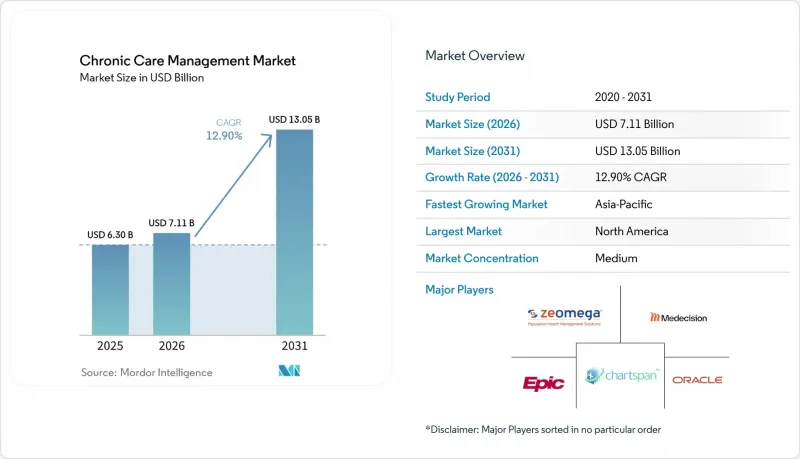
According to Mordor Intelligence, the chronic care management market size is projected to expand from USD 6.30 billion in 2025 and USD 7.11 billion in 2026 to USD 13.05 billion by 2031, registering a CAGR of 12.90% between 2026 to 2031.
This report is Segmented by Component (Software, Services), Deployment (Cloud-Based, On-Premise), End User (Providers, Payers, Other End Users), Disease Category (Diabetes, Cardiovascular Diseases, Chronic Respiratory Diseases, Cancer, Others), and Geography (North America, Europe, Asia-Pacific, Middle East and Africa, South America). The Market Forecasts are Provided in Terms of Value (USD).
Global Chronic Care Management Market Trends and Insights
Rising Medicare and Value-Based Care Adoption Accelerates Platform Deployment
Medicare's payment reforms are reshaping the landscape of chronic care management. Providers are now prioritizing systems that emphasize reporting, coordination, and measurable outcomes over mere monthly activity tracking. Benefiting from CMS's push for deeper accountable care participation and the 2025 APCM pathway, the chronic care management market is witnessing a shift towards structured primary care management and value-based reimbursement. The 2026 fee schedule further fueled this momentum by boosting CCM reimbursement rates, enhancing ROI for providers who can scale compliant programs. This shift is pivotal; manual workflows falter when timely data capture, validated care plans, and consistent follow-ups are tied to reimbursement. Consequently, there's a surging demand for software that seamlessly integrates clinical actions, documentation, and payment readiness.
AI-Enabled Care Gap Detection Redefines Time-to-Intervention Economics
AI-driven care gap detection is revolutionizing the chronic care management market by accelerating the pace from problem identification to clinical intervention. Cadence unveiled its AI-centric Proactive Care Engine on July 1, 2025, boasting a nearly 30% closure rate for care gaps in patients monitored for a minimum of 90 days. This underscores the tangible benefits of automated surveillance in enhancing follow-up performance. The competitive landscape is shifting, with a focus moving from staffing scale to the quality of data, workflow automation, and real-time action triggers. Projections indicate that by 2026, agentic AI will carve out a significant portion of healthcare IT budgets in the Asia-Pacific, with chronic disease management emerging as a prime investment area. Organizations leveraging persistent AI monitoring can act swiftly, bridge more care gaps, and manage larger patient groups without a proportional increase in labor.
Fragmented Interoperability Across EHR and RPM Platforms Constrains Scale
Fragmented interoperability continues to hinder the chronic care management market, as effective workflows require complete and timely patient records from multiple systems. A 2025 ONC survey revealed that 60% of U.S. health systems identified fragmented and unstructured data as a barrier to managing care gaps effectively. Humana's planned 2026 partnership with b.well Connected Health aims to address this by integrating provider, plan, pharmacy, and application data in real time. However, smaller vendors and provider groups often lack the resources for such advanced data integration, limiting the market's ability to scale evenly and affecting care plan quality, patient identification, and billing accuracy.
Other drivers and restraints analyzed in the detailed report include:
- Under-Diagnosed Multimorbidity in Aging Populations Creates Latent Demand
- Remote Patient Monitoring Partnerships Extend the Data Perimeter for Chronic Care
- Clinical Documentation Burden Creates Adoption Drag and Compliance Exposure
For complete list of drivers and restraints, kindly check the Table Of Contents.
Segment Analysis
In 2025, services accounted for 57.18% of the chronic care management market, highlighting the reliance on outsourced care coordination models during the market's early stages. Providers often depended on third-party organizations for clinical staffing, outreach, and billing support, as these services were easier to implement than internal digital workflows. While human intervention remains critical for managing complex chronic populations, the market is shifting toward platform-led automation, reducing reliance on labor-intensive delivery methods.
Software is projected to grow at a 15.90% CAGR through 2031, driven by AI systems automating tasks like intake, documentation, care plan generation, and routine patient engagement without proportional headcount increases. CCS announced in April 2026 that its AI deployment aims to process 70%-80% of over 100,000 monthly intake documents by year-end 2026, delivering over 30% in annual cost savings. eClinicalWorks launched the healow CCM Specialist Service in April 2026, reflecting a trend toward hybrid models where software and services converge. The industry is moving toward AI-augmented human interaction for complex tasks, while software handles repetitive, high-volume workflows.
Cloud-based deployment held 71.22% of the chronic care management market in 2025, driven by its scalability, interoperability, and ability to handle large data volumes. Cloud environments support remote patient monitoring, centralized analytics, distributed care teams, and continuous updates, making them the preferred choice for organizations seeking fast implementation and system-wide visibility. Major vendors are aligning product roadmaps with cloud-native AI functionalities, reinforcing this trend.
Oracle launched an AI-driven EHR for ambulatory providers in August 2025, emphasizing voice-first clinical intelligence and conversational workflows. Epic introduced Agent Factory in March 2026, enabling AI agent deployment across clinical workflows. On-premise deployment is expected to grow at a 14.25% CAGR through 2031, as data sovereignty and residency requirements remain critical in governance-heavy contracts. While cloud solutions dominate by volume, on-premise systems retain relevance in markets with stricter regulatory controls.
Complete Report Scope:
- By Component
- Software
- Services
- By Deployment
- Cloud-Based
- On-Premise
- By End User
- Providers
- Payers
- Other End Users
- By Disease Category
- Diabetes
- Cardiovascular Diseases
- Chronic Respiratory Diseases
- Cancer
- Other Chronic Diseases
- By Geography
- North America
- United States
- Canada
- Mexico
- Europe
- Germany
- United Kingdom
- France
- Italy
- Spain
- Rest of Europe
- Asia-Pacific
- China
- India
- Japan
- Australia
- South Korea
- Rest of Asia-Pacific
- Middle East and Africa
- GCC
- South Africa
- Rest of Middle East and Africa
- South America
- Brazil
- Argentina
- Rest of South America
- North America
Geography Analysis
In 2025, North America accounted for 41.55% of the chronic care management market, establishing itself as the largest regional contributor to current revenues. This leadership is driven by the maturity of Medicare's CCM billing, increased payer digitization, and significant investments in chronic care software and services. The CY 2026 Physician Fee Schedule introduced a 10% reimbursement increase for CCM, encouraging broader provider adoption and improving program economics. The U.S. market is also becoming polarized between integrated payer-delivery platforms and specialist vendors supporting smaller and mid-sized practices.
Europe remains the second-largest region in the chronic care management market, with Germany and the U.K. leading adoption. Germany's DiGA framework facilitates digital health reimbursements, creating a streamlined pathway for certified chronic disease management applications. The U.K. is advancing in digital chronic care, with studies highlighting the cost-effectiveness of remote monitoring systems for older adults under public insurance frameworks. Other countries like France, Italy, and Spain are expanding gradually as demographic pressures rise and reimbursement structures mature.
Asia-Pacific is projected to grow at a 16.45% CAGR through 2031, making it the fastest-growing region in the chronic care management market. Growth is driven by the rising chronic disease burden, investments in digital health policies, and the need for structured care delivery in fragmented health systems. Countries like India, China, Japan, South Korea, and Australia are advancing through diverse initiatives, including national digital health programs, preventive AI strategies, and clinically governed decision support models. The Middle East, Africa, and South America remain in early stages, with demand focused on urban modernization projects and selective health system digitization rather than widespread national adoption.
- ChartSpan Medical Technologies, Inc.
- CVS Health
- eClinicalWorks LLC
- Elevance Health, Inc.
- Epic Systems
- EXLService Holdings, Inc.
- HealthSnap, Inc.
- Humana Inc.
- Koninklijke Philips
- Mckesson
- Medecision, Inc.
- Medtronic
- NextGen Healthcare
- Oracle
- Prevounce Health, LLC
- Siemens Healthineers
- The Cigna Group
- United Health Group
- Veradigm Inc.
- ZeOmega, Inc.
Additional Benefits:
- The market estimate (ME) sheet in Excel format
- 3 months of analyst support
TABLE OF CONTENTS
1 INTRODUCTION
- 1.1 Study Assumptions and Market Definition
- 1.2 Scope of the Study
2 RESEARCH METHODOLOGY
3 EXECUTIVE SUMMARY
4 MARKET LANDSCAPE
- 4.1 Market Overview
- 4.2 Market Drivers
- 4.2.1 Rising Medicare and Value-Based Care Adoption
- 4.2.2 Expansion of Remote Patient Monitoring Paired with Chronic Care Workflows
- 4.2.3 Under-Diagnosed Multimorbidity in Aging Populations
- 4.2.4 Provider Need to Reduce Avoidable Readmissions and Total Cost of Care
- 4.2.5 Reimbursement Friction for Documentation-Heavy CCM Workflows
- 4.2.6 AI-Enabled Care Gap Detection and Time Capture
- 4.3 Market Restraints
- 4.3.1 Clinical Documentation Burden and Billing Complexity
- 4.3.2 Fragmented Interoperability Across EHR, RPM, and Billing Systems
- 4.3.3 Care Team Staffing Constraints and Patient Non-Adherence
- 4.3.4 Narrow Margin Pressure in Small Practices Due to Reimbursement Dependence
- 4.4 Supply/Value Chain Analysis
- 4.5 Regulatory Landscape
- 4.6 Technological Outlook
- 4.7 Porter's Five Forces Analysis
- 4.7.1 Threat of New Entrants
- 4.7.2 Bargaining Power of Suppliers
- 4.7.3 Bargaining Power of Buyers
- 4.7.4 Threat of Substitutes
- 4.7.5 Industry Rivalry
5 MARKET SIZE AND GROWTH FORECASTS (VALUE, USD)
- 5.1 By Component
- 5.1.1 Software
- 5.1.2 Services
- 5.2 By Deployment
- 5.2.1 Cloud-Based
- 5.2.2 On-Premise
- 5.3 By End User
- 5.3.1 Providers
- 5.3.2 Payers
- 5.3.3 Other End Users
- 5.4 By Disease Category
- 5.4.1 Diabetes
- 5.4.2 Cardiovascular Diseases
- 5.4.3 Chronic Respiratory Diseases
- 5.4.4 Cancer
- 5.4.5 Other Chronic Diseases
- 5.5 By Geography
- 5.5.1 North America
- 5.5.1.1 United States
- 5.5.1.2 Canada
- 5.5.1.3 Mexico
- 5.5.2 Europe
- 5.5.2.1 Germany
- 5.5.2.2 United Kingdom
- 5.5.2.3 France
- 5.5.2.4 Italy
- 5.5.2.5 Spain
- 5.5.2.6 Rest of Europe
- 5.5.3 Asia-Pacific
- 5.5.3.1 China
- 5.5.3.2 India
- 5.5.3.3 Japan
- 5.5.3.4 Australia
- 5.5.3.5 South Korea
- 5.5.3.6 Rest of Asia-Pacific
- 5.5.4 Middle East and Africa
- 5.5.4.1 GCC
- 5.5.4.2 South Africa
- 5.5.4.3 Rest of Middle East and Africa
- 5.5.5 South America
- 5.5.5.1 Brazil
- 5.5.5.2 Argentina
- 5.5.5.3 Rest of South America
- 5.5.1 North America
6 COMPETITIVE LANDSCAPE
- 6.1 Market Concentration
- 6.2 Market Share Analysis
- 6.3 Company Profiles (includes Global Level Overview, Market Level Overview, Core Segments, Financials as available, Strategic Information, Market Rank/Share, Products and Services, Recent Developments)
- 6.3.1 ChartSpan Medical Technologies, Inc.
- 6.3.2 CVS Health Corporation
- 6.3.3 eClinicalWorks LLC
- 6.3.4 Elevance Health, Inc.
- 6.3.5 Epic Systems Corporation
- 6.3.6 EXLService Holdings, Inc.
- 6.3.7 HealthSnap, Inc.
- 6.3.8 Humana Inc.
- 6.3.9 Koninklijke Philips N.V.
- 6.3.10 McKesson Corporation
- 6.3.11 Medecision, Inc.
- 6.3.12 Medtronic plc
- 6.3.13 NextGen Healthcare, Inc.
- 6.3.14 Oracle Corporation
- 6.3.15 Prevounce Health, LLC
- 6.3.16 Siemens Healthineers AG
- 6.3.17 The Cigna Group
- 6.3.18 UnitedHealth Group Incorporated
- 6.3.19 Veradigm Inc.
- 6.3.20 ZeOmega, Inc.
7 MARKET OPPORTUNITIES AND FUTURE OUTLOOK
- 7.1 White-Space and Unmet-Need Assessment

