PUBLISHER: Mordor Intelligence | PRODUCT CODE: 2073127

PUBLISHER: Mordor Intelligence | PRODUCT CODE: 2073127
Africa Feed Yeast - Market Share Analysis, Industry Trends & Statistics, Growth Forecasts (2026 - 2031)
According to Mordor Intelligence, the africa feed yeast market size is anticipated to grow from USD 66.85 million in 2025 to USD 69.42 million in 2026 and is forecast to reach USD 8.04 million by 2031 at 3.14% CAGR over 2026-2031.
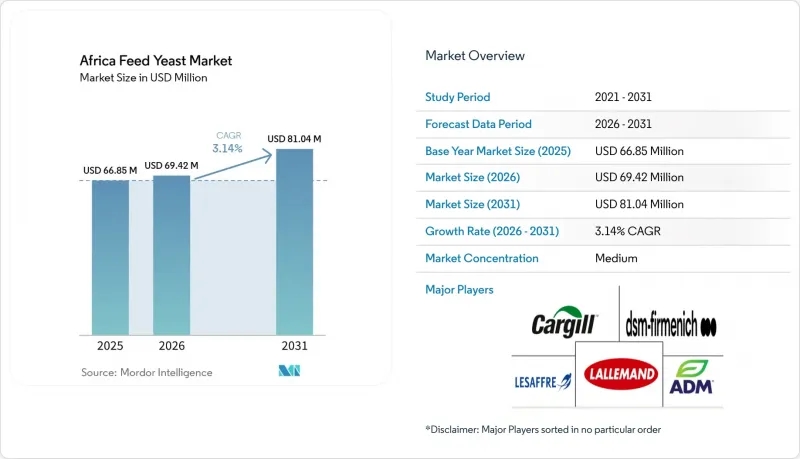
This report is Segmented by Sub Additive (Live Yeast, Selenium Yeast, Spent Yeast, and More), by Animal (Aquaculture, Poultry, and More), and by Geography (South Africa, Kenya, Egypt, and the Rest of Africa). The Market Forecasts are Provided in Terms of Value (USD) and Volume (Metric Tons).
Africa Feed Yeast Market Trends and Insights
Poultry Feed Industrialization
Poultry production is making the Africa feed yeast market more structured because larger farms and integrated feed systems depend on consistent formulations rather than variable on-farm mixing. That shift matters because yeast performs best when inclusion rates are stable and tied to measurable production targets such as gut integrity, feed conversion, flock resilience, and output uniformity. In this setting, spent yeast has remained relevant because it delivers protein, nucleotides, and beta-glucans at a price point that works for buyers managing narrow feed margins. The Africa feed yeast market also benefits from the fact that poultry is the first animal segment to formalize when commercial feed capacity expands, which makes it the earliest route for repeat additive adoption. As compound feed systems deepen across South Africa, Egypt, Nigeria, and Ethiopia, the Africa feed yeast market gains from better procurement discipline, stronger technical support, and clearer product differentiation between value-grade and performance-grade yeast solutions.
Aflatoxin-Risk Mitigation Through Yeast-Based Resilience Solutions
Aflatoxin exposure is becoming a stronger purchase driver in the Africa feed yeast market because contamination is no longer treated as an occasional quality issue in many livestock systems. A 2024 study in Tropical Animal Health and Production found that Pichia manshurica supplementation improved rumen fermentation and nutrient degradability in aflatoxin B1-contaminated diets, which supports the case for functional yeast use beyond basic nutrition. A 2025 study in World Journal of Microbiology and Biotechnology also showed that Pichia kudriavzevii supplementation in broiler feed reduced the adverse effects linked with aflatoxin stress, which strengthens the commercial case for strain-specific yeast products. In Ethiopia, a 2025 study reported aflatoxin B1 contamination in 85.4% of sampled dairy concentrates, which underlines how feed safety concerns can shift yeast cell wall and binder products from optional use toward standard use. The Africa feed yeast market therefore gains from a broader value proposition where yeast supports compliance, feed safety, and production stability at the same time.
Currency Volatility and Imported-Input Inflation
Currency instability still limits the Africa feed yeast market because many specialty inputs, fermentation materials, and imported finished additives are priced against hard currencies. When local currencies weaken, distributors face margin pressure and feed mills often postpone upgrades to higher-value yeast formats even if the technical case remains intact. The impact is strongest on smaller commercial mills because they usually lack hedging capacity, deep inventories, or the balance sheet needed to absorb short-term cost shocks. This keeps part of the Africa feed yeast market tied to low-cost product choices and slows the move into live yeast, selenium yeast, and advanced derivatives. The pressure should ease gradually where more in-region manufacturing comes online, but near-term pricing sensitivity remains a defining restraint in the Africa feed yeast market.
Other drivers and restraints analyzed in the detailed report include:
- Aquaculture Feed Expansion
- Feed-Efficiency Optimization Under High Feed-Cost Pressure
- Soybean and Protein-Meal Deficits in East Africa
For complete list of drivers and restraints, kindly check the Table Of Contents.
Segment Analysis
Spent yeast held the largest Africa feed yeast market share at 24% in 2025, which reflects its strong fit with cost-conscious commercial feed buyers. It remains widely used because it adds protein, nucleotides, and beta-glucans without the price premium attached to more specialized yeast formats. In the Africa feed yeast market, this makes spent yeast the practical choice where poultry and ruminant formulas need functional support, but budget discipline remains strict. Selenium yeast is gaining ground in more formal dairy and layer systems because organic selenium positioning is increasingly tied to animal health, product quality, and premium feeding programs. Torula dried yeast, whey yeast, and yeast derivatives remain smaller today, but each plays a defined role in palatability support, rumen stability, gut health, and feed safety applications.
In Africa feed yeast market size terms, live yeast is set to expand at the fastest 3.5% CAGR through 2031, reflecting a stronger shift toward performance-led buying. The segment benefits from tighter scrutiny of antibiotic reduction, broader use in rumen modulation, and stronger interest in gut integrity solutions for broilers and dairy cattle. In 2025, Research published in Frontiers in Veterinary Science also supported the premium positioning of organic selenium sources by showing greater selenium bioavailability than inorganic forms, which helps explain the longer-term upside for selenium yeast in structured operations. The Africa feed yeast market is therefore moving toward a more layered product mix, where spent yeast keeps scale, but live yeast and derivatives take a larger part of the value. That pattern points to gradual premiumization rather than rapid replacement, which is why lower-cost and higher-function products are likely to coexist through the forecast period.
Complete Report Scope:
- By Sub Additive
- Live Yeast
- Selenium Yeast
- Spent Yeast
- Torula Dried Yeast
- Whey Yeast
- Yeast Derivatives
- Animal
- Aquaculture
- Fish
- Shrimp
- Other Aquaculture Species
- Poultry
- Broiler
- Layer
- Other Poultry Birds
- Ruminants
- Beef Cattle
- Dairy Cattle
- Other Ruminants
- Swine
- Other Animals
- Aquaculture
- Country
- South Africa
- Kenya
- Egypt
- Rest of Africa
List of Companies Covered in this Report:
- Lesaffre et Compagnie
- Angel Yeast Co., Ltd.
- Lallemand Inc.
- Archer Daniels Midland Company
- Cargill, Incorporated
- Alltech, Inc.
- Nutreco N.V.
- Novonesis A/S
- Leiber GmbH
- Kemin Industries, Inc.
- Royal Agrifirm Group
- DSM-Firmenich AG
- Novus International, Inc.
- Adisseo France S.A.S.
- Evonik Industries AG
Additional Benefits:
- The market estimate (ME) sheet in Excel format
- 3 months of analyst support
TABLE OF CONTENTS
1 INTRODUCTION
- 1.1 Study Assumptions & Market Definition
- 1.2 Scope of the Study
- 1.3 Research Methodology
2 REPORT OFFERS
3 EXECUTIVE SUMMARY & KEY FINDINGS
4 KEY INDUSTRY TRENDS
- 4.1 Animal Headcount
- 4.1.1 Poultry
- 4.1.2 Ruminants
- 4.1.3 Swine
- 4.2 Feed Production
- 4.2.1 Aquaculture
- 4.2.2 Poultry
- 4.2.3 Ruminants
- 4.2.4 Swine
- 4.3 Regulatory Framework
- 4.3.1 Africa
- 4.4 Value Chain & Distribution Channel Analysis
- 4.5 Market Drivers
- 4.5.1 Poultry feed industrialization
- 4.5.2 Aquaculture feed expansion
- 4.5.3 Commercial feed penetration gains
- 4.5.4 Feed-efficiency optimization under high feed-cost pressure
- 4.5.5 Faster feed registration and licensing in Egypt
- 4.5.6 Aflatoxin-risk mitigation through yeast-based resilience solutions
- 4.6 Market Restraints
- 4.6.1 Currency volatility and imported-input inflation
- 4.6.2 Low compound-feed penetration in informal channels
- 4.6.3 Soybean and protein-meal deficits in East Africa
- 4.6.4 Uneven storage hygiene and additive quality assurance
5 Market Size and Growth Forecasts (Value and Volume)
- 5.1 By Sub Additive
- 5.1.1 Live Yeast
- 5.1.2 Selenium Yeast
- 5.1.3 Spent Yeast
- 5.1.4 Torula Dried Yeast
- 5.1.5 Whey Yeast
- 5.1.6 Yeast Derivatives
- 5.2 Animal
- 5.2.1 Aquaculture
- 5.2.1.1 Fish
- 5.2.1.2 Shrimp
- 5.2.1.3 Other Aquaculture Species
- 5.2.2 Poultry
- 5.2.2.1 Broiler
- 5.2.2.2 Layer
- 5.2.2.3 Other Poultry Birds
- 5.2.3 Ruminants
- 5.2.3.1 Beef Cattle
- 5.2.3.2 Dairy Cattle
- 5.2.3.3 Other Ruminants
- 5.2.4 Swine
- 5.2.5 Other Animals
- 5.2.1 Aquaculture
- 5.3 Country
- 5.3.1 South Africa
- 5.3.2 Kenya
- 5.3.3 Egypt
- 5.3.4 Rest of Africa
6 COMPETITIVE LANDSCAPE
- 6.1 Key Strategic Moves
- 6.2 Market Share Analysis
- 6.3 Market Share Analysis
- 6.4 Company Profiles (Includes Global Level Overview, Market Level Overview, Core Business Segments, Financials, Headcount, Key Information, Market Rank, Market Share, Products and Services, and Analysis of Recent Developments).
- 6.4.1 Lesaffre et Compagnie
- 6.4.2 Angel Yeast Co., Ltd.
- 6.4.3 Lallemand Inc.
- 6.4.4 Archer Daniels Midland Company
- 6.4.5 Cargill, Incorporated
- 6.4.6 Alltech, Inc.
- 6.4.7 Nutreco N.V.
- 6.4.8 Novonesis A/S
- 6.4.9 Leiber GmbH
- 6.4.10 Kemin Industries, Inc.
- 6.4.11 Royal Agrifirm Group
- 6.4.12 DSM-Firmenich AG
- 6.4.13 Novus International, Inc.
- 6.4.14 Adisseo France S.A.S.
- 6.4.15 Evonik Industries AG
7 KEY STRATEGIC QUESTIONS FOR FEED ADDITIVE CEOS

