PUBLISHER: Mordor Intelligence | PRODUCT CODE: 2073219

PUBLISHER: Mordor Intelligence | PRODUCT CODE: 2073219
Middle East Feed Yeast - Market Share Analysis, Industry Trends & Statistics, Growth Forecasts (2026 - 2031)
According to Mordor Intelligence, the middle east feed yeast market size is projected to expand from USD 37.91 million in 2025 and USD 42.81 million in 2026 to USD 48.37 million by 2031, registering a CAGR of 2.47% between 2026 and 2031.
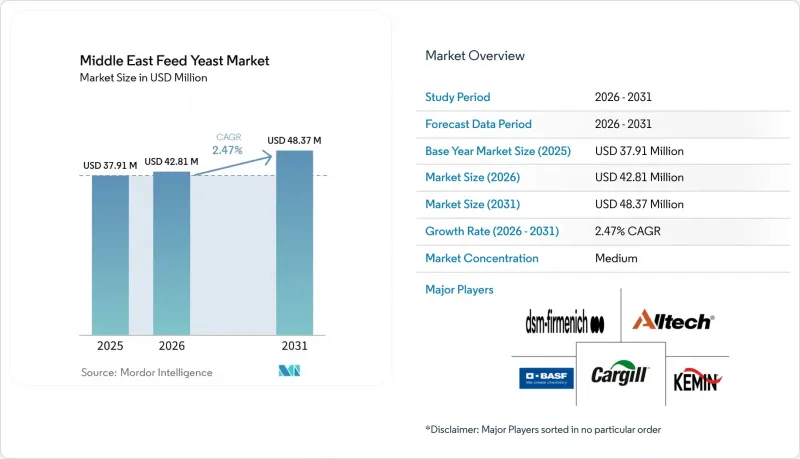
This report is Segmented by Sub Additive (Live Yeast, Selenium Yeast, Spent Yeast, and More), by Animal (Aquaculture, Poultry, and More), and by Geography (Saudi Arabia, Iran, and the Rest of Middle East). The Market Forecasts are Provided in Terms of Value (USD) and Volume (Metric Tons).
Middle East Feed Yeast Market Trends and Insights
Saudi Poultry Self-Sufficiency Expansion
Saudi Arabia's broiler meat production reached 1.2 million metric tons in 2024, and the country's self-sufficiency rate stood at 72%, keeping domestic livestock expansion closely tied to the Vision 2030 food security target of 90%, as per General Authority for Statistics (GASTAT). This production push is raising the need for more consistent feed performance across large integrated poultry operations in the Middle East feed yeast market. Bigger farms usually rely on standardized feed programs, which favor additives that support immunity and improve feed conversion without disrupting existing formulations. The same expansion is also tightening quality expectations for supplier service, registration readiness, and product stability in commercial rations. As Saudi producers scale output, the Middle East feed yeast market is seeing stronger demand for yeast-based products that fit both productivity goals and export-oriented production standards.
Antibiotic-Reduction Shift Toward Functional Yeast Additives
The United Arab Emirates National Action Plan on Antimicrobial Resistance 2025 to 2031 and Saudi Arabia's comparable framework are pushing livestock systems toward lower reliance on antibiotic growth promoters under the World Health Organization One Health approach. In the Middle East feed yeast market, that change is most visible in broiler and shrimp production, where gut health support and feed efficiency remain critical after antibiotic withdrawal. A 2025 review in Veterinary Science found that yeast-derived products and probiotics can help maintain productivity during early growth stages in poultry after antibiotic growth promoters are removed. That evidence matters because it gives buyers a scientific basis for replacing older synthetic pathways with functional yeast inputs. The Middle East feed yeast market is therefore gaining support from a demand stream driven by compliance pressure rather than short-term cost shifts.
Import Dependence and Freight Volatility
The region's feed sector depends heavily on imported corn, soybean meal, and fermentation-linked inputs, leaving the Middle East feed yeast market exposed to freight volatility, port disruptions, and geopolitical routing risks. Iran experiences significant challenges in this area due to reduced food affordability, driven by currency depreciation and a decline in domestic grain production. Additionally, feed availability and producer margins continued to face significant pressure, according to the Statistical Center of Iran (SCI). Live yeast products are especially vulnerable because shelf life and temperature sensitivity limit how much stock importers can safely hold. That makes the Middle East feed yeast market more sensitive to external supply shocks than categories that can be warehoused with fewer performance risks.
Other drivers and restraints analyzed in the detailed report include:
- Dairy Yield Optimization Across Saudi Arabia and Gulf Cooperation Council
- United Arab Emirates Aquaculture Capacity Build-Out
- Feed Additive Registration and Arabic Labeling Burden
For complete list of drivers and restraints, kindly check the Table Of Contents.
Segment Analysis
Yeast Derivatives held the largest market share at 44.3% in 2025, making it the anchor product in commercial poultry and ruminant rations across the Middle East feed yeast market. Its leading position stems from practical value rather than narrow specialization, as it can serve as a protein contributor, an immunostimulant, and a mycotoxin-binding support ingredient in a single formulation. The product mix is significant in a region where feed cost pressures are high, and buyers typically favor products with multiple functional roles. Selenium yeast is gaining relevance in dairy and ruminant applications where selenium deficiency in arid conditions supports demand for organic selenium sources. Live yeast, torula dried yeast, whey yeast, and yeast derivatives each remain present in more targeted niches where performance claims are easier to defend than simple price points.
Within the Middle East feed yeast market size, spent yeast is projected to be the fastest-growing sub-additive segment, with a 2.7% CAGR from 2026 to 2031, indicating that mainstream demand will remain durable even as premium formats expand. A 2024 Frontiers in Veterinary Science study found that hydrolyzed yeast supplementation in heat-stressed broilers improved intestinal redox balance and reduced mortality, supporting the move toward more standardized yeast fractions with clearer performance claims. This creates opportunities for higher-margin formulations within the Middle East feed yeast market, particularly for suppliers capable of transitioning from bulk spent yeast to validated derivative products. The same sub-additive landscape also gives pre-registered products an advantage because Saudi regulatory compliance applies across all functional categories. As a result, the segment is broad enough to support both volume growth and selective premiumization.
Complete Report Scope:
- By Sub Additive
- Live Yeast
- Selenium Yeast
- Spent Yeast
- Torula Dried Yeast
- Whey Yeast
- Yeast Derivatives
- By Animal
- Aquaculture
- Fish
- Shrimp
- Other Aquaculture Species
- Poultry
- Broiler
- Layer
- Other Poultry Birds
- Ruminants
- Beef Cattle
- Dairy Cattle
- Other Ruminants
- Swine
- Other Animals
- Aquaculture
- By Country
- Saudi Arabia
- Iran
- Rest of Middle East
List of Companies Covered in this Report:
- DSM-Firmenich AG
- Kemin Industries, Inc.
- Alltech, Inc.
- Cargill, Incorporated
- BASF SE
- Bluestar Adisseo Company
- Archer Daniels Midland Company
- EW Nutrition GmbH
- Clariant AG
- Nutreco N.V.
- Novus International, Inc.
- Phibro Animal Health Corporation
- Special Nutrients, LLC
- Impextraco NV
- Bentoli, Inc.
Additional Benefits:
- The market estimate (ME) sheet in Excel format
- 3 months of analyst support
TABLE OF CONTENTS
1 INTRODUCTION
- 1.1 Study Assumptions & Market Definition
- 1.2 Scope of the Study
- 1.3 Research Methodology
2 REPORT OFFERS
3 EXECUTIVE SUMMARY & KEY FINDINGS
4 KEY INDUSTRY TRENDS
- 4.1 Animal Headcount
- 4.1.1 Poultry
- 4.1.2 Ruminants
- 4.1.3 Swine
- 4.2 Feed Production
- 4.2.1 Aquaculture
- 4.2.2 Poultry
- 4.2.3 Ruminants
- 4.2.4 Swine
- 4.3 Regulatory Framework
- 4.3.1 Middle East
- 4.4 Value Chain & Distribution Channel Analysis
- 4.5 Market Drivers
- 4.5.1 Saudi poultry self-sufficiency expansion
- 4.5.2 Antibiotic-reduction shift toward functional yeast additives
- 4.5.3 Dairy yield optimization across Saudi Arabia and Gulf Cooperation Council
- 4.5.4 United Arab Emirates aquaculture capacity build-out
- 4.5.5 Heat-stress mitigation demand for gut-stable yeast products
- 4.5.6 Mycotoxin pressure in imported feed grains
- 4.6 Market Restraints
- 4.6.1 Import dependence and freight volatility
- 4.6.2 Feed additive registration and Arabic labeling burden
- 4.6.3 Halal and substrate traceability scrutiny
- 4.6.4 Field-level efficacy variability in hot-climate pelleting
5 MARKET SIZE AND GROWTH FORECASTS (VALUE AND VOLUME)
- 5.1 By Sub Additive
- 5.1.1 Live Yeast
- 5.1.2 Selenium Yeast
- 5.1.3 Spent Yeast
- 5.1.4 Torula Dried Yeast
- 5.1.5 Whey Yeast
- 5.1.6 Yeast Derivatives
- 5.2 By Animal
- 5.2.1 Aquaculture
- 5.2.1.1 Fish
- 5.2.1.2 Shrimp
- 5.2.1.3 Other Aquaculture Species
- 5.2.2 Poultry
- 5.2.2.1 Broiler
- 5.2.2.2 Layer
- 5.2.2.3 Other Poultry Birds
- 5.2.3 Ruminants
- 5.2.3.1 Beef Cattle
- 5.2.3.2 Dairy Cattle
- 5.2.3.3 Other Ruminants
- 5.2.4 Swine
- 5.2.5 Other Animals
- 5.2.1 Aquaculture
- 5.3 By Country
- 5.3.1 Saudi Arabia
- 5.3.2 Iran
- 5.3.3 Rest of Middle East
6 COMPETITIVE LANDSCAPE
- 6.1 Key Strategic Moves
- 6.2 Market Share Analysis
- 6.3 Company Landscape
- 6.4 Company Profiles (Includes Global Level Overview, Market Level Overview, Core Business Segments, Financials, Headcount, Key Information, Market Rank, Market Share, Products and Services, and Analysis of Recent Developments).
- 6.4.1 DSM-Firmenich AG
- 6.4.2 Kemin Industries, Inc.
- 6.4.3 Alltech, Inc.
- 6.4.4 Cargill, Incorporated
- 6.4.5 BASF SE
- 6.4.6 Bluestar Adisseo Company
- 6.4.7 Archer Daniels Midland Company
- 6.4.8 EW Nutrition GmbH
- 6.4.9 Clariant AG
- 6.4.10 Nutreco N.V.
- 6.4.11 Novus International, Inc.
- 6.4.12 Phibro Animal Health Corporation
- 6.4.13 Special Nutrients, LLC
- 6.4.14 Impextraco NV
- 6.4.15 Bentoli, Inc.
7 KEY STRATEGIC QUESTIONS FOR FEED ADDITIVE CEOS

