PUBLISHER: Mordor Intelligence | PRODUCT CODE: 2073148

PUBLISHER: Mordor Intelligence | PRODUCT CODE: 2073148
Education Laptop - Market Share Analysis, Industry Trends & Statistics, Growth Forecasts (2026 - 2031)
According to Mordor Intelligence, the education laptop market size is expected to be USD 17.30 billion in 2025, USD 18.54 billion in 2026, and reach USD 29.66 billion by 2031, growing at a CAGR of 9.86% from 2026 to 2031.
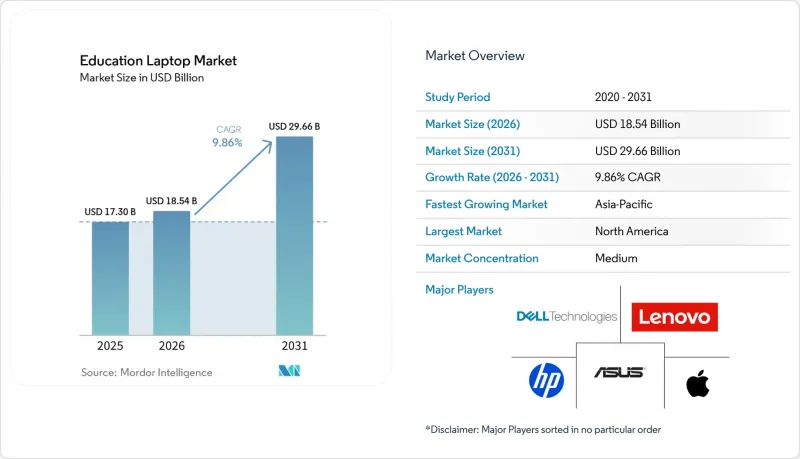
This report is Segmented by Product Type (Traditional Clamshell Laptops, 2-In-1 Convertible Laptops, Chromebooks, Rugged Laptops, and Other Product Types), Operating System (Windows, Chrome OS, Macos, Linux, and Other Operating Systems), End User (K-12 Schools, and More), Distribution Channel (Online Retail, and More), and Geography. The Market Forecasts are Provided in Terms of Value (USD).
Global Education Laptop Market Trends and Insights
Government Digital Learning Initiatives
Multi-year public-sector funding frames hardware and connectivity as universal rights, enabling predictable purchase cycles. Japan's Next GIGA refresh funds 8 million replacements and channels 60% of orders toward Chrome OS to cut administrative labor. Germany's Digital Pact 2.0 commits EUR 5 billion (USD 5.65 billion) through 2030 and rings-fences EUR 250 million (USD 282.5 million) for adaptive-learning research. India's Free Laptop Yojana distributed more than 1 million laptops in Tamil Nadu under a INR 2,000 crore (USD 240 million) line item. Nigeria's Digital Literacy Network schedules 47 million units and builds local assembly hubs to bypass import tariffs. Such programs convert episodic buying into rolling annual allocations that vendors can forecast with confidence.
Expanding 1:1 Device Programs in K-12 Schools
Surveys show 93% of United States districts planned Chromebook purchases in 2025, pushing the global installed base beyond 38 million. New York City issued 350,000 units to guarantee every grade 3-12 student a personal device. Tokyo's joint tender pooled 23 wards, saving ¥8.06 billion (USD 54.5 million) through consolidated logistics. These deployments normalize device-per-student ratios and shift competition toward warranty length, spare-device pools, and recycling schemes.
Budget Constraints in Developing-World School Districts
Fiscal ceilings anchor device rollouts to grants or donor aid rather than recurring budgets. Lesotho accepted 400 UAE-funded laptops in 2025, underscoring dependence on external finance. Currency swings and tariff disputes delay Nigeria's low-cost imports by up to nine months. Refurbished fleets, priced 40-50% below new, gain traction as 38 million Chromebooks approach end-of-life between 2026 and 2028. Vendors courting these regions adopt lease-to-own models and accept thinner margins to secure volume.
Other drivers and restraints analyzed in the detailed report include:
- Rising Availability of Low-Cost Chromebooks
- Surge in Hybrid and Distance-Learning Models
- Component Supply-Chain Volatility and Price Spikes
For complete list of drivers and restraints, kindly check the Table Of Contents.
Segment Analysis
2-in-1 convertibles accelerated at a 16.71% CAGR through 2031 as teachers lean on stylus annotation for interactive whiteboarding. In 2025, traditional clamshells still accounted for 31.66% of shipments within the education laptop market, mainly because non-touch panels remain cheaper to procure. Chromebooks dominate the low-cost clamshell tier, while rugged laptops with MIL-STD-810H ratings serve vocational courses that expose devices to dust and drops. Dell's Pro Education 11 and 14 reinforced hinges to survive 30,000 open-close cycles, tackling the 5-7% yearly breakage common in K-12 fleets.
Convertibles increasingly blend touch, pen, and 360-degree hinges into a single configuration that suits both note-taking and group work. ASUS's BR and CR Chromebook lines launch hot-swap keyboards and tool-less battery modules, cutting service desk wait times. Framework's Laptop 12 scored a perfect repairability rating but its USD 1,199 entry price limits adoption to sustainability pilots. Over the forecast horizon, the education laptop market size for convertibles is projected to keep outpacing clamshells as curriculum developers embed pen-first activities, while ruggedized builds defend niche workloads that justify premium pricing.
Chrome OS held 38.11% share of the education laptop market in 2025, expanding at a 17.00% CAGR because zero-touch enrollment slashes IT labor. Windows persists in institutes that need AutoCAD, Adobe, and full Office suites, yet its share erodes as cloud alternatives gain parity. macOS maintains a loyal base in creative arts faculties, while Linux caters to coding bootcamps. Tokyo's aggregated order showed a 40% administration cost reduction for Chrome OS versus Windows, freeing JPY 8.06 billion (USD 54.5 million) for other priorities.
The education laptop market size tied to Chrome OS is poised to move beyond entry-level hardware. Lenovo's Chromebook Plus 14 integrates a MediaTek Kompanio Ultra 910 NPU rated at 50 TOPS, enabling on-device inference that historically demanded Windows devices.Microsoft counters by bundling Copilot with Windows 11 Education SKUs, pitching AI lesson planning and real-time transcription. Operating-system preference is therefore shorthand for total cost of ownership, security posture, and AI readiness.
Complete Report Scope:
- By Product Type
- Traditional Clamshell Laptops
- 2-in-1 Convertible Laptops
- Chromebooks
- Rugged Laptops
- Other Product Types
- By Operating System
- Windows
- Chrome OS
- macOS
- Linux
- Other Operating Systems
- By End User
- K-12 Schools
- Higher Education Institutions
- Vocational and Technical Institutes
- Corporate Training Centers
- Government Educational Programs
- Other End Users
- By Distribution Channel
- Online Retail
- Offline Retail
- By Geography
- North America
- United States
- Canada
- Mexico
- South America
- Brazil
- Argentina
- Rest of South America
- Europe
- Germany
- United Kingdom
- France
- Italy
- Spain
- Russia
- Rest of Europe
- Asia-Pacific
- China
- India
- Japan
- South Korea
- Australia
- Rest of Asia-Pacific
- Middle East
- Saudi Arabia
- United Arab Emirates
- Turkey
- Rest of Middle East
- Africa
- South Africa
- Egypt
- Nigeria
- Rest of Africa
- North America
Geography Analysis
North America contributed 36.27% of 2025 revenue, buoyed by the Emergency Connectivity Fund and E-Rate extensions that reimbursed USD 7.17 billion in connectivity and devices. Replacement cycles are now lengthening because most districts achieved 1:1 parity, pivoting budgets toward cybersecurity software and teacher professional development. The education laptop market size in the region therefore tracks refurbishment and AI-ready refreshes rather than raw unit expansion.
Asia-Pacific is the fastest growing at a 16.21% CAGR. Japan's Next GIGA refresh, India's multi-state Free Laptop Yojanas, and China's vocational-training mandates combine into multi-million-unit pipelines. Tokyo's consolidated tender saved ¥8.06 billion (USD 54.5 million) through joint logistics, demonstrating that administrative reforms can free capital for higher-spec models.
Europe advances on the back of Germany's EUR 5 billion (USD 5.65 billion) Digital Pact 2.0, the United Kingdom's GBP 325 million (USD 412 million) Connect the Classroom, and Belgium's EUR 176 million (USD 199 million) Digiplan. GDPR compliance adds 10-15% to lifecycle cost, channeling demand toward vendors offering encrypted storage and data-processing agreements.
South America and Africa lag on per-capita spend yet stage blockbuster orders when funding aligns. Nigeria's 47-million-device roadmap and the UAE's 46,888-unit rollout highlight how oil revenues and development loans can fast-track digital equity. Saudi Arabia's USD 2 billion Lenovo-Alat plant, opening late 2026, aims to localize 500,000 units a year and trim import duties. Regional growth therefore hinges on policy resolve more than household purchasing power.
- HP Inc.
- Lenovo Group Limited
- Dell Technologies Inc.
- Apple Inc.
- Acer Inc.
- ASUSTeK Computer Inc.
- Samsung Electronics Co., Ltd.
- Microsoft Corporation
- Huawei Technologies Co., Ltd.
- Dynabook Inc.
- LG Electronics Inc.
- Fujitsu Limited
- Micro-Star International Co., Ltd.
- Beijing Chuwi Innovation Technology Co., Ltd.
- Haier Smart Home Co., Ltd.
- Panasonic Holdings Corporation
- Getac Technology Corporation
- Razer Inc.
- CTL Corporation
- Nexstgo Company Limited
Additional Benefits:
- The market estimate (ME) sheet in Excel format
- 3 months of analyst support
TABLE OF CONTENTS
1 INTRODUCTION
- 1.1 Study Assumptions and Market Definition
- 1.2 Scope of the Study
2 RESEARCH METHODOLOGY
3 EXECUTIVE SUMMARY
4 MARKET LANDSCAPE
- 4.1 Market Overview
- 4.2 Market Drivers
- 4.2.1 Government Digital Learning Initiatives
- 4.2.2 Expanding 1:1 Device Programs in K-12 Schools
- 4.2.3 Rising Availability of Low-Cost Chromebooks
- 4.2.4 Surge in Hybrid and Distance-Learning Models
- 4.2.5 Growing Demand for AI-Ready Edge Computing Laptops
- 4.2.6 Procurement Preferences for Repairable Modular Designs
- 4.3 Market Restraints
- 4.3.1 Budget Constraints in Developing-World School Districts
- 4.3.2 Component Supply-Chain Volatility and Price Spikes
- 4.3.3 Device Saturation in Mature Education Markets
- 4.3.4 Data-Privacy Compliance Costs for Student Devices
- 4.4 Industry Supply Chain Analysis
- 4.5 Regulatory Landscape
- 4.6 Technological Outlook
- 4.7 Porter's Five Forces Analysis
- 4.7.1 Competitive Rivalry
- 4.7.2 Threat of New Entrants
- 4.7.3 Bargaining Power of Suppliers
- 4.7.4 Bargaining Power of Buyers
- 4.7.5 Threat of Substitutes
- 4.8 Impact of Macroeconomic Factors on the Market
5 MARKET SIZE AND GROWTH FORECASTS (VALUE)
- 5.1 By Product Type
- 5.1.1 Traditional Clamshell Laptops
- 5.1.2 2-in-1 Convertible Laptops
- 5.1.3 Chromebooks
- 5.1.4 Rugged Laptops
- 5.1.5 Other Product Types
- 5.2 By Operating System
- 5.2.1 Windows
- 5.2.2 Chrome OS
- 5.2.3 macOS
- 5.2.4 Linux
- 5.2.5 Other Operating Systems
- 5.3 By End User
- 5.3.1 K-12 Schools
- 5.3.2 Higher Education Institutions
- 5.3.3 Vocational and Technical Institutes
- 5.3.4 Corporate Training Centers
- 5.3.5 Government Educational Programs
- 5.3.6 Other End Users
- 5.4 By Distribution Channel
- 5.4.1 Online Retail
- 5.4.2 Offline Retail
- 5.5 By Geography
- 5.5.1 North America
- 5.5.1.1 United States
- 5.5.1.2 Canada
- 5.5.1.3 Mexico
- 5.5.2 South America
- 5.5.2.1 Brazil
- 5.5.2.2 Argentina
- 5.5.2.3 Rest of South America
- 5.5.3 Europe
- 5.5.3.1 Germany
- 5.5.3.2 United Kingdom
- 5.5.3.3 France
- 5.5.3.4 Italy
- 5.5.3.5 Spain
- 5.5.3.6 Russia
- 5.5.3.7 Rest of Europe
- 5.5.4 Asia-Pacific
- 5.5.4.1 China
- 5.5.4.2 India
- 5.5.4.3 Japan
- 5.5.4.4 South Korea
- 5.5.4.5 Australia
- 5.5.4.6 Rest of Asia-Pacific
- 5.5.5 Middle East
- 5.5.5.1 Saudi Arabia
- 5.5.5.2 United Arab Emirates
- 5.5.5.3 Turkey
- 5.5.5.4 Rest of Middle East
- 5.5.6 Africa
- 5.5.6.1 South Africa
- 5.5.6.2 Egypt
- 5.5.6.3 Nigeria
- 5.5.6.4 Rest of Africa
- 5.5.1 North America
6 COMPETITIVE LANDSCAPE
- 6.1 Market Concentration
- 6.2 Strategic Moves
- 6.3 Market Share Analysis
- 6.4 Company Profiles (includes Global Level Overview, Market Level Overview, Core Segments, Financials as available, Strategic Information, Market Rank/Share, Products and Services, Recent Developments)
- 6.4.1 HP Inc.
- 6.4.2 Lenovo Group Limited
- 6.4.3 Dell Technologies Inc.
- 6.4.4 Apple Inc.
- 6.4.5 Acer Inc.
- 6.4.6 ASUSTeK Computer Inc.
- 6.4.7 Samsung Electronics Co., Ltd.
- 6.4.8 Microsoft Corporation
- 6.4.9 Huawei Technologies Co., Ltd.
- 6.4.10 Dynabook Inc.
- 6.4.11 LG Electronics Inc.
- 6.4.12 Fujitsu Limited
- 6.4.13 Micro-Star International Co., Ltd.
- 6.4.14 Beijing Chuwi Innovation Technology Co., Ltd.
- 6.4.15 Haier Smart Home Co., Ltd.
- 6.4.16 Panasonic Holdings Corporation
- 6.4.17 Getac Technology Corporation
- 6.4.18 Razer Inc.
- 6.4.19 CTL Corporation
- 6.4.20 Nexstgo Company Limited
7 MARKET OPPORTUNITIES AND FUTURE OUTLOOK
- 7.1 White-Space and Unmet-Need Assessment

