PUBLISHER: Mordor Intelligence | PRODUCT CODE: 2073198

PUBLISHER: Mordor Intelligence | PRODUCT CODE: 2073198
United States Fruit Puree - Market Share Analysis, Industry Trends & Statistics, Growth Forecasts (2026 - 2031)
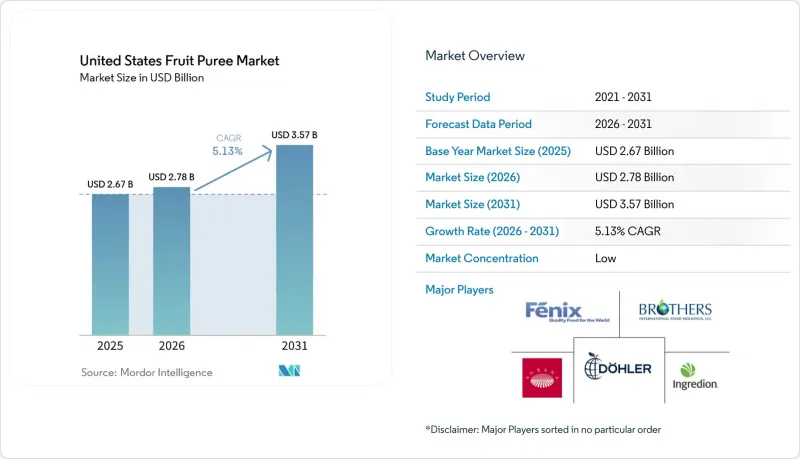
According to Mordor Intelligence, the united states fruit puree market was valued at USD 2.67 billion in 2025 and is expected to reach USD 2.78 billion in 2026. This report is Segmented by Fruit Type (Apple Puree, Banana Puree, Strawberry Puree, Mango Puree, Mixed Fruit Puree, and Other Fruit Types), Category (Conventional and Organic), Application (Baby Food and Infant Nutrition, Beverages, Bakery and Confectionery, Dairy and Frozen Desserts, Sauces, Toppings and Fillings, and Others). The Market Forecasts are Provided in Both Value (USD) and Volume (Tons).
United States Fruit Puree Market Trends and Insights
Demand for clean label and natural ingredients
The growing demand for clean-label and natural ingredients is a significant factor driving the expansion of the United States fruit puree market. According to the International Food Information Council (IFIC), by 2025, 41% of Americans are expected to prefer products labeled as "natural," reflecting an increasing consumer emphasis on ingredient transparency and minimally processed food options . This trend is strongly promoting the use of fruit purees, which offer natural sweetness, authentic fruit flavor, color, and texture while reducing the need for artificial additives, synthetic flavors, and processed sweeteners. Additionally, heightened awareness of simple ingredient formulations and easily recognizable food components is encouraging manufacturers to actively integrate fruit purees into product development to align with evolving clean-label preferences.
Increasing consumer interest in exotic and tropical flavors
The growing consumer interest in exotic and tropical flavors is a significant factor driving the growth of the United States fruit puree market. Consumers are increasingly seeking unique and globally inspired taste experiences. According to the Observatory of Economic Complexity (OEC), the United States imported USD 5.69 billion worth of tropical fruits in 2025, highlighting strong demand and availability of these varieties . The rising popularity of flavors such as mango, passion fruit, guava, and pineapple is boosting the use of fruit purees, which offer authentic taste, natural sweetness, vibrant color, and enhanced sensory appeal. The preference for innovative and premium fruit experiences is prompting manufacturers to use tropical fruit purees as natural alternatives to artificial flavors, colors, and sweeteners. These purees enable the creation of differentiated formulations while aligning with consumer expectations for clean-label and fruit-forward products.
Seasonal availability and fluctuation in fruit supply
Seasonal availability and fluctuations in fruit supply pose significant challenges for the United States fruit puree market, as production relies heavily on a steady supply of high-quality fresh fruits. Factors such as variations in harvesting periods, changing weather conditions, crop diseases, and agricultural uncertainties can affect fruit yield, quality, and supply continuity. Given the perishable nature of fruits, any disruption in availability can hinder consistent production volumes, flavor profiles, color, and nutritional characteristics. Furthermore, variations in fruit maturity, sugar content, and texture across harvest seasons complicate the standardization of puree quality. These supply inconsistencies necessitate effective storage, preservation, and sourcing strategies, making it difficult for manufacturers to ensure year-round product consistency and meet increasing demand.
Other drivers and restraints analyzed in the detailed report include:
- Product innovation and diversification
- Growth of organic and non-GMO fruit puree products
- Short shelf life and quality degradation challenges
For complete list of drivers and restraints, kindly check the Table Of Contents.
Segment Analysis
Apple puree accounted for 32.67% of the market share in 2025, supported by the abundant availability of apples as a raw material and their adaptable processing characteristics. According to the National Agricultural Statistics Service (NASS), apple production increased from 5,452.5 thousand tons in 2024 to 5,551 thousand tons in 2025, ensuring a consistent supply for puree manufacturing . This growth is primarily attributed to apples' naturally balanced sweetness, mild flavor, smooth texture, and high compatibility with various processed food formulations. Additionally, apples contain natural pectin, which enhances thickness, mouthfeel, and consistency, reducing the need for additional stabilizing ingredients. The rising preference for natural, minimally processed, and clean-label ingredients has further driven the adoption of apple puree as a substitute for artificial sweeteners, flavors, and texturizing agents.
Mango puree is expected to grow at a CAGR of 5.81% through 2031, driven by increasing consumer demand for tropical and naturally flavorful fruit ingredients. This growth is supported by mango's unique taste profile, natural sweetness, vibrant color, and smooth consistency, making it ideal for premium and innovative food formulations. The rising demand for clean-label and fruit-based ingredients is promoting the use of mango puree as a natural alternative to artificial flavors, colors, and sweeteners. Furthermore, mango puree offers nutritional benefits, including vitamins, antioxidants, and dietary fiber, aligning with the growing emphasis on healthier and minimally processed products. Advancements in processing technologies, such as aseptic packaging and improved preservation methods, are also enhancing shelf stability while retaining fresh taste, aroma, and nutritional quality.
Complete Report Scope:
- By Fruit Type
- Apple Puree
- Banana Puree
- Strawberry Puree
- Mango Puree
- Mixed Fruit Puree
- Other Fruit Types
- By Category
- Conventional
- Organic
- By Application
- Baby Food and Infant Nutrition
- Beverages
- Bakery and Confectionery
- Dairy and Frozen Desserts
- Sauces, Toppings, and Fillings
- Others
List of Companies Covered in this Report:
- Dohler Group
- Fenix S.A.
- Ingredion Inc.
- AGRANA Beteiligungs-AG
- Brothers International Food Holdings, LLC.
- Uren Food Group Limited
- Milne Fruit Products, Inc.
- Kerry Group plc
- Tree Top, Inc.
- Oregon Fruit Products, L.L.C.
- Rich Products Corporation
- The Perfect Puree of Napa Valley
- Grunewald International
- American International Foods, Inc.
- Aseptic Fruit Purees
- SVZ International B.V.
- Les vergers Boiron
- SunOpta Inc.
- Del Monte Foods, Inc.
- Dole Food Company, Inc.
Additional Benefits:
- The market estimate (ME) sheet in Excel format
- 3 months of analyst support
TABLE OF CONTENTS
1 INTRODUCTION
- 1.1 Study Assumptions and Market Definition
- 1.2 Scope of the Study
2 RESEARCH METHODOLOGY
3 EXECUTIVE SUMMARY
4 MARKET LANDSCAPE
- 4.1 Market Overview
- 4.2 Market Drivers
- 4.2.1 Demand for clean label and natural ingredients
- 4.2.2 Increasing consumer interest in exotic and tropical flavors
- 4.2.3 Product innovation and diversification
- 4.2.4 Growth of organic and non-GMO fruit puree products
- 4.2.5 Advancements in processing and preservation technologies
- 4.2.6 Demand for plant-based and vegan food products
- 4.3 Market Restraints
- 4.3.1 Seasonal availability and fluctuation in fruit supply
- 4.3.2 Short shelf life and quality degradation challenges
- 4.3.3 Complex storage and cold chain requirements
- 4.3.4 High processing and preservation challenges
- 4.4 Technological Outlook
- 4.5 Regulatory Landscape
- 4.6 Supply-Chain Analysis
- 4.7 Porter's Five Forces Analysis
- 4.7.1 Threat of New Entrants
- 4.7.2 Bargaining Power of Buyers
- 4.7.3 Bargaining Power of Suppliers
- 4.7.4 Threat of Substitutes
- 4.7.5 Intensity of Competitive Rivalry
5 MARKET SIZE AND GROWTH FORECASTS (VALUE AND VOLUME)
- 5.1 By Fruit Type
- 5.1.1 Apple Puree
- 5.1.2 Banana Puree
- 5.1.3 Strawberry Puree
- 5.1.4 Mango Puree
- 5.1.5 Mixed Fruit Puree
- 5.1.6 Other Fruit Types
- 5.2 By Category
- 5.2.1 Conventional
- 5.2.2 Organic
- 5.3 By Application
- 5.3.1 Baby Food and Infant Nutrition
- 5.3.2 Beverages
- 5.3.3 Bakery and Confectionery
- 5.3.4 Dairy and Frozen Desserts
- 5.3.5 Sauces, Toppings, and Fillings
- 5.3.6 Others
6 COMPETITIVE LANDSCAPE
- 6.1 Market Concentration
- 6.2 Strategic Moves
- 6.3 Market Positioning Analysis
- 6.4 Company Profiles (includes Global level Overview, Market level overview, Core Segments, Financials as available, Strategic Information, Market Rank/Share for key companies, Products and Services, and Recent Developments)
- 6.4.1 Dohler Group
- 6.4.2 Fenix S.A.
- 6.4.3 Ingredion Inc.
- 6.4.4 AGRANA Beteiligungs-AG
- 6.4.5 Brothers International Food Holdings, LLC.
- 6.4.6 Uren Food Group Limited
- 6.4.7 Milne Fruit Products, Inc.
- 6.4.8 Kerry Group plc
- 6.4.9 Tree Top, Inc.
- 6.4.10 Oregon Fruit Products, L.L.C.
- 6.4.11 Rich Products Corporation
- 6.4.12 The Perfect Puree of Napa Valley
- 6.4.13 Grunewald International
- 6.4.14 American International Foods, Inc.
- 6.4.15 Aseptic Fruit Purees
- 6.4.16 SVZ International B.V.
- 6.4.17 Les vergers Boiron
- 6.4.18 SunOpta Inc.
- 6.4.19 Del Monte Foods, Inc.
- 6.4.20 Dole Food Company, Inc.
7 MARKET OPPORTUNITIES AND FUTURE OUTLOOK

