PUBLISHER: Mordor Intelligence | PRODUCT CODE: 2118980

PUBLISHER: Mordor Intelligence | PRODUCT CODE: 2118980
Fruit Puree - Market Share Analysis, Industry Trends & Statistics, Growth Forecasts (2026 - 2031)
According to Mordor Intelligence, the fruit puree market size is expected to grow from USD 10.39 billion in 2025 to USD 10.75 billion in 2026 and is forecast to reach USD 13.15 billion by 2031 at a 4.11% CAGR over 2026-2031.
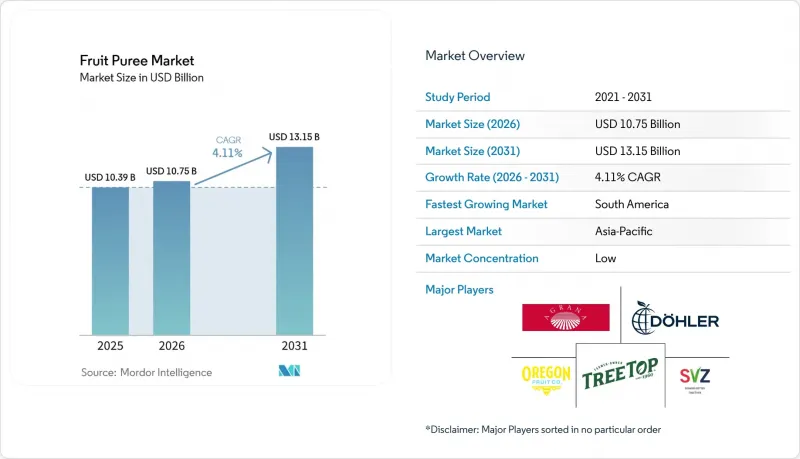
This report is Segmented by Fruit Type (Tropical Fruits, Citrus Fruits, Berries, and More), Category (Conventional and Organic), Application (Baby Food/Infant Nutrition, Beverages, Bakery/Confectionery, Dairy/Frozen Desserts, and More), and Geography (North America, Europe, Asia-Pacific, South America, and Middle East and Africa). The Market Forecasts are Provided in Terms of Value (USD) and Volume (Tons).
Global Fruit Puree Market Trends and Insights
Clean-label reformulation and natural ingredient demand
Growing consumer preference for clean-label foods is driving the use of fruit purees as natural ingredients. Fruit purees provide natural sweetness, color, flavor, and texture, helping manufacturers reduce reliance on artificial additives and synthetic ingredients. According to the 2025 International Food Information Council (IFIC) Food & Health Survey, 41% of United States consumers actively look for "natural" label claims when purchasing foods and beverages. The same survey found that 30% of consumers seek organic products, reflecting increasing demand for minimally processed, fruit-based ingredients in clean-label product formulations.
Rising consumer preference for healthier fruit-based beverages
Growing consumer preference for healthier beverages is encouraging manufacturers to expand fruit-based drinks and smoothies, increasing the use of fruit purees as natural sources of flavor, color, and sweetness. Fruit purees enable manufacturers to formulate beverages with recognizable fruit ingredients while meeting consumer demand for nutritious drink options. According to the 2025 IFIC Food & Health Survey, 25% of consumers define a healthy food as one that contains fruits or vegetables, highlighting the importance of fruit-based ingredients in food and beverage choices. This is encouraging beverage manufacturers to incorporate fruit purees into juices, smoothies, and other fruit-forward beverage formulations.
Seasonal fruit supply and climate-linked yield volatility
The fruit puree market is highly dependent on the availability and quality of fresh fruit, making it vulnerable to seasonal production cycles and climate-related disruptions. Extreme weather events, irregular rainfall, prolonged droughts, floods, and rising temperatures can reduce fruit yields and affect the consistency of raw material supply for processors. Variations in harvest volumes and fruit quality also contribute to fluctuations in procurement costs and production schedules. These supply-side uncertainties can limit manufacturing efficiency, increase price volatility, and challenge producers' ability to meet growing demand consistently.
Other drivers and restraints analyzed in the detailed report include:
- Growing Adoption in Infant and Baby Nutrition
- Tropical and exotic flavor premiumization
- Cold-chain and storage requirements
For complete list of drivers and restraints, kindly check the Table Of Contents.
Segment Analysis
Tropical fruits held the largest share of the fruit puree market, accounting for 35.55% of global revenue in 2025. This segment's dominance is driven by the widespread use of mango, pineapple, banana, and papaya purees across multiple applications. Broad consumer acceptance, year-round demand, and well-established cultivation, processing, and aseptic packaging infrastructure in major producing regions continue to strengthen the segment's market position.
Exotic fruits are projected to register the fastest growth during the forecast period, expanding at a CAGR of 5.44% from 2026 to 2031. Rising consumer interest in premium and globally inspired flavors is encouraging manufacturers to incorporate fruits such as dragon fruit, passion fruit, guava, lychee, and soursop into a multitude of applications. Ongoing product innovation, premiumization, and expanding processing capabilities are expected to further drive demand for exotic fruit purees.
Complete Report Scope:
- By Fruit Type
- Tropical Fruits
- Citrus Fruits
- Berries
- Exotic Fruits
- Others
- By Category
- Conventional
- Organic
- By Application
- Baby Food/Infant Nutrition
- Beverages
- Bakery/Confectionery
- Dairy/Frozen Desserts
- Sauces, Toppings/Fillings
- Others
- By Geography
- North America
- United States
- Canada
- Mexico
- Rest of North America
- Europe
- Germany
- United Kingdom
- Italy
- France
- Spain
- Netherlands
- Poland
- Belgium
- Sweden
- Rest of Europe
- Asia-Pacific
- China
- India
- Japan
- Australia
- Indonesia
- South Korea
- Thailand
- Singapore
- Rest of Asia-Pacific
- South America
- Brazil
- Argentina
- Colombia
- Chile
- Peru
- Rest of South America
- Middle East and Africa
- South Africa
- Saudi Arabia
- United Arab Emirates
- Nigeria
- Egypt
- Morocco
- Turkey
- Rest of Middle East and Africa
- North America
Geography Analysis
Asia-Pacific accounted for the largest share of the global fruit puree market, representing 36.46% of revenue in 2025. The region's dominance is supported by abundant tropical fruit production, a well-established fruit processing industry, and strong demand from the food and beverage sector. Major producing countries such as China, India, Thailand, and Indonesia benefit from extensive cultivation of mango, pineapple, banana, and guava, ensuring a consistent supply of raw materials for puree manufacturers. Growing investments in processing capacity and export-oriented production continue to strengthen the region's position in the global market.
South America is projected to register the fastest growth during the forecast period, expanding at a 5.13% CAGR from 2026 to 2031. Rising investments in fruit processing infrastructure, expanding cultivation of tropical and exotic fruits, and increasing exports of processed fruit products are supporting regional market growth. Brazil, Chile, and Peru continue to strengthen their positions as key suppliers of fruit-based ingredients, while growing domestic demand for packaged foods, beverages, and infant nutrition products is further driving the adoption of fruit purees across the region.
North America and Europe continue to witness steady demand, supported by growing consumption of clean-label, premium, and organic food products. Manufacturers across both regions are increasingly utilizing fruit purees in various products to meet evolving consumer preferences for natural ingredients. Meanwhile, the Middle East and Africa is emerging as a developing market, driven by rising urbanization, increasing consumption of packaged foods and beverages, and gradual investments in food processing capabilities.
- AGRANA Beteiligungs-AG
- Dohler GmbH
- SVZ International B.V.
- Tree Top, Inc.
- Oregon Fruit Products, LLC
- The Perfect Puree of Napa Valley
- Kerry Group plc
- Ingredion Incorporated
- Cargill, Incorporated
- Archer Daniels Midland Company
- Symrise AG
- SunOpta Inc.
- Milne Fruit Products, Inc.
- Uren Food Group Limited
- Capricorn Food Products India Limited
- Fenix S.A.
- Boiron Freres SAS
- Rich Products Corporation
- FruitSmart, Inc.
- ABC Fruits
- Westfalia Fruit
- China Kunyu Industrial Co., Limited
- Shimla Hills Offerings Pvt. Ltd.
- SICOLY-SICODIS cooperative group
Additional Benefits:
- The market estimate (ME) sheet in Excel format
- 3 months of analyst support
TABLE OF CONTENTS
1 INTRODUCTION
- 1.1 Study Assumptions and Market Definition
- 1.2 Scope of the Study
2 RESEARCH METHODOLOGY
3 EXECUTIVE SUMMARY
4 MARKET LANDSCAPE
- 4.1 Market Overview
- 4.2 Market Drivers
- 4.2.1 Clean-label reformulation and natural ingredient demand
- 4.2.2 Rising consumer preference for healthier fruit-based beverages
- 4.2.3 Growing adoption in infant and baby nutrition
- 4.2.4 Tropical and exotic flavor premiumization
- 4.2.5 Increasing use of fruit purees in dairy, bakery, and confectionery products
- 4.2.6 Advancements in fruit processing and preservation technologies
- 4.3 Market Restraints
- 4.3.1 Seasonal fruit supply and climate-linked yield volatility
- 4.3.2 Cold-chain and storage requirements
- 4.3.3 Microbial stability and limited shelf life in minimally processed products
- 4.3.4 Competition from alternative fruit ingredients
- 4.4 Supply Chain Analysis
- 4.5 Regulatory Landscape
- 4.6 Porter's Five Forces Analysis
- 4.6.1 Threat of New Entrants
- 4.6.2 Bargaining Power of Suppliers
- 4.6.3 Bargaining Power of Buyers
- 4.6.4 Threat of Substitutes
- 4.6.5 Industry Rivalry
5 MARKET SIZE AND GROWTH FORECASTS (VALUE AND VOLUME)
- 5.1 By Fruit Type
- 5.1.1 Tropical Fruits
- 5.1.2 Citrus Fruits
- 5.1.3 Berries
- 5.1.4 Exotic Fruits
- 5.1.5 Others
- 5.2 By Category
- 5.2.1 Conventional
- 5.2.2 Organic
- 5.3 By Application
- 5.3.1 Baby Food/Infant Nutrition
- 5.3.2 Beverages
- 5.3.3 Bakery/Confectionery
- 5.3.4 Dairy/Frozen Desserts
- 5.3.5 Sauces, Toppings/Fillings
- 5.3.6 Others
- 5.4 By Geography
- 5.4.1 North America
- 5.4.1.1 United States
- 5.4.1.2 Canada
- 5.4.1.3 Mexico
- 5.4.1.4 Rest of North America
- 5.4.2 Europe
- 5.4.2.1 Germany
- 5.4.2.2 United Kingdom
- 5.4.2.3 Italy
- 5.4.2.4 France
- 5.4.2.5 Spain
- 5.4.2.6 Netherlands
- 5.4.2.7 Poland
- 5.4.2.8 Belgium
- 5.4.2.9 Sweden
- 5.4.2.10 Rest of Europe
- 5.4.3 Asia-Pacific
- 5.4.3.1 China
- 5.4.3.2 India
- 5.4.3.3 Japan
- 5.4.3.4 Australia
- 5.4.3.5 Indonesia
- 5.4.3.6 South Korea
- 5.4.3.7 Thailand
- 5.4.3.8 Singapore
- 5.4.3.9 Rest of Asia-Pacific
- 5.4.4 South America
- 5.4.4.1 Brazil
- 5.4.4.2 Argentina
- 5.4.4.3 Colombia
- 5.4.4.4 Chile
- 5.4.4.5 Peru
- 5.4.4.6 Rest of South America
- 5.4.5 Middle East and Africa
- 5.4.5.1 South Africa
- 5.4.5.2 Saudi Arabia
- 5.4.5.3 United Arab Emirates
- 5.4.5.4 Nigeria
- 5.4.5.5 Egypt
- 5.4.5.6 Morocco
- 5.4.5.7 Turkey
- 5.4.5.8 Rest of Middle East and Africa
- 5.4.1 North America
6 COMPETITIVE LANDSCAPE
- 6.1 Market Concentration
- 6.2 Strategic Moves
- 6.3 Market Share Analysis
- 6.4 Company Profiles (includes Company Highlights, Core Segments, Financials (if available), Strategic Information, Market Share Analysis for Key Companies, Products, and Recent Developments)
- 6.4.1 AGRANA Beteiligungs-AG
- 6.4.2 Dohler GmbH
- 6.4.3 SVZ International B.V.
- 6.4.4 Tree Top, Inc.
- 6.4.5 Oregon Fruit Products, LLC
- 6.4.6 The Perfect Puree of Napa Valley
- 6.4.7 Kerry Group plc
- 6.4.8 Ingredion Incorporated
- 6.4.9 Cargill, Incorporated
- 6.4.10 Archer Daniels Midland Company
- 6.4.11 Symrise AG
- 6.4.12 SunOpta Inc.
- 6.4.13 Milne Fruit Products, Inc.
- 6.4.14 Uren Food Group Limited
- 6.4.15 Capricorn Food Products India Limited
- 6.4.16 Fenix S.A.
- 6.4.17 Boiron Freres SAS
- 6.4.18 Rich Products Corporation
- 6.4.19 FruitSmart, Inc.
- 6.4.20 ABC Fruits
- 6.4.21 Westfalia Fruit
- 6.4.22 China Kunyu Industrial Co., Limited
- 6.4.23 Shimla Hills Offerings Pvt. Ltd.
- 6.4.24 SICOLY-SICODIS cooperative group
7 MARKET OPPORTUNITIES AND FUTURE OUTLOOK

