PUBLISHER: Mordor Intelligence | PRODUCT CODE: 2073237

PUBLISHER: Mordor Intelligence | PRODUCT CODE: 2073237
Beef Cattle Feed Additives - Market Share Analysis, Industry Trends & Statistics, Growth Forecasts (2026 - 2031)
According to Mordor Intelligence, the beef cattle feed additives market size is projected to grow from USD 4.04 billion in 2025 to USD 4.27 billion in 2026 and is forecast to reach USD 5.49 billion by 2031 at 5.15% CAGR over 2026-2031.
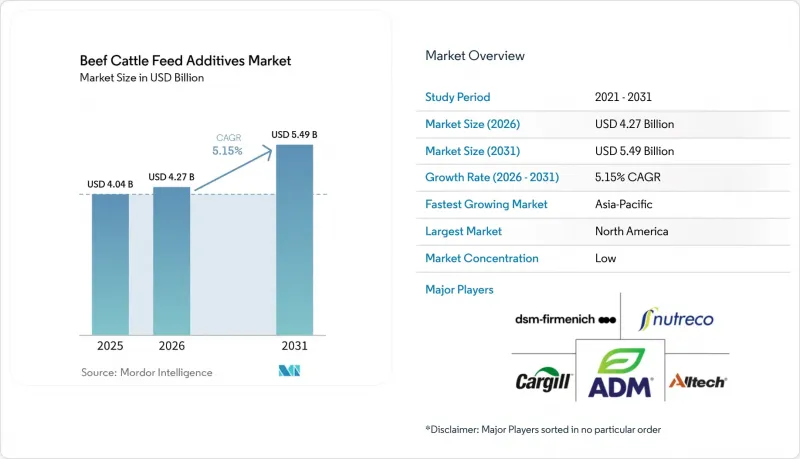
This report is Segmented by Additive Type (Acidifiers, Antibiotics, Antioxidants, Amino Acids, Binders, Enzymes, Flavors and Sweeteners, Minerals, Mycotoxin Detoxifiers, and More), by Form (Dry and Liquid), and by Geography (North America, South America, Europe, Asia-Pacific, Middle East, and Africa). The Market Forecasts are Provided in Terms of Value and Volume.
Global Beef Cattle Feed Additives Market Trends and Insights
Commercial Feedlot Demand for Better Feed Conversion and Daily Gain
Large feedlot systems remain the most stable demand base in the beef cattle feed additives market because their economics depend on measurable feed efficiency and weight gain. In 2025, the World Resources Institute (WRI) reported that methane-inhibiting feed additives are among the most commercially advanced livestock emission-reduction technologies, with average methane reductions of around 30% and some technologies achieving reductions exceeding 90% under controlled conditions. That level of use shows that performance additives in major confinement systems are treated as operating necessities rather than optional inputs. When grain costs rise, the financial value of even modest improvements in feed conversion becomes more apparent, helping keep demand resilient amid margin pressure. The same logic is now strengthening adoption in South American confinement systems, where more producers are validating high-concentrate feeding programs against local finishing economics.
Shift from Antibiotic Growth Promoters to Gut-Health Additives
The market is benefiting from the move away from antibiotic growth promoters in regulated livestock systems. This change is pushing commercial buyers toward probiotics, prebiotics, organic acids, and yeast derivatives that can support intake stability and gut function in receiving and finishing phases. In practice, many producers are not substituting one antibiotic product for another. Instead, they implement layered programs that incorporate multiple additive types to address various digestive and health needs. Products that move through recognized approval pathways, such as the Generally Recognized as Safe (GRAS) route in the United States and authorization reviews under the European Food Safety Authority (EFSA), gain stronger commercial traction because buyers place greater value on documented compliance. That sorting effect favors larger suppliers with regulatory depth and raises the average technical standard across the beef cattle feed additives market.
Tight Approval and Residue-Compliance Burden
The stringent approval processes significantly slow the commercialization of new biological and specialty products. In the United States, the Food and Drug Administration (FDA) employs the New Animal Drug Application (NADA) process for medicated feed combinations, which typically takes 3 to 5 years to complete. In the European Union, Regulation (EC) No 1831/2003 mandates safety evaluations covering animal health, human health, and environmental impact, maintaining a high review standard. Export markets further complicate the process, as producers exporting to regions such as Japan, South Korea, or the European Union must comply with the strictest residue limits. Consequently, the beef cattle feed additives market tends to favor companies with robust regulatory capabilities over those with faster product development cycles.
Other drivers and restraints analyzed in the detailed report include:
- Higher Mycotoxin and Forage Variability in Beef Rations
- Carbon-Insetting Demand for Methane-Reducing Additives
- Limited Grazing-System Fit for Some Methane Inhibitors
For complete list of drivers and restraints, kindly check the Table Of Contents.
Segment Analysis
Amino acids accounted for 20.8% of the beef cattle feed additives market share in 2025, making them the largest additive type. Their position reflects a clear role in protein efficiency, lean tissue deposition, and nitrogen use optimization across finishing, growing, and cow-calf systems. The fastest-growing additive type is antioxidants, which are projected to expand at a 6.7% CAGR during 2026-2031 as feed storage periods lengthen and higher-energy rations increase oxidation risk. The beef cattle feed additives market is also seeing stronger trade preference for natural antioxidant systems, such as tocopherols and citric acid, in export-sensitive applications. That demand pattern keeps amino acids central to performance programs while giving antioxidants a faster expansion path in more quality-conscious feeding systems.
Within the broader beef cattle feed additives industry, probiotics and prebiotics are gaining a stronger role in receiving and transition programs, where gut stability is closely tied to health cost control. Multi-strain formats are becoming more attractive than single-strain products because buyers want broader digestive support in post-antibiotic management. Yeast products are also advancing from a niche support role to a more regular inclusion in feedlot diets that need rumen pH balance and stronger fiber utilization. The European Commission authorized Saccharomyces cerevisiae CNCM I-4407 as a feed additive for cattle for fattening in 2025, which supports the commercial standing of live yeast systems in regulated markets. The beef cattle feed additives market still relies on minerals and vitamins as foundational categories, but the growth mix is shifting toward products that solve ration stability, gut health, and feed preservation issues more directly.
Complete Report Scope:
- By Additive
- Acidifiers
- Lactic Acid
- Propionic Acid
- Fumaric Acid
- Other Acidifiers
- Antibiotics
- Tetracyclines
- Penicillins
- Tylosin
- Bacitracin
- Other Antibiotics
- Antioxidants
- Butylated Hydroxyanisole (BHA)
- Butylated Hydroxytoluene (BHT)
- Ethoxyquin
- Propyl Gallate
- Tocopherols
- Citric Acid
- Other Antioxidants
- Amino Acids
- Lysine
- Tryptophan
- Methionine
- Threonine
- Other Amino Acid
- Binders
- Natural Binders
- Synthetic Binders
- Enzymes
- Carbohydrases
- Phytases
- Other Enzymes
- Flavors and Sweeteners
- Flavors
- Sweeteners
- Minerals
- Macrominerals
- Microminerals
- Mycotoxin Detoxifiers
- Binders
- Biotransformers
- Phytogenics
- Herbs & Spices
- Essential Oil
- Other Phytogenics
- Pigments
- Carotenoids
- Curcumin & Spirulina
- Prebiotics
- Inulin
- Fructo Oligosaccharides
- Galacto Oligosaccharides
- Xylo Oligosaccharides
- Lactulose
- Mannan Oligosaccharides
- Other Prebiotics
- Probiotics
- Lactobacilli
- Bifidobacteria
- Streptococcus
- Pediococcus
- Enterococcus
- Other Probiotics
- Vitamins
- Vitamin A
- Vitamin B
- Vitamin C
- Vitamin E
- Other Vitamins
- Yeast
- Live Yeast
- Spent Yeast
- Torula Dried Yeast
- Selenium Yeast
- Whey Yeast
- Yeast Derivatives
- Acidifiers
- By Form
- Dry
- Liquid
- By Geography
- North America
- United States
- Canada
- Mexico
- Rest of North America
- South America
- Brazil
- Argentina
- Chile
- Rest of South America
- Europe
- Germany
- France
- United Kingdom
- Italy
- Spain
- Netherlands
- Russia
- Rest of Europe
- Asia-Pacific
- China
- India
- Japan
- Australia
- New Zealand
- South Korea
- Indonesia
- Thailand
- Vietnam
- Rest of Asia-Pacific
- Middle East
- Saudi Arabia
- Turkey
- Iran
- United Arab Emirates
- Rest of Middle East
- Africa
- South Africa
- Egypt
- Kenya
- Rest of Africa
- North America
Geography Analysis
North America held 59.1% of the beef cattle feed additives market share in 2025, which made it the largest regional segment. The region's position reflects the technical intensity of the United States feedlot model, where multiple additive classes are already standard in high-concentrate finishing rations. The beef cattle feed additives market in North America is now driven by demand for methane-reduction programs, precision amino acid use, and gut-health products for the receiving phase that address morbidity and carcass-quality goals. Growth will likely stay moderate compared with faster regions because baseline adoption of core performance additives is already high in the most commercial systems. Future value creation in this region is likely to come more from premium products with stronger documentation than from simple volume expansion.
South America remains the highest-growth emerging region in the beef cattle feed additives market, as its cattle base is large and additive penetration still has room to grow. Brazil's cattle herd exceeded 220 million head during the 2024-2025 period, confirming the region's scale and its relevance to long-term additive demand. The growth case is strongest where more cattle are moving through confinement or semi-intensive finishing systems that require structured feeding and more consistent nutritional intervention. In 2024, DSM-Firmenich inaugurated a new animal nutrition facility in Sete Lagoas, Brazil, with the capacity to produce 100,000 metric tons of supplements annually for beef and dairy cattle, reinforcing industry investment in the Brazilian ruminant nutrition value chain and supporting future additive penetration across commercial beef systems. Argentina also supports demand because producers are using more targeted mineral programs in systems where deficiencies in copper, zinc, and selenium can materially reduce calf performance.
Europe remains a mature but specialized part of the beef cattle feed additives market, with demand centered on regulated yeast products, phytogenics, amino acids, and methane-related solutions. Asia-Pacific is the fastest regional segment and is projected to expand at 5.9% CAGR during 2026-2031, supported by feedlot growth and regulatory modernization in China and nearby markets. China expanded the approved use of guanidinoacetic acid for beef fattening cattle in Total Mixed Ration (TMR) programs in January 2026, which shows official support for performance additives in a growing commercial system. De Heus Animal Nutrition B.V. maintains operations across Southeast Asia and Sub-Saharan Africa, where cattle population growth and feed modernization are creating early-stage demand for more formal additive programs. The Middle East presents a distinct opportunity set for the beef cattle feed additives market, as heat stress, reliance on imported feed, and long storage cycles support steady use of antioxidants, acidifiers, and mineral premixes.
- Cargill, Incorporated
- Archer Daniels Midland Company
- Nutreco N.V. (SHV Holdings N.V.)
- DSM-Firmenich AG
- Alltech, Inc.
- Kemin Industries, Inc.
- BASF SE
- Evonik Industries AG
- Elanco Animal Health Incorporated
- Novus International, Inc.
- Bluestar Adisseo Company
- Lallemand Inc.
- Zinpro Corporation
- Land O'Lakes, Inc.
- De Heus Animal Nutrition B.V. (Royal De Heus)
Additional Benefits:
- The market estimate (ME) sheet in Excel format
- 3 months of analyst support
TABLE OF CONTENTS
1 Introduction
- 1.1 Study Assumptions and Market Definition
- 1.2 Scope of the Study
2 Research Methodology
3 Executive Summary
4 Market Landscape
- 4.1 Market Overview
- 4.2 Market Drivers
- 4.2.1 Commercial feedlot demand for better feed conversion and daily gain
- 4.2.2 Shift from antibiotic growth promoters to gut-health additives
- 4.2.3 Higher mycotoxin and forage variability in beef rations
- 4.2.4 Precision mineral and amino acid supplementation adoption
- 4.2.5 Carbon-insetting demand for methane-reducing additives
- 4.2.6 Byproduct-rich rations need more stabilizing additives
- 4.3 Market Restraints
- 4.3.1 Tight approval and residue-compliance burden
- 4.3.2 Volatile input costs for vitamins amino acids and fermentation products
- 4.3.3 Limited grazing-system fit for some methane inhibitors
- 4.3.4 Weak on-farm data capture slows return on investment validation
- 4.4 Regulatory Landscape
- 4.5 Technological Outlook
- 4.6 Porter's Five Forces Analysis
- 4.6.1 Threat of New Entrants
- 4.6.2 Bargaining Power of Suppliers
- 4.6.3 Bargaining Power of Buyers
- 4.6.4 Threat of Substitutes
- 4.6.5 Intensity of Competitive Rivalry
5 Market Size and Growth Forecasts (Value and Volume)
- 5.1 By Additive
- 5.1.1 Acidifiers
- 5.1.1.1 Lactic Acid
- 5.1.1.2 Propionic Acid
- 5.1.1.3 Fumaric Acid
- 5.1.1.4 Other Acidifiers
- 5.1.2 Antibiotics
- 5.1.2.1 Tetracyclines
- 5.1.2.2 Penicillins
- 5.1.2.3 Tylosin
- 5.1.2.4 Bacitracin
- 5.1.2.5 Other Antibiotics
- 5.1.3 Antioxidants
- 5.1.3.1 Butylated Hydroxyanisole (BHA)
- 5.1.3.2 Butylated Hydroxytoluene (BHT)
- 5.1.3.3 Ethoxyquin
- 5.1.3.4 Propyl Gallate
- 5.1.3.5 Tocopherols
- 5.1.3.6 Citric Acid
- 5.1.3.7 Other Antioxidants
- 5.1.4 Amino Acids
- 5.1.4.1 Lysine
- 5.1.4.2 Tryptophan
- 5.1.4.3 Methionine
- 5.1.4.4 Threonine
- 5.1.4.5 Other Amino Acid
- 5.1.5 Binders
- 5.1.5.1 Natural Binders
- 5.1.5.2 Synthetic Binders
- 5.1.6 Enzymes
- 5.1.6.1 Carbohydrases
- 5.1.6.2 Phytases
- 5.1.6.3 Other Enzymes
- 5.1.7 Flavors and Sweeteners
- 5.1.7.1 Flavors
- 5.1.7.2 Sweeteners
- 5.1.8 Minerals
- 5.1.8.1 Macrominerals
- 5.1.8.2 Microminerals
- 5.1.9 Mycotoxin Detoxifiers
- 5.1.9.1 Binders
- 5.1.9.2 Biotransformers
- 5.1.10 Phytogenics
- 5.1.10.1 Herbs & Spices
- 5.1.10.2 Essential Oil
- 5.1.10.3 Other Phytogenics
- 5.1.11 Pigments
- 5.1.11.1 Carotenoids
- 5.1.11.2 Curcumin & Spirulina
- 5.1.12 Prebiotics
- 5.1.12.1 Inulin
- 5.1.12.2 Fructo Oligosaccharides
- 5.1.12.3 Galacto Oligosaccharides
- 5.1.12.4 Xylo Oligosaccharides
- 5.1.12.5 Lactulose
- 5.1.12.6 Mannan Oligosaccharides
- 5.1.12.7 Other Prebiotics
- 5.1.13 Probiotics
- 5.1.13.1 Lactobacilli
- 5.1.13.2 Bifidobacteria
- 5.1.13.3 Streptococcus
- 5.1.13.4 Pediococcus
- 5.1.13.5 Enterococcus
- 5.1.13.6 Other Probiotics
- 5.1.14 Vitamins
- 5.1.14.1 Vitamin A
- 5.1.14.2 Vitamin B
- 5.1.14.3 Vitamin C
- 5.1.14.4 Vitamin E
- 5.1.14.5 Other Vitamins
- 5.1.15 Yeast
- 5.1.15.1 Live Yeast
- 5.1.15.2 Spent Yeast
- 5.1.15.3 Torula Dried Yeast
- 5.1.15.4 Selenium Yeast
- 5.1.15.5 Whey Yeast
- 5.1.15.6 Yeast Derivatives
- 5.1.1 Acidifiers
- 5.2 By Form
- 5.2.1 Dry
- 5.2.2 Liquid
- 5.3 By Geography
- 5.3.1 North America
- 5.3.1.1 United States
- 5.3.1.2 Canada
- 5.3.1.3 Mexico
- 5.3.1.4 Rest of North America
- 5.3.2 South America
- 5.3.2.1 Brazil
- 5.3.2.2 Argentina
- 5.3.2.3 Chile
- 5.3.2.4 Rest of South America
- 5.3.3 Europe
- 5.3.3.1 Germany
- 5.3.3.2 France
- 5.3.3.3 United Kingdom
- 5.3.3.4 Italy
- 5.3.3.5 Spain
- 5.3.3.6 Netherlands
- 5.3.3.7 Russia
- 5.3.3.8 Rest of Europe
- 5.3.4 Asia-Pacific
- 5.3.4.1 China
- 5.3.4.2 India
- 5.3.4.3 Japan
- 5.3.4.4 Australia
- 5.3.4.5 New Zealand
- 5.3.4.6 South Korea
- 5.3.4.7 Indonesia
- 5.3.4.8 Thailand
- 5.3.4.9 Vietnam
- 5.3.4.10 Rest of Asia-Pacific
- 5.3.5 Middle East
- 5.3.5.1 Saudi Arabia
- 5.3.5.2 Turkey
- 5.3.5.3 Iran
- 5.3.5.4 United Arab Emirates
- 5.3.5.5 Rest of Middle East
- 5.3.6 Africa
- 5.3.6.1 South Africa
- 5.3.6.2 Egypt
- 5.3.6.3 Kenya
- 5.3.6.4 Rest of Africa
- 5.3.1 North America
6 Competitive Landscape
- 6.1 Market Concentration
- 6.2 Strategic Moves
- 6.3 Market Share Analysis
- 6.4 Company Profiles (Includes Global Level Overview, Market Level Overview, Core Segments, Financials as Available, Strategic Information, Market Rank/Share for Key Companies, Products and Services, and Recent Developments)
- 6.4.1 Cargill, Incorporated
- 6.4.2 Archer Daniels Midland Company
- 6.4.3 Nutreco N.V. (SHV Holdings N.V.)
- 6.4.4 DSM-Firmenich AG
- 6.4.5 Alltech, Inc.
- 6.4.6 Kemin Industries, Inc.
- 6.4.7 BASF SE
- 6.4.8 Evonik Industries AG
- 6.4.9 Elanco Animal Health Incorporated
- 6.4.10 Novus International, Inc.
- 6.4.11 Bluestar Adisseo Company
- 6.4.12 Lallemand Inc.
- 6.4.13 Zinpro Corporation
- 6.4.14 Land O'Lakes, Inc.
- 6.4.15 De Heus Animal Nutrition B.V. (Royal De Heus)
7 Market Opportunities and Future Outlook

