PUBLISHER: Mordor Intelligence | PRODUCT CODE: 2063347

PUBLISHER: Mordor Intelligence | PRODUCT CODE: 2063347
Dairy Cattle Feed - Market Share Analysis, Industry Trends & Statistics, Growth Forecasts (2026 - 2031)
According to Mordor Intelligence, the dairy cattle feed market size is projected to grow from USD 78.6 billion in 2025 to USD 82.4 billion in 2026 and USD 105.8 billion by 2031, with a CAGR of 5.1% from 2026 to 2031.
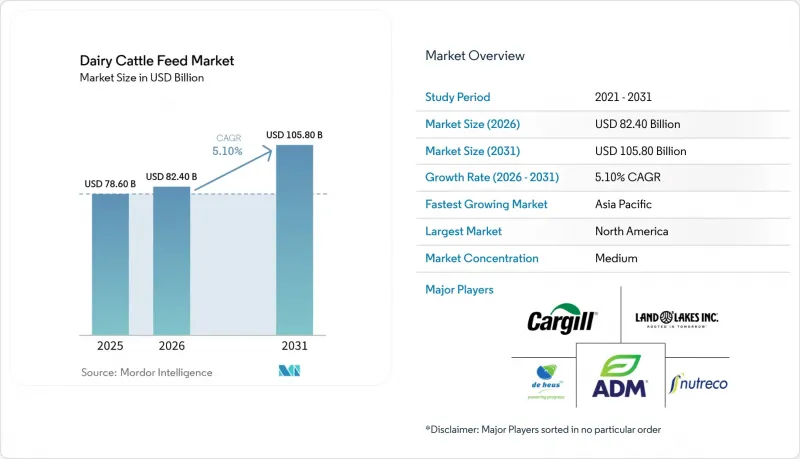
This report is Segmented by Feed Type (Energy Feed, Protein Feed, Minerals, Vitamins, and More), by Form (Pellets, Crumbles, Mash, and More), by Ingredient Source (Corn, Soybean Meal, Wheat, and More), by Lifecycle Stage (Calf Starter, Heifer Grower, and More), and by Geography (North America, South America, Europe, and More). The Market Forecasts are Provided in Terms of Value (USD).
Global Dairy Cattle Feed Market Trends and Insights
Growing Intensification of Dairy Farms in Emerging Economies
The growth of dairy cattle farming in India is increasing the demand for ruminant and compound cattle feed, driven by rising herd productivity and structured feeding practices. According to the Government of India, milk production totaled 247.87 million metric tons in 2024-25, a 3.58% increase from 239.30 million metric tons in 2023-24, reflecting the expansion of organized dairy systems and larger herd sizes. This growth underscores the need for nutritionally balanced ruminant feed to maintain productivity levels. As dairy farms transition to commercial operations with enhanced feed management practices, the use of formulated cattle feed is projected to increase, supporting sustained growth in the dairy cattle feed market.
Adoption of Precision-Feeding Software and IoT Ration Sensors
According to a study by the National Institutes of Health, the growth of dairy farms and larger herd sizes have increased the complexity of animal monitoring, resulting in challenges related to health, welfare, and productivity. The study emphasizes that precision livestock farming (PLF) employs sensors to monitor individual animals in real time, facilitating improved herd management and performance optimization. These systems incorporate IoT technologies, including cloud computing and machine learning, to enable data-driven decision-making in dairy operations.
Escalating Phytosanitary Import Barriers on Feed Ingredients
Increasingly stringent phytosanitary regulations are restricting global trade in feed ingredients, significantly affecting the supply availability for the dairy cattle feed market. The United States Department of Agriculture reports that the European Union's proposed stricter pesticide residue limits could impact agricultural exports worth over USD 5.4 billion annually . These regulatory measures raise compliance costs and restrict market access for exporters. Consequently, feed manufacturers encounter supply disruptions and price challenges, emphasizing the importance of diversified sourcing strategies and flexible procurement practices.
Other drivers and restraints analyzed in the detailed report include:
- Surge in Functional Dairy Demand for A2 and Lactose-free Products
- Volatility-Hedging Contracts for Feed Corn and Soybean Meal
- Antibiotic-Use Scrutiny Tightening Medicated-Feed Approvals
For complete list of drivers and restraints, kindly check the Table Of Contents.
Segment Analysis
Energy feed led with the largest 40% of the dairy cattle feed market share in 2025, while the functional additives market size is advancing at the fastest 8.9% CAGR from 2026 to 2031. Producers are increasingly focusing on 3-nitrooxypropanol, as an investment in this additive can be offset through carbon credits and reduced methane-related milk levies. While energy feeds continue to dominate the dairy cattle feed market in terms of size, their share is gradually declining as feed mills allocate budgets toward probiotics, live yeast, and protected amino acids. Start-ups focusing on rumen microbiome modulation are entering a space previously dominated by medicated crumbles.
In practical ration formulation, enzymes and direct-fed microbials are combined with coated methionine to enhance protein efficiency. Functional additives could capture a significant market share if regulatory bodies accept prescription-like marketing strategies. Energy feeds will remain a key component, but are projected to shift toward local grain by-products when corn prices reach export-parity levels. This trend underscores the dairy cattle feed market's transition toward nutrient density over simple calorie content.
Pellets held the largest 46% of the dairy cattle feed market share in 2025, whereas the total mixed ration (TMR) market size is expanding at the fastest 9.7% CAGR from 2036 to 2031. Robotic mixers that weigh, blend, and deliver feed with high precision are driving advancements in the dairy cattle feed market. Large herds increasingly rely on Total Mixed Ration (TMR) robots to address staffing challenges caused by persistent labor shortages. As a result, the market for TMR components is expanding, particularly in regions where energy efficiency contributes to improved carbon scorecards, attracting interest from milk buyers.
While demand for crumble and mash feed remains steady in calf and heifer diets, its growth is limited. Conversely, the introduction of advanced TMR nutrient sensors, which transmit detailed data such as Neutral Detergent Fiber (NDF) and starch content to cloud-based dashboards, is transforming feed into a data-driven product. Feed mills capable of providing both the physical feed blend and accompanying data insights are positioned to benefit significantly in this evolving market.
Geography Analysis
North America is projected to account for 29% of the dairy cattle feed market share in 2025. States such as California, Wisconsin, Idaho, and Texas represent significant demand centers, supported by regional mills that provide Total Mixed Ration (TMR) startups and cloud-based analytics. Canada's quota system stabilizes milk payments, which in turn balances feed budgets. Meanwhile, Mexico leverages its proximity to surplus ingredients from the United States, fostering a strong cross-border logistics network. Archer-Daniels-Midland Company (ADM) and Alltech, Inc. Akralos venture, launched in February 2026, highlights the region's focus on scaling operations and integrating technical services.
The Asia-Pacific market is projected to grow at a 7.4% CAGR from 2026 to 2031, making it the fastest-growing region. Government initiatives supporting cold-chain infrastructure and genotyping are increasing the demand for higher feed specification requirements. These programs aim to enhance the efficiency and quality of feed production, ensuring compliance with evolving industry standards. Although Australia and Japan are regarded as mature markets, they maintain a strong demand for feed traceability and functional additives that meet consumer expectations for sustainability, reflecting a growing emphasis on transparency and environmental responsibility.
Europe is navigating challenges such as stagnant milk production, stringent climate policies, and competition from plant-based alternatives. Carbon footprint considerations and residue limits are influencing ingredient choices, encouraging the use of regional grains and deforestation-free soy certifications. Eastern Europe remains a promising area for expansion, as demonstrated by ForFarmers' recent activities in Poland. South America benefits from cost advantages associated with pasture-based systems but is increasingly adopting confinement diets to capture export opportunities.
- Cargill, Incorporated
- Archer-Daniels-Midland Company (ADM)
- Nutreco N.V. (SHV Holdings N.V.)
- Land O'Lakes, Inc.
- De Heus Voeders B.V.
- ForFarmers N.V.
- Lallemand Inc.
- Alltech, Inc.
- Evonik Industries AG
- BASF SE
- DSM-Firmenich AG
- Godrej Agrovet Limited
- Royal Agrifirm Group (Cooperatie Koninklijke Agrifirm U.A.)
- Kent Nutrition Group, Inc. (Kent Corporation)
- Ridley Corporation Limited
Additional Benefits:
- The market estimate (ME) sheet in Excel format
- 3 months of analyst support
TABLE OF CONTENTS
1 Introduction
- 1.1 Study Assumptions and Market Definition
- 1.2 Scope of the Study
2 Research Methodology
3 Executive Summary
4 Market Landscape
- 4.1 Market Overview
- 4.2 Market Drivers
- 4.2.1 Growing intensification of dairy farms in emerging economies
- 4.2.2 Adoption of precision-feeding software and IoT ration sensors
- 4.2.3 Surge in functional dairy demand for A2 and lactose-free products
- 4.2.4 Volatility-hedging contracts for feed corn and soybean meal
- 4.2.5 Carbon-credit programs rewarding low-methane dairy herds
- 4.2.6 On-farm insect bioconversion of manure into high-protein feed
- 4.3 Market Restraints
- 4.3.1 Escalating phytosanitary import barriers on feed ingredients
- 4.3.2 Antibiotic-use scrutiny tightening medicated-feed approvals
- 4.3.3 Margin squeeze from alternative milk uptake
- 4.3.4 Smallholder credit limitations in Africa and South Asia
- 4.4 Regulatory Landscape
- 4.5 Technological Outlook
- 4.6 Porters Five Forces Analysis
- 4.6.1 Intensity of Competitive Rivalry
- 4.6.2 Threat of New Entrants
- 4.6.3 Bargaining Power of Suppliers
- 4.6.4 Bargaining Power of Buyers
- 4.6.5 Threat of Substitutes
5 Market Size and Growth Forecasts (Value)
- 5.1 By Feed Type
- 5.1.1 Energy Feed
- 5.1.2 Protein Feed
- 5.1.3 Minerals
- 5.1.4 Vitamins
- 5.1.5 Functional Additives
- 5.1.6 Others
- 5.2 By Form
- 5.2.1 Pellets
- 5.2.2 Crumbles
- 5.2.3 Mash
- 5.2.4 Total Mixed Ration (TMR)
- 5.2.5 Others
- 5.3 By Ingredient Source
- 5.3.1 Corn
- 5.3.2 Soybean Meal
- 5.3.3 Wheat
- 5.3.4 Alfalfa
- 5.3.5 Others
- 5.4 By Lifecycle Stage
- 5.4.1 Calf Starter
- 5.4.2 Heifer Grower
- 5.4.3 Lactating Cow Ration
- 5.4.4 Dry Cow Ration
- 5.5 By Geography
- 5.5.1 North America
- 5.5.1.1 United States
- 5.5.1.2 Canada
- 5.5.1.3 Mexico
- 5.5.1.4 Rest of North America
- 5.5.2 South America
- 5.5.2.1 Brazil
- 5.5.2.2 Argentina
- 5.5.2.3 Rest of South America
- 5.5.3 Europe
- 5.5.3.1 Germany
- 5.5.3.2 France
- 5.5.3.3 Russia
- 5.5.3.4 Italy
- 5.5.3.5 Spain
- 5.5.3.6 United Kingdom
- 5.5.3.7 Rest of Europe
- 5.5.4 Asia-Pacific
- 5.5.4.1 China
- 5.5.4.2 India
- 5.5.4.3 Australia
- 5.5.4.4 Japan
- 5.5.4.5 Rest of Asia-Pacific
- 5.5.5 Middle East
- 5.5.5.1 United Arab Emirates
- 5.5.5.2 Saudi Arabia
- 5.5.5.3 Rest of Middle East
- 5.5.6 Africa
- 5.5.6.1 South Africa
- 5.5.6.2 Egypt
- 5.5.6.3 Rest of Africa
- 5.5.1 North America
6 Competitive Landscape
- 6.1 Market Concentration
- 6.2 Strategic Moves
- 6.3 Market Share Analysis
- 6.4 Company Profiles (Includes Global Level Overview, Market Level Overview, Core Segments, Financials as Available, Strategic Information, Market Rank/Share for Key Companies, Products and Services, and Recent Developments)
- 6.4.1 Cargill, Incorporated
- 6.4.2 Archer-Daniels-Midland Company (ADM)
- 6.4.3 Nutreco N.V. (SHV Holdings N.V.)
- 6.4.4 Land O'Lakes, Inc.
- 6.4.5 De Heus Voeders B.V.
- 6.4.6 ForFarmers N.V.
- 6.4.7 Lallemand Inc.
- 6.4.8 Alltech, Inc.
- 6.4.9 Evonik Industries AG
- 6.4.10 BASF SE
- 6.4.11 DSM-Firmenich AG
- 6.4.12 Godrej Agrovet Limited
- 6.4.13 Royal Agrifirm Group (Cooperatie Koninklijke Agrifirm U.A.)
- 6.4.14 Kent Nutrition Group, Inc. (Kent Corporation)
- 6.4.15 Ridley Corporation Limited
7 Market Opportunities and Future Outlook

