PUBLISHER: Mordor Intelligence | PRODUCT CODE: 2073245

PUBLISHER: Mordor Intelligence | PRODUCT CODE: 2073245
Broiler Feed Additives - Market Share Analysis, Industry Trends & Statistics, Growth Forecasts (2026 - 2031)
According to Mordor Intelligence, the broiler feed additives market size is projected to grow from USD 11.08 billion in 2025 to USD 11.64 billion in 2026 and is forecast to reach USD 15.15 billion by 2031 at 5.42% CAGR over 2026-2031.
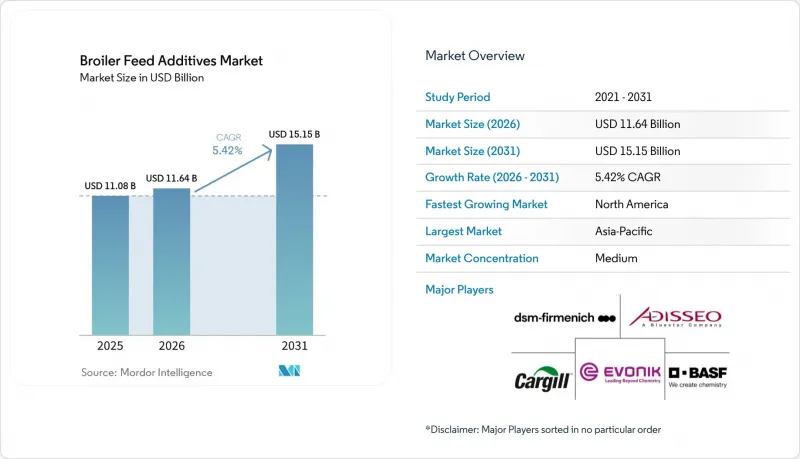
This report is Segmented by Additive (Acidifiers, Antibiotics, Amino Acids, Enzymes, Phytogenics, Probiotics, and More), by Form (Dry and Liquid), by Broiler Production Phase (Starter Feed, Grower Feed, and Finisher Feed), and by Geography (North America, South America, Europe, Asia-Pacific, Middle East, and Africa). The Market Forecasts are Provided in Terms of Value (USD) and Volume (Metric Tons).
Global Broiler Feed Additives Market Trends and Insights
Antibiotic-Free Broiler Programs Accelerate Eubiotic Adoption
The broiler feed additives market is seeing faster adoption of eubiotics as antibiotic rules tighten and more producers maintain no-antibiotics-ever programs. The Food and Drug Administration (FDA) issued Guidance for Industry 273 in February 2026, requiring drug sponsors to add duration limits to medically important antibiotics that lacked them in food-producing animals. The report, published by the United States Poultry & Egg Association (USPOULTRY) in 2025 using data through 2024, emphasizes the ongoing decline in the use of medically important antibiotics in broiler production. This trend demonstrates advancements in antibiotic stewardship within commercial poultry operations. As a result, alternatives such as probiotics, organic acids, phytogenics, and feed enzymes are gaining significance for improving gut health, nutrient utilization, and production performance. Suppliers offering flexible portfolios that cater to both conventional and reduced-antibiotic systems are well-positioned to meet market demand.
Feed Conversion Ratio Optimization Under Feed-Cost Pressure
The use of feed additives for broilers continues to be driven by the need to improve feed conversion ratios, as feed remains the largest cost component in broiler production. Evonik Industries AG states that poultry nutrition programs center on improving nutrient use and flock performance, which keeps amino acids and enzymes closely tied to return-on-investment decisions at the farm level. A 2025 study in Frontiers in Animal Science found that a protease, phytase, and xylanase combination improved body weight, feed conversion ratio, ileal digestibility, and gut morphology in broilers under commercial conditions. This evidence supports a move away from single-product optimization toward stacked additive programs that deliver measurable economic gains across the flock. The broiler feed additives market, therefore, gains not only from higher inclusion rates but also from a richer product mix with better pricing power for suppliers.
Concentrated Vitamin and Amino-acid Supply Base Raises Sourcing Risk
The broiler feed additives market is exposed to sourcing risk because several core inputs depend on a narrow production base. This matters most for vitamins and amino acids, where price movements and supply disruptions can quickly shift premix economics and force reformulation. Adisseo announced a worldwide price increase for SmartLine methionine effective May 1, 2026, and linked it to sustained raw material, energy, manufacturing, and logistics cost increases. For producers and feed formulators, the problem is not only cost inflation but also the risk of supply gaps that interrupt established inclusion programs. This creates a practical ceiling on how quickly premium programs can scale in the broiler feed additives market when they rely heavily on imported active ingredients.
Other drivers and restraints analyzed in the detailed report include:
- Amino-Acid-Enabled Low-Protein Formulations Gain Traction
- Enteric Disease and Mycotoxin Control Raise Additive Intensity
- Regulatory Proof Burden Slows Novel Microbial and Phytogenic Launches
For complete list of drivers and restraints, kindly check the Table Of Contents.
Segment Analysis
Amino acids were the largest additive type, and accounted for 22.1% of the broiler feed additives market share in 2025. Their position reflects the basic role of lysine, methionine, threonine, and tryptophan in protein synthesis, growth performance, and carcass quality across commercial broiler feeding programs. Methionine remains especially important because it is the first-limiting amino acid in many corn and soybean meal diets, which keeps its use close to universal in intensive broiler systems. Enzymes also play a significant role in the broiler feed additives market, as phytase, carbohydrase, and protease products help producers extract greater value from feed ingredients under cost pressure. Vitamins, acidifiers, minerals, antioxidants, and antibiotics play stable or residual roles depending on local regulations, dietary structure, and production model.
Probiotics are projected to be the fastest-growing additive category in the broiler feed additives market, with a 6.6% CAGR over 2026-2031. This growth reflects stronger demand for non-antibiotic gut health tools and better strain-level positioning in commercial poultry nutrition. Novonesis completed the acquisition of DSM-Firmenich AG's share in the Feed Enzyme Alliance in 2025 for USD 1.62 billion (EUR 1.5 billion), thereby strengthening its reach across enzyme and probiotic applications. In 2026, the company also agreed to acquire a production facility in Rayong, Thailand, for USD 50 million, expanding supply capacity closer to Asian demand centers. Within the broiler feed additives industry, phytogenics, prebiotics, yeast derivatives, mycotoxin detoxifiers, and pigments remain smaller but important categories because they support gut health, stress response, feed safety, and product quality in targeted production systems.
Complete Report Scope:
- By Additive
- Acidifiers
- Lactic Acid
- Propionic Acid
- Fumaric Acid
- Other Acidifiers
- Antibiotics
- Tetracyclines
- Penicillins
- Tylosin
- Bacitracin
- Other Antibiotics
- Antioxidants
- Butylated Hydroxyanisole (BHA)
- Butylated Hydroxytoluene (BHT)
- Ethoxyquin
- Propyl Gallate
- Tocopherols
- Citric Acid
- Other Antioxidants
- Amino Acids
- Lysine
- Tryptophan
- Methionine
- Threonine
- Other Amino Acids
- Binders
- Natural Binders
- Synthetic Binders
- Enzymes
- Carbohydrases
- Phytases
- Other Enzymes
- Flavors & Sweeteners
- Flavors
- Sweeteners
- Minerals
- Macrominerals
- Microminerals
- Mycotoxin Detoxifiers
- Binders
- Biotransformers
- Phytogenics
- Herbs & Spices
- Essential Oil
- Other Phytogenics
- Pigments
- Carotenoids
- Curcumin & Spirulina
- Prebiotics
- Inulin
- Fructo Oligosaccharides
- Galacto Oligosaccharides
- Xylo Oligosaccharides
- Lactulose
- Mannan Oligosaccharides
- Other Prebiotics
- Probiotics
- Lactobacilli
- Bifidobacteria
- Streptococcus
- Pediococcus
- Enterococcus
- Other Probiotics
- Vitamins
- Vitamin A
- Vitamin B
- Vitamin C
- Vitamin E
- Other Vitamins
- Yeast
- Live Yeast
- Spent Yeast
- Torula Dried Yeast
- Selenium Yeast
- Whey Yeast
- Yeast Derivatives
- Acidifiers
- By Form
- Dry
- Liquid
- By Broiler Production Phase
- Starter Feed
- Grower Feed
- Finisher Feed
- By Geography
- North America
- United States
- Canada
- Mexico
- Rest of North America
- South America
- Brazil
- Argentina
- Rest of South America
- Europe
- Germany
- France
- United Kingdom
- Spain
- Italy
- Russia
- Rest of Europe
- Asia-Pacific
- China
- India
- Japan
- Thailand
- Indonesia
- Australia
- Rest of Asia-Pacific
- Middle East
- Saudi Arabia
- Turkey
- Iran
- Rest of Middle East
- Africa
- South Africa
- Egypt
- Rest of Africa
- North America
Geography Analysis
Asia-Pacific accounted for 34.1% of the broiler feed additives market in 2025 and remained the largest regional base entering 2026. As per Alltech's Agri-Food Outlook, China's total commercial broiler feed output reached 101.0 million metric tons in 2025, while India reached 20.3 million metric tons, and Indonesia's output was 8.7 million metric tons. The broiler feed additives market in Asia-Pacific benefits from the ongoing shift from on-farm mixing to more commercial feed systems that adopt more consistent additive programs. That shift supports greater demand for amino acids, enzymes, vitamins, and probiotics across large integrated poultry operations and is gradually formalizing mid-scale producers. Supplier interest in the region also remained visible when Novonesis agreed in 2026 to acquire a production facility in Rayong, Thailand.
North America is anticipated to be the fastest-growing region in the broiler feed additives market, with a 6.3% CAGR over 2026-2031. The region's growth is tied to premiumization in nutrition programs, especially where integrators operate under no-antibiotics-ever or reduced-antibiotic commitments. The Food and Drug Administration (FDA) guidance issued in February 2026 supported tighter antibiotic stewardship in food-producing animals, which is anticipated to keep demand favorable for eubiotics and functional nutrition tools. The Archer Daniels Midland Company and Alltech, Inc. feed joint venture launched in the first quarter of 2026 and added scale to the regional supply platform for premix and additive solutions. In this part of the broiler feed additives market, growth comes less from flock expansion and more from higher additive value per bird and more specialized customer requirements.
South America remains a strong growth geography for the broiler feed additives market, as Brazil combines large domestic poultry output with export discipline. According to the Brazilian Association of Animal Protein (ABPA), Brazil produced 15.3 million metric tons of chicken meat in 2025 and exported 5.3 million metric tons, valued at USD 9.8 billion, which shows the scale of the country's commercial poultry chain. Europe remains mature, but innovation remains active because its long-standing ban on antibiotic growth promoters, welfare rules, and detailed additive approvals keep technical requirements high. Germany's broiler feed production reached 4.1 million metric tons in 2025, according to the Alltech Agri-Food Outlook, which confirmed steady underlying feed demand in a regulated European setting. The Middle East and Africa are smaller in absolute size, but the broiler feed additives market there is expanding from a lower base as commercial feed adoption rises in countries such as Saudi Arabia, Turkey, South Africa, Egypt, and Nigeria.
- DSM-Firmenich AG
- Evonik Industries AG
- Bluestar Adisseo Company
- Cargill, Incorporated
- BASF SE
- Archer Daniels Midland Company
- Nutreco N.V. (SHV Holdings N.V.)
- Novus International, Inc. (Mitsui & Co., Ltd.)
- Kemin Industries, Inc.
- International Flavors & Fragrances Inc.
- Novonesis A/S
- Alltech, Inc.
- Elanco Animal Health Incorporated
- Phibro Animal Health Corporation
- Lesaffre
Additional Benefits:
- The market estimate (ME) sheet in Excel format
- 3 months of analyst support
TABLE OF CONTENTS
1 Introduction
- 1.1 Study Assumptions and Market Definition
- 1.2 Scope of the Study
2 Research Methodology
3 Executive Summary
4 Market Landscape
- 4.1 Market Overview
- 4.2 Market Drivers
- 4.2.1 Antibiotic-free broiler programs accelerate eubiotic adoption
- 4.2.2 Feed conversion ratio optimization under feed-cost pressure
- 4.2.3 Amino-acid-enabled low-protein formulations gain traction
- 4.2.4 Enteric disease and mycotoxin control raise additive intensity
- 4.2.5 Pelleting-stable precision additives widen commercial use
- 4.2.6 Carcass yield and footpad outcome optimization drive premium blends
- 4.3 Market Restraints
- 4.3.1 Inconsistent field response across diet matrices and flock conditions
- 4.3.2 Concentrated vitamin and amino-acid supply base raises sourcing risk
- 4.3.3 Regulatory proof burden slows novel microbial and phytogenic launches
- 4.3.4 Cost-sensitive producers retain legacy additive programs in some systems
- 4.4 Regulatory Landscape
- 4.5 Technological Outlook
- 4.6 Porter's Five Forces Analysis
- 4.6.1 Threat of New Entrants
- 4.6.2 Bargaining Power of Suppliers
- 4.6.3 Bargaining Power of Buyers
- 4.6.4 Threat of Substitutes
- 4.6.5 Intensity of Competitive Rivalry
5 Market Size and Growth Forecasts (Value and Volume)
- 5.1 By Additive
- 5.1.1 Acidifiers
- 5.1.1.1 Lactic Acid
- 5.1.1.2 Propionic Acid
- 5.1.1.3 Fumaric Acid
- 5.1.1.4 Other Acidifiers
- 5.1.2 Antibiotics
- 5.1.2.1 Tetracyclines
- 5.1.2.2 Penicillins
- 5.1.2.3 Tylosin
- 5.1.2.4 Bacitracin
- 5.1.2.5 Other Antibiotics
- 5.1.3 Antioxidants
- 5.1.3.1 Butylated Hydroxyanisole (BHA)
- 5.1.3.2 Butylated Hydroxytoluene (BHT)
- 5.1.3.3 Ethoxyquin
- 5.1.3.4 Propyl Gallate
- 5.1.3.5 Tocopherols
- 5.1.3.6 Citric Acid
- 5.1.3.7 Other Antioxidants
- 5.1.4 Amino Acids
- 5.1.4.1 Lysine
- 5.1.4.2 Tryptophan
- 5.1.4.3 Methionine
- 5.1.4.4 Threonine
- 5.1.4.5 Other Amino Acids
- 5.1.5 Binders
- 5.1.5.1 Natural Binders
- 5.1.5.2 Synthetic Binders
- 5.1.6 Enzymes
- 5.1.6.1 Carbohydrases
- 5.1.6.2 Phytases
- 5.1.6.3 Other Enzymes
- 5.1.7 Flavors & Sweeteners
- 5.1.7.1 Flavors
- 5.1.7.2 Sweeteners
- 5.1.8 Minerals
- 5.1.8.1 Macrominerals
- 5.1.8.2 Microminerals
- 5.1.9 Mycotoxin Detoxifiers
- 5.1.9.1 Binders
- 5.1.9.2 Biotransformers
- 5.1.10 Phytogenics
- 5.1.10.1 Herbs & Spices
- 5.1.10.2 Essential Oil
- 5.1.10.3 Other Phytogenics
- 5.1.11 Pigments
- 5.1.11.1 Carotenoids
- 5.1.11.2 Curcumin & Spirulina
- 5.1.12 Prebiotics
- 5.1.12.1 Inulin
- 5.1.12.2 Fructo Oligosaccharides
- 5.1.12.3 Galacto Oligosaccharides
- 5.1.12.4 Xylo Oligosaccharides
- 5.1.12.5 Lactulose
- 5.1.12.6 Mannan Oligosaccharides
- 5.1.12.7 Other Prebiotics
- 5.1.13 Probiotics
- 5.1.13.1 Lactobacilli
- 5.1.13.2 Bifidobacteria
- 5.1.13.3 Streptococcus
- 5.1.13.4 Pediococcus
- 5.1.13.5 Enterococcus
- 5.1.13.6 Other Probiotics
- 5.1.14 Vitamins
- 5.1.14.1 Vitamin A
- 5.1.14.2 Vitamin B
- 5.1.14.3 Vitamin C
- 5.1.14.4 Vitamin E
- 5.1.14.5 Other Vitamins
- 5.1.15 Yeast
- 5.1.15.1 Live Yeast
- 5.1.15.2 Spent Yeast
- 5.1.15.3 Torula Dried Yeast
- 5.1.15.4 Selenium Yeast
- 5.1.15.5 Whey Yeast
- 5.1.15.6 Yeast Derivatives
- 5.1.1 Acidifiers
- 5.2 By Form
- 5.2.1 Dry
- 5.2.2 Liquid
- 5.3 By Broiler Production Phase
- 5.3.1 Starter Feed
- 5.3.2 Grower Feed
- 5.3.3 Finisher Feed
- 5.4 By Geography
- 5.4.1 North America
- 5.4.1.1 United States
- 5.4.1.2 Canada
- 5.4.1.3 Mexico
- 5.4.1.4 Rest of North America
- 5.4.2 South America
- 5.4.2.1 Brazil
- 5.4.2.2 Argentina
- 5.4.2.3 Rest of South America
- 5.4.3 Europe
- 5.4.3.1 Germany
- 5.4.3.2 France
- 5.4.3.3 United Kingdom
- 5.4.3.4 Spain
- 5.4.3.5 Italy
- 5.4.3.6 Russia
- 5.4.3.7 Rest of Europe
- 5.4.4 Asia-Pacific
- 5.4.4.1 China
- 5.4.4.2 India
- 5.4.4.3 Japan
- 5.4.4.4 Thailand
- 5.4.4.5 Indonesia
- 5.4.4.6 Australia
- 5.4.4.7 Rest of Asia-Pacific
- 5.4.5 Middle East
- 5.4.5.1 Saudi Arabia
- 5.4.5.2 Turkey
- 5.4.5.3 Iran
- 5.4.5.4 Rest of Middle East
- 5.4.6 Africa
- 5.4.6.1 South Africa
- 5.4.6.2 Egypt
- 5.4.6.3 Rest of Africa
- 5.4.1 North America
6 Competitive Landscape
- 6.1 Market Concentration
- 6.2 Strategic Moves
- 6.3 Market Share Analysis
- 6.4 Company Profiles (Includes Global Level Overview, Market Level Overview, Core Segments, Financials as Available, Strategic Information, Market Rank/Share for Key Companies, Products and Services, and Recent Developments)
- 6.4.1 DSM-Firmenich AG
- 6.4.2 Evonik Industries AG
- 6.4.3 Bluestar Adisseo Company
- 6.4.4 Cargill, Incorporated
- 6.4.5 BASF SE
- 6.4.6 Archer Daniels Midland Company
- 6.4.7 Nutreco N.V. (SHV Holdings N.V.)
- 6.4.8 Novus International, Inc. (Mitsui & Co., Ltd.)
- 6.4.9 Kemin Industries, Inc.
- 6.4.10 International Flavors & Fragrances Inc.
- 6.4.11 Novonesis A/S
- 6.4.12 Alltech, Inc.
- 6.4.13 Elanco Animal Health Incorporated
- 6.4.14 Phibro Animal Health Corporation
- 6.4.15 Lesaffre
7 Market Opportunities and Future Outlook

