PUBLISHER: Mordor Intelligence | PRODUCT CODE: 2073331

PUBLISHER: Mordor Intelligence | PRODUCT CODE: 2073331
Africa Feed Flavors and Sweeteners - Market Share Analysis, Industry Trends & Statistics, Growth Forecasts (2026 - 2031)
According to Mordor Intelligence, the africa feed flavors and sweeteners market was valued at USD 48.39 million in 2025 and is projected to grow from USD 49.83 million in 2026 to USD 57.76 million by 2031 at a CAGR of 3.0% from 2026 to 2031.
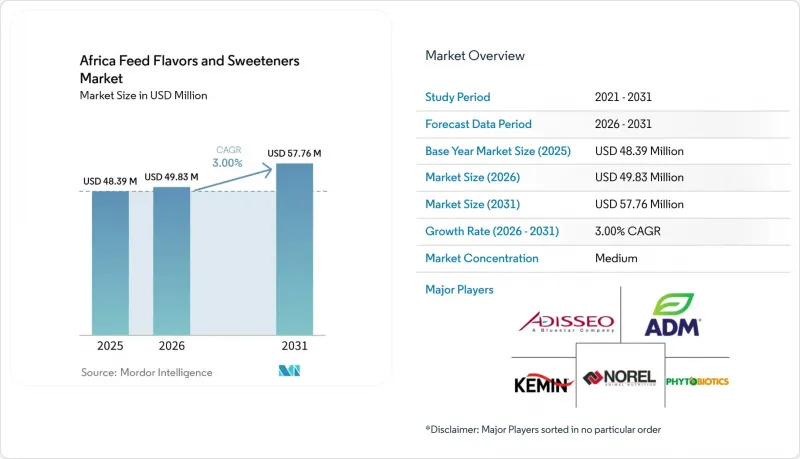
This report is Segmented by Sub-Additive (Flavors and Sweeteners), by Animal (Aquaculture, Poultry, Ruminants, Swine, and Other Animals), and by Geography (Egypt, Kenya, South Africa, and Rest of Africa). The Market Forecasts are Provided in Terms of Value (USD) and Volume (Metric Tons).
Africa Feed Flavors and Sweeteners Market Trends and Insights
Industrialization of Poultry and Dairy Feed
As Africa's livestock feed production industrializes, particularly in poultry and dairy, the importance of palatability and feed intake management is rising. According to the United States Department of Agriculture (USDA) Foreign Agricultural Service (FAS) in 2025, poultry feed made up roughly 41% of Kenya's total compound feed output, with dairy feed close behind at 39%. This underscores the dominance of commercially formulated feed in Kenya's organized feed industry. With feed manufacturers increasingly adopting standardized compound feed for poultry and dairy, there's a growing demand for flavoring and sweetening additives. These additives are crucial for ensuring feed acceptance, promoting consistent intake, and enhancing the efficacy of pelleted and processed rations. This trend towards commercial feed manufacturing is expanding the market for feed flavors and sweeteners throughout Africa.
Feed Intake and Conversion Ratio Optimization Focus
As livestock producers in Africa prioritize feed intake and conversion efficiency to manage production costs, the market for feed flavors and sweeteners is witnessing a surge. The United States Department of Agriculture Foreign Agricultural Service highlights that by 2025, feed costs in Kenya could constitute a staggering 82% of the total expenses in chicken meat production, underscoring the pivotal role of feed performance in determining farm profitability. In light of this, there is a growing trend of integrating feed flavors and sweeteners into commercial formulations. These additives not only boost palatability but also promote steady feed consumption, especially in processed and pelleted diets. With producers on the lookout for solutions that enhance nutrient utilization and bolster production economics, the demand for feed flavors and sweeteners is poised for growth in Africa's commercial livestock sector.
Cost-Sensitive Inclusion Economics
The feed flavors and sweeteners market in Africa encounters challenges as livestock producers prioritize essential nutritional components over specialty additives in feed formulations due to cost considerations. According to the United States Department of Agriculture Foreign Agricultural Service (USDA FAS), Egypt's corn consumption reached 15.8 million metric tons in the 2025/26 marketing year, driven by a recovery in the poultry sector. With commercial livestock production requiring substantial feed grain inputs, a significant portion of feed budgets is allocated to core energy ingredients. This focus restricts the financial resources available for non-essential additives, limiting the adoption of feed flavors and sweeteners, particularly among producers aiming to control feed costs and sustain competitive production economics.
Other drivers and restraints analyzed in the detailed report include:
- Replacement of Antibiotic-Led Performance Tools
- Natural and Phytogenic Palatability Demand
- Substitute Additives and Flavor Masking Workarounds
For complete list of drivers and restraints, kindly check the Table Of Contents.
Segment Analysis
The Africa feed flavors and sweeteners market share for flavors accounted for the largest 94.0% in 2025, reflecting the strong preference for palatability enhancement solutions in the region's livestock sector. The market dynamics are shaped by the prevalence of ruminant production systems, where feed flavors play a pivotal role in ensuring feed acceptance and consistent intake, regardless of forage and ration variations. Commercial feed manufacturers are increasingly infusing flavoring solutions into their compound feeds, aiming to boost product consistency and enhance animal performance. Demand is particularly pronounced in organized feed channels, emphasizing the significance of formulation precision and intake management for livestock productivity.
The Africa feed flavors and sweeteners market size for sweeteners is projected to grow at the fastest CAGR of 3.0% from 2026 to 2031, outpacing the more mature flavor segment as feed producers explore broader palatability strategies. The surge is bolstered by the rising commercialization of livestock production and heightened awareness regarding feed intake optimization, especially during challenging production phases. Sweeteners are carving a niche in young animal nutrition and specialized feed applications, where their role in enhancing feed acceptance can drive production efficiency. While their uptake lags behind flavors-primarily because many African livestock systems still emphasize fundamental nutritional needs-the gradual modernization of feed manufacturing is paving the way for deeper market penetration.
Complete Report Scope:
- By Sub-Additive
- Flavors
- Sweeteners
- By Animal
- Aquaculture
- Fish
- Shrimp
- Other Aquaculture Species
- Poultry
- Broiler
- Layer
- Other Poultry Birds
- Ruminants
- Beef Cattle
- Dairy Cattle
- Other Ruminants
- Swine
- Other Animals
- Aquaculture
- By Geography
- Egypt
- Kenya
- South Africa
- Rest of Africa
List of Companies Covered in this Report:
- Adisseo France SAS (China National BlueStar (Group) Co., Ltd.)
- Archer Daniels Midland Company
- Kemin Industries, Inc.
- Norel, S.A.
- Phytobiotics Futterzusatzstoffe GmbH
- Lucta, S.A.
- Alltech, Inc.
- Innovad NV/SA (Innovad Group)
- Palital Feed Additives B.V. (Arvesta NV)
- Nutreco N.V. (SHV Holdings N.V.)
- dsm-firmenich AG
- Evonik Industries AG
- Cargill, Incorporated
- International Flavors and Fragrances Inc.
- Guilin Layn Natural Ingredients Corp.
Additional Benefits:
- The market estimate (ME) sheet in Excel format
- 3 months of analyst support
TABLE OF CONTENTS
1 INTRODUCTION
- 1.1 Study Assumptions and Market Definition
- 1.2 Scope of the Study
- 1.3 Research Methodology
2 REPORT OFFERS
3 EXECUTIVE SUMMARY AND KEY FINDINGS
4 KEY INDUSTRY TRENDS
- 4.1 Animal Headcount
- 4.1.1 Poultry
- 4.1.2 Ruminants
- 4.1.3 Swine
- 4.2 Feed Production
- 4.2.1 Aquaculture
- 4.2.2 Poultry
- 4.2.3 Ruminants
- 4.2.4 Swine
- 4.3 Regulatory Framework
- 4.3.1 Egypt
- 4.3.2 Kenya
- 4.3.3 South Africa
- 4.3.4 Rest of Africa
- 4.4 Value Chain and Distribution Channel Analysis
- 4.5 Market Drivers
- 4.5.1 Industrialization of poultry and dairy feed
- 4.5.2 Feed intake and conversion ratio optimization focus
- 4.5.3 Replacement of antibiotic-led performance tools
- 4.5.4 Natural and phytogenic palatability demand
- 4.5.5 Heat-stress intake stabilization needs
- 4.5.6 African Continental Free Trade Area (AfCFTA)-led formal feed trade integration
- 4.6 Market Restraints
- 4.6.1 Cost-sensitive inclusion economics
- 4.6.2 Substitute additives and flavor masking workarounds
- 4.6.3 FX-driven import cost inflation
- 4.6.4 Local sweetener and molasses supply unreliability
- 4.7 Porter's Five Forces Analysis
- 4.7.1 Bargaining Power of Suppliers
- 4.7.2 Bargaining Power of Buyers
- 4.7.3 Threat of New Entrants
- 4.7.4 Threat of Substitutes
- 4.7.5 Intensity of Competitive Rivalry
5 MARKET SIZE AND GROWTH FORECASTS (VALUE AND VOLUME)
- 5.1 By Sub-Additive
- 5.1.1 Flavors
- 5.1.2 Sweeteners
- 5.2 By Animal
- 5.2.1 Aquaculture
- 5.2.1.1 Fish
- 5.2.1.2 Shrimp
- 5.2.1.3 Other Aquaculture Species
- 5.2.2 Poultry
- 5.2.2.1 Broiler
- 5.2.2.2 Layer
- 5.2.2.3 Other Poultry Birds
- 5.2.3 Ruminants
- 5.2.3.1 Beef Cattle
- 5.2.3.2 Dairy Cattle
- 5.2.3.3 Other Ruminants
- 5.2.4 Swine
- 5.2.5 Other Animals
- 5.2.1 Aquaculture
- 5.3 By Geography
- 5.3.1 Egypt
- 5.3.2 Kenya
- 5.3.3 South Africa
- 5.3.4 Rest of Africa
6 COMPETITIVE LANDSCAPE
- 6.1 Market Concentration
- 6.2 Strategic Moves
- 6.3 Market Share Analysis
- 6.4 Company Profiles (Includes Global Level Overview, Market Level Overview, Core Segments, Financials as Available, Strategic Information, Market Rank/Share for Key Companies, Products and Services, and Recent Developments)
- 6.4.1 Adisseo France SAS (China National BlueStar (Group) Co., Ltd.)
- 6.4.2 Archer Daniels Midland Company
- 6.4.3 Kemin Industries, Inc.
- 6.4.4 Norel, S.A.
- 6.4.5 Phytobiotics Futterzusatzstoffe GmbH
- 6.4.6 Lucta, S.A.
- 6.4.7 Alltech, Inc.
- 6.4.8 Innovad NV/SA (Innovad Group)
- 6.4.9 Palital Feed Additives B.V. (Arvesta NV)
- 6.4.10 Nutreco N.V. (SHV Holdings N.V.)
- 6.4.11 dsm-firmenich AG
- 6.4.12 Evonik Industries AG
- 6.4.13 Cargill, Incorporated
- 6.4.14 International Flavors and Fragrances Inc.
- 6.4.15 Guilin Layn Natural Ingredients Corp.
7 KEY STRATEGIC QUESTIONS FOR FEED ADDITIVE CEOS

