PUBLISHER: Mordor Intelligence | PRODUCT CODE: 2073339

PUBLISHER: Mordor Intelligence | PRODUCT CODE: 2073339
Perfumes and Deodorants - Market Share Analysis, Industry Trends & Statistics, Growth Forecasts (2026 - 2031)
The Asia-Pacific region is expected to witness the fastest growth in the perfumes and deodorants market, with a projected CAGR of 8.38% through 2031.
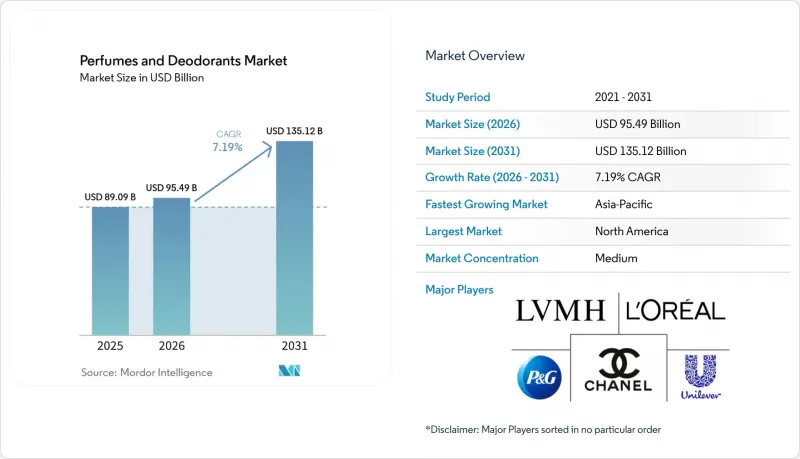
According to Mordor Intelligence, the perfumes and deodorants market is projected to grow significantly, increasing from USD 89.08 billion in 2025 to USD 95.49 billion in 2026 and reaching USD 135.12 billion by 2031. This report is Segmented by Product Type (Perfumes and Deodorants), Ingredient Source (Natural/Organic and Synthetic/Conventional), Price Range (Mass and Premium/Luxury), End User (Men, Women, and More), Distribution Channel (Supermarkets/Hypermarkets, Specialty Stores, and More), and Geography (North America, Europe, and More). The Market Forecasts are Provided in Terms of Value (USD).
Global Perfumes and Deodorants Market Trends and Insights
Rising consumer focus on personal grooming and hygiene
The perfumes and deodorants market is being driven by increasing awareness of personal grooming, hygiene, and self-care. Consumers are now making deodorants and fragrances a regular part of their daily routines to stay fresh and boost confidence. This shift is evident in both developed and emerging markets, fueled by growing participation in social events, professional engagements, and fitness activities. To meet these evolving demands, companies are focusing on innovative products and packaging. For example, in November 2025, Amcor launched its Shadow roll-on deodorant packaging, which uses less plastic, is recyclable, and offers customization options for beauty and personal care brands. Such advancements not only enhance product appeal but also address consumers' rising preference for sustainable, convenient solutions.
Expanding adoption of ethical and traceable fashion products
Consumers are increasingly favoring ethical, sustainable, and traceable fashion products, boosting demand for alpaca apparel and accessories globally. Shoppers now prioritize transparency in how fibers are sourced, how products are made, and their environmental impact. This shift is pushing brands to improve supply chain traceability and adopt responsible sourcing practices. Alpaca fiber fits well with this trend due to its natural, biodegradable, and durable properties. A report by NSF in March 2025 highlighted that 74% of consumers value organic ingredients in personal care products, reflecting a broader preference for sustainability and ethical sourcing across various lifestyle categories. As a result, demand for alpaca apparel and accessories produced with ethical, sustainable practices is expected to grow steadily worldwide.
Stringent regulations governing fragrance ingredients and chemical formulations
Strict regulations on fragrance ingredients, chemical formulations, and product labeling are slowing the growth of the global perfumes and deodorants market. Governments and regulatory bodies in key markets are enforcing tougher rules to ensure ingredient safety, disclose allergens, and improve transparency for consumers. These changes are driving up compliance costs for manufacturers. For instance, the European Commission's Regulation (EU) 2023/1545 mandates more detailed allergen labeling, requiring companies to update packaging and product details across their portfolios. Similarly, the International Fragrance Association (IFRA) 51st Amendment imposes stricter limits on certain fragrance ingredients, forcing manufacturers to reformulate products to meet the new standards. These evolving regulations not only increase production and development costs but also extend the time required for product approvals.
Other drivers and restraints analyzed in the detailed report include:
- Growing travel retail and duty-free fragrance sales
- Popularity of celebrity, designer, and niche fragrance brands
- Sales of imitation fragrances at lower price points are intensifying competitive pressure
For complete list of drivers and restraints, kindly check the Table Of Contents.
Segment Analysis
In 2025, deodorants accounted for 63.67% of the perfumes and deodorants market, making them the leading product segment. Their widespread use in daily personal care routines across various age groups drives this dominance. Factors such as increasing awareness of personal hygiene, rapid urbanization, and the availability of deodorants at different price points contribute to their steady demand. Manufacturers are enhancing product offerings with features like long-lasting protection, skin-friendly ingredients, and multi-purpose applications, further boosting their popularity among consumers.
Perfumes are projected to be the fastest-growing segment, with a CAGR of 8.82% from 2026 to 2031. This growth is fueled by rising consumer interest in premium and niche fragrances that offer unique and personalized scent experiences. Higher disposable incomes, the expansion of online fragrance sales, and the influence of social media and celebrity endorsements are key factors driving demand. Moreover, frequent product innovations and the growing perception of fragrances as a lifestyle statement and a form of self-expression are expected to sustain the segment's growth during the forecast period.
Synthetic and conventional formulations accounted for 85.36% of the perfumes and deodorants market revenue in 2025, establishing themselves as the leading formulation types. These formulations dominate due to their cost efficiency, reliable fragrance performance, and ability to deliver long-lasting scents at scale. They also provide manufacturers with greater flexibility in creating diverse fragrances, making them a preferred choice for mass-market products. As a result, companies continue to rely on synthetic ingredients to meet high consumer demand while maintaining competitive pricing.
Natural and organic formulations are projected to grow at the fastest rate, with a CAGR of 8.14% during the 2026-2031 period. This growth is driven by rising consumer preference for products with transparent ingredients, sustainability, and clean-label attributes. Many consumers now prioritize fragrances and deodorants free from synthetic chemicals, parabens, and artificial additives, especially in premium and wellness-focused segments. To cater to this demand, brands are expanding their natural product offerings and investing in plant-based ingredients and eco-friendly formulations.
Complete Report Scope:
- By Product Type
- Perfumes
- Parfum/Extrait de Parfum
- Eau de Parfum
- Eau de Toilette
- Eau de Cologne
- Deodorants
- Spray Deodorants
- Roll-On Deodorants
- Stick Deodorants
- Others
- Perfumes
- By Ingredient Source
- Natural/Organic
- Synthetic/Conventional
- By Price Range
- Mass
- Premium/Luxury
- By End User
- Men
- Women
- Unisex
- By Distribution Channel
- Supermarkets/Hypermarkets
- Drugstores and Pharmacies
- Specialty Stores
- Online Retail Stores
- Other Distribution Channels
- By Geography
- North America
- United States
- Canada
- Mexico
- Rest of North America
- Europe
- Germany
- United Kingdom
- Italy
- France
- Spain
- Poland
- Belgium
- Sweden
- Rest of Europe
- Asia-Pacific
- China
- Japan
- India
- Australia
- Indonesia
- South Korea
- Thailand
- Singapore
- Rest of Asia-Pacific
- South America
- Brazil
- Argentina
- Colombia
- Chile
- Peru
- Rest of South America
- Middle East and Africa
- South Africa
- Saudi Arabia
- United Arab Emirates
- Nigeria
- Egypt
- Morocco
- Turkey
- Rest of Middle East and Africa
- North America
Geography Analysis
North America held the largest share of the perfumes and deodorants market in 2025, accounting for 33.56%. This dominance is attributed to high consumer spending on personal care products, a robust retail infrastructure, and the widespread popularity of premium fragrances and deodorants. The United States leads the region, driven by continuous product innovations, celebrity-endorsed launches, and a growing online retail sector. Canada and Mexico are also key contributors, as global brands expand their presence in these markets.
Factors such as rapid urbanization, increasing disposable incomes, and heightened awareness of personal grooming are fueling this growth. The expanding middle-class population and evolving lifestyle preferences are boosting demand for both affordable deodorants and premium fragrances. Furthermore, the rise of modern retail and e-commerce platforms is making these products more accessible to consumers across the region.
Europe remains a significant market for perfumes and deodorants, supported by its strong fragrance heritage and a loyal consumer base. Countries like France, Germany, the United Kingdom, Italy, and Spain continue to dominate in fragrance consumption and innovation. The demand for luxury and premium fragrances remains robust, aided by well-established retail networks and travel retail channels. Meanwhile, South America and the Middle East & Africa are emerging as important markets, driven by increasing fragrance adoption, cultural preferences, and growing investments from international brands.
- L'Oreal S.A.
- The Procter and Gamble Company
- Unilever PLC
- Coty Inc.
- Beiersdorf AG
- Henkel AG and Co. KGaA
- The Estee Lauder Companies Inc.
- CHANEL Limited
- LVMH Moet Hennessy Louis Vuitton SE
- Puig Brands, S.A.
- Shiseido Company, Limited
- Kao Corporation
- Revlon, Inc.
- Compagnie Financiere Richemont SA.
- Godrej Consumer Products Limited
- Natura and Co Holding S.A.
- Kao Corporation
- Maurer & Wirtz GmbH & Co. KG
- Bath and Body Works, Inc.
- Inter Parfums, Inc.
Additional Benefits:
- The market estimate (ME) sheet in Excel format
- 3 months of analyst support
TABLE OF CONTENTS
1 INTRODUCTION
- 1.1 Study Assumptions and Market Definition
- 1.2 Scope of the Study
2 RESEARCH METHODOLOGY
3 EXECUTIVE SUMMARY
4 MARKET LANDSCAPE
- 4.1 Market Overview
- 4.2 Market Drivers
- 4.2.1 Rising consumer focus on personal grooming and hygiene
- 4.2.2 Increasing investment by brands in personalized and AI-driven fragrance recommendations
- 4.2.3 Expanding adoption of ethical and traceable fashion products
- 4.2.4 Continuous product innovation in long-lasting, multifunctional, and skin-friendly formulations
- 4.2.5 Popularity of celebrity, designer, and niche fragrance brands
- 4.2.6 Growing travel retail and duty-free fragrance sales
- 4.3 Market Restraints
- 4.3.1 Stringent regulations governing fragrance ingredients and chemical formulations
- 4.3.2 Concerns regarding skin irritation, allergies, and sensitivity to fragrance ingredients
- 4.3.3 Sales of imitation fragrances at lower price points are intensifying competitive pressure
- 4.3.4 Use of aerosol propellants and packaging materials is raising environmental concerns
- 4.4 Consumer Behavior Analysis
- 4.5 Regulatory Outlook
- 4.6 Porter's Five Forces
- 4.6.1 Threat of New Entrants
- 4.6.2 Bargaining Power of Buyers
- 4.6.3 Bargaining Power of Suppliers
- 4.6.4 Threat of Substitute Products
- 4.6.5 Intensity of Competitive Rivalry
5 MARKET SIZE AND GROWTH FORECASTS (VALUE)
- 5.1 By Product Type
- 5.1.1 Perfumes
- 5.1.1.1 Parfum/Extrait de Parfum
- 5.1.1.2 Eau de Parfum
- 5.1.1.3 Eau de Toilette
- 5.1.1.4 Eau de Cologne
- 5.1.2 Deodorants
- 5.1.2.1 Spray Deodorants
- 5.1.2.2 Roll-On Deodorants
- 5.1.2.3 Stick Deodorants
- 5.1.2.4 Others
- 5.1.1 Perfumes
- 5.2 By Ingredient Source
- 5.2.1 Natural/Organic
- 5.2.2 Synthetic/Conventional
- 5.3 By Price Range
- 5.3.1 Mass
- 5.3.2 Premium/Luxury
- 5.4 By End User
- 5.4.1 Men
- 5.4.2 Women
- 5.4.3 Unisex
- 5.5 By Distribution Channel
- 5.5.1 Supermarkets/Hypermarkets
- 5.5.2 Drugstores and Pharmacies
- 5.5.3 Specialty Stores
- 5.5.4 Online Retail Stores
- 5.5.5 Other Distribution Channels
- 5.6 By Geography
- 5.6.1 North America
- 5.6.1.1 United States
- 5.6.1.2 Canada
- 5.6.1.3 Mexico
- 5.6.1.4 Rest of North America
- 5.6.2 Europe
- 5.6.2.1 Germany
- 5.6.2.2 United Kingdom
- 5.6.2.3 Italy
- 5.6.2.4 France
- 5.6.2.5 Spain
- 5.6.2.6 Poland
- 5.6.2.7 Belgium
- 5.6.2.8 Sweden
- 5.6.2.9 Rest of Europe
- 5.6.3 Asia-Pacific
- 5.6.3.1 China
- 5.6.3.2 Japan
- 5.6.3.3 India
- 5.6.3.4 Australia
- 5.6.3.5 Indonesia
- 5.6.3.6 South Korea
- 5.6.3.7 Thailand
- 5.6.3.8 Singapore
- 5.6.3.9 Rest of Asia-Pacific
- 5.6.4 South America
- 5.6.4.1 Brazil
- 5.6.4.2 Argentina
- 5.6.4.3 Colombia
- 5.6.4.4 Chile
- 5.6.4.5 Peru
- 5.6.4.6 Rest of South America
- 5.6.5 Middle East and Africa
- 5.6.5.1 South Africa
- 5.6.5.2 Saudi Arabia
- 5.6.5.3 United Arab Emirates
- 5.6.5.4 Nigeria
- 5.6.5.5 Egypt
- 5.6.5.6 Morocco
- 5.6.5.7 Turkey
- 5.6.5.8 Rest of Middle East and Africa
- 5.6.1 North America
6 COMPETITIVE LANDSCAPE
- 6.1 Market Concentration
- 6.2 Strategic Moves
- 6.3 Market Share Analysis
- 6.4 Company Profiles (includes Global-level Overview, Market-level Overview, Core Segments, Financials (if available), Strategic Information, Market Rank/Share, Products and Services, Recent Developments)
- 6.4.1 L'Oreal S.A.
- 6.4.2 The Procter and Gamble Company
- 6.4.3 Unilever PLC
- 6.4.4 Coty Inc.
- 6.4.5 Beiersdorf AG
- 6.4.6 Henkel AG and Co. KGaA
- 6.4.7 The Estee Lauder Companies Inc.
- 6.4.8 CHANEL Limited
- 6.4.9 LVMH Moet Hennessy Louis Vuitton SE
- 6.4.10 Puig Brands, S.A.
- 6.4.11 Shiseido Company, Limited
- 6.4.12 Kao Corporation
- 6.4.13 Revlon, Inc.
- 6.4.14 Compagnie Financiere Richemont SA.
- 6.4.15 Godrej Consumer Products Limited
- 6.4.16 Natura and Co Holding S.A.
- 6.4.17 Kao Corporation
- 6.4.18 Maurer & Wirtz GmbH & Co. KG
- 6.4.19 Bath and Body Works, Inc.
- 6.4.20 Inter Parfums, Inc.
7 MARKET OPPORTUNITIES AND FUTURE OUTLOOK

