PUBLISHER: Mordor Intelligence | PRODUCT CODE: 2114350

PUBLISHER: Mordor Intelligence | PRODUCT CODE: 2114350
South America Deodorants - Market Share Analysis, Industry Trends & Statistics, Growth Forecasts (2026 - 2031)
According to Mordor Intelligence, the south american deodorants market size was valued at USD 3.82 billion in 2025 and estimated to grow from USD 4.01 billion in 2026 to reach USD 5.11 billion by 2031, at a CAGR of 4.97% during the forecast period (2026-2031).
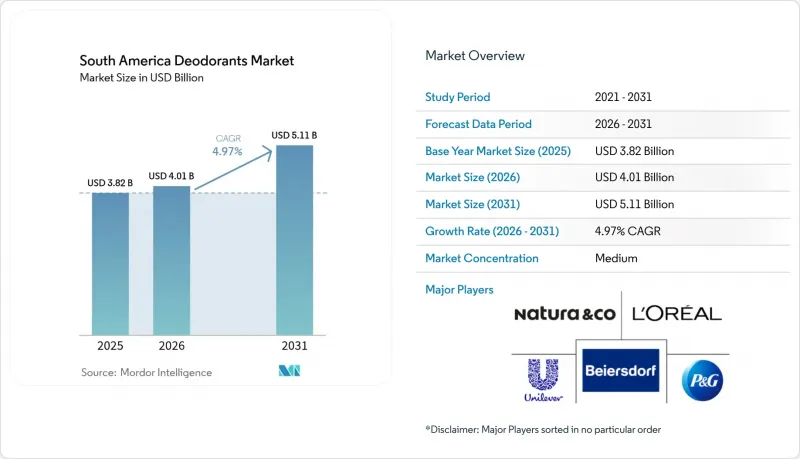
This report is Segmented by Product Type (Sprays, Creams, Roll-Ons, and Others), Category (Mass and Premium), End User (Men, Women, and Unisex), Distribution Channel (Supermarkets and Hypermarkets, Convenience Stores, Specialty Stores, Online Retail Stores, and Other Distribution Channels), and Geography. The Market Forecasts are Provided in Terms of Value (USD).
South America Deodorants Market Trends and Insights
Rising disposable incomes and trading-up to premium formats
In 2024, Colombia's GDP grew by 1.8%, with a forecasted rise to 2.3% in 2025. Meanwhile, Peru boasted a 3.2% growth in 2024. This economic backdrop has birthed a class of aspirational consumers in both nations, perceiving deodorants not merely as commodities but as symbols of status. In Brazil, the luxury perfumery market witnessed a surge in the first half of 2024. Grupo Boticario's Privee Legumes collection and Natura's premium line, launched in November 2024, featuring seven eau de parfum fragrances, successfully captured market share from imported brands. This trend of premiumization isn't limited to just fragrance intensity; it encompasses packaging aesthetics and the narrative behind ingredients. Brands are now emphasizing Amazonian botanicals and securing dermatologist endorsements, allowing them to command prices two to three times higher than mass-market offerings. This shift is especially evident among Gen Z and millennials, who are dedicating a larger portion of their discretionary spending to personal care compared to earlier generations. A significant majority of Brazilians not only use deodorants daily but also voice concerns about body odor. In response, retailers are allocating prime shelf space for premium products and setting up in-store fragrance sampling stations. Simultaneously, e-commerce platforms are spotlighting "clean beauty" and "luxury self-care" categories, using algorithms to highlight high-margin SKUs to discerning shoppers.
Health-oriented shift toward aluminum-free and natural formulations
South American shoppers increasingly favor natural ingredients in personal-care products, prompting heightened regulatory scrutiny and more frequent reformulations. Brazil's ANVISA has rolled out RDC 894/2024 to bolster post-market oversight of cosmetics, including antiperspirants. Meanwhile, Argentina's ANMAT is aligning with MERCOSUR standards, mandating clear labeling of aluminum salts like aluminum chlorohydrate, as highlighted by the Brazilian Health Regulatory Agency. Unilever is making waves with its June 2025 debut of the All Body Deo line, featuring brands like Rexona, Dove, and Dove Men+Care. These new offerings boast aluminum-free, alcohol-free formulas with a commendable 72-hour efficacy. Achieving this milestone necessitated a revamp of propellant systems and active-delivery matrices. In December 2024, Natura introduced its Tododia Limao Siciliano roll-on, enriched with prebiotic complexes to bolster skin microbiome health. This move is a strategic nod to dermatology-savvy consumers who often cross-check ingredient lists with online databases. Meanwhile, Natura &Co's Care Natural Beauty, a direct-to-consumer newcomer, derives a significant 80% of its sales from online channels. The brand emphasizes sustainability, using 95% glass or green plastic and offering refill options. Notably, refill purchases alone account for 9% of its revenue. However, the shift to aluminum-free formulations comes with challenges. Formulators grapple with achieving the right balance between efficacy, skin feel, and shelf stability. Moreover, early adopters have noted increased per-unit costs, which can strain margins until economies of scale are realized.
Supply-chain inflation pressuring aerosol propellant costs
Aerosol deodorants use liquefied petroleum gas (LPG) or compressed hydrocarbons as propellants. These commodities are vulnerable to fluctuations in energy markets and geopolitical supply disruptions. While data on propellant costs for 2024-2025 is proprietary, broader reports from the FMCG supply chain highlight that inflation in packaging and raw materials has squeezed gross margins in personal care. This has led brands to either reduce pack sizes or reformulate using more affordable active ingredients. Due to Brazil's currency depreciation against the U.S. dollar, import costs for specialty chemicals have surged. This situation compels local manufacturers to either absorb the resulting margin compression or increase prices. However, retailers are hesitant to accept these hikes in a competitive landscape. Unilever's investment of BRL 410 million (USD 82 million) in March 2025, aimed at expanding its Aguai factory and logistics network, underscores the importance of vertical integration and economies of scale as shields against input-cost fluctuations. In contrast, smaller players, lacking the financial muscle for such maneuvers, find themselves at a disadvantage. This has led to a market divide: established brands enhance their market share through operational efficiency, while niche brands carve out their identity through unique formulations or sustainability efforts, rather than competing on price. If the inflation in aerosol costs continues, there might be a quicker shift towards roll-ons and creams, formats that don't need pressurized propellants. Yet, it's worth noting that in hot and humid regions, where the quick-dry convenience of sprays is paramount, consumer preference for spray formats remains strong, even in the face of rising costs.
Other drivers and restraints analyzed in the detailed report include:
- Expansion of direct-to-consumer (D2C) digital native brands
- Adoption of refillable packaging to meet ESG mandates
- Regulatory scrutiny over antiperspirant actives in Brazil and Argentina
For complete list of drivers and restraints, kindly check the Table Of Contents.
Segment Analysis
From 2026 to 2031, roll-ons are projected to grow at a rate of 5.95% CAGR, surpassing the market average of 4.97%. This growth comes as brands rectify past packaging issues. Data from ANVISA, Brazil's Health Regulatory Agency, highlighted that 9% to 24% of consumer complaints in personal care were due to leaky bottles. In response, manufacturers revamped ball-and-socket designs and introduced tamper-evident seals. In December 2024, Natura launched its Tododia Limao Siciliano roll-on, boasting a prebiotic formula and 48-hour protection, appealing to consumers who value skin health over the convenience of sprays.
In 2025, sprays held a dominant 47.98% market share, driven by consumer preference for quick-drying applications in hot, humid conditions. However, rising costs of aerosol propellants and challenges in reformulating without aluminum could threaten their margin edge. Meanwhile, creams and other formats cater to niche audiences, like travelers needing TSA-compliant sizes and athletes seeking potent actives, but they lack the scale for broader category growth. Unilever's June 2025 launch of All Body Deo in both aerosol and cream formats indicates a strategic move, allowing incumbents to mitigate format risks and cater to varied consumer occasions. The rise of roll-ons is also tied to their compatibility with natural formulations; water-based gels and prebiotic complexes thrive in roll-on systems, unlike pressurized aerosols that depend on alcohol or synthetic solvents for stability.
From 2026 to 2031, premium deodorants are set to expand at a robust 7.01% CAGR, nearly doubling the growth pace of their mass-market counterparts. This shift underscores a growing consumer preference for formulations that seamlessly blend effectiveness with a touch of sensory luxury. In 2025, the mass segment commanded a dominant 67.92% market share, buoyed by value-driven shoppers and their frequent repurchase habits. However, this segment grapples with challenges: intense price competition and the infiltration of counterfeit products are squeezing margins and curtailing innovation budgets. Meanwhile, Brazil's luxury perfumery scene witnessed a notable uptick in early 2024. Notably, Grupo Boticario unveiled its 'Privee Legumes' collection in September, and Natura rolled out a premium line featuring seven eau de parfum fragrances in November, both targeting the aspirational consumer base.
Premium brands are capitalizing on Amazonian botanicals, securing endorsements from dermatologists, and introducing refillable glass packaging. These strategies allow them to command price points that are two to three times higher than mass-market offerings. Retailers, recognizing this trend, are dedicating prime shelf space and setting up in-store fragrance sampling stations to encourage trials. The trend of premiumization is especially evident among Gen Z and millennial consumers. These younger cohorts are channeling a larger portion of their discretionary spending towards personal care, perceiving deodorants as status symbols rather than mere commodities. In response, mass brands are rolling out "masstige" sub-brands, mid-tier lines that adopt premium characteristics like minimalist packaging and natural ingredient claims. This strategy aims to protect market share without cannibalizing flagship products. However, there's a fine line: if not executed meticulously, it could lead to consumer confusion and potential dilution of brand equity.
Complete Report Scope:
- Product Type
- Sprays
- Creams
- Roll-ons
- Others
- Category
- Mass
- Premium
- End User
- Men
- Women
- Unisex
- By Distribution Channel
- Supermarkets and hypermarkets
- Convenience stores
- Specialty stores
- Online Retail Stores
- Other Distribution Channels
- Geography
- Brazil
- Argentina
- Colombia
- Peru
- Chile
- Rest of South America
List of Companies Covered in this Report:
- Unilever PLC
- Natura & Co Holding SA
- Procter & Gamble Company
- Beiersdorf AG
- Grupo Boticario
- Colgate-Palmolive Company
- Avon Products Inc.
- Coty Inc.
- L'Oreal S.A.
- SC Johnson & Son Inc.
- Johnson & Johnson Consumer Health
- Reckitt Benckiser Group plc
- Edgewell Personal Care
- Mary Kay Inc.
- Hinode Group
- Jequiti Cosmeticos
- Belcorp Corporation
- Genomma Lab Internacional SAB
- Hypera S.A.
- Puig S.L.
Additional Benefits:
- The market estimate (ME) sheet in Excel format
- 3 months of analyst support
TABLE OF CONTENTS
1 INTRODUCTION
- 1.1 Study Assumptions and Market Definition
- 1.2 Scope of the Study
2 RESEARCH METHODOLOGY
3 EXECUTIVE SUMMARY
4 MARKET LANDSCAPE
- 4.1 Market Overview
- 4.2 Market Drivers
- 4.2.1 Rising disposable incomes and trading-up to premium formats
- 4.2.2 Health-oriented shift toward aluminum-free and natural formulations
- 4.2.3 Expansion of direct-to-consumer (D2C) digital native brands
- 4.2.4 Adoption of refillable packaging to meet ESG mandates
- 4.2.5 On-device biosensor integration enabling "smart deodorants"
- 4.2.6 Effective promotional and marketing strategies
- 4.3 Market Restraints
- 4.3.1 Supply-chain inflation pressuring aerosol propellant costs
- 4.3.2 Regulatory scrutiny over antiperspirant actives in Brazil and Argentina
- 4.3.3 Fragmented last-mile logistics outside Tier-1 Brazilian cities
- 4.3.4 Proliferation of counterfeit Products
- 4.4 Consumer Behaviour Analysis
- 4.5 Regulatory Landscape
- 4.6 Technological Outlook
- 4.7 Porter's Five Forces
- 4.7.1 Threat of New Entrants
- 4.7.2 Bargaining Power of Buyers
- 4.7.3 Bargaining Power of Suppliers
- 4.7.4 Threat of Substitutes
- 4.7.5 Intensity of Competitive Rivalry
5 MARKET SIZE AND GROWTH FORECASTS (VALUE)
- 5.1 Product Type
- 5.1.1 Sprays
- 5.1.2 Creams
- 5.1.3 Roll-ons
- 5.1.4 Others
- 5.2 Category
- 5.2.1 Mass
- 5.2.2 Premium
- 5.3 End User
- 5.3.1 Men
- 5.3.2 Women
- 5.3.3 Unisex
- 5.4 By Distribution Channel
- 5.4.1 Supermarkets and hypermarkets
- 5.4.2 Convenience stores
- 5.4.3 Specialty stores
- 5.4.4 Online Retail Stores
- 5.4.5 Other Distribution Channels
- 5.5 Geography
- 5.5.1 Brazil
- 5.5.2 Argentina
- 5.5.3 Colombia
- 5.5.4 Peru
- 5.5.5 Chile
- 5.5.6 Rest of South America
6 COMPETITIVE LANDSCAPE
- 6.1 Market Concentration
- 6.2 Strategic Moves
- 6.3 Market Share Analysis
- 6.4 Company Profiles (includes Global level Overview, Market level overview, Core Segments, Financials as available, Strategic Information, Market Rank/Share for key companies, Products and Services, and Recent Developments)
- 6.4.1 Unilever PLC
- 6.4.2 Natura & Co Holding SA
- 6.4.3 Procter & Gamble Company
- 6.4.4 Beiersdorf AG
- 6.4.5 Grupo Boticario
- 6.4.6 Colgate-Palmolive Company
- 6.4.7 Avon Products Inc.
- 6.4.8 Coty Inc.
- 6.4.9 L'Oreal S.A.
- 6.4.10 SC Johnson & Son Inc.
- 6.4.11 Johnson & Johnson Consumer Health
- 6.4.12 Reckitt Benckiser Group plc
- 6.4.13 Edgewell Personal Care
- 6.4.14 Mary Kay Inc.
- 6.4.15 Hinode Group
- 6.4.16 Jequiti Cosmeticos
- 6.4.17 Belcorp Corporation
- 6.4.18 Genomma Lab Internacional SAB
- 6.4.19 Hypera S.A.
- 6.4.20 Puig S.L.
7 MARKET OPPORTUNITIES AND FUTURE OUTLOOK

