PUBLISHER: Mordor Intelligence | PRODUCT CODE: 2073350

PUBLISHER: Mordor Intelligence | PRODUCT CODE: 2073350
Indonesia Data Center Construction - Market Share Analysis, Industry Trends & Statistics, Growth Forecasts (2026 - 2031)
According to Mordor Intelligence, the indonesian data center construction market size in 2026 is estimated at USD 3.61 billion, growing from 2025 value of USD 3.05 billion with 2031 projections showing USD 8.29 billion, growing at 18.12% CAGR over 2026-2031.
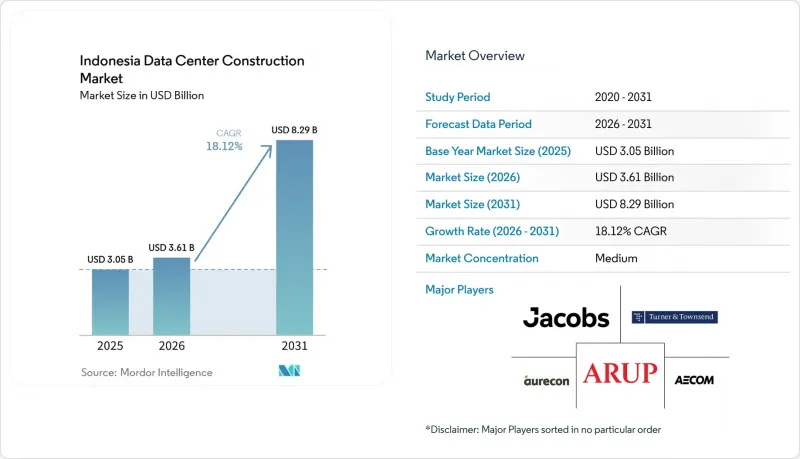
This report is Segmented by Tier Type (Tier 1 and 2, Tier 3 and Tier 4), Data Center Type(Colocation, Self-Built Hyperscalers (CSPs), Enterprise, and Edge), Infrastructure (Electrical Infrastructure, Mechanical Infrastructure). The Market Forecasts are Provided in Terms of Value (USD).
Indonesia Data Center Construction Market Trends and Insights
Cloud and AI-Led Hyperscale Investments Accelerate Facility Demand
Hyperscale cloud firms are redefining the Indonesian data center construction market by introducing AI workloads that require liquid-cooling, 40-60 kW racks, and contiguous power blocks exceeding 50 MW per campus. Tencent's USD 500 million commitment, Nvidia's USD 200 million GPU center with Indosat Ooredoo Hutchison, and BDx's 500 MW renewable-powered AI campus exemplify the scale of capital flowing into. Indonesia (AI) optimised data center is increasing demand for high-density infrastructure and advanced cooling technologies across hyperscale facilities. The need for immersion cooling and high-density electrical buses is stretching local contractors' skill sets, prompting global engineering firms to form joint teams with domestic specialists. Construction schedules have tightened from an average 22 months in 2022 to 16-18 months in 2025 as land owners provide pre-approved permits and ready-built substations.
National Digital Indonesia Roadmap 2030 Spurs Public-Sector IT Loads
The Roadmap mandates the consolidation of ministerial IT workloads into four National Data Centers (PDN). The flagship Cikarang PDN, financed at EUR 164.68 million (USD 189.59 million), delivers 25,000 processor cores and is scheduled to begin in August 2024. Three additional PDN sites in Batam and Nusantara are in the pipeline, ensuring steady demand for Tier 4 builds over the next five years. Presidential Regulation 82/2023 requires agencies to migrate from legacy facilities, stimulating a surge of design-build contracts for secure cloud zones, zero-trust networks, and cyber-resilient plant rooms. The ramp-up has also catalysed INA DIGITAL, the new single window for public services that launched in May 2024, which now drives inter-ministerial bandwidth requirements well beyond earlier forecasts
Rising Power-Use and Carbon-Tax Exposure
Indonesia's carbon-tax regime took effect in 2022, applying levies on emissions that exceed sector caps. Because coal still supplies 67% of PLN's generation mix, large campuses risk material cost over-runs unless they secure renewable PPAs or on-site solar. PLN's roadmap to net-zero by 2060 adds future price uncertainty, driving operators toward real-time power monitoring, waste-heat reuse, and demand-response programmes. Early movers such as EDGE2 now pass carbon-neutral costs through to tenants, setting a precedent for premium pricing.
Other drivers and restraints analyzed in the detailed report include:
- New International Subsea Cables Landing in Jakarta and Batam Raise Latency Standards
- Edge Build-Outs in Surabaya, Medan and Makassar to Serve Tier-2 Cities
- Escalating Land Prices Around Jakarta CBD and Cikarang Industrial Parks
For complete list of drivers and restraints, kindly check the Table Of Contents.
Segment Analysis
Tier 3 facilities account for 50.62% of the Indonesia data center construction market size, reflecting their balanced cost-to-availability ratio. Colocation providers such as NeutraDC rely on Tier 3 certifications to court enterprise tenants that demand 99.982% uptime while staying mindful of capex constraints. Tier 1 and Tier 2 sites continue to serve latency-sensitive edge nodes where modest redundancy is acceptable.
Tier 4 builds, advancing at 18.6% CAGR, are reshaping the Indonesia data center construction market as AI workloads and sovereign-cloud mandates eliminate tolerance for downtime. DCI Indonesia's Tier IV edge facility in central Jakarta signals the march toward zero-fault architecture, with immersion cooling and compartmentalised power paths driving project costs 25-30% above Tier 3. STT GDC's announced AI clusters will further entrench Tier 4's position in future-ready designs.
Colocation maintains 56.72% of 2025 revenue thanks to Indonesia's fragmented enterprise base. Facilities such as Digital Edge's 23 MW Jakarta site offer scalability through modular halls, securing multi-year anchor tenants that raise the utilisation curve faster than legacy carrier-hotels.
Self-build hyperscalers are registering a 19.5% CAGR, swelling the Indonesia data center construction market through 120-MW-plus campuses on 20-hectare plots. EdgeConneX's USD 403.8 million sustainability-linked loan typifies how operators deploy green-bond structures to finance renewable-powered builds. The hyperscaler push is forcing colocation incumbents to pivot toward wholesale suites and build-to-suit models, blurring once-clear lines between multi-tenant and single-tenant strategies.
Complete Report Scope:
- By Tier Type
- Tier 1 and 2
- Tier 3
- Tier 4
- By Data Center Type
- Colocation
- Self-build Hyperscalers (CSPs)
- Enterprise and Edge
- By Infrastructure
- By Electrical Infrastructure
- Power Distribution Solution
- Power Distribution Solution
- Power Backup Solutions
- Power Backup Solutions
- Power Distribution Solution
- By Mechanical Infrastructure
- Cooling Systems
- Cooling Systems
- Racks and Cabinets
- Racks and Cabinets
- Servers and Storage
- Servers and Storage
- Other Mechanical Infrastructure
- Other Mechanical Infrastructure
- Cooling Systems
- General Construction
- Service - Design and Consulting, Integration, Support and Maintenance
- By Electrical Infrastructure
List of Companies Covered in this Report:
- Aurecon Group Pty Ltd
- PT AECOM Indonesia
- Arup Group
- Jacobs Engineering Group Inc.
- Turner and Townsend
- AWP Architects
- Aesler Group International
- PT Arkonin
- DSCO Group Pte Ltd
- Larsen and Toubro Ltd
- NTT Global Data Centers Indonesia
- Huawei Technologies
- Vertiv Group Corp.
- Schneider Electric SE
- ABB Ltd
- Legrand SA
- PT DCI Indonesia Tbk
- Princeton Digital Group
- Telkom Data Ekosistem (NeutraDC)
- BDx Indonesia
Additional Benefits:
- The market estimate (ME) sheet in Excel format
- 3 months of analyst support
TABLE OF CONTENTS
1 INTRODUCTION
- 1.1 Study Assumptions and Market Definition
- 1.2 Scope of the Study
2 RESEARCH METHODOLOGY
3 EXECUTIVE SUMMARY
4 MARKET LANDSCAPE
- 4.1 Market Overview
- 4.2 Market Drivers
- 4.2.1 Cloud-and-AI led hyperscale investments accelerate facility demand
- 4.2.2 National Digital Indonesia Roadmap 2030 spurs public-sector IT loads
- 4.2.3 New international subsea cables landing in Jakarta and Batam raise latency standards
- 4.2.4 Jakarta Bandung data-center corridor public-private zoning incentives
- 4.2.5 Corporate PPAs and green-tariff schemes open the door for renewable-powered campuses
- 4.2.6 Edge build-outs in Surabaya, Medan and Makassar to serve emerging Tier-2 cities
- 4.3 Market Restraints
- 4.3.1 Rising power-use and carbon-tax exposure
- 4.3.2 Escalating land prices around Jakarta CBD and Cikarang industrial parks
- 4.3.3 Shortage of specialised MEP-certified construction labour
- 4.3.4 Slow grid-upgrade cycle times at PLN substations delay energisation
- 4.4 Supply-Chain Analysis
- 4.5 Regulatory Landscape
- 4.6 Technological Outlook
- 4.7 Porters Five Forces Analysis
- 4.7.1 Bargaining Power of Suppliers
- 4.7.2 Bargaining Power of Consumers
- 4.7.3 Threat of New Entrants
- 4.7.4 Threat of Substitutes
- 4.7.5 Intensity of Competitive Rivalry
- 4.8 Key Data Center Statistics
- 4.8.1 Exhaustive Data Center Operators in Indonesia(in MW)
- 4.8.2 List of Major Upcoming Data Center Projects in Indonesia (2025-2030)
- 4.8.3 CAPEX and OPEX For Indonesia Data Center Construction
- 4.8.4 Data Center Power Capacity Absorption In MW, Selected Cities, Indonesia, 2023 and 2024
- 4.9 Artificial Intelligence (AI) Inclusion in Data Center Construction in Indonesia
- 4.10 Regulatory and Compliance Framework
5 MARKET SIZE AND GROWTH FORECASTS (VALUE)
- 5.1 By Tier Type
- 5.1.1 Tier 1 and 2
- 5.1.2 Tier 3
- 5.1.3 Tier 4
- 5.2 By Data Center Type
- 5.2.1 Colocation
- 5.2.2 Self-build Hyperscalers (CSPs)
- 5.2.3 Enterprise and Edge
- 5.3 By Infrastructure
- 5.3.1 By Electrical Infrastructure
- 5.3.1.1 Power Distribution Solution
- 5.3.1.1.1 Power Distribution Solution
- 5.3.1.2 Power Backup Solutions
- 5.3.1.2.1 Power Backup Solutions
- 5.3.1.1 Power Distribution Solution
- 5.3.2 By Mechanical Infrastructure
- 5.3.2.1 Cooling Systems
- 5.3.2.1.1 Cooling Systems
- 5.3.2.2 Racks and Cabinets
- 5.3.2.2.1 Racks and Cabinets
- 5.3.2.3 Servers and Storage
- 5.3.2.3.1 Servers and Storage
- 5.3.2.4 Other Mechanical Infrastructure
- 5.3.2.4.1 Other Mechanical Infrastructure
- 5.3.2.1 Cooling Systems
- 5.3.3 General Construction
- 5.3.4 Service - Design and Consulting, Integration, Support and Maintenance
- 5.3.1 By Electrical Infrastructure
6 COMPETITIVE LANDSCAPE
- 6.1 Market Concentration
- 6.2 Strategic Moves
- 6.3 Market Share Analysis
- 6.4 Data Center Infrastructure Investment Based on Megawatt (MW) Capacity, 2024 vs 2030
- 6.5 Data Center Construction Landscape (Key Vendors Listings)
- 6.6 Company Profiles (includes Global level Overview, Market level overview, Core Segments, Financials as available, Strategic Information, Market Rank/Share for key companies, Products and Services, Recent Developments)
- 6.6.1 Aurecon Group Pty Ltd
- 6.6.2 PT AECOM Indonesia
- 6.6.3 Arup Group
- 6.6.4 Jacobs Engineering Group Inc.
- 6.6.5 Turner and Townsend
- 6.6.6 AWP Architects
- 6.6.7 Aesler Group International
- 6.6.8 PT Arkonin
- 6.6.9 DSCO Group Pte Ltd
- 6.6.10 Larsen and Toubro Ltd
- 6.6.11 NTT Global Data Centers Indonesia
- 6.6.12 Huawei Technologies
- 6.6.13 Vertiv Group Corp.
- 6.6.14 Schneider Electric SE
- 6.6.15 ABB Ltd
- 6.6.16 Legrand SA
- 6.6.17 PT DCI Indonesia Tbk
- 6.6.18 Princeton Digital Group
- 6.6.19 Telkom Data Ekosistem (NeutraDC)
- 6.6.20 BDx Indonesia
- 6.7 List of Data Center Construction Companies
7 MARKET OPPORTUNITIES and FUTURE OUTLOOK
- 7.1 White-space and Unmet-need Assessment

