PUBLISHER: Mordor Intelligence | PRODUCT CODE: 2073352

PUBLISHER: Mordor Intelligence | PRODUCT CODE: 2073352
United States Express Delivery - Market Share Analysis, Industry Trends & Statistics, Growth Forecasts (2026 - 2031)
According to Mordor Intelligence, the united states express delivery market size was valued at USD 96.30 billion in 2025 and estimated to grow from USD 100.84 billion in 2026 to reach USD 127.05 billion by 2031, at a CAGR of 4.72% during the forecast period (2026-2031).
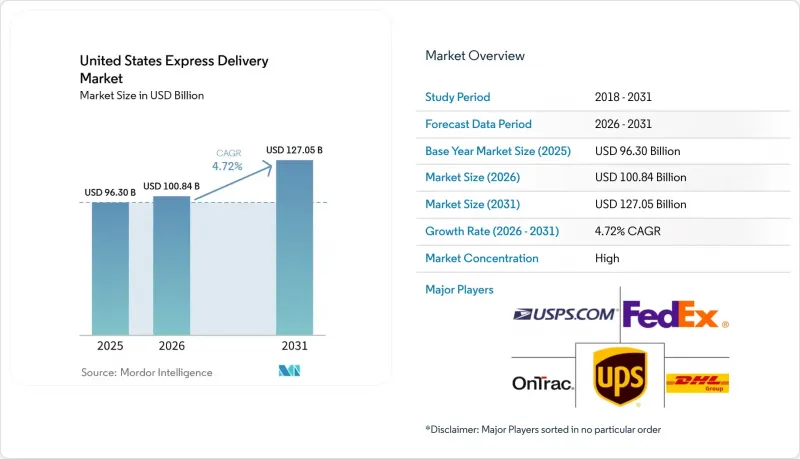
This report is Segmented by End User Industry (E-Commerce and More), by Destination (Domestic and International), by Delivery Commitment (Time-Definite-Express and Day-Definite-Express), by Mode of Transport (Air, Road and Others), by Shipment Weight (Heavy Weight Shipments and More), and by Model (Business-To-Business and More). The Market Forecasts are Provided in Terms of Value (USD).
United States Express Delivery Market Trends and Insights
Explosive Growth of Same-Day and Next-Day E-Commerce Parcels in Top-60 MSAs
Amazon fulfilled 4 billion same-day or next-day orders domestically in 2024, showcasing the operational impact of its regionalized fulfillment model. This achievement created a cascading requirement for comparable velocity among competitors, with 99% of large players in the United States same day delivery market aiming to offer some form of same-day delivery by 2025. Express carriers are doubling same-day facilities and reallocating urban sortation capacity to protect high-yield corridors. The United States express delivery market is therefore concentrating capital in the densest metropolitan areas, leading to a two-tier service structure that challenges nationwide coverage economics. In rural zones, carriers are piloting drones and autonomous vans as viable substitutes for costly truck-based routes, highlighting a technology-led push for inclusive service reach.
Retailers' Shift to Micro-Fulfillment Centers Boosting "Zone-0/1" Express Volumes
Automated micro-fulfillment centers shorten average parcel miles to under five, enabling ground-priced shipments to meet express-level speed targets. Amazon's Project Juniper roll-out illustrates how modular robotics can retrofit underutilized retail footprints into sub-hour fulfillment nodes. Express providers gain incremental revenue by offering zone-skipping, scheduled pick-ups, and managed returns tailored to these urban nodes. Yet, scaling micro-fulfillment remains capital intensive, and early grocery-focused enthusiasm has moderated as volumes normalize. Continuous robotics upgrades and flexible racking are improving ROI, allowing the United States express delivery market to capture premium, ultra-local traffic despite cooling hype cycles.
Ground-Express Modal Substitution as Shippers Trade Down for Cost Optimization
Shippers are gravitating toward economical tiers such as UPS Ground Saver to mitigate inflationary pressures. Consumer research confirms that 90% of buyers accept longer waits in exchange for free shipping, eroding the urgency premium once unique to express. FedEx and UPS instituted 5.9-6.6% general rate increases for 2025 but are blending ground and express operations to preserve service dependability. USPS's Ground Advantage compounds the margin squeeze by offering reliable two-to-five-day options at aggressive pricing. Aggregate volume migration toward deferred tiers dampens near-term revenue expansion across the United States express delivery market.
Other drivers and restraints analyzed in the detailed report include:
- As Healthcare Cold-Chain Compliance Tightens, Premium Express Services Stand to Gain
- International Inbound Growth on Cross-Border Returns from China-Origin Marketplaces
- Labor Union Agreements Escalating Last-Mile Cost per Stop
For complete list of drivers and restraints, kindly check the Table Of Contents.
Segment Analysis
E-Commerce held a 39.62% share of the United States express delivery market size in 2025, anchoring daily volume expectations. Apparel and beauty items dominate shipment counts, and returns management is a critical ancillary service.
Wholesale and Retail Trade (Offline) bookings are expected to grow fastest at 5.62% CAGR (2026-2031) as brick-and-mortar chains launched store-to-door express fulfillment, narrowing the service gap with online-only rivals. Manufacturing relies on overnight parts to minimize production disruption, while healthcare drives premium yields because cold chain failures carry compliance penalties. Financial services send fewer parcels but require ironclad chain-of-custody controls, sustaining a niche premium for secure express. Vertical specialization thus remains a durable strategy for margin preservation in the United States express delivery market.
International express is projected to record a 5.73% CAGR (2026-2031) trajectory, while the domestic channel sustained a larger base with 62.10% of the United States express delivery market size in 2025. Increased document verification, tariff calculations, and return logistics confer pricing power on integrators possessing brokerage depth. Nearshoring under the USMCA framework accelerates intra-regional lanes such as Mexico-United States, producing shorter average line-haul distances yet not eroding premium service demand.
Domestic growth, though slower, benefits from e-commerce densification, spare-parts urgency, and temperature-controlled pharmaceuticals that cannot tolerate deferred transit. Amazon's regional inventory placement elevated customer expectations for 24-hour delivery windows across the continental footprint. The United States express delivery market, therefore, maintains a dual-engine model in which domestic volume secures network density and international parcels deliver a higher yield.
Complete Report Scope:
- Destination
- Domestic
- International
- By Route
- Inter-Region
- Intra-Region
- By Route
- Delivery Commitment
- Time-Definite-Express (TDE)
- Day-Definite-Express (DDE)
- Mode of Transport
- Air
- Road
- Others
- Shipment Weight
- Heavy Weight Shipments
- Light Weight Shipments
- Medium Weight Shipments
- Model
- Business-to-Business (B2B)
- Business-to-Consumer (B2C)
- Consumer-to-Consumer (C2C)
- End User Industry
- E-Commerce
- Financial Services (BFSI)
- Healthcare
- Manufacturing
- Primary Industry
- Wholesale and Retail Trade (Offline)
- Others
List of Companies Covered in this Report:
- American Expediting
- Breakaway Courier Systems
- Canada Post Corporation (Including Purolator, Inc.)
- Courier Express
- DHL Group
- Dropoff, Inc.
- ExpressIt Delivery
- FedEx
- International Distribution Services PLC (Inculding GLS)
- Jet Delivery, Inc.
- King Courier
- MedSpeed
- Need It Now Delivers (Formerly A1-SameDay)
- NOW Delivery
- OnTrac (Formerly LaserShip/OnTrac)
- Priority One Courier and Logistics
- Spee-Dee Delivery Service, Inc.
- TFI International, Inc. (Including TForce Logistics)
- United Parcel Service of America, Inc. (UPS)
- United States Postal Service (USPS)
- WeDo Logistics, Ltd. (Including Lone Star Overnight, Inc.)
Additional Benefits:
- The market estimate (ME) sheet in Excel format
- 3 months of analyst support
TABLE OF CONTENTS
1 Introduction
- 1.1 Study Assumptions and Market Definition
- 1.2 Scope of the Study
2 Research Methodology
3 Executive Summary
4 Market Landscape
- 4.1 Market Overview
- 4.2 Demographics
- 4.3 GDP Distribution by Economic Activity
- 4.4 GDP Growth by Economic Activity
- 4.5 Inflation
- 4.6 Economic Performance and Profile
- 4.6.1 Trends in E-Commerce Industry
- 4.6.2 Trends in Manufacturing Industry
- 4.7 Transport and Storage Sector GDP
- 4.8 Export Trends
- 4.9 Import Trends
- 4.10 Fuel Price
- 4.11 Logistics Performance
- 4.12 Infrastructure
- 4.13 Regulatory Framework
- 4.14 Value Chain and Distribution Channel Analysis
- 4.15 Market Drivers
- 4.15.1 Explosive Growth of Same-Day and Next-Day E-commerce Parcels in Top-60 MSAs (Amazon Prime Effect)
- 4.15.2 Retailers' Shift to Micro-Fulfillment Centers Boosting "Zone-0/1" Express Volumes
- 4.15.3 As Healthcare Cold-Chain Compliance Tightens, Premium Express Temperature-Controlled Services Stand to Gain
- 4.15.4 International Express Inbound Thrives on Rising Cross-Border Returns from China-Origin Marketplaces
- 4.15.5 Subscription Commerce and Direct-to-Consumer Brands Driving Predictable Express Volume Growth
- 4.15.6 "2-hour" Drone/Van Hybrid Networks Gain Traction in B2B Time-Critical Spare-Parts Programs
- 4.16 Market Restraints
- 4.16.1 Ground-Express Modal Substitution as Shippers Trade-Down for Cost Optimization
- 4.16.2 Labor Union Agreements Escalating Last-Mile Cost per Stop
- 4.16.3 Airport Capacity Curfews Limiting Night-Sort Expansion in Tier-1 Hubs
- 4.16.4 Rising Fuel Costs Pressuring Delivery Economics and Route Optimization
- 4.17 Technology Innovations in the Market
- 4.18 Porter's Five Forces Analysis
- 4.18.1 Threat of New Entrants
- 4.18.2 Bargaining Power of Suppliers
- 4.18.3 Bargaining Power of Buyers
- 4.18.4 Threat of Substitutes
- 4.18.5 Competitive Rivalry
5 Market Size and Growth Forecasts (Value, USD)
- 5.1 Destination
- 5.1.1 Domestic
- 5.1.2 International
- 5.1.2.1 By Route
- 5.1.2.1.1 Inter-Region
- 5.1.2.1.2 Intra-Region
- 5.1.2.1 By Route
- 5.2 Delivery Commitment
- 5.2.1 Time-Definite-Express (TDE)
- 5.2.2 Day-Definite-Express (DDE)
- 5.3 Mode of Transport
- 5.3.1 Air
- 5.3.2 Road
- 5.3.3 Others
- 5.4 Shipment Weight
- 5.4.1 Heavy Weight Shipments
- 5.4.2 Light Weight Shipments
- 5.4.3 Medium Weight Shipments
- 5.5 Model
- 5.5.1 Business-to-Business (B2B)
- 5.5.2 Business-to-Consumer (B2C)
- 5.5.3 Consumer-to-Consumer (C2C)
- 5.6 End User Industry
- 5.6.1 E-Commerce
- 5.6.2 Financial Services (BFSI)
- 5.6.3 Healthcare
- 5.6.4 Manufacturing
- 5.6.5 Primary Industry
- 5.6.6 Wholesale and Retail Trade (Offline)
- 5.6.7 Others
6 Competitive Landscape
- 6.1 Market Concentration
- 6.2 Key Strategic Moves
- 6.3 Market Share Analysis
- 6.4 Company Profiles (Includes Global Level Overview, Market Level Overview, Core Segments, Financials as Available, Strategic Information, Market Rank/Share for Key Companies, Products and Services, and Recent Developments)
- 6.4.1 American Expediting
- 6.4.2 Breakaway Courier Systems
- 6.4.3 Canada Post Corporation (Including Purolator, Inc.)
- 6.4.4 Courier Express
- 6.4.5 DHL Group
- 6.4.6 Dropoff, Inc.
- 6.4.7 ExpressIt Delivery
- 6.4.8 FedEx
- 6.4.9 International Distribution Services PLC (Inculding GLS)
- 6.4.10 Jet Delivery, Inc.
- 6.4.11 King Courier
- 6.4.12 MedSpeed
- 6.4.13 Need It Now Delivers (Formerly A1-SameDay)
- 6.4.14 NOW Delivery
- 6.4.15 OnTrac (Formerly LaserShip/OnTrac)
- 6.4.16 Priority One Courier and Logistics
- 6.4.17 Spee-Dee Delivery Service, Inc.
- 6.4.18 TFI International, Inc. (Including TForce Logistics)
- 6.4.19 United Parcel Service of America, Inc. (UPS)
- 6.4.20 United States Postal Service (USPS)
- 6.4.21 WeDo Logistics, Ltd. (Including Lone Star Overnight, Inc.)
7 Market Opportunities and Future Outlook
- 7.1 White-Space and Unmet-Need Assessment

