PUBLISHER: Mordor Intelligence | PRODUCT CODE: 2073426

PUBLISHER: Mordor Intelligence | PRODUCT CODE: 2073426
Polystyrene - Market Share Analysis, Industry Trends & Statistics, Growth Forecasts (2026 - 2031)
According to Mordor Intelligence, the polystyrene market size is projected to expand from 17.40 million tons in 2025 and 18.19 million tons in 2026 to 22.72 million tons by 2031, registering a CAGR of 4.55% between 2026 to 2031.
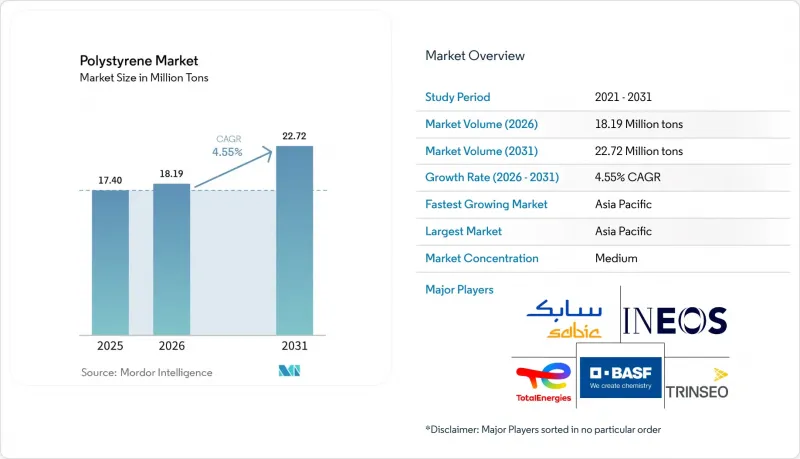
This report is Segmented by Resin Type (General-Purpose Polystyrene, High-Impact Polystyrene, and More), Form Type (Foams, Films and Sheets, and More), End-User Industry (Packaging, Building and Construction, Electrical and Electronics, and More), and Geography (Asia-Pacific, North America, Europe, South America, and the Middle-East and Africa). The Market Forecasts are Provided in Terms of Volume (tons).
Global Polystyrene Market Trends and Insights
E-commerce and Food-service Packaging Boom
Online retail and quick-service restaurant growth continue to lift protective packaging volumes, particularly in the Asia-Pacific where regulatory exemptions remain common. Lightweight EPS cushioning lowers dimensional-weight freight charges, securing its place versus corrugated inserts. Food-service operators in Latin America and Southeast Asia still rely on insulated beverage cups and clamshells because alternative compostable polymers remain cost-prohibitive. In North America, molded-fiber investments have started to displace foam in quick-service packaging, yet the sheer scale of e-commerce keeps the polystyrene market expanding. Brands balancing cost, cushioning performance, and consumer perceptions are therefore sustaining dual sourcing strategies.
Energy-Efficiency Codes Lifting EPS/XPS Insulation Demand
The 2024 International Energy Conservation Code and ASHRAE 90.1-2022 raised minimum R-values for walls and foundations, generating multi-year demand for thicker EPS and XPS boards in U.S. and European building envelopes. Europe's Energy Performance of Buildings Directive, recast in 2024, stipulates near-zero-energy standards for new structures by 2030. Responding, BASF is adding 50,000 tons of Neopor EPS capacity at Ludwigshafen to come online in early 2027. China's GB 55015-2021 mirrors these requirements for high-rise housing, entrenching EPS insulation as a structural growth pillar that is insulated from short-term cyclicality in packaging.
Single-use PS Bans and Extended Producer-Responsibility Fees
The EU Single-Use Plastics Directive, fully enforced in 2024, imposes EPR fees that lift polystyrene food-container costs by 15-25% across member states. California's SB 54 mandates 25% recycled content by 2032 for single-use packaging, accelerating the shift toward fiber clamshells and compostable polymers. The UK plastic packaging tax of GBP 210.82 per tonne penalizes virgin PS imports lacking 30% recycled content, and Taipei plus Seoul have initiated phased bans on foam take-out ware. These measures are redirecting volume growth toward insulation, electronics, and other durable segments.
Other drivers and restraints analyzed in the detailed report include:
- Electronics and Appliance Output Growth
- Technology Break-throughs in Chemical Recycling
- High-performance Paper and Bio-polymer Substitutes
For complete list of drivers and restraints, kindly check the Table Of Contents.
Segment Analysis
General-purpose polystyrene is set to outpace the broader market at 5.51% CAGR through 2031, despite expandable polystyrene's commanding 45.19% share in 2025. GPPS's acceleration stems from food-contact packaging innovations, particularly injection-molded yogurt cups, dessert containers, and portion-control trays that leverage its clarity, rigidity, and FDA-compliant formulations. High-impact polystyrene (HIPS), the second-largest resin type, serves durable-goods applications such as refrigerator liners, television bezels, and small-appliance housings, where its toughness and dimensional stability justify a price premium over commodity GPPS. HIPS demand correlates tightly with consumer electronics output; China's 11.77% year-over-year production growth in the first half of 2025 directly lifted HIPS consumption in injection-molding operations.
Expandable polystyrene remains the volume leader, driven by construction insulation and protective packaging, yet its growth rate lags GPPS due to regulatory headwinds in foodservice applications. EPS insulation demand is structural, tied to building energy codes such as IECC 2024 and ASHRAE 90.1-2022, which mandate higher R-values for commercial and residential envelopes. BASF's 50,000-tonne Neopor expansion at Ludwigshafen, targeting early 2027 commissioning, underscores confidence in long-term EPS insulation demand despite single-use packaging bans.
Complete Report Scope:
- By Resin Type
- General-Purpose Polystyrene (GPPS)
- High-Impact Polystyrene (HIPS)
- Expandable Polystyrene (EPS)
- By Form Type
- Foams
- Films and Sheets
- Injection-Molded Parts
- Other Form Types (3-D Printing Filaments,etc.)
- By End-user Industry
- Packaging
- Building and Construction
- Electrical and Electronics
- Consumer Goods
- Other End user Industries (Automotive and Transportation,Medical Devices)
- By Geography
- Asia-Pacific
- China
- India
- Japan
- South Korea
- Rest of Asia-Pacific
- North America
- United States
- Canada
- Mexico
- Europe
- Germany
- United Kingdom
- France
- Italy
- Rest of Europe
- South America
- Brazil
- Argentina
- Rest of South America
- Middle-East and Africa
- Saudi Arabia
- South Africa
- Rest Middle-East and Africa
- Asia-Pacific
Geography Analysis
Asia-Pacific commanded 56.88% of the 2025 volume and is forecast to deliver a 5.66% CAGR through 2031. In China, consumer electronics production, up 11.77% in the first half of 2025, underpins HIPS demand, while building-code GB 55015-2021 ensures steady EPS pull-through in residential high-rises. India's pharma cold-chain subsidies continue to boost EPS shipper usage, and Styrenix's acquisition of INEOS's Thailand site adds 100,000 tons of capacity to serve Southeast Asia.
North America enjoys feedstock-cost leadership, with ethane-based styrene driving exports that rose 18% year-on-year during 2025. Energy-efficiency codes such as IECC 2024 sustain domestic insulation demand, even as single-use bans in California and municipal ordinances in Seattle and Portland trim food-service foam. Canada's supply landscape is consolidating after INEOS decided to idle its Sarnia styrene plant by mid-2026, redirecting shipments to Gulf Coast hubs. Mexico gains from near-shoring as appliance assemblers add injection-molding lines in Monterrey and Queretaro industrial clusters.
The Europe expanded polystyrene (EPS) market faces a dual reality: rigorous Single-Use Plastics Directive levies reduce disposable food-ware volumes, yet the EPBD recast drives sustained EPS insulation growth. BASF's Neopor expansion exemplifies the investment case tied to near-zero-energy building requirements. INEOS's ResolVe program aligns with UK plastic-packaging-tax thresholds and EPR fee schedules, ensuring access to high-margin applications. Growth lags Asia-Pacific but remains durable in segments aligned with circular-economy mandates.
South America is anchored by Brazil, where e-commerce and residential construction lift GPPS and EPS usage. Argentina's macro-economic headwinds limit building activity, but medical-device assembly in Cordoba offers a pocket of strength. Middle East and Africa volumes are nascent yet accelerating, led by Saudi Arabia's Vision 2030 infrastructure pipeline and South Africa's vaccine cold-chain expansions. Lack of local resin production keeps these regions tied to imports from Asia-Pacific and Europe, but rising insulation standards and healthcare investments signal long-term opportunity.
- Alpek S.A.B. de C.V.
- Americas Styrenics LLC (AmSty)
- Atlas Molded Products
- BASF
- CHIMEI
- Dow
- Eni S.p.A
- Formosa Chemicals and Fibre Corp.
- INEOS
- Innova
- KUMHO PETROCHEMICAL
- LG Chem
- Loyal Group
- Ravago
- Sabert Corporation
- SABIC
- Supreme Petrochem Ltd
- Synthos
- TotalEnergies
- Trinseo
Additional Benefits:
- The market estimate (ME) sheet in Excel format
- 3 months of analyst support
TABLE OF CONTENTS
1 Introduction
- 1.1 Study Assumptions and Market Definition
- 1.2 Scope of the Study
2 Research Methodology
3 Executive Summary
4 Market Landscape
- 4.1 Market Overview
- 4.2 Market Drivers
- 4.2.1 E-commerce and Food-service Packaging Boom
- 4.2.2 Energy-Efficiency Codes Lifting EPS/XPS Insulation Demand
- 4.2.3 Electronics and Appliance Output Growth
- 4.2.4 Technology Break-throughs in Chemical Recycling
- 4.2.5 Cold-chain Pharma Logistics in Emerging Markets
- 4.3 Market Restraints
- 4.3.1 Single-use PS Bans and Extended Producer-Responsibility Fees
- 4.3.2 High-performance Paper and Bio-polymer Substitutes
- 4.3.3 Styrene Feedstock Tightness from Light-feed Steam Crackers
- 4.4 Value Chain Analysis
- 4.5 Porter's Five Forces
- 4.5.1 Bargaining Power of Suppliers
- 4.5.2 Bargaining Power of Buyers
- 4.5.3 Threat of New Entrants
- 4.5.4 Threat of Substitute Products
- 4.5.5 Degree of Competition
5 Market Size and Growth Forecasts (Volume)
- 5.1 By Resin Type
- 5.1.1 General-Purpose Polystyrene (GPPS)
- 5.1.2 High-Impact Polystyrene (HIPS)
- 5.1.3 Expandable Polystyrene (EPS)
- 5.2 By Form Type
- 5.2.1 Foams
- 5.2.2 Films and Sheets
- 5.2.3 Injection-Molded Parts
- 5.2.4 Other Form Types (3-D Printing Filaments,etc.)
- 5.3 By End-user Industry
- 5.3.1 Packaging
- 5.3.2 Building and Construction
- 5.3.3 Electrical and Electronics
- 5.3.4 Consumer Goods
- 5.3.5 Other End user Industries (Automotive and Transportation,Medical Devices)
- 5.4 By Geography
- 5.4.1 Asia-Pacific
- 5.4.1.1 China
- 5.4.1.2 India
- 5.4.1.3 Japan
- 5.4.1.4 South Korea
- 5.4.1.5 Rest of Asia-Pacific
- 5.4.2 North America
- 5.4.2.1 United States
- 5.4.2.2 Canada
- 5.4.2.3 Mexico
- 5.4.3 Europe
- 5.4.3.1 Germany
- 5.4.3.2 United Kingdom
- 5.4.3.3 France
- 5.4.3.4 Italy
- 5.4.3.5 Rest of Europe
- 5.4.4 South America
- 5.4.4.1 Brazil
- 5.4.4.2 Argentina
- 5.4.4.3 Rest of South America
- 5.4.5 Middle-East and Africa
- 5.4.5.1 Saudi Arabia
- 5.4.5.2 South Africa
- 5.4.5.3 Rest Middle-East and Africa
- 5.4.1 Asia-Pacific
6 Competitive Landscape
- 6.1 Market Concentration
- 6.2 Strategic Moves
- 6.3 Market Share(%)/Ranking Analysis
- 6.4 Company Profiles (includes Global level Overview, Market level overview, Core Segments, Financials as available, Strategic Information, Market Rank/Share for key companies, Products and Services, Recent Developments)
- 6.4.1 Alpek S.A.B. de C.V.
- 6.4.2 Americas Styrenics LLC (AmSty)
- 6.4.3 Atlas Molded Products
- 6.4.4 BASF
- 6.4.5 CHIMEI
- 6.4.6 Dow
- 6.4.7 Eni S.p.A
- 6.4.8 Formosa Chemicals and Fibre Corp.
- 6.4.9 INEOS
- 6.4.10 Innova
- 6.4.11 KUMHO PETROCHEMICAL
- 6.4.12 LG Chem
- 6.4.13 Loyal Group
- 6.4.14 Ravago
- 6.4.15 Sabert Corporation
- 6.4.16 SABIC
- 6.4.17 Supreme Petrochem Ltd
- 6.4.18 Synthos
- 6.4.19 TotalEnergies
- 6.4.20 Trinseo
7 Market Opportunities and Future Outlook
- 7.1 White-space and Unmet-Need Assessment
- 7.2 Ongoing Research and Development in Bio-based and Chemically Recycled Polystyrene

