PUBLISHER: Mordor Intelligence | PRODUCT CODE: 2073429

PUBLISHER: Mordor Intelligence | PRODUCT CODE: 2073429
United States Coffee - Market Share Analysis, Industry Trends & Statistics, Growth Forecasts (2026 - 2031)
According to Mordor Intelligence, the united states coffee market size stands at USD 23.76 billion in 2025, and is expected to grow from USD 24.98 billion in 2026 to reach USD 31.05 billion by 2031, growing at a 4.45% CAGR.
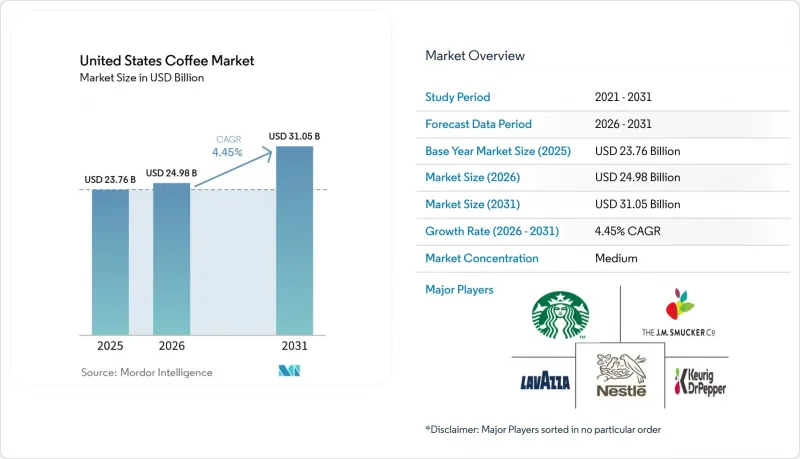
This report is Segmented by Product Type (Whole Bean, Ground Coffee, Instant Coffee, and Coffee Pods and Capsules), Type (Conventional and Specialty), Packaging Type (Flexible, Rigid, and Single-Serve), Distribution Channel (On-Trade and Off-Trade), and Geography (California, Texas, Florida, and More). The Market Forecasts are Provided in Terms of Value (USD) and Volume (Tons).
United States Coffee Market Trends and Insights
Premiumization and third-wave adoption among consumers
Third-wave coffee has transitioned from niche to mainstream, with 45% of Americans consuming specialty coffee on any given day in 2024, up from 25% a decade earlier, according to the National Coffee Association (NCA). This shift is most pronounced among 25-to-39-year-olds, 64% of whom drank specialty coffee in the past week in 2025, a cohort that values transparency around origin, processing method, and roaster relationships with farmers. The willingness to pay extra for a single-origin pour-over or a nitro cold brew creates a margin buffer that insulates roasters from commodity-price volatility, specialty brands absorbed the increase without losing customers because the value proposition rests on craft and story rather than price per ounce. West Coast markets lead adoption, with 58% of consumers in the region purchasing specialty coffee, but the trend is diffusing eastward as independent roasters open tasting rooms and subscription services deliver freshly roasted beans direct to doorsteps. This premiumization dynamic explains why the specialty segment will grow annually through 2031.
Growing demand for functional and specialty coffee range
In 2024, searches for mushroom coffee on Ocado's platform skyrocketed, reflecting a surge of interest in the United States for blends that merge caffeine with adaptogens. This trend highlights a growing consumer shift toward functional beverages that cater to both wellness and lifestyle needs. Brands like MUD/WTR are blending cacao, lion's mane, and chaga, aligning with Gen Z's wellness aspirations for focused energy without the jitters. These products appeal to health-conscious consumers seeking alternatives to traditional high-caffeine beverages. While the Food and Drug Administration (FDA) guidelines set a daily caffeine cap of 400 mg for adults, this opens avenues for lower-caffeine products that emphasize nootropic and anti-inflammatory advantages, offering a balance between functionality and safety. This evolution compels conventional roasters to delve deeper into ingredient science and navigate regulatory validations to remain competitive. The convergence of coffee and wellness trends is driving innovation, pushing brands to adapt and meet the growing demand for functional, health-oriented beverages.
Climate-induced yield volatility raising costs
Severe weather events in key coffee-growing regions have disrupted production, leading to fluctuations in United States market prices. According to Food and Agriculture Organization (FAO) data, these weather-related supply disruptions were responsible for 40% of price hikes in 2024. In Vietnam, coffee production plummeted by 20% in 2023/24 due to extended dry spells, resulting in a 10% drop in exports for the second consecutive year. Indonesia witnessed a 16.5% year-on-year decline in production, as rains in April-May 2023 damaged coffee cherries, leading to a 23% cut in exports. Brazil's production forecast for 2023/24 was revised from an anticipated 5.5% increase to a 1.6% decline, primarily due to drought conditions in pivotal states like Minas Gerais and Sao Paulo. These supply challenges have driven up retail coffee prices. Furthermore, climate models indicate a shrinking suitable land for coffee cultivation, perpetuating price pressures and constraining growth in markets sensitive to price changes.
Other drivers and restraints analyzed in the detailed report include:
- Urbanization and a fast-paced lifestyle drive demand in on-trade distribution
- Growth in the coffee house stores fueling market demand
- Detrimental impact of coffee pods and capsules on the environment
For complete list of drivers and restraints, kindly check the Table Of Contents.
Segment Analysis
In 2025, the United States coffee market saw ground coffee commanding a 39.60% share. While price-sensitive households continue to buy bulk canisters, maintaining a steady volume, premium niches are also flourishing due to increasing consumer interest in high-quality and specialty coffee products. Yet, the ascent of single-cup machines and the burgeoning home-barista trend are nibbling away at this share, as consumers seek convenience and the ability to replicate cafe-style beverages at home.
The pods and capsules will see a 5.93% CAGR growth through 2031, driven by convenience seekers poised to switch formats once compostable solutions achieve scale. Whole-bean coffee benefits from a craft preparation image and a fresher aroma, while instant coffee's growth is fueled by premium sticks marketed for travel and outdoor enthusiasts. To counter direct-to-consumer (DTC) roasters, mass-market incumbents are integrating subscription models with loyalty apps. Their value proposition now combines freshness guarantees, carbon-neutral shipping, and storytelling about coffee origins, bridging the experiential divide with boutique brands.
In 2025, conventional coffee commanded a dominant 53.95% share of the United States coffee market, bolstered by extensive grocery distribution and strategic price promotions. During the commodity price spikes of 2024-25, some consumers opted for conventional coffee, underscoring its resilience amid inflationary pressures.
Meanwhile, the specialty coffee segment is set to grow at a robust 7.03% rate through 2031, outpacing the broader United States coffee market. This growth is driven by younger consumers who increasingly view coffee as an artisanal experience rather than just a caffeine fix, valuing unique flavors, premium quality, and ethical sourcing. Specialty coffee's footprint is expanding beyond major cities, with secondary metros embracing micro-roasters and barista training labs. These developments are fostering a culture of coffee craftsmanship and education in previously untapped regions. In response, corporate giants are unveiling reserve collections to capitalize on this trend.
Complete Report Scope:
- By Product Type
- Whole Bean
- Ground Coffee
- Instant Coffee
- Coffee Pods and Capsules
- By Type
- Conventional Coffee
- Specialty Coffee
- By Packaging Type
- Flexible
- Rigid
- Single-Serve
- By Distribution Channel
- On-Trade
- Off-Trade
- Supermarkets/Hypermarkets
- Convenience/Grocery Stores
- Online Retail Stores
- Other off-trade Channels
- By Geography
- California
- Texas
- Florida
- New York
- Pennsylvania
- Illinois
- Rest of the United States
List of Companies Covered in this Report:
- Starbucks Corporation
- J.M. Smucker Co.
- Keurig Dr Pepper Inc.
- Nestle SA
- Kraft Heinz Co.
- Luigi Lavazza S.p.A.
- Community Coffee Company
- Dunkin' Brands Group, Inc.
- Caribou Coffee Company
- Farmer Brothers Co.
- La Colombe Coffee Roasters
- Death Wish Coffee Co.
- Black Rifle Coffee Company
- High Brew Coffee
- Bulletproof 360 Inc.
- Allegro Coffee Company
- RISE Brewing Co.
- Coffee Bros
- Chilz Coffee
- Counter Culture Coffee
Additional Benefits:
- The market estimate (ME) sheet in Excel format
- 3 months of analyst support
TABLE OF CONTENTS
1 INTRODUCTION
- 1.1 Study Assumptions and Market Definition
- 1.2 Scope of the Study
2 RESEARCH METHODOLOGY
3 EXECUTIVE SUMMARY
4 MARKET LANDSCAPE
- 4.1 Market Overview
- 4.2 Market Drivers
- 4.2.1 Premiumization and third-wave coffee adoption among consumers
- 4.2.2 Growing demand for a functional and specialty coffee range
- 4.2.3 Urbanization and a fast-paced lifestyle drive demand in on-trade distribution
- 4.2.4 State compostable-packaging mandates packaging innovations
- 4.2.5 Growth of home-barista equipment is boosting whole-bean sales
- 4.2.6 Growth in the coffee house stores is fuelling market demand
- 4.3 Market Restraints
- 4.3.1 Climate-induced yield volatility raising costs
- 4.3.2 Detrimental impact of coffee pods and capsules on the environment
- 4.3.3 Growing consumer awareness regarding the adverse impacts of caffeine on human health
- 4.3.4 Competition from alternative beverages
- 4.4 Supply-Chain Analysis
- 4.5 Regulatory Outlook
- 4.6 Trade and Production Analysis
- 4.7 Consumer Behaviour Analysis
- 4.8 Technological Outlook
- 4.9 Specialized Certifications by Coffee Producers and Manufactuers
- 4.10 Porter's Five Forces Analysis
- 4.10.1 Bargaining Power of Suppliers
- 4.10.2 Bargaining Power of Buyers/Consumers
- 4.10.3 Threat of New Entrants
- 4.10.4 Threat of Substitute Products
- 4.10.5 Intensity of Competitive Rivalry
5 MARKET SIZE AND GROWTH FORECASTS (VALUE AND VOLUME)
- 5.1 By Product Type
- 5.1.1 Whole Bean
- 5.1.2 Ground Coffee
- 5.1.3 Instant Coffee
- 5.1.4 Coffee Pods and Capsules
- 5.2 By Type
- 5.2.1 Conventional Coffee
- 5.2.2 Specialty Coffee
- 5.3 By Packaging Type
- 5.3.1 Flexible
- 5.3.2 Rigid
- 5.3.3 Single-Serve
- 5.4 By Distribution Channel
- 5.4.1 On-Trade
- 5.4.2 Off-Trade
- 5.4.2.1 Supermarkets/Hypermarkets
- 5.4.2.2 Convenience/Grocery Stores
- 5.4.2.3 Online Retail Stores
- 5.4.2.4 Other off-trade Channels
- 5.5 By Geography
- 5.5.1 California
- 5.5.2 Texas
- 5.5.3 Florida
- 5.5.4 New York
- 5.5.5 Pennsylvania
- 5.5.6 Illinois
- 5.5.7 Rest of the United States
6 COMPETITIVE LANDSCAPE
- 6.1 Market Concentration
- 6.2 Strategic Moves
- 6.3 Market Share Analysis
- 6.4 Company Profiles (includes Global level Overview, Market level overview, Core Segments, Financials as available, Strategic Information, Market Rank/Share for key companies, Products and Services, and Recent Developments)
- 6.4.1 Starbucks Corporation
- 6.4.2 J.M. Smucker Co.
- 6.4.3 Keurig Dr Pepper Inc.
- 6.4.4 Nestle SA
- 6.4.5 Kraft Heinz Co.
- 6.4.6 Luigi Lavazza S.p.A.
- 6.4.7 Community Coffee Company
- 6.4.8 Dunkin' Brands Group, Inc.
- 6.4.9 Caribou Coffee Company
- 6.4.10 Farmer Brothers Co.
- 6.4.11 La Colombe Coffee Roasters
- 6.4.12 Death Wish Coffee Co.
- 6.4.13 Black Rifle Coffee Company
- 6.4.14 High Brew Coffee
- 6.4.15 Bulletproof 360 Inc.
- 6.4.16 Allegro Coffee Company
- 6.4.17 RISE Brewing Co.
- 6.4.18 Coffee Bros
- 6.4.19 Chilz Coffee
- 6.4.20 Counter Culture Coffee
7 MARKET OPPORTUNITIES AND FUTURE OUTLOOK

