PUBLISHER: Mordor Intelligence | PRODUCT CODE: 2073471

PUBLISHER: Mordor Intelligence | PRODUCT CODE: 2073471
Smart Electricity Meter - Market Share Analysis, Industry Trends & Statistics, Growth Forecasts (2026 - 2031)
According to Mordor Intelligence, smart electricity meter market size in 2026 is estimated at USD 15.02 billion, growing from 2025 value of USD 13.74 billion with 2031 projections showing USD 23.46 billion, growing at 9.31% CAGR over 2026-2031.
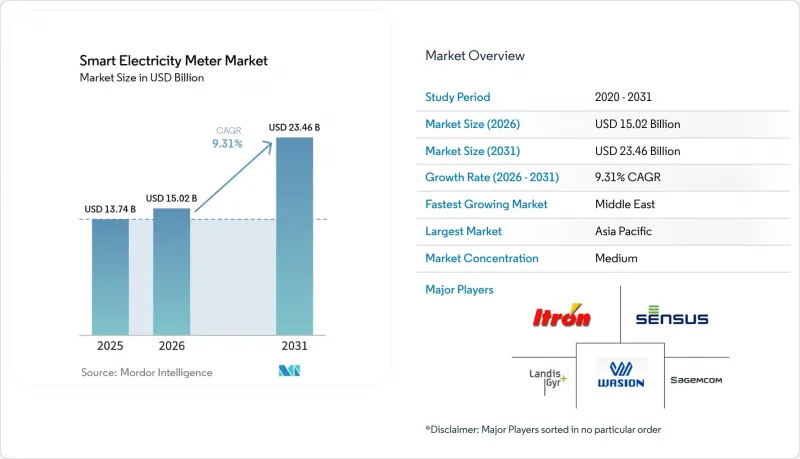
This report is Segmented by Phase (Single-Phase and Three-Phase), Communication Technology (Power-Line Communication (PLC), and More), Technology (Advanced Metering Infrastructure (AMI) and More), End-User (Residential, Commercial, and Industrial), Installation Mode (New Installations and Retrofits / Replacements), and Geography. The Market Forecasts are Provided in Terms of Value (USD).
Global Smart Electricity Meter Market Trends and Insights
Mandatory EU-2025 Three-Phase Replacement Mandates
Europe's legally binding schedule to swap legacy three-phase meters forces utilities to replace millions of commercial and industrial units before 2027. Utilities are seizing the window to roll out AMI platforms that capture granular interval data and support sub-metering services. Meter vendors benefit from a higher average selling price, roughly triple that of single-phase units, while software providers gain recurring revenue through data-management contracts. Capital spending earmarked for compliance is also accelerating investment in data hubs that will underpin tariff innovation and demand-side flexibility programs.
China NB-IoT Smart-Meter Mega-Tenders
The State Grid Corporation's 2025 tender for 6 million dual-mode NB-IoT meters cements cellular connectivity as a price-competitive option. Bulk procurement compresses component costs for global buyers and speeds certification cycles for modem vendors. The meters' dual-band design future-proofs deployments against 2G sunsets, while cloud-native head-end systems streamline software upgrades. These operational gains resonate with Southeast Asian utilities that share similar urban density challenges, reinforcing China's design template as a de-facto standard.
ASIC Supply-Chain Shortages Inflate BOM Costs
Persistent scarcity of specialized processors continues to lift meter manufacturing expenses by 15-25%. Smaller vendors are redesigning boards to use multi-purpose MCUs, extending validation cycles and inflating working capital. Several North American municipal utilities have postponed tranche-two deployments until 2027 in the hope that wafer fabs coming online in 2026 will relieve shortages. The squeeze is most acute for AMI meters that require cryptographic acceleration and edge-analytics cores
Other drivers and restraints analyzed in the detailed report include:
- U.S.-Japan Demand-Response AMI Roll-Outs
- Prosumer Billing Surge in Oceania
- UK CPA/EU RED Cyber-Certification Delays
For complete list of drivers and restraints, kindly check the Table Of Contents.
Segment Analysis
Single-phase meters led with a 63.25% revenue share in 2025, whereas three-phase devices are projected to grow at a 9.05% CAGR through 2031. Utilities favor them for medium-voltage feeders, renewable inverters, and EV fast-chargers that demand harmonic-rich load profiling. In contrast, single-phase units, although still numerically dominant, are shifting toward replacement cycles driven by cybersecurity and firmware upgrade requirements. Field-proven accuracy in non-linear load environments has removed a historic adoption barrier for industrial automation users, boosting order backlogs among meter OEMs in Germany, Italy, and Poland.
The segment benefits from the EU mandate that forces advanced three-phase functions such as voltage sag logging and integrated disconnect relays. As a result, the smart electricity meter market is experiencing a clear shift in value towards higher-margin industrial contracts. Three-phase shipments command average selling prices roughly 2.8 times that of residential units, thereby enlarging the smart electricity meter market size for commercial and industrial applications. Vendors are bundling power-quality modules and carbon-intensity reporting to differentiate, and utilities are responding by launching subscription-based analytics that monetize the new data stream.
Power-Line Communication (PLC) retained a 44.10% share in 2025, underpinned by deep penetration in Europe's LV networks. Yet cellular NB-IoT and LTE-M modules are closing the cost gap and are on track for a 11.62% CAGR through 2031. Successful Chinese mega-tenders showcase deployment timelines that beat PLC by six months in dense urban corridors. The smart electricity meter market is shifting toward hybrid architectures, where RF mesh backhauls the outskirts while cellular technology covers high-rise clusters, ensuring contiguous coverage without the need for repeater farms.
eSIM adoption simplifies provisioning because utilities can switch carriers without truck rolls, cutting opex by up to 35%. Field trials in Brazil confirm that NB-IoT penetration into basements and meter rooms outperforms legacy mesh by 22 percentage points. The cellular uptrend expands the smart electricity meter market share of telecom-centric vendors that bundle managed connectivity with hardware. As roaming costs decline, African utilities are utilizing cross-border cellular agreements to standardize AMI formats, thereby reducing import duties associated with proprietary mesh radios.
Complete Report Scope:
- By Phase
- Single-Phase
- Three-Phase
- By Communication Technology
- Power-Line Communication (PLC)
- Radio-Frequency Mesh
- Cellular (NB-IoT / LTE-M)
- Hybrid / Others
- By Technology
- Advanced Metering Infrastructure (AMI)
- Automatic Meter Reading (AMR)
- By End-user
- Residential
- Commercial
- Industrial
- By Installation Mode
- New Installations
- Retrofits / Replacements
- By Geography
- North America
- United States
- Canada
- Mexico
- South America
- Brazil
- Chile
- Colombia
- Rest of South America
- Europe
- United Kingdom
- Germany
- France
- Spain
- Italy
- Nordics
- Benelux
- Rest of Europe
- Asia Pacific
- China
- India
- Japan
- South Korea
- Southeast Asia
- Rest of Asia Pacific
- Middle East
- GCC
- Turkey
- Israel
- Rest of Middle East
- Africa
- South Africa
- Egypt
- Rest of Africa
- North America
Geography Analysis
Asia Pacific held a revenue share of 47.55% in the smart electricity meter market in 2025 and contributed a significant share of global shipments in 2025, continuing to be the volume engine of the smart electricity meter market. China alone has deployed 590 million AMI endpoints across 26 provinces, giving local suppliers unrivaled scale advantages. India's federal push toward 250 million prepaid smart meters by 2027 is spurring public-private joint ventures and unlocking third-party financing structures. High-density urban nodes in Japan and South Korea are rolling out AMI 2.0 to capture sub-second event data, thereby enhancing their power-quality oversight amid the surge in rooftop solar installations.
From 2026 to 2031, the Middle East's smart electricity meter market is set to grow at a robust rate of 10.18%. This surge is largely driven by utilities in the Gulf Cooperation Council (GCC) pushing for grid digitalization, implementing time-of-use tariffs, and emphasizing demand-side management. In countries such as Saudi Arabia, the UAE, and Oman, extensive rollouts of Advanced Metering Infrastructure (AMI) are enhancing billing precision and visibility during power outages. Additionally, the region's momentum is bolstered by a rising adoption of rooftop solar, updates in regulations, and ambitious efficiency targets.
North America achieved 77% penetration by 2024, with utilities now swapping first-wave AMI units for devices that integrate outage-detection algorithms and EV-load forecasting. The U.S. Department of Energy's USD 10.5 billion grid-resilience grant scheme helps mid-size municipals justify upgrades that include meter-centric fault-isolation routines. The region's insistence on open-standards such as Wi-SUN cultivates an ecosystem of interoperable software vendors, thereby increasing competitive tension and driving down lifecycle costs.
Europe's policy-driven landscape stands out for its strict cybersecurity and data-privacy mandates. With 56% of customers already on smart meters by end-2022, the continent pivots toward harmonizing data access so that retailers can offer flexible tariffs across borders.A EUR 5 billion innovation fund aims for 90% coverage by 2027 and earmarks AI-enabled load forecasting as a critical deliverable. The mandatory three-phase replacement starting in 2025 is accelerating industrial uptake, especially in Germany, Spain and the Nordic bloc.
- Landis+Gyr Group AG
- Itron Inc.
- Sagemcom SAS
- Honeywell International Inc. (Elster)
- Kamstrup A/S
- Wasion Group Holdings
- Jiangsu Linyang Energy Co. Ltd
- Ningbo Sanxing Electric Co. Ltd
- Hexing Electric Company Ltd
- Holley Technology Ltd
- Nanjing Xinlian Electronics Co. Ltd
- Sensus USA Inc. (Xylem Inc.)
- ABB Ltd.
- Siemens AG
- Schneider Electric SE
- General Electric Co.
- Aclara Technologies LLC
- EDMI Ltd
- Genus Power Infrastructures Ltd
- ZENNER International GmbH and Co. KG
- Secure Meters Ltd
Additional Benefits:
- The market estimate (ME) sheet in Excel format
- 3 months of analyst support
TABLE OF CONTENTS
1 INTRODUCTION
- 1.1 Study Assumptions and Market Definition
- 1.2 Scope of the Study
2 RESEARCH METHODOLOGY
3 EXECUTIVE SUMMARY
4 MARKET LANDSCAPE
- 4.1 Market Overview
- 4.2 Market Drivers
- 4.2.1 Mandatory EU-2025 three-phase replacement mandates
- 4.2.2 China NB-IoT smart-meter mega-tenders
- 4.2.3 U.S.-Japan demand-response AMI roll-outs
- 4.2.4 Prosumer billing surge in Oceania
- 4.2.5 Grid-modernization stimulus in Southern Cone
- 4.2.6 GCC time-of-use tariff introduction
- 4.3 Market Restraints
- 4.3.1 ASIC supply-chain shortages inflate BOM costs
- 4.3.2 UK CPA/EU RED cyber-certification delays
- 4.3.3 RF-emission pushback in France and Canada
- 4.3.4 Legacy-SCADA incompatibility in Sub-Saharan utilities
- 4.4 Industry Value Chain Analysis
- 4.5 Regulatory Outlook
- 4.6 Technological Outlook
- 4.7 Porters Five Forces Analysis
- 4.7.1 Threat of New Entrants
- 4.7.2 Bargaining Power of Buyers
- 4.7.3 Bargaining Power of Suppliers
- 4.7.4 Threat of Substitutes
- 4.7.5 Competitive Rivalry
5 MARKET SIZE AND GROWTH FORECASTS (VALUE)
- 5.1 By Phase
- 5.1.1 Single-Phase
- 5.1.2 Three-Phase
- 5.2 By Communication Technology
- 5.2.1 Power-Line Communication (PLC)
- 5.2.2 Radio-Frequency Mesh
- 5.2.3 Cellular (NB-IoT / LTE-M)
- 5.2.4 Hybrid / Others
- 5.3 By Technology
- 5.3.1 Advanced Metering Infrastructure (AMI)
- 5.3.2 Automatic Meter Reading (AMR)
- 5.4 By End-user
- 5.4.1 Residential
- 5.4.2 Commercial
- 5.4.3 Industrial
- 5.5 By Installation Mode
- 5.5.1 New Installations
- 5.5.2 Retrofits / Replacements
- 5.6 By Geography
- 5.6.1 North America
- 5.6.1.1 United States
- 5.6.1.2 Canada
- 5.6.1.3 Mexico
- 5.6.2 South America
- 5.6.2.1 Brazil
- 5.6.2.2 Chile
- 5.6.2.3 Colombia
- 5.6.2.4 Rest of South America
- 5.6.3 Europe
- 5.6.3.1 United Kingdom
- 5.6.3.2 Germany
- 5.6.3.3 France
- 5.6.3.4 Spain
- 5.6.3.5 Italy
- 5.6.3.6 Nordics
- 5.6.3.7 Benelux
- 5.6.3.8 Rest of Europe
- 5.6.4 Asia Pacific
- 5.6.4.1 China
- 5.6.4.2 India
- 5.6.4.3 Japan
- 5.6.4.4 South Korea
- 5.6.4.5 Southeast Asia
- 5.6.4.6 Rest of Asia Pacific
- 5.6.5 Middle East
- 5.6.5.1 GCC
- 5.6.5.2 Turkey
- 5.6.5.3 Israel
- 5.6.5.4 Rest of Middle East
- 5.6.6 Africa
- 5.6.6.1 South Africa
- 5.6.6.2 Egypt
- 5.6.6.3 Rest of Africa
- 5.6.1 North America
6 COMPETITIVE LANDSCAPE
- 6.1 Market Concentration
- 6.2 Strategic Moves
- 6.3 Market Share Analysis
- 6.4 Company Profiles (includes Global level Overview, Market level overview, Core Segments, Financials as available, Strategic Information, Market Rank/Share for key companies, Products and Services, Recent Developments)
- 6.4.1 Landis+Gyr Group AG
- 6.4.2 Itron Inc.
- 6.4.3 Sagemcom SAS
- 6.4.4 Honeywell International Inc. (Elster)
- 6.4.5 Kamstrup A/S
- 6.4.6 Wasion Group Holdings
- 6.4.7 Jiangsu Linyang Energy Co. Ltd
- 6.4.8 Ningbo Sanxing Electric Co. Ltd
- 6.4.9 Hexing Electric Company Ltd
- 6.4.10 Holley Technology Ltd
- 6.4.11 Nanjing Xinlian Electronics Co. Ltd
- 6.4.12 Sensus USA Inc. (Xylem Inc.)
- 6.4.13 ABB Ltd.
- 6.4.14 Siemens AG
- 6.4.15 Schneider Electric SE
- 6.4.16 General Electric Co.
- 6.4.17 Aclara Technologies LLC
- 6.4.18 EDMI Ltd
- 6.4.19 Genus Power Infrastructures Ltd
- 6.4.20 ZENNER International GmbH and Co. KG
- 6.4.21 Secure Meters Ltd
7 MARKET OPPORTUNITIES AND FUTURE OUTLOOK
- 7.1 White-Space and Unmet-Need Assessment

