PUBLISHER: Mordor Intelligence | PRODUCT CODE: 2073495

PUBLISHER: Mordor Intelligence | PRODUCT CODE: 2073495
Islamic Finance - Market Share Analysis, Industry Trends & Statistics, Growth Forecasts (2026 - 2031)
According to Mordor Intelligence, the islamic finance market size is projected to be USD 4.53 trillion in 2025, USD 5.10 trillion in 2026, and reach USD 8.46 trillion by 2031, growing at a CAGR of 10.70% from 2026 to 2031.
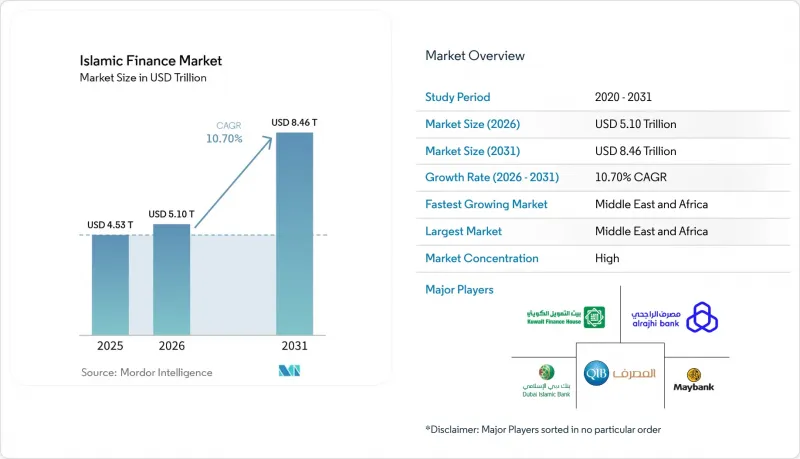
This report is Segmented by Financial Sector (Islamic Banking, Takaful, Sukuk, Islamic Funds, Other Islamic Financial Institutions), Customer Type (Retail Consumers, Businesses), and Geography (Middle East and Africa, Asia-Pacific, Europe, Rest of the World). The Market Forecasts are Provided in Terms of Value (USD).
Global Islamic Finance Market Trends and Insights
Rising Muslim Affluence & Demand for Sharia-Compliant Products
The global Muslim population of 2 billion in 2025 is projected to expand to 2.8 billion by 2050, yet raw demographic growth masks a subtler catalyst - rising per-capita incomes in Organization of Islamic Cooperation countries are lifting Muslim consumer spending to USD 2.43 trillion as of 2023, creating a middle class that views Shariah compliance not as a premium feature but as a baseline expectation. In Malaysia, a meaningful portion of Islamic finance customers identify as non-Muslim, which signals that product appeal now aligns to broader ESG preferences rather than religious segmentation alone. Retail participation in sovereign sukuk programs in Southeast Asia also shows a durable investor base that returns in each issuance cycle. The Islamic finance market sees this adoption pattern reinforced by digital onboarding and low-ticket investment options that fit the savings behavior of younger cohorts. Institutional allocations that apply exclusion criteria to conventional investments are finding Shariah-compliant instruments that fit standard ESG mandates, which improves liquidity and deepens secondary markets over time.
Government Policy Pushes & Regulatory Harmonisation
Regulatory intent is now a visible growth catalyst for the Islamic finance market as several governments set explicit asset targets and conversion timelines that redirect funding to Shariah channels. Pakistan's parliamentary mandate to eliminate Riba by 2027 sets a compressed window for conversion that reorients treasury and risk practices at incumbent lenders. The UAE's Islamic Finance Strategy 2025-2031 targets AED 2.56 trillion in banking assets and AED 660 billion in sukuk listings by 2031, embedding Islamic finance as a sovereign wealth diversification lever rather than a niche offering. Other markets are advancing harmonization through legal reforms and supervisory alignment, which lowers cross-border friction and aids the distribution of sukuk and takaful products. Pan-regional efforts in West Africa and selected African sovereigns also show early signs of coordination that could support scale and reduce structuring complexity for the Islamic finance market.
Fragmented Shariah Standards Across Jurisdictions
Divergent jurisprudence and local interpretations create inconsistent screening thresholds, contract treatments, and asset eligibility, which adds cost to cross-border issuance and distribution. Proposed changes around true asset ownership in sukuk structures can alter the debt-like character of many outstanding instruments and may affect pricing and investor appetite. Uneven adoption of standards across jurisdictions results in selective compliance, which weakens the benefits of harmonization and slows product standardization. Malaysia and several GCC markets maintain distinct frameworks that reflect local legal traditions and supervisory priorities, which complicates scalability for global programs. Issuers and investors navigating multiple regimes incur higher documentation and legal review costs than in conventional markets, which narrows the investor base for the Islamic finance market.
Other drivers and restraints analyzed in the detailed report include:
- Surge in ESG/Green Sukuk Issuance
- Cross-Border Islamic FinTech Platforms Opening Micro-Investment Pools
- Cyber-Security Vulnerabilities in Digital Islamic Banks/FinTechs
For complete list of drivers and restraints, kindly check the Table Of Contents.
Segment Analysis
Islamic banking commanded 70.58% of the Islamic finance market size in 2025, reflecting an asset base that has scaled across core geographies and now underpins credit intermediation at national levels. The Islamic finance market continues to see banks act as anchor issuers and key distribution channels, while takaful has emerged as the fastest-growing segment with a 12.80% CAGR projected through 2031. GCC reforms that mandate coverage in motor and medical lines, combined with new licenses across frontier markets, are sustaining contribution growth and extending reach to underserved segments. In several GCC markets, regulatory capital thresholds are shaping consolidation dynamics, which can reduce fragmentation and raise operating efficiency for the Islamic finance market. Malaysia's depth in family and general takaful demonstrates that policy support and product breadth can shift household coverage preferences when awareness and access improve.
The Islamic finance market benefits from a wider mix of sovereign, quasi-sovereign, financial, and corporate issuers in 2024 and a rising share of corporate placements. A near-term maturity wall, including USD 105 billion due in 2025, is supporting refinancing activity and anchoring steady primary volumes. Islamic funds reached USD 308 billion in assets under management in 2024, although the long tail of small funds points to scale challenges and fee pressure. Exchange-traded formats and robo-advisory channels are expanding product access, and tokenization pilots indicate pathways to lower investment thresholds without compromising Shariah governance for the Islamic finance market.
Complete Report Scope:
- By Financial Sector
- Islamic Banking
- Takaful (Islamic Insurance)
- Sukuk (Islamic Bonds)
- Islamic Funds
- Other Islamic Financial Institutions (OIFIs)
- By Customer Type
- Retail Consumers
- Businesses
- By Region
- Middle East and Africa
- United Arab Emirates
- Saudi Arabia
- Qatar
- Kuwait
- Bahrain
- Oman
- Egypt
- Nigeria
- Rest of Middle East and Africa
- Asia-Pacific
- Malaysia
- Indonesia
- Pakistan
- Bangladesh
- Rest of Asia-Pacific
- Europe
- United Kingdom
- Rest of Europe
- Rest of the World
- Middle East and Africa
Geography Analysis
Middle East and Africa held 69.82% of the global base in 2025, and GCC markets accounted for a significant share of asset growth as national programs leaned on sukuk and Shariah-compliant lending. Saudi Arabia has one of the highest Islamic banking penetration levels, supported by steady sovereign and agency issuance pipelines that reinforce market depth. Qatar, Kuwait, and Bahrain maintain strong positions in Islamic banking and are building fintech sandboxes and digital-asset labs that support experimentation in custody and tokenization. Oman and Egypt show momentum with double-digit growth in Islamic assets and increasing transaction volumes, although penetration remains below regional leaders. Sub-Saharan Africa has a growing footprint of banks and windows across many jurisdictions, yet most institutions remain subscale and rely on policy support and multilateral partnerships to extend reach in the Islamic finance market.
Asia-Pacific is the fastest-growing region at a 11.20% CAGR for the Islamic finance market size through 2031, with Indonesia, Malaysia, and Pakistan setting the pace. Malaysia combines deep capital markets with a high share of Shariah financing and has signaled its intent to expand retail access through tokenized lots. Indonesia has established itself as a benchmark sovereign for green sukuk, which attracts ESG-focused mandates from Europe and other regions while building a domestic retail investor base. Pakistan's conversion timeline introduces execution challenges but also creates a roadmap that could reconfigure market structure and accelerate product innovation. The region's digital-first banking approaches and mobile adoption rates support seamless retail growth for the Islamic finance market.
Europe and the Rest of the World contribute smaller shares but carry strategic weight through listings and specialization. The United Kingdom operates five standalone Islamic banks and multiple windows, while the London Stock Exchange captures a leading share of hard-currency sukuk listings. Retail growth has been solid as digital channels expand product access and align with ethical investing trends among diverse communities. Cross-border fintech links are expanding the number of platforms and providers that operate in new corridors and enable Islamic savings and investment solutions. Partnerships among regional agencies and international standard-setters are building harmonized frameworks that can reduce friction and improve scale for Islamic finance.
- Al Rajhi Bank
- Dubai Islamic Bank
- Kuwait Finance House
- Qatar Islamic Bank
- Maybank Islamic
- Abu Dhabi Islamic Bank
- Saudi National Bank (SNB)
- Boubyan Bank
- Meezan Bank
- Jaiz Bank
- Gatehouse Bank
- CIMB Islamic
- Alinma Bank
- Bank Syariah Indonesia
- Banque Misr (Islamic Window)
- Standard Chartered Saadiq
- HSBC Amanah
- Zurich Takaful
- Prudential BSN Takaful
- Salaam Takaful
Additional Benefits:
- The market estimate (ME) sheet in Excel format
- 3 months of analyst support
TABLE OF CONTENTS
1 Introduction
- 1.1 Study Assumptions & Market Definition
- 1.2 Scope of the Study
2 Research Methodology
3 Executive Summary
4 Market Landscape
- 4.1 Market Overview
- 4.2 Market Drivers
- 4.2.1 Rising Muslim affluence & demand for Sharia-compliant products
- 4.2.2 Government policy pushes & regulatory harmonisation
- 4.2.3 Surge in ESG/green Sukuk issuance
- 4.2.4 Cross-border Islamic FinTech platforms opening micro-investment pools
- 4.2.5 Blockchain-enabled tokenised Sukuk lowering issuance costs
- 4.3 Market Restraints
- 4.3.1 Fragmented Shariah standards across jurisdictions
- 4.3.2 Shortage of certified Shariah scholars & risk professionals
- 4.3.3 Cyber-security vulnerabilities in digital Islamic banks/FinTechs
- 4.3.4 Climate-stress exposure of asset-heavy Islamic banks in GCC
- 4.4 Value Chain Analysis
- 4.5 Regulatory Landscape
- 4.6 Technological Outlook
- 4.7 Porter's Five Forces
- 4.7.1 Bargaining Power of Buyers
- 4.7.2 Bargaining Power of Suppliers
- 4.7.3 Threat of New Entrants
- 4.7.4 Threat of Substitutes
- 4.7.5 Intensity of Competitive Rivalry
5 Market Size & Growth Forecasts (Value)
- 5.1 By Financial Sector
- 5.1.1 Islamic Banking
- 5.1.2 Takaful (Islamic Insurance)
- 5.1.3 Sukuk (Islamic Bonds)
- 5.1.4 Islamic Funds
- 5.1.5 Other Islamic Financial Institutions (OIFIs)
- 5.2 By Customer Type
- 5.2.1 Retail Consumers
- 5.2.2 Businesses
- 5.3 By Region
- 5.3.1 Middle East and Africa
- 5.3.1.1 United Arab Emirates
- 5.3.1.2 Saudi Arabia
- 5.3.1.3 Qatar
- 5.3.1.4 Kuwait
- 5.3.1.5 Bahrain
- 5.3.1.6 Oman
- 5.3.1.7 Egypt
- 5.3.1.8 Nigeria
- 5.3.1.9 Rest of Middle East and Africa
- 5.3.2 Asia-Pacific
- 5.3.2.1 Malaysia
- 5.3.2.2 Indonesia
- 5.3.2.3 Pakistan
- 5.3.2.4 Bangladesh
- 5.3.2.5 Rest of Asia-Pacific
- 5.3.3 Europe
- 5.3.3.1 United Kingdom
- 5.3.3.2 Rest of Europe
- 5.3.4 Rest of the World
- 5.3.1 Middle East and Africa
6 Competitive Landscape
- 6.1 Market Concentration
- 6.2 Strategic Moves
- 6.3 Market Share Analysis
- 6.4 Company Profiles (includes Global Level Overview, Market Level Overview, Core Segments, Financials as available, Strategic Information, Market Rank/Share for Key Companies, Products & Services, and Recent Developments)
- 6.4.1 Al Rajhi Bank
- 6.4.2 Dubai Islamic Bank
- 6.4.3 Kuwait Finance House
- 6.4.4 Qatar Islamic Bank
- 6.4.5 Maybank Islamic
- 6.4.6 Abu Dhabi Islamic Bank
- 6.4.7 Saudi National Bank (SNB)
- 6.4.8 Boubyan Bank
- 6.4.9 Meezan Bank
- 6.4.10 Jaiz Bank
- 6.4.11 Gatehouse Bank
- 6.4.12 CIMB Islamic
- 6.4.13 Alinma Bank
- 6.4.14 Bank Syariah Indonesia
- 6.4.15 Banque Misr (Islamic Window)
- 6.4.16 Standard Chartered Saadiq
- 6.4.17 HSBC Amanah
- 6.4.18 Zurich Takaful
- 6.4.19 Prudential BSN Takaful
- 6.4.20 Salaam Takaful
7 Market Opportunities & Future Outlook
- 7.1 White-space & Unmet-Need Assessment

