PUBLISHER: Mordor Intelligence | PRODUCT CODE: 2116421

PUBLISHER: Mordor Intelligence | PRODUCT CODE: 2116421
UK Islamic Finance - Market Share Analysis, Industry Trends & Statistics, Growth Forecasts (2026 - 2031)
According to Mordor Intelligence, the UK islamic finance market size is expected to grow from USD 7.81 billion in 2025 to USD 8.06 billion in 2026 and is forecast to reach USD 9.42 billion by 2031 at 3.19% CAGR over 2026-2031.
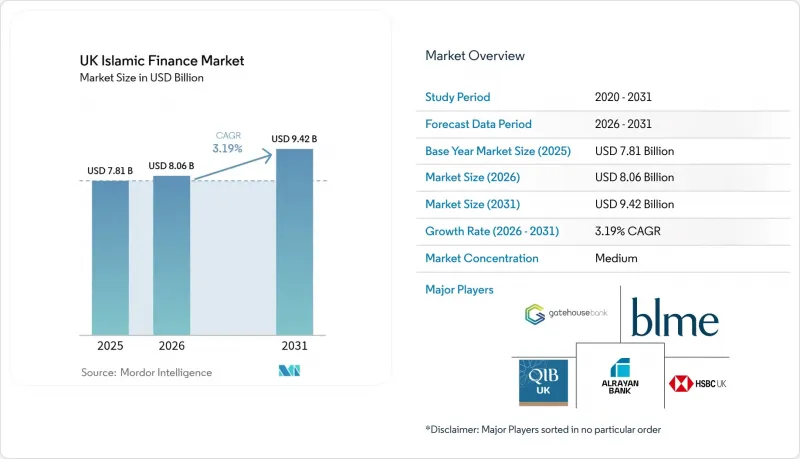
This report is Segmented by Financial Sector (Islamic Banking, Islamic Insurance (Takaful), Islamic Bonds (Sukuk), Islamic Funds, Other Islamic Financial Institutions (OIFLs)), Customer Type (Business, Consumer), and Mode of Service Delivery (Full-Fledged Islamic FIs, Islamic Windows in Conventional FIs, and More). The Market Forecasts are Provided in Terms of Value (USD).
UK Islamic Finance Market Trends and Insights
Government Tax & Regulatory Parity Measures
Tax neutrality provisions have eliminated the double taxation that previously placed Islamic mortgages at a pricing disadvantage compared with conventional equivalents. The Bank of England's Alternative Liquidity Facility supplies a Shariah-compliant instrument that satisfies high-quality liquid-asset (HQLA) rules, giving Islamic banks balance-sheet flexibility otherwise unavailable through interest-bearing gilts. These reforms collectively signal credible long-term policy support and attribute foreign issuers' value when selecting sukuk listing venues. The UK thereby cements its standing as the only Western jurisdiction offering a fully articulated regulatory framework for Shariah-compliant banking. Market participants consequently anticipate a steady pipeline of new product launches targeting retail and wholesale segments.
Islamic Fintech Democratizing Distribution
Fintech platforms remove geographic barriers by offering Shariah-compliant products via mobile channels, reaching consumers outside the main urban Muslim clusters. Wahed Invest's halal workplace pension demonstrates how low-cost digital architecture can solve underserved pain points while meeting Shariah governance standards. Reduced operating overheads allow competitive pricing that appeals to non-Muslim ethical savers, widening the total addressable base for the UK Islamic finance market. Regulatory sandboxes administered by the Financial Conduct Authority (FCA) shorten product-development cycles and ensure early compliance feedback. The result is an ecosystem where agile entrants can scale quickly, pressuring incumbent banks to retool their digital propositions.
Sub-scale Balance Sheets Limit Profitability
Most dedicated Islamic banks in the UK operate with total assets below USD 5 billion, a level that constrains economies of scale relative to universal lenders. Thin capital bases raise the unit cost of regulatory compliance, especially under Basel III and Senior Managers regimes. HSBC's exit from the UK Amanah proposition illustrates the difficulty of attaining sustainable returns when customer density remains low. Smaller institutions respond by focusing on specialist niches such as real-estate bridging finance, yet such concentration elevates portfolio risk. Without consolidation or fresh equity injections, profitability headwinds will restrict the growth runway for the UK Islamic finance market.
Other drivers and restraints analyzed in the detailed report include:
- UK's Role as Western Islamic-Finance Hub
- ESG/Green-Sukuk Pulls in Ethical Investors
- Scarcity of Shariah-Compliant HQLA Tools
For complete list of drivers and restraints, kindly check the Table Of Contents.
Segment Analysis
Islamic banking represented 64.82% of 2025 revenue, anchoring the UK Islamic finance market through deposit mobilization and retail financing. However, sukuk's 4.66% CAGR illustrates an investor pivot toward fixed-income assets structured under Shariah rules, leveraging the London Stock Exchange's efficient listing processes. The UK Islamic finance market size for sukuk is projected to widen as issuers such as Al Rajhi Bank and Khazanah Nasional tap London for benchmark deals. Liquidity benefits also spill back to banks that hold sukuk as secondary reserves, reinforcing a virtuous capital-market loop.
Although banking retains critical mass, fee income from capital markets advisory and custody of sukuk lifts non-interest revenue proportions, Takaful remains embryonic but gains traction from real-estate and motor policies, a shift encouraged by regulators clarifying solvency-margin calculations for Shariah-compliant insurers. Specialized players such as Cobalt Underwriting illustrate how niche focus can complement full-service banking, deepening ecosystem maturity. As sukuk depth expands, pricing transparency enhances market efficiency and raises competitive pressure on banks to streamline cost bases.
Complete Report Scope:
- By Financial Sector
- Islamic Banking
- Islamic Insurance (Takaful)
- Islamic Bonds (Sukuk)
- Islamic Funds
- Other Islamic Financial Institutions (OIFLs)
- By Customer Type
- Business
- Consumer
- By Mode of Service Delivery
- Full-fledged Islamic FIs
- Islamic Windows in Conventional FIs
- Digital-only / FinTech Platforms
- Alternative Platforms (Crowdfunding, P2P)
List of Companies Covered in this Report:
- Al Rayan Bank
- Gatehouse Bank
- Bank of London & The Middle East (BLME)
- QIB (UK)
- HSBC Amanah (UK)
- Lloyds Islamic Window
- United National Bank - Islamic Window
- ABC International Bank
- Standard Chartered Saadiq (UK Window)
- Cobalt Underwriting (Takaful)
- Offa (Islamic Bridging Finance)
- Nester
- Wahed Invest UK
- Yielders
- Primary Finance
- StrideUp
- Kestrl
- Niyah
- Rizq
- MyAhmed
Additional Benefits:
- The market estimate (ME) sheet in Excel format
- 3 months of analyst support
TABLE OF CONTENTS
1 Introduction
- 1.1 Study Assumptions & Market Definition
- 1.2 Scope of the Study
2 Research Methodology
3 Executive Summary
4 Market Landscape
- 4.1 Market Overview
- 4.2 Market Drivers
- 4.2.1 Government tax & regulatory parity measures
- 4.2.2 Rising domestic Muslim population & demand
- 4.2.3 UK's role as Western Islamic-finance hub
- 4.2.4 Islamic fintech democratising distribution
- 4.2.5 ESG/green-sukuk pull in ethical investors
- 4.2.6 CGT/ATED reforms unlocking home-finance
- 4.3 Market Restraints
- 4.3.1 Sub-scale balance sheets limit profitability
- 4.3.2 Scarcity of Shariah-compliant HQLA tools
- 4.3.3 Fragmented Shariah standards & scholar pool
- 4.3.4 Legal-enforcement friction in DSOA mortgages
- 4.4 Value / Supply-Chain Analysis
- 4.5 Regulatory Landscape
- 4.6 Technological Outlook
- 4.7 Porter's Five Forces
- 4.7.1 Threat of New Entrants
- 4.7.2 Bargaining Power of Buyers
- 4.7.3 Bargaining Power of Suppliers
- 4.7.4 Threat of Substitutes
- 4.7.5 Competitive Rivalry
- 4.8 Liquidity-Management Outlook
5 Market Size & Growth Forecasts (Value)
- 5.1 By Financial Sector
- 5.1.1 Islamic Banking
- 5.1.2 Islamic Insurance (Takaful)
- 5.1.3 Islamic Bonds (Sukuk)
- 5.1.4 Islamic Funds
- 5.1.5 Other Islamic Financial Institutions (OIFLs)
- 5.2 By Customer Type
- 5.2.1 Business
- 5.2.2 Consumer
- 5.3 By Mode of Service Delivery
- 5.3.1 Full-fledged Islamic FIs
- 5.3.2 Islamic Windows in Conventional FIs
- 5.3.3 Digital-only / FinTech Platforms
- 5.3.4 Alternative Platforms (Crowdfunding, P2P)
6 Competitive Landscape
- 6.1 Market Concentration
- 6.2 Strategic Moves
- 6.3 Market Share Analysis
- 6.4 Company Profiles (includes Global level Overview, Market level overview, Core Segments, Financials as available, Strategic Information, Market Rank/Share for key companies, Products & Services, and Recent Developments)
- 6.4.1 Al Rayan Bank
- 6.4.2 Gatehouse Bank
- 6.4.3 Bank of London & The Middle East (BLME)
- 6.4.4 QIB (UK)
- 6.4.5 HSBC Amanah (UK)
- 6.4.6 Lloyds Islamic Window
- 6.4.7 United National Bank - Islamic Window
- 6.4.8 ABC International Bank
- 6.4.9 Standard Chartered Saadiq (UK Window)
- 6.4.10 Cobalt Underwriting (Takaful)
- 6.4.11 Offa (Islamic Bridging Finance)
- 6.4.12 Nester
- 6.4.13 Wahed Invest UK
- 6.4.14 Yielders
- 6.4.15 Primary Finance
- 6.4.16 StrideUp
- 6.4.17 Kestrl
- 6.4.18 Niyah
- 6.4.19 Rizq
- 6.4.20 MyAhmed
7 Market Opportunities & Future Outlook
- 7.1 White-space & Unmet-Need Assessment

