PUBLISHER: Mordor Intelligence | PRODUCT CODE: 2073541

PUBLISHER: Mordor Intelligence | PRODUCT CODE: 2073541
Customer Experience Management - Market Share Analysis, Industry Trends & Statistics, Growth Forecasts (2026 - 2031)
According to Mordor Intelligence, the customer experience management market size stands at USD 22.79 billion in 2026 and is projected to reach USD 37.23 billion by 2031, registering a 10.31% CAGR across the forecast period.
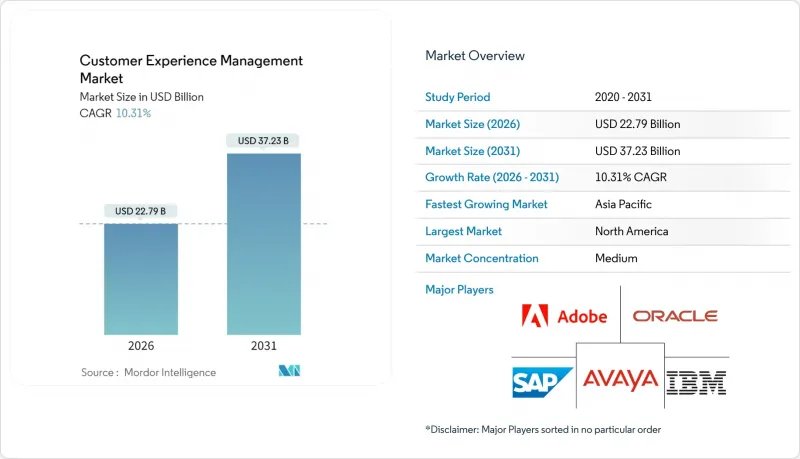
This report is Segmented by Component (Solutions, and Services), Deployment (Cloud, and On-Premise), Organization Size (Small and Medium Enterprises, and Large Enterprises), Touchpoint (Telephone, Email, Web, Social Media, and More), Application (BFSI, Retail, IT and Telecom, Healthcare, Manufacturing, Travel, and More), and Geography. The Market Forecasts are Provided in Terms of Value (USD).
Global Customer Experience Management Market Trends and Insights
Rapid Adoption of Cloud-Based Technology, Advanced Analytics, and Automation
Subscription-based cloud platforms eliminate the capital cost of servers and accelerate feature releases, allowing vendors to push sentiment analysis, predictive routing, and proactive quality monitoring to customers without downtime. Elastic infrastructure scales automatically with interaction volume, and usage-aligned pricing appeals to mid-market firms that previously deferred CX upgrades. Machine-learning models now ingest voice, chat, and social posts to surface churn risks in near real time, letting brands intervene before dissatisfaction escalates. Automation extends beyond chatbots, coordinating case escalations and personalized offers across channels. As deployment cycles shrink from quarters to weeks, enterprises recalibrate ROI expectations toward continuous iteration rather than large one-time rollouts.
Growing Demand for Personalized Customer Experience
Consumers expect brands to recognize prior purchases, channel preferences, and real-time intent every time they engage. Unified profiles merge transaction data, behavioral signals, and declared preferences so recommendation engines can tailor content, adjust prices, and refine offers instantly. Regulations such as GDPR and the California Consumer Privacy Act require explicit consent, forcing firms to balance personalization ambitions with transparency. Loyalty programs and progressive profiling incentivize users to share data directly, replacing third-party cookies with trusted first-party relationships. Outcomes include higher conversion rates, larger average order values, and deeper engagement that outlasts single promotions.
Privacy and Data Security Issues
Large-scale breaches and stiff penalties transform privacy from compliance checkbox to board-level risk, as GDPR fines can reach 4% of global revenue and U.S. regulators acquire extended enforcement authority. Customer experience platforms consolidate payment, health, and location data, creating rich but attractive attack surfaces. Zero-trust security, encryption in motion and at rest, and continuous monitoring raise deployment complexity and prolong project timelines. Firms sometimes anonymize or aggregate data, but reduced granularity can blunt personalization precision and dilute insight quality.
Other drivers and restraints analyzed in the detailed report include:
- Integration of AI-Powered Chatbots with Omnichannel CX Platforms
- Monetization of First-Party Data Amid Cookie Deprecation
- Vendor Lock-In Across Multi-Cloud CX Stacks
For complete list of drivers and restraints, kindly check the Table Of Contents.
Segment Analysis
Solutions secured 63.47% revenue in 2025 thanks to experience analytics, journey mapping, and social listening modules that transform unstructured feedback into strategic insight. Services are poised for an 11.03% CAGR through 2031 as organizations need experts to meld cloud platforms with legacy CRM, customize dashboards, and operationalize insights. Professional services dominate early phases, guiding data migration, user training, and governance. Over time, managed services gain favor, offloading routine maintenance so internal teams can focus on strategy. Experience analytics now applies machine learning to predict churn and detect upsell moments, yet value creation still depends on analysts who translate model output into action. Customer journey mapping highlights friction and opportunity along multi-step paths, while real-time social monitoring sharpens brand response to emerging trends. The convergence of these functions into unified suites reduces point-solution sprawl, but seamless information flow keeps integration partners indispensable.
The customer experience management market continues to reward vendors that package robust API libraries and low-code connectors, letting partners orchestrate data across disparate systems. As more enterprises embrace end-to-end platforms, service providers move upstream, offering change-management guidance, value-realization analytics, and continuous optimization. The trend underpins double-digit growth for the services segment and cements its role as a critical enabler of long-term platform success.
Cloud deployments captured 77.39% revenue in 2025 and are expected to retain momentum with a 10.42% CAGR, propelled by operating-expense conversion, instant scalability, and continuous feature access. Vendors roll out new AI models, compliance updates, and UI enhancements with no customer downtime, removing upgrade headaches that plagued on-premise environments. Elastic capacity absorbs holiday peaks or viral campaigns without pre-purchasing excess hardware. Multi-tenant architecture lowers per-seat cost, letting mid-size firms tap enterprise-grade capabilities. Highly regulated sectors still maintain data residency or latency mandates, preserving a niche for on-premise or private cloud builds, but hybrid models bridge the gap by retaining sensitive data behind the firewall while analytics run in public clouds.
Competitive focus now shifts from infrastructure to analytics depth, integration breadth, and user experience. The customer experience management market size tied to cloud platforms benefits from faster onboarding and simplified proof-of-concepts, letting buyers test value quickly. Nonetheless, buyers scrutinize vendor service-level agreements, exit clauses, and data portability to avoid future constraints. Open APIs and event streaming frameworks thus become decisive in vendor selection.
Complete Report Scope:
- By Component
- Solutions
- Experience Analytics
- Customer Journey Mapping
- Social Media Monitoring
- Text and Speech Analytics
- Services
- Professional Services
- Managed Services
- Solutions
- By Deployment
- Cloud
- On-Premise
- By Organization Size
- Small and Medium Enterprises
- Large Enterprises
- By Touchpoint
- Telephone
- Web
- Social Media
- Other Touchpoints
- By Application
- Banking, Financial Services, and Insurance
- Retail and E-Commerce
- Information Technology and Telecommunication
- Healthcare
- Manufacturing
- Government
- Travel and Transportation
- Other Applications
- By Geography
- North America
- United States
- Canada
- Mexico
- Europe
- Germany
- United Kingdom
- France
- Spain
- Italy
- Sweden
- Russia
- Rest of Europe
- Asia-Pacific
- China
- India
- Japan
- South Korea
- Australia and New Zealand
- Southeast Asia
- Rest of Asia-Pacific
- Middle East
- Saudi Arabia
- United Arab Emirates
- Turkey
- Rest of Middle East
- Africa
- South Africa
- Nigeria
- Kenya
- Rest of Africa
- North America
Geography Analysis
North America controlled 37.12% revenue in 2025, underpinned by early cloud migration, strict privacy laws, and competitive differentiation grounded in experience quality. Enterprises pioneer omnichannel orchestration, advanced analytics, and AI-driven automation to counter high labor costs and rising service expectations. Regulations such as the California Consumer Privacy Act compel transparency, driving investment in consent management and encryption. Europe follows with strong compliance culture anchored in GDPR, which sets global benchmarks for consent, portability, and breach notification. The continent's linguistic and cultural diversity heightens demand for localization engines that adapt tone, offers, and workflows across markets.
Asia Pacific expands at a brisk 12.06% CAGR, propelled by mobile-first consumers, super-app ecosystems, and government stimuli that push digital commerce. China's mini-program frameworks let brands launch full-fledged experiences inside WeChat without dedicated apps, while India's Unified Payments Interface normalizes instant digital payments across urban and rural settings. Southeast Asian marketplaces integrate customer service chat, delivery tracking, and returns workflows directly into shopping apps, raising user expectations. The Middle East invests in smart city projects and tourism technology, prioritizing seamless digital touchpoints for residents and visitors alike. Africa's growth remains tempered by network and payment infrastructure gaps, yet mobile money and social commerce foster leap-frog adoption.
These regional dynamics reinforce the customer experience management market's need for flexible deployment, multi-lingual AI models, and compliance toolkits that adjust to local statutes. Vendors with global footprints forge regional data centers and tailored industry accelerators to secure mindshare and wallet share.
- Adobe Inc.
- Oracle Corporation
- SAP SE
- International Business Machines Corporation
- Avaya Holdings Corporation
- Verint Systems Inc.
- Tech Mahindra Limited
- Open Text Corporation
- Zendesk Inc.
- Sitecore Holding II A/S
- Clarabridge Inc.
- Medallia Inc.
- Qualtrics International Inc.
- Nice Ltd.
- Genesys Telecommunications Laboratories Inc.
- Sprinklr Inc.
- Pegasystems Inc.
- Freshworks Inc.
- InMoment Inc.
- Alida Inc.
- MaritzCX Research LLC
- Khoros LLC
Additional Benefits:
- The market estimate (ME) sheet in Excel format
- 3 months of analyst support
TABLE OF CONTENTS
1 INTRODUCTION
- 1.1 Study Assumptions and Market Definition
- 1.2 Scope of the Study
2 RESEARCH METHODOLOGY
3 EXECUTIVE SUMMARY
4 MARKET LANDSCAPE
- 4.1 Market Overview
- 4.2 Market Drivers
- 4.2.1 Rapid Adoption of Cloud-Based Technology, Advanced Analytics, and Automation
- 4.2.2 Growing Demand for Personalized Customer Experience
- 4.2.3 Integration of AI-Powered Chatbots with Omnichannel CX Platforms
- 4.2.4 Monetization of First-Party Data Amid Cookie Deprecation
- 4.2.5 Expansion of CX Analytics into Voice of the Employee (VoE) Programs
- 4.2.6 Emergence of Customer Data Platforms (CDPs) for Real-Time Personalization
- 4.3 Market Restraints
- 4.3.1 Privacy and Data Security Issues
- 4.3.2 Vendor Lock-In Across Multi-Cloud CX Stacks
- 4.3.3 Talent Shortage in Advanced CX Analytics and Data Science
- 4.3.4 High Total Cost of Ownership for End-to-End CX Suites in SMEs
- 4.4 Industry Value Chain Analysis
- 4.5 Regulatory Landscape
- 4.6 Technological Outlook
- 4.7 Impact of Macroeconomic Factors on the Market
- 4.8 Porter's Five Forces Analysis
- 4.8.1 Bargaining Power of Suppliers
- 4.8.2 Bargaining Power of Consumers
- 4.8.3 Threat of New Entrants
- 4.8.4 Threat of Substitute Products
- 4.8.5 Intensity of Competitive Rivalry
5 MARKET SIZE AND GROWTH FORECASTS (VALUE)
- 5.1 By Component
- 5.1.1 Solutions
- 5.1.1.1 Experience Analytics
- 5.1.1.2 Customer Journey Mapping
- 5.1.1.3 Social Media Monitoring
- 5.1.1.4 Text and Speech Analytics
- 5.1.2 Services
- 5.1.2.1 Professional Services
- 5.1.2.2 Managed Services
- 5.1.1 Solutions
- 5.2 By Deployment
- 5.2.1 Cloud
- 5.2.2 On-Premise
- 5.3 By Organization Size
- 5.3.1 Small and Medium Enterprises
- 5.3.2 Large Enterprises
- 5.4 By Touchpoint
- 5.4.1 Telephone
- 5.4.2 Email
- 5.4.3 Web
- 5.4.4 Social Media
- 5.4.5 Other Touchpoints
- 5.5 By Application
- 5.5.1 Banking, Financial Services, and Insurance
- 5.5.2 Retail and E-Commerce
- 5.5.3 Information Technology and Telecommunication
- 5.5.4 Healthcare
- 5.5.5 Manufacturing
- 5.5.6 Government
- 5.5.7 Travel and Transportation
- 5.5.8 Other Applications
- 5.6 By Geography
- 5.6.1 North America
- 5.6.1.1 United States
- 5.6.1.2 Canada
- 5.6.1.3 Mexico
- 5.6.2 Europe
- 5.6.2.1 Germany
- 5.6.2.2 United Kingdom
- 5.6.2.3 France
- 5.6.2.4 Spain
- 5.6.2.5 Italy
- 5.6.2.6 Sweden
- 5.6.2.7 Russia
- 5.6.2.8 Rest of Europe
- 5.6.3 Asia-Pacific
- 5.6.3.1 China
- 5.6.3.2 India
- 5.6.3.3 Japan
- 5.6.3.4 South Korea
- 5.6.3.5 Australia and New Zealand
- 5.6.3.6 Southeast Asia
- 5.6.3.7 Rest of Asia-Pacific
- 5.6.4 Middle East
- 5.6.4.1 Saudi Arabia
- 5.6.4.2 United Arab Emirates
- 5.6.4.3 Turkey
- 5.6.4.4 Rest of Middle East
- 5.6.5 Africa
- 5.6.5.1 South Africa
- 5.6.5.2 Nigeria
- 5.6.5.3 Kenya
- 5.6.5.4 Rest of Africa
- 5.6.1 North America
6 COMPETITIVE LANDSCAPE
- 6.1 Market Concentration
- 6.2 Strategic Moves
- 6.3 Market Share Analysis
- 6.4 Company Profiles (includes Global Level Overview, Market Level Overview, Core Segments, Financials as Available, Strategic Information, Market Rank/Share for Key Companies, Products and Services, and Recent Developments)
- 6.4.1 Adobe Inc.
- 6.4.2 Oracle Corporation
- 6.4.3 SAP SE
- 6.4.4 International Business Machines Corporation
- 6.4.5 Avaya Holdings Corporation
- 6.4.6 Verint Systems Inc.
- 6.4.7 Tech Mahindra Limited
- 6.4.8 Open Text Corporation
- 6.4.9 Zendesk Inc.
- 6.4.10 Sitecore Holding II A/S
- 6.4.11 Clarabridge Inc.
- 6.4.12 Medallia Inc.
- 6.4.13 Qualtrics International Inc.
- 6.4.14 Nice Ltd.
- 6.4.15 Genesys Telecommunications Laboratories Inc.
- 6.4.16 Sprinklr Inc.
- 6.4.17 Pegasystems Inc.
- 6.4.18 Freshworks Inc.
- 6.4.19 InMoment Inc.
- 6.4.20 Alida Inc.
- 6.4.21 MaritzCX Research LLC
- 6.4.22 Khoros LLC
7 MARKET OPPORTUNITIES AND FUTURE OUTLOOK
- 7.1 White-Space and Unmet-Need Assessment

