PUBLISHER: Mordor Intelligence | PRODUCT CODE: 2073606

PUBLISHER: Mordor Intelligence | PRODUCT CODE: 2073606
Secondary Macronutrients - Market Share Analysis, Industry Trends & Statistics, Growth Forecasts (2026 - 2031)
According to Mordor Intelligence, the secondary macronutrients market size was valued at USD 18.38 billion in 2025, is estimated at USD 19.43 billion in 2026, and is projected to reach USD 24.59 billion by 2031, expanding at a CAGR of 4.82% during the forecast period (2026-2031).
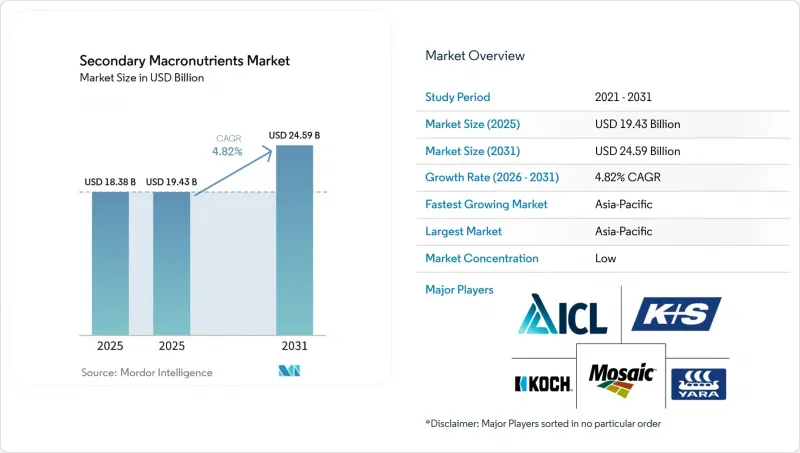
This report Segments the Industry Into Type (Calcium, Magnesium, and Sulfur), Application Mode (Fertigation, Foliar, and Soil), Crop Type (Field Crops, Horticultural Crops, and Turf & Ornamental), and Region (Asia-Pacific, Europe, Middle East & Africa, North America, and South America). The Report Includes Market Size in Value (USD) and Volume (metric Tons).
Global Secondary Macronutrients Market Trends and Insights
Soil Acidity-Driven Calcium Demand in Bread-Wheat Belts
Continuous wheat cultivation tied to heavy nitrogen use is accelerating soil acidification. Domestic agricultural lime output in the United States climbed sharply in 2024, indicating a stronger farmer response to falling soil pH. Calcium nitrate and calcium sulfate are increasingly applied to restore nutrient balance, improve grain quality, and sustain protein premiums in export-oriented supply chains. Because acidification is cumulative, recurring calcium applications create a steady pull-through for suppliers. Premium flour millers who reward higher dough-strength profiles reinforce grower willingness to budget for secondary nutrients. The trend extends across Canada, France, and Poland, aligning with national soil health initiatives that tie payments to improved cation exchange capacity.
Retrofit of Fertigation in Drip-Irrigated Mega Greenhouses
Industrial-scale greenhouse farms across China, the Gulf states, Spain, and Mexico now favor liquid calcium, magnesium, and sulfur delivered through existing drip lines. Converting from granular topdress to fertigation lowers labor by up to 25% per hectare and boosts uptake by synchronizing nutrient flow with plant transpiration. Facilities integrate real-time sensors that guide dosing adjustments, cutting oversupply while lifting yield per square meter. Input distributors respond by launching technical-grade, chloride-free calcium nitrate, fully soluble in cold water. This capital-light retrofit wave lifts premium formulation demand across the secondary macronutrient fertilizer market and prompts equipment suppliers to bundle venturi injectors with subscription nutrient packs.
Sea-Freight Volatility for Bulk Calcium Nitrate
Transoceanic shipping costs remain above pre-pandemic norms, with spot rates swinging 40% within months. The USDA Freight Dashboard shows fertilizer shipments facing container shortages that prolong the delivery window. Import-reliant markets like South Asia absorb these higher freight fees in landed cost, raising farm-gate prices. Some buyers postpone calcium nitrate orders or substitute lower-grade calcium ammonium nitrate, depressing near-term growth in the secondary macronutrient fertilizer market.
Other drivers and restraints analyzed in the detailed report include:
- Sugar-Crop Acreage Expansion in Southeast Asia
- Ultra-Low-Sulfur Diesel Rules Boosting Elemental Sulfur Supply
- Declining Magnesium Ore Grades in Russia and Israel
For complete list of drivers and restraints, kindly check the Table Of Contents.
Segment Analysis
Sulfur held 47.9% of the secondary macronutrients market in 2025, powered by its vital link to amino acid formation and oil development in canola and soybean. The segment grows steadily on abundant refinery-derived elemental sulfur that underpins competitive pricing. Calcium is projected to grow at the fastest pace, with a 5.8% CAGR from 2026 to 2031, as growers address soil acidification and fruit firmness requirements in orchards. Magnesium demand centers on high-value horticulture quotas that reward optimal chlorophyll levels. Sulfur's cost advantage and broad crop need will keep it firmly in front, but calcium's accelerated uptake in both open-field and controlled-environment agriculture signals a narrowing gap.
Wider refinery desulfurization across North America, the Middle East, and Asia ensures a structurally long supply of raw sulfur, supporting the expansion of granular and pastille capacity. Precision fertigation unlocks calcium and nitrate potential in tomato and pepper glasshouses, reinforcing margins for soluble product lines. Magnesium maintains its specialty role in leafy greens and tropical fruit, where color retention is non-negotiable for export markets.
Complete Report Scope:
- Type
- Straight
- Secondary Macronutrients
- Calcium
- Magnesium
- Sulfur
- Secondary Macronutrients
- Straight
- Application Mode
- Fertigation
- Foliar
- Soil
- Crop Type
- Field Crops
- Horticultural Crops
- Turf & Ornamental
- Region
- Asia-Pacific
- Australia
- Bangladesh
- China
- India
- Indonesia
- Japan
- Pakistan
- Philippines
- Thailand
- Vietnam
- Rest of Asia-Pacific
- Europe
- France
- Germany
- Italy
- Netherlands
- Russia
- Spain
- Ukraine
- United Kingdom
- Rest of Europe
- Middle East & Africa
- Nigeria
- Saudi Arabia
- South Africa
- Turkey
- Rest of Middle East & Africa
- North America
- Canada
- Mexico
- United States
- Rest of North America
- South America
- Argentina
- Brazil
- Rest of South America
- Asia-Pacific
Geography Analysis
Asia-Pacific retained a 40.0% share of the secondary macronutrients market in 2025 and is projected to expand at a 5.8% CAGR during 2026-2031. Government-backed modernization in China, India, and Southeast Asia couples soil-health subsidies with extension services that champion balanced nutrient programs. Sugarcane area in Thailand and Vietnam alone lifts sulfur offtake by double digits, while greenhouse acreage in Shandong province drives liquid calcium imports. The region's diverse agro-climatic zones create multifaceted demand pockets that global suppliers serve through region-specific grade portfolios.
North America enjoys mature adoption and focuses on efficiency gains. Ultra-low-sulfur diesel rules ensure a steady supply of elemental sulfur, reducing price volatility. Farmers integrate variable-rate applicators to match secondary nutrient prescriptions with yield maps. Europe prioritizes circular-economy sourcing but wrestles with extended REACH timelines for recycled products. Calcium applications feature prominently as growers neutralize acidifying nitrogen inputs, especially in Germany and Poland.
South America presents a dichotomy: Brazil, the continent's powerhouse, increases secondary macronutrient usage as soybean and sugar mills demand higher protein and sucrose; Argentina lags under credit restrictions that dampen discretionary spending. The Middle East and Africa demonstrate rising interest in calcium nitrate for protected farming; Saudi food-security projects and Egyptian greenhouse clusters spur growth from a small base. These emerging corridors are gradually adding heft to the secondary macronutrients market.
- Coromandel International Ltd.
- Deepak fertilizers & Petrochemicals Corporation Ltd
- Grupa Azoty S.A. (Compo Expert)
- Haifa Group
- ICL Group Ltd
- K+S Aktiengesellschaft
- Koch Industries Inc.
- The Mosaic Company
- Yara International ASA
Additional Benefits:
- The market estimate (ME) sheet in Excel format
- 3 months of analyst support
TABLE OF CONTENTS
1 INTRODUCTION
- 1.1 Study Assumptions & Market Definition
- 1.2 Scope of the Study
- 1.3 Research Methodology
2 REPORT OFFERS
3 EXECUTIVE SUMMARY & KEY FINDINGS
4 KEY INDUSTRY TRENDS
- 4.1 Acreage Of Major Crop Types
- 4.1.1 Field Crops
- 4.1.2 Horticultural Crops
- 4.2 Average Nutrient Application Rates
- 4.2.1 Secondary Macronutrients
- 4.2.1.1 Field Crops
- 4.2.1.2 Horticultural Crops
- 4.2.1 Secondary Macronutrients
- 4.3 Agricultural Land Equipped For Irrigation
- 4.4 Regulatory Framework
- 4.5 Value Chain & Distribution Channel Analysis
5 MARKET SEGMENTATION (Value in USD and Volume in Metric Tons)
- 5.1 Type
- 5.1.1 Straight
- 5.1.1.1 Secondary Macronutrients
- 5.1.1.1.1 Calcium
- 5.1.1.1.2 Magnesium
- 5.1.1.1.3 Sulfur
- 5.1.1.1 Secondary Macronutrients
- 5.1.1 Straight
- 5.2 Application Mode
- 5.2.1 Fertigation
- 5.2.2 Foliar
- 5.2.3 Soil
- 5.3 Crop Type
- 5.3.1 Field Crops
- 5.3.2 Horticultural Crops
- 5.3.3 Turf & Ornamental
- 5.4 Region
- 5.4.1 Asia-Pacific
- 5.4.1.1 Australia
- 5.4.1.2 Bangladesh
- 5.4.1.3 China
- 5.4.1.4 India
- 5.4.1.5 Indonesia
- 5.4.1.6 Japan
- 5.4.1.7 Pakistan
- 5.4.1.8 Philippines
- 5.4.1.9 Thailand
- 5.4.1.10 Vietnam
- 5.4.1.11 Rest of Asia-Pacific
- 5.4.2 Europe
- 5.4.2.1 France
- 5.4.2.2 Germany
- 5.4.2.3 Italy
- 5.4.2.4 Netherlands
- 5.4.2.5 Russia
- 5.4.2.6 Spain
- 5.4.2.7 Ukraine
- 5.4.2.8 United Kingdom
- 5.4.2.9 Rest of Europe
- 5.4.3 Middle East & Africa
- 5.4.3.1 Nigeria
- 5.4.3.2 Saudi Arabia
- 5.4.3.3 South Africa
- 5.4.3.4 Turkey
- 5.4.3.5 Rest of Middle East & Africa
- 5.4.4 North America
- 5.4.4.1 Canada
- 5.4.4.2 Mexico
- 5.4.4.3 United States
- 5.4.4.4 Rest of North America
- 5.4.5 South America
- 5.4.5.1 Argentina
- 5.4.5.2 Brazil
- 5.4.5.3 Rest of South America
- 5.4.1 Asia-Pacific
6 COMPETITIVE LANDSCAPE
- 6.1 Key Strategic Moves
- 6.2 Market Share Analysis
- 6.3 Company Landscape
- 6.4 Company Profiles
- 6.4.1 Coromandel International Ltd.
- 6.4.2 Deepak fertilizers & Petrochemicals Corporation Ltd
- 6.4.3 Grupa Azoty S.A. (Compo Expert)
- 6.4.4 Haifa Group
- 6.4.5 ICL Group Ltd
- 6.4.6 K+S Aktiengesellschaft
- 6.4.7 Koch Industries Inc.
- 6.4.8 The Mosaic Company
- 6.4.9 Yara International ASA
7 KEY STRATEGIC QUESTIONS FOR FERTILIZER CEOS

