PUBLISHER: Mordor Intelligence | PRODUCT CODE: 2097070

PUBLISHER: Mordor Intelligence | PRODUCT CODE: 2097070
Asia-Pacific Gluten-Free Food and Beverages - Market Share Analysis, Industry Trends & Statistics, Growth Forecasts (2026 - 2031)
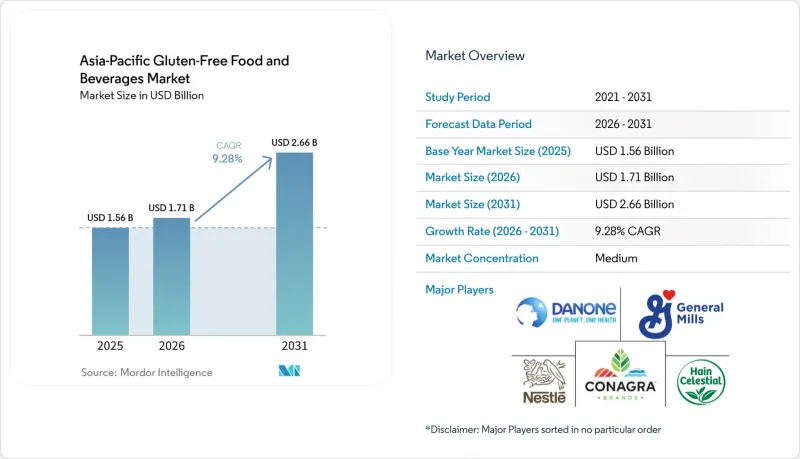
According to Mordor Intelligence, the Asia-Pacific gluten-free food and beverages market is expected to grow from USD 1.56 billion in 2025 to USD 1.71 billion in 2026 and is forecast to reach USD 2.66 billion by 2031 at 9.28% CAGR over 2026-2031.
This report is Segmented by Product Type (Bakery Products, Meat/Meat Substitutes, Dairy/Dairy Substitutes, Sauces, Dressings, and Seasonings, Frozen Desserts, and Beverages), Distribution Channel (On-Trade and Off-Trade), and Geography (China, Japan, India, Malaysia, Philippines, and More). The Market Forecasts are Provided in Terms of Value (USD).
Asia-Pacific Gluten-Free Food and Beverages Market Trends and Insights
Rise in Gluten-Related Disorder Diagnoses
In developed Asia-Pacific markets, heightened clinical recognition of celiac disease and non-celiac gluten sensitivity is fueling a surge in demand. Australia stands at the forefront, with celiac disease, with Coeliac Australia Ltd reporting that while about 1 in 70 Australians is affected by celiac disease, a mere 20% have received a diagnosis. Meanwhile, Japan and South Korea are ramping up awareness initiatives, led by healthcare professionals. The rise of specialized gastroenterology clinics in major urban hubs, focusing on gluten-related disorders, highlights a consumer base that prioritizes product efficacy over cost. This medical endorsement sets the Asia-Pacific market apart from its Western peers, where lifestyle choices often sway adoption. In Australia, the healthcare system's integration of gluten-free product subsidies for diagnosed patients lays a robust foundation for demand, resilient to economic fluctuations.
Increased Health and Wellness Focus
In China and India, urbanization is closely linked to evolving dietary preferences. Here, the rise in gluten-free consumption is more a reflection of health consciousness than a response to medical needs. As of 2024, China's middle class has expanded to 400 million households, as reported by the Ministry of Foreign Affairs of the People's Republic of China. This burgeoning middle class wields significant purchasing power, turning its attention towards premium food categories, including gluten-free alternatives. Moreover, the melding of traditional Chinese medicine with contemporary nutritional science rebrands gluten-free foods. They're now seen as solutions for digestive wellness, rather than mere dietary restrictions. In Singapore, the government's commitment to promoting healthier food alternatives, including gluten-free options, is evident. The Singapore Food Agency's Healthier Ingredient Development Scheme has earmarked a substantial SGD 20 million for food innovation. This strategic positioning in the wellness arena not only justifies premium pricing but also propels market value growth, outpacing mere volume increases.
Taste and Texture Challenges
In the Asia-Pacific region, formulation challenges in gluten-free products lead to consumer dissatisfaction, which in turn hinders repeat purchases. Bread alternatives made from rice flour often fall short of delivering the elasticity and mouthfeel that Asian consumers associate with high-quality baked goods, particularly in steamed buns and dinner rolls. Many gluten-free flours have a higher glycemic index, which raises concerns for health-conscious consumers regarding blood sugar management. This poses a challenge for adoption among diabetes-aware populations, a significant market segment in developed countries of the Asia-Pacific region. Smaller regional players struggle to compete with well-funded multinational corporations due to the substantial research and development investments required for advanced binding agents and texture modifiers. Furthermore, there's a lack of consumer education on realistic texture expectations, leading to trial disappointments and negative word-of-mouth, especially in price-sensitive segments.
Other drivers and restraints analyzed in the detailed report include:
- Innovation in Product Development
- Government-Backed Awareness and Initiatives
- Competition from Traditional and Naturally Gluten-Free Alternatives
For complete list of drivers and restraints, kindly check the Table Of Contents.
Segment Analysis
In 2025, bakery products command a dominant 31.78% market share, underscoring consumers' preference for bread and baked goods as their primary choices in the gluten-free category. Yet, it's the dairy and its substitutes that are poised for the most significant growth, projected at a robust 10.52% CAGR through 2031. This trend signals a shift in consumer behavior, moving from merely substituting wheat to seeking holistic dietary solutions. While the bakery segment enjoys the advantage of consumer familiarity with gluten-free bread alternatives, it faces rising competition from artisanal rice-based products, which are gaining traction due to traditional Asian baking methods. Meanwhile, meat and its substitutes hold a moderate market share, yet they're witnessing steady growth. This uptick is largely attributed to the convergence of plant-based protein trends with gluten-free positioning, especially among health-conscious urban dwellers in China and Singapore.
There's a burgeoning opportunity in sauces, dressings, and seasonings. Traditional Asian condiments are evolving with gluten-free formulations, and leading the charge are Korean firms, innovating with fermented gluten-free seasonings that preserve authentic flavors. While frozen desserts and beverages occupy a smaller slice of the market, they're on a consistent growth trajectory, buoyed by premium positioning and seasonal demand. Addressing both dietary needs and environmental sustainability, the development of gluten-free instant noodles using cassava-based formulations stands out. Cassava, requiring notably less fertilizer than traditional wheat, presents an eco-friendlier alternative. Other product categories, such as snacks and ready-to-eat meals, are finding their footing through e-commerce platforms, which facilitate niche product discovery and direct-to-consumer sales.
Complete Report Scope:
- By Product Type
- Bakery products
- Meat/meat substitutes
- Dairy/dairy substitutes
- Sauces, dressings, and seasonings
- Frozen desserts
- Beverages
- Other product types
- By Distribution Channel
- On-Trade
- Off-Trade
- Supermarkets/Hypermarkets
- Convenience Stores
- Specialty/Health Food Stores
- Online Retail Stores
- Other Distribution Channels
- By Geography
- China
- Japan
- India
- Malaysia
- Philippines
- Thailand
- Singapore
- Indonesia
- South Korea
- Australia
- Rest of Asia Pacific
List of Companies Covered in this Report:
- General Mills Inc.
- Nestle SA
- Conagra Brands Inc.
- Danone SA
- Hain Celestial Group
- PepsiCo Inc.
- Mondelez International
- The Kellogg Company
- The Kraft Heinz Company
- Dr. Schar AG/SPA
- Bob's Red Mill Natural Foods Inc.
- Amy's Kitchen Inc.
- Freedom Foods Group
- Goodman Fielder
- Arnott's Group
- 1440 Foods (FITCRUNCH)
- San Remo Macaroni Co.
- Orgran Health & Nutrition
- Noumi Ltd.
- Gardenia Foods (QAF)
Additional Benefits:
- The market estimate (ME) sheet in Excel format
- 3 months of analyst support
TABLE OF CONTENTS
1 INTRODUCTION
- 1.1 Study Assumptions and Market Definition
- 1.2 Scope of the Study
2 RESEARCH METHODOLOGY
3 EXECUTIVE SUMMARY
4 MARKET LANDSCAPE
- 4.1 Market Overview
- 4.2 Market Drivers
- 4.2.1 Rise in gluten-related disorder diagnoses
- 4.2.2 Increased health and wellness focus
- 4.2.3 Innovation in product development
- 4.2.4 Government-backed awareness and initiatives
- 4.2.5 Positive social media and influencer marketing
- 4.2.6 Fusion of traditional and modern cuisine
- 4.3 Market Restraints
- 4.3.1 Taste and texture challenges
- 4.3.2 Competition from traditional and naturally gluten-free alternatives
- 4.3.3 Immature supply chains for raw materials
- 4.3.4 Limited product availability in rural areas
- 4.4 Consumer Behaviour Analysis
- 4.5 Supply-Chain Analysis
- 4.6 Regulatory Landscape
- 4.7 Technological Outlook
- 4.8 Porter's Five Forces
- 4.8.1 Threat of New Entrants
- 4.8.2 Bargaining Power of Buyers
- 4.8.3 Bargaining Power of Suppliers
- 4.8.4 Threat of Substitutes
- 4.8.5 Competitive Rivalry
5 MARKET SIZE AND GROWTH FORECASTS
- 5.1 By Product Type
- 5.1.1 Bakery products
- 5.1.2 Meat/meat substitutes
- 5.1.3 Dairy/dairy substitutes
- 5.1.4 Sauces, dressings, and seasonings
- 5.1.5 Frozen desserts
- 5.1.6 Beverages
- 5.1.7 Other product types
- 5.2 By Distribution Channel
- 5.2.1 On-Trade
- 5.2.2 Off-Trade
- 5.2.2.1 Supermarkets/Hypermarkets
- 5.2.2.2 Convenience Stores
- 5.2.2.3 Specialty/Health Food Stores
- 5.2.2.4 Online Retail Stores
- 5.2.2.5 Other Distribution Channels
- 5.3 By Geography
- 5.3.1 China
- 5.3.2 Japan
- 5.3.3 India
- 5.3.4 Malaysia
- 5.3.5 Philippines
- 5.3.6 Thailand
- 5.3.7 Singapore
- 5.3.8 Indonesia
- 5.3.9 South Korea
- 5.3.10 Australia
- 5.3.11 Rest of Asia Pacific
6 COMPETITIVE LANDSCAPE
- 6.1 Market Concentration
- 6.2 Strategic Moves
- 6.3 Market Share Analysis
- 6.4 Company Profiles (includes Global level Overview, Market level overview, Core Segments, Financials as available, Strategic Information, Market Rank/Share for key companies, Products and Services, and Recent Developments)
- 6.4.1 General Mills Inc.
- 6.4.2 Nestle SA
- 6.4.3 Conagra Brands Inc.
- 6.4.4 Danone SA
- 6.4.5 Hain Celestial Group
- 6.4.6 PepsiCo Inc.
- 6.4.7 Mondelez International
- 6.4.8 The Kellogg Company
- 6.4.9 The Kraft Heinz Company
- 6.4.10 Dr. Schar AG/SPA
- 6.4.11 Bob's Red Mill Natural Foods Inc.
- 6.4.12 Amy's Kitchen Inc.
- 6.4.13 Freedom Foods Group
- 6.4.14 Goodman Fielder
- 6.4.15 Arnott's Group
- 6.4.16 1440 Foods (FITCRUNCH)
- 6.4.17 San Remo Macaroni Co.
- 6.4.18 Orgran Health & Nutrition
- 6.4.19 Noumi Ltd.
- 6.4.20 Gardenia Foods (QAF)
7 MARKET OPPORTUNITIES AND FUTURE OUTLOOK

