PUBLISHER: Mordor Intelligence | PRODUCT CODE: 2097080

PUBLISHER: Mordor Intelligence | PRODUCT CODE: 2097080
India Agricultural Tractor Machinery - Market Share Analysis, Industry Trends & Statistics, Growth Forecasts (2026 - 2031)
According to Mordor Intelligence, the India agricultural tractor machinery market size in 2026 is estimated at USD 3.99 billion, growing from 2025 value of USD 3.60 billion with 2031 projections showing USD 6.71 billion, growing at 10.93% CAGR over 2026-2031.
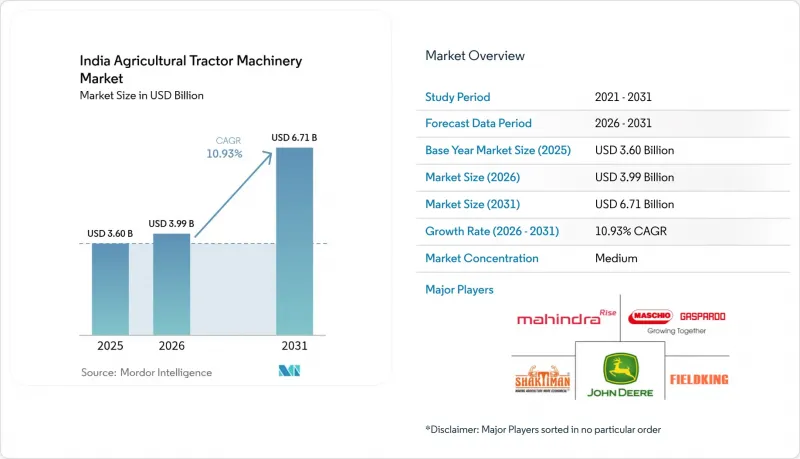
This report is Segmented by Machinery Type (Plowing and Cultivating Machinery, Planting Machinery, Haying and Forage Machinery, Sprayers, and Other Types). The Market Forecasts are Provided in Terms of Value (USD).
India Agricultural Tractor Machinery Market Trends and Insights
Subsidized purchase of tractor-mounted implements under SMAM/CHC schemes
Direct benefit transfers covering 40-50% of equipment cost for individual buyers and up to 80% for community Custom Hiring Centers (CHCs) have become the market's primary accelerator. The 26,662 CHCs established by December 2024 are providing rental access to implements that were once unaffordable to marginal growers. A National Bank for Agriculture and Rural Development (NABARD) priority lending target for farm machinery during FY 2024-25 indicates continued liquidity for new fleets. Higher subsidy slabs for crop-residue management equipment have already cut stubble-burning incidents in Punjab in 2024.
Precision-ready rotavators now bundled by leading OEMs
Mahindra and Mahindra Limited's Krish-e Smart Kit, priced at INR 4,995 (USD 60), converts rotavators into connected assets that track acres covered and fuel use; daily active usage exceeds 85%, proving operator stickiness. Tractors and Farm Equipment Limited mirrors the model with JFarm Services, which processed more than 100,000 rental orders by January 2025. The integration of telemetry and digital marketplaces shortens the payback periods for Custom Hiring Center (CHC) investors and provides real-time maintenance data to service networks.
Fragmented small holdings limit pay-back period
The average farm size of 0.74 hectares restricts the economic viability of large attachments such as balers and combine harvesters, which require minimum plot sizes of 5 to 10 hectares to achieve breakeven utilization. Bihar, West Bengal, Uttar Pradesh, and Kerala exhibit the highest fragmentation, with marginal holdings (below 1 hectare) comprising over 70 percent of operational farms in these states. For INR 1.5 lakh (USD 1,800) rotavator, a farmer cultivating 0.5 hectares would need to rent out the implement for 100 to 150 hours annually to recover costs, but localized demand and seasonal clustering make such utilization difficult without digital aggregation platforms.
Other drivers and restraints analyzed in the detailed report include:
- Demand spike from labor-scarcity during kharif sowing season
- Rising vineyard/orchard acreage driving niche PTO sprayers
- Looming 2026 TREM-V emission rule requiring PTO-power-matching retrofits
For complete list of drivers and restraints, kindly check the Table Of Contents.
Segment Analysis
Plowing and cultivating machinery accounted for 41.35% market share, with rotary tillers as the dominant stock-keeping unit (SKU). Tirth Agro Technology (Shaktiman) accounts for the most domestic rotavator sales, underscoring the segment's brand concentration. Rotavators cut seedbed preparation to a single pass, saving diesel and time. The Indian agricultural tractors machinery market size for Sprayers is set to expand at a CAGR of 14.2% through 2031, driven by orchard expansion and precision input mandates. CNH Industrial N.V.'s AI sprayer platform promises double-digit chemical savings, a strong selling point for high-value fruit growers.
Planting Machinery gains from 40-50% subsidies that encourage seed-drill ownership and from digital soil maps that call for precise seeding depth. Deere and Company offers bundled tractor-plus-planter packages to medium farms, helping it capture affluent buyers. Haying and Forage equipment remains predominantly rented due to high ticket prices, reinforcing the relevance of the Custom Hiring Center. Smaller niche categories, such as potato planters and sugarcane harvesters, are still supplied by regional specialists that tailor frame widths to local crops.
Complete Report Scope:
- By Machinery Type
- Plowing and Cultivating Machinery
- Plows
- Harrows
- Rotovators and Cultivators
- Other Plowing and Cultivating Machinery
- Planting Machinery
- Seed Drills
- Planters
- Spreaders
- Other Planting Machinery
- Haying and Forage Machinery
- Mowers and Conditioners
- Balers
- Other Haying and Forage Machinery
- Sprayers
- Other Types
- Plowing and Cultivating Machinery
List of Companies Covered in this Report:
- Mahindra & Mahindra Limited.
- Tractors and Farm Equipment Limited
- Escorts Kubota Limited
- Deere & Company
- International Tractors Limited (Sonalika)
- VST Tillers Tractors Limited
- Tirth Agro Technology (Shaktiman)
- Maschio Gaspardo S.p.A.
- CNH Industrial N.V
- Boraste Agro Sales Corporation
- Dragonne Macchine Agricole
- Tirupati Udyog (Champion Implements)
- Captain Tractors Pvt. Ltd
- Beri Udyog Pvt. Ltd. (Fieldking)
Additional Benefits:
- The market estimate (ME) sheet in Excel format
- 3 months of analyst support
TABLE OF CONTENTS
1 Introduction
- 1.1 Study Assumptions and Market Definition
- 1.2 Scope of the Study
2 Research Methodology
3 Executive Summary
4 Market Landscape
- 4.1 Market Overview
- 4.2 Market Drivers
- 4.2.1 Subsidized purchase of tractor-mounted implements under SMAM/CHC schemes
- 4.2.2 Precision-ready rotavators now bundled by leading OEMs
- 4.2.3 Demand spike from labor-scarcity during kharif sowing season
- 4.2.4 Government push for crop-residue management attachments
- 4.2.5 Surge in start-up led "implements-as-a-service" mobile apps
- 4.2.6 Rising vineyard/orchard acreage driving niche PTO sprayers
- 4.3 Market Restraints
- 4.3.1 High upfront cost of powered implements
- 4.3.2 Fragmented small holdings limit pay-back period
- 4.3.3 Looming 2026 TREM-V emission rule requiring PTO-power-matching retrofits
- 4.3.4 Shortage of skilled mechanics for gear-box repair in Tier-3 towns
- 4.4 Regulatory Landscape
- 4.5 Technological Outlook
- 4.6 Porters Five Forces Analysis
- 4.6.1 Bargaining Power of Buyers
- 4.6.2 Bargaining Power of Suppliers
- 4.6.3 Threat of New Entrants
- 4.6.4 Threat of Substitute Products
- 4.6.5 Intensity of Competitive Rivalry
5 Market Size & Growth Forecasts (Value)
- 5.1 By Machinery Type
- 5.1.1 Plowing and Cultivating Machinery
- 5.1.1.1 Plows
- 5.1.1.2 Harrows
- 5.1.1.3 Rotovators and Cultivators
- 5.1.1.4 Other Plowing and Cultivating Machinery
- 5.1.2 Planting Machinery
- 5.1.2.1 Seed Drills
- 5.1.2.2 Planters
- 5.1.2.3 Spreaders
- 5.1.2.4 Other Planting Machinery
- 5.1.3 Haying and Forage Machinery
- 5.1.3.1 Mowers and Conditioners
- 5.1.3.2 Balers
- 5.1.3.3 Other Haying and Forage Machinery
- 5.1.4 Sprayers
- 5.1.5 Other Types
- 5.1.1 Plowing and Cultivating Machinery
6 Competitive Landscape
- 6.1 Market Concentration
- 6.2 Strategic Moves
- 6.3 Market Share Analysis
- 6.4 Company Profiles (Includes Global Level Overview, Market Level overview, Core Segments, Financials as available, Strategic Information, Market Rank/Share for key companies, Products and Services, and Recent Developments)
- 6.4.1 Mahindra & Mahindra Limited.
- 6.4.2 Tractors and Farm Equipment Limited
- 6.4.3 Escorts Kubota Limited
- 6.4.4 Deere & Company
- 6.4.5 International Tractors Limited (Sonalika)
- 6.4.6 VST Tillers Tractors Limited
- 6.4.7 Tirth Agro Technology (Shaktiman)
- 6.4.8 Maschio Gaspardo S.p.A.
- 6.4.9 CNH Industrial N.V
- 6.4.10 Boraste Agro Sales Corporation
- 6.4.11 Dragonne Macchine Agricole
- 6.4.12 Tirupati Udyog (Champion Implements)
- 6.4.13 Captain Tractors Pvt. Ltd
- 6.4.14 Beri Udyog Pvt. Ltd. (Fieldking)
7 Market Opportunities and Future Outlook

