PUBLISHER: Mordor Intelligence | PRODUCT CODE: 2097095

PUBLISHER: Mordor Intelligence | PRODUCT CODE: 2097095
Middle East and Africa Polyvinyl Chloride (PVC) - Market Share Analysis, Industry Trends & Statistics, Growth Forecasts (2026 - 2031)
According to Mordor Intelligence, the middle-East and Africa Polyvinyl Chloride Market size in 2026 is estimated at 3.62 million tons, growing from 2025 value of 3.53 million tons with 2031 projections showing 4.08 million tons, growing at 2.43% CAGR over 2026-2031.
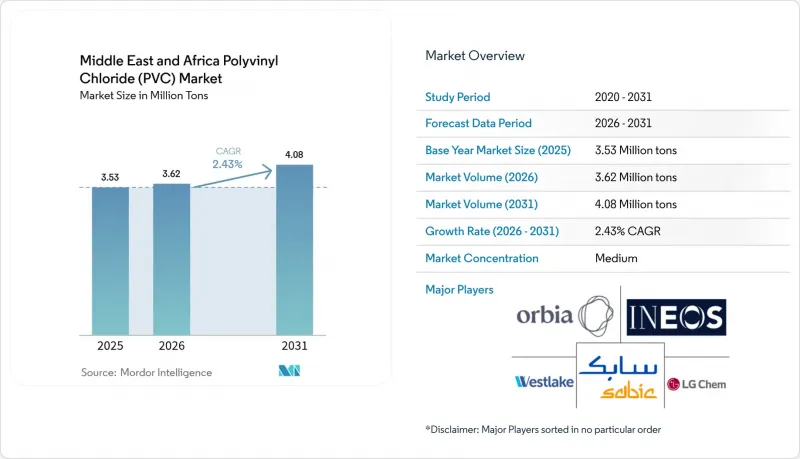
This report is Segmented by Product Type (Rigid PVC, Flexible PVC, Low-Smoke Zero-Halogen PVC, and More), Application (Pipes and Fittings, Films and Sheets, Wires and Cables, and More), End-User Industry (Building and Construction, Automotive and Mobility, and More), and Geography (Saudi Arabia, UAE, Qatar, and More). The Market Forecasts are Provided in Terms of Volume (Tons).
Middle East and Africa Polyvinyl Chloride (PVC) Market Trends and Insights
Booming Public-Sector Infrastructure Programs Drive Sustained PVC Demand
Multi-billion-dollar national visions underpin a robust order book for the Middle-East and Africa Poly Vinyl Chloride (PVC) market. Saudi Arabia allocated USD 1.2 billion to water infrastructure in 2024, and NEOM's multi-decade build-out signals prolonged offtake for conduits, profiles, and cladding. Egypt's USD 10.9 billion Suez Canal Economic Zone petrochemical complex deepens downstream PVC utilization in utilities and industrial structures. Long-term funding structures insulate volumes from oil-price cycles, anchoring a predictable baseline for producers.
Rapid Expansion of Desalination Networks Accelerates Pipe Demand
Water-scarce GCC and North African states are scaling desalination capacity, a pipe-intensive endeavor. Veolia's USD 320 million award in the UAE and Morocco's 822,000 m3/day Atlantic facility both specify high-pressure, saltwater-resistant PVC piping. The International Desalination Association expects regional capacity to climb 50% by 2030, translating directly into sustained rigid-grade consumption.
Escalating ESG Pressure and PVC Phase-Out Clauses Challenge Growth
Green-building certifications, such as LEED and local schemes like Dubai's Al Sa'fat, discourage chlorine-based polymers, pressuring conventional grades and nudging the Middle-East and Africa Poly Vinyl Chloride (PVC) market toward bio-based variants. The European Union's 0.1% lead-stabilizer cap, effective November 2024, requires exporters to accelerate the development of non-lead formulations, thereby increasing compliance costs.
Other drivers and restraints analyzed in the detailed report include:
- Grid-Hardening and Renewable-Energy Cabling Surge
- Medical-Grade PVC Capacity Build-Out in Healthcare Corridors
- Volatile Ethylene and Chlorine Feedstock Pricing Pressures Margins
For complete list of drivers and restraints, kindly check the Table Of Contents.
Segment Analysis
Rigid grades accounted for 57.70% of the Middle-East and Africa Poly Vinyl Chloride (PVC) market size in 2025, driven by pipeline and construction orders. Bio-based PVC advances 2.71% CAGR as builders seek ESG-compliant alternatives. Capacity additions by integrated producers help maintain a balanced regional supply, but the faster adoption of recyclable additives could shift the share toward low-carbon formulations after 2028. The segment's pricing premium supports visibility in the Middle East Africa Poly Vinyl Chloride (PVC) market.
Second-generation bio-routes using non-food biomass cut cradle-to-gate emissions by up to 90%, helping GCC megaprojects meet Scope 3 targets. Rigid's resilience, meanwhile, hinges on desalination pipelines and high-rise facades that demand corrosion resistance and structural rigidity. As lead-free stabilizer technologies mature, rigid grades should defend volume even under stricter codes.
Complete Report Scope:
- By Product Type
- Rigid PVC
- Flexible PVC
- Low-smoke Zero-Halogen PVC
- Chlorinated PVC (CPVC)
- Bio-based PVC
- By Application
- Pipes and Fittings
- Films and Sheets
- Wires and Cables
- Bottles and Containers
- Profiles, Hoses and Tubing
- Others (toys, fabrics, 3-D printing)
- By End-user Industry
- Building and Construction
- Automotive and Mobility
- Electrical and Electronics
- Packaging
- Footwear and Leisurewear
- Healthcare and Life Sciences
- Agriculture and Textiles
- By Geography
- Saudi Arabia
- United Arab Emirates
- Qatar
- Kuwait
- South Africa
- Egypt
- Nigeria
- Morocco
- Rest of Middle-East and Africa
List of Companies Covered in this Report:
- Africa PVC Industries Ltd
- Egyptian Petrochemicals Co. (EPC)
- Formosa Plastics Corporation
- INOVYN
- LG Chem
- Neproplast
- Occidental Petroleum Corporation
- Orbia
- Qatar Petrochemical Company (QAPCO) Q.P.J.S.C
- Reliance Industries Limited.
- SABIC
- SASOL
- Shin-Etsu Chemical Co., Ltd.
- TCI Sanmar Chemicals (S.A.E.)
- Westlake Corporation
Additional Benefits:
- The market estimate (ME) sheet in Excel format
- 3 months of analyst support
TABLE OF CONTENTS
1 Introduction
- 1.1 Study Assumptions
- 1.2 Scope of the Study
2 Research Methodology
3 Executive Summary
4 Market Landscape
- 4.1 Market Overview
- 4.2 Market Drivers
- 4.2.1 Booming public-sector infrastructure programs (GCC Vision 2030, Egypt Vision 2030)
- 4.2.2 Rapid expansion of desalination and water-reuse pipe networks
- 4.2.3 Grid-hardening and renewable-energy cabling demand surge
- 4.2.4 Medical-grade PVC capacity build-out in MEA healthcare corridors (e.g., Dubai Science Park)
- 4.2.5 Local-content mandates driving in-region PVC compounding (Saudi IKTVA, UAE ICV)
- 4.3 Market Restraints
- 4.3.1 Escalating ESG pressure and PVC phase-out clauses in green-building codes
- 4.3.2 Volatile ethylene and chlorine feedstock pricing linked to crude swings
- 4.3.3 Upcoming bans on lead-based stabilisers across GCC and Pan-African standards
- 4.4 Value Chain Analysis
- 4.5 Regulatory Landscape
- 4.6 Porter's Five Forces
- 4.6.1 Bargaining Power of Suppliers
- 4.6.2 Bargaining Power of Buyers
- 4.6.3 Threat of New Entrants
- 4.6.4 Threat of Substitutes
- 4.6.5 Competitive Rivalry
5 Market Size and Growth Forecasts (Volume)
- 5.1 By Product Type
- 5.1.1 Rigid PVC
- 5.1.2 Flexible PVC
- 5.1.3 Low-smoke Zero-Halogen PVC
- 5.1.4 Chlorinated PVC (CPVC)
- 5.1.5 Bio-based PVC
- 5.2 By Application
- 5.2.1 Pipes and Fittings
- 5.2.2 Films and Sheets
- 5.2.3 Wires and Cables
- 5.2.4 Bottles and Containers
- 5.2.5 Profiles, Hoses and Tubing
- 5.2.6 Others (toys, fabrics, 3-D printing)
- 5.3 By End-user Industry
- 5.3.1 Building and Construction
- 5.3.2 Automotive and Mobility
- 5.3.3 Electrical and Electronics
- 5.3.4 Packaging
- 5.3.5 Footwear and Leisurewear
- 5.3.6 Healthcare and Life Sciences
- 5.3.7 Agriculture and Textiles
- 5.4 By Geography
- 5.4.1 Saudi Arabia
- 5.4.2 United Arab Emirates
- 5.4.3 Qatar
- 5.4.4 Kuwait
- 5.4.5 South Africa
- 5.4.6 Egypt
- 5.4.7 Nigeria
- 5.4.8 Morocco
- 5.4.9 Rest of Middle-East and Africa
6 Competitive Landscape
- 6.1 Market Concentration
- 6.2 Strategic Moves
- 6.3 Market Share(%)/Ranking Analysis
- 6.4 Company Profiles (includes Global level Overview, Market level overview, Core Segments, Financials as available, Strategic Information, Market Rank/Share for key companies, Products and Services, and Recent Developments)
- 6.4.1 Africa PVC Industries Ltd
- 6.4.2 Egyptian Petrochemicals Co. (EPC)
- 6.4.3 Formosa Plastics Corporation
- 6.4.4 INOVYN
- 6.4.5 LG Chem
- 6.4.6 Neproplast
- 6.4.7 Occidental Petroleum Corporation
- 6.4.8 Orbia
- 6.4.9 Qatar Petrochemical Company (QAPCO) Q.P.J.S.C
- 6.4.10 Reliance Industries Limited.
- 6.4.11 SABIC
- 6.4.12 SASOL
- 6.4.13 Shin-Etsu Chemical Co., Ltd.
- 6.4.14 TCI Sanmar Chemicals (S.A.E.)
- 6.4.15 Westlake Corporation
7 Market Opportunities and Future Outlook
- 7.1 White-space and Unmet-need Assessment

