PUBLISHER: Mordor Intelligence | PRODUCT CODE: 2115253

PUBLISHER: Mordor Intelligence | PRODUCT CODE: 2115253
Bio-Based Polyvinyl Chloride - Market Share Analysis, Industry Trends & Statistics, Growth Forecasts (2026 - 2031)
According to Mordor Intelligence, the bio-Based polyvinyl chloride market size is expected to grow from USD 0.96 billion in 2025 to USD 1.01 billion in 2026 and is forecast to reach USD 1.31 billion by 2031 at 5.37% CAGR over 2026-2031.
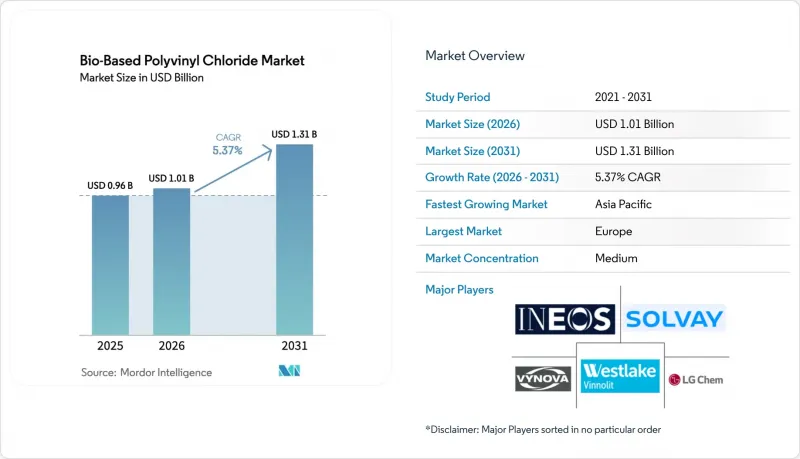
This report is Segmented by Product Type (Rigid Bio-PVC and Flexible Bio-PVC), Application (Pipes, Wires, Cables, Films and Sheets, and Others), End-User Industry (Building and Construction, Transportation and Packaging, Electrical and Electronics, and Others), and Geography (Asia-Pacific, North America, Europe, and More). The Market Forecasts are Provided in Terms of Value (USD).
Global Bio-Based Polyvinyl Chloride Market Trends and Insights
Stricter Environmental Regulations And ESG Mandates
The EU Carbon Border Adjustment Mechanism entered its transitional phase in late 2023 and will apply full embedded-carbon tariffs from 2026, making high-carbon PVC imports costlier by 2028 . California's SB 253 and SB 261 require scope-3 disclosures from 2024, pushing building and automotive buyers to audit polymer origins. Teknor Apex noted in 2025 a growth of European flooring customers demanding bio-attributed compounds verified for carbon footprint. These converging rules tilt procurement toward certified bio-PVC despite its price premium. Producers able to document chain-of-custody compliance earn preferred-supplier status in regulated tenders.
Corporate Sustainability Commitments And Green-Building Standards
LEED v5, fully rolling out in 2026, grants extra points for ISO 16620-verified bio-based content, putting bio-PVC on specification lists for projects targeting Gold or Platinum ratings . The EPA's 2025 update of Product Category Rules for resilient flooring mandates life-cycle assessments that reveal feedstock origin, effectively disadvantaging fossil resin in public procurement. Automaker scorecards reinforce the pull: Volkswagen assigns a portion of its supplier ratings to bio-based or recycled polymers. Meanwhile, Ford mandates the use of certified bio-PVC in its North American models by 2028. Such targets provide resin suppliers with the volume certainty essential for retrofitting crackers to process bio-feedstocks.
High Production-Cost Gap Versus Fossil PVC
Bio-ethanol commands a higher price than naphtha-based ethylene, resulting in a resin premium before accounting for capital charges related to cracker retrofits. In Brazil and India, fuel-blending mandates consume the majority of ethanol volumes, leaving limited surplus for chemical applications. Buyers in the price-sensitive packaging and construction sectors hesitate to pay the premium unless carbon penalties bridge the difference. In 2025, LyondellBasell reported that while bio-attributed polyolefins achieved a premium in Europe, they faced challenges in Southeast Asia, where fossil resins are priced lower.
Other drivers and restraints analyzed in the detailed report include:
- Cost-Competitive Bio-Ethylene Routes Reaching Commercial Scale
- EU Carbon-Border Adjustments Accelerating Low-Carbon Feedstock Use
- Limited Commercial-Scale Renewable-Feedstock Supply
For complete list of drivers and restraints, kindly check the Table Of Contents.
Segment Analysis
Rigid variants controlled 62.48% of 2025 volume, reflecting the need for 50-year service lives in potable-water pipes and window profiles. This dominance underpins a substantial portion of the bio-based polyvinyl chloride market size, securing predictable offtake for resin suppliers. Flexible grades, forecast at a 5.88% CAGR, benefit from drop-in substitution in automotive interiors where scope-3 targets drive material choices.
Rigid compounds require minimal tooling changes when swapping fossil for bio-attributed resin, trimming adoption risk, and ensuring that the bio-based polyvinyl chloride market grows steadily within infrastructure projects. Flexible formulations depend on compatible plasticizers and careful migration testing; Teknor Apex launched a 40% bio-content flexible compound in 2025 to meet these performance demands. These advances show how formulation know-how, not polymer chemistry, sets the pace of segment uptake in the bio-based polyvinyl chloride industry.
Complete Report Scope:
- By Product Type
- Rigid Bio-PVC
- Flexible Bio-PVC
- By Application
- Pipes
- Wires
- Cables
- Films and Sheets
- Others
- By End-User Industry
- Building and Construction
- Transportation and Packaging
- Electrical and Electronics
- Others
- By Geography
- Asia-Pacific
- China
- India
- Japan
- South Korea
- ASEAN Countries
- Rest of Asia-Pacific
- North America
- United States
- Canada
- Mexico
- Europe
- Germany
- United Kingdom
- France
- Italy
- Russia
- NORDIC Countries
- Rest of Europe
- South America
- Brazil
- Argentina
- Rest of South America
- Middle-East and Africa
- Saudi-Arabia
- South Africa
- Rest of Middle-East and Africa
- Asia-Pacific
Geography Analysis
Europe claimed a 48.22% bio-based polyvinyl chloride market share in 2025, lifted by CBAM's transitional reporting and mass-balance supply deals between INEOS, Vynova, and downstream fabricators. Germany, France, and Italy lead demand, while Sweden and Denmark test bio-PVC in district-heating pipes. Russia remains sidelined due to sanctions and carbide-route dependence that lacks bio-feedstock infrastructure.
Asia-Pacific is the fastest-growing region at a 5.94% CAGR through 2031. India diverts surplus sugarcane ethanol into chemical routes, and Praj's Gujarat demo plant signals domestic feedstock readiness. China's five-year plan opens pilot quotas for bio-ethanol co-processing, giving state-owned crackers a pathway to carbon-adjustment compliance. Japan and South Korea import certified bio-naphtha from Malaysia and Thailand for electronics and automotive customers.
North America, while holding a smaller market share, reaps significant benefits from the United States tax credits, reducing CO2-to-ethylene costs. Dow faces feedstock constraints, highlighting supplier qualification timelines over production bottlenecks. In North America, Mexico aligns its operations with the United States OEM scorecards, and Brazil's ethanol-to-ethylene plant bolsters South America's supply. The Middle East remains in its infancy; however, SABIC's scheduled trial of bio-naphtha hints at budding demand, with potential for substantial capacity expansion if the trial proves successful.
- Avient Corporation
- Bio-Plastic Solutions LLC.
- Bio-Tec Environmental
- Braskem
- CLARIANT
- Dow
- ENSO Plastics
- Formosa Plastics Corporation, U.S.A.
- GEON Performance Solutions
- INEOS
- LG Chem
- LyondellBasell
- Metabolix, Inc.
- Nomaco
- Shin-Etsu Chemical Co., Ltd.
- Solvay SA
- Sylvin Technologies, Inc.
- Teknor Apex
- Vynova Group
- Westlake Vinnolit GmbH & Co. KG
Additional Benefits:
- The market estimate (ME) sheet in Excel format
- 3 months of analyst support
TABLE OF CONTENTS
1 Introduction
- 1.1 Study Assumptions
- 1.2 Scope of the Study
2 Research Methodology
3 Executive Summary
4 Market Landscape
- 4.1 Market Overview
- 4.2 Market Drivers
- 4.2.1 Stricter environmental regulations and ESG mandates
- 4.2.2 Corporate sustainability commitments and green-building standards
- 4.2.3 Cost-competitive bio-ethylene routes reaching commercial scale
- 4.2.4 EU carbon-border adjustments accelerating low-carbon feedstock use
- 4.2.5 Mass-balance flooring/pipe supply deals catalyzing downstream uptake
- 4.3 Market Restraints
- 4.3.1 High production-cost gap vs. fossil PVC
- 4.3.2 Limited commercial-scale renewable-feedstock supply
- 4.3.3 Traceability issues in mixed bio-attributed recycling streams
- 4.4 Value Chain Analysis
- 4.5 Porter's Five Forces
- 4.5.1 Threat of New Entrants
- 4.5.2 Bargaining Power of Buyers
- 4.5.3 Bargaining Power of Suppliers
- 4.5.4 Threat of Substitutes
- 4.5.5 Degree of Competition
5 Market Size and Growth Forecasts (Value)
- 5.1 By Product Type
- 5.1.1 Rigid Bio-PVC
- 5.1.2 Flexible Bio-PVC
- 5.2 By Application
- 5.2.1 Pipes
- 5.2.2 Wires
- 5.2.3 Cables
- 5.2.4 Films and Sheets
- 5.2.5 Others
- 5.3 By End-User Industry
- 5.3.1 Building and Construction
- 5.3.2 Transportation and Packaging
- 5.3.3 Electrical and Electronics
- 5.3.4 Others
- 5.4 By Geography
- 5.4.1 Asia-Pacific
- 5.4.1.1 China
- 5.4.1.2 India
- 5.4.1.3 Japan
- 5.4.1.4 South Korea
- 5.4.1.5 ASEAN Countries
- 5.4.1.6 Rest of Asia-Pacific
- 5.4.2 North America
- 5.4.2.1 United States
- 5.4.2.2 Canada
- 5.4.2.3 Mexico
- 5.4.3 Europe
- 5.4.3.1 Germany
- 5.4.3.2 United Kingdom
- 5.4.3.3 France
- 5.4.3.4 Italy
- 5.4.3.5 Russia
- 5.4.3.6 NORDIC Countries
- 5.4.3.7 Rest of Europe
- 5.4.4 South America
- 5.4.4.1 Brazil
- 5.4.4.2 Argentina
- 5.4.4.3 Rest of South America
- 5.4.5 Middle-East and Africa
- 5.4.5.1 Saudi-Arabia
- 5.4.5.2 South Africa
- 5.4.5.3 Rest of Middle-East and Africa
- 5.4.1 Asia-Pacific
6 Competitive Landscape
- 6.1 Market Concentration
- 6.2 Strategic Moves
- 6.3 Market Share/Ranking Analysis
- 6.4 Company Profiles (includes Global level Overview, Market level overview, Core Segments, Financials as available, Strategic Information, Market Rank/Share for key companies, Products and Services, and Recent Developments)
- 6.4.1 Avient Corporation
- 6.4.2 Bio-Plastic Solutions LLC.
- 6.4.3 Bio-Tec Environmental
- 6.4.4 Braskem
- 6.4.5 CLARIANT
- 6.4.6 Dow
- 6.4.7 ENSO Plastics
- 6.4.8 Formosa Plastics Corporation, U.S.A.
- 6.4.9 GEON Performance Solutions
- 6.4.10 INEOS
- 6.4.11 LG Chem
- 6.4.12 LyondellBasell
- 6.4.13 Metabolix, Inc.
- 6.4.14 Nomaco
- 6.4.15 Shin-Etsu Chemical Co., Ltd.
- 6.4.16 Solvay SA
- 6.4.17 Sylvin Technologies, Inc.
- 6.4.18 Teknor Apex
- 6.4.19 Vynova Group
- 6.4.20 Westlake Vinnolit GmbH & Co. KG
7 Market Opportunities and Future Outlook
- 7.1 White-Space and Unmet-Need Assessment

