PUBLISHER: Mordor Intelligence | PRODUCT CODE: 2097110

PUBLISHER: Mordor Intelligence | PRODUCT CODE: 2097110
Asia-Pacific Cane Sugar - Market Share Analysis, Industry Trends & Statistics, Growth Forecasts (2026 - 2031)
According to Mordor Intelligence, the Asia-Pacific cane sugar market size in 2026 is estimated at USD 89.25 billion, growing from 2025 value of USD 87.14 billion with 2031 projections showing USD 100.53 billion, growing at 2.42% CAGR over 2026-2031.
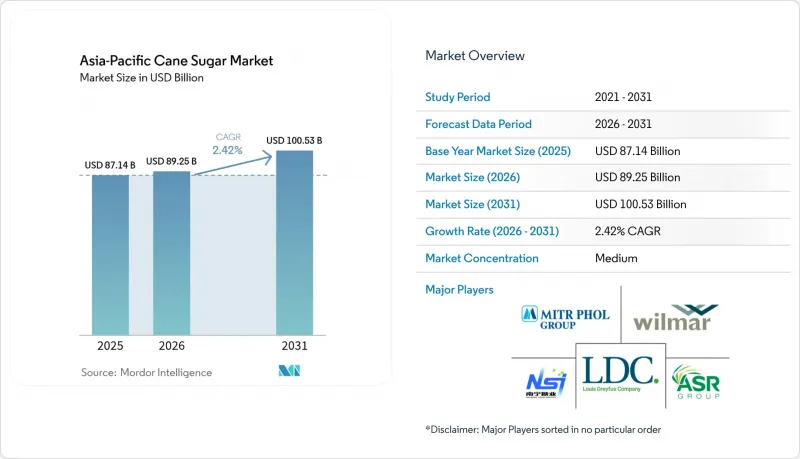
This report is Segmented by Category (Organic, Conventional), Form (Crystallised Sugar, Liquid Syrup), End User (Food and Others), and Geography (Australia, China, India, Indonesia, Japan, Malaysia, South Korea, Thailand, Vietnam, Rest of Asia-Pacific). Market Forecasts are Provided in Terms of Value (USD) and Volume (Tons).
Asia-Pacific Cane Sugar Market Trends and Insights
Rising per-capita sugar intake in emerging Asia-Pacific economies
Asia, with an average sugar consumption of 21.2 kg per capita, lags behind the global mean of 23.1 kg. However, due to its vast population, Asia is projected to account for 64% of the incremental global sugar demand through 2034, highlighting the region's critical role in shaping global sugar markets. In 2024, Indonesia consumed 7.2 million tons of sugar, but with only 2.2 million tons produced domestically, the nation faces a significant 69% import gap. This gap underscores Indonesia's heavy reliance on imports, which persists even as the government prioritizes achieving self-sufficiency through policy measures and domestic production initiatives. Meanwhile, India ramped up its sugar consumption to 29 million tons in 2024-25, driven by a surge in packaged food popularity in tier-2 cities, where rising disposable incomes and urbanization are fueling demand. In Vietnam, competitive farmgate pricing ensures attractive margins for downstream players, encouraging sustained production and investment in the sector. On the other hand, China's per-capita sugar intake stands at 11 kg, indicating potential growth opportunities for the market, even as state campaigns advocate for reduced sugar consumption to address health concerns and promote healthier dietary habits.
Rapid expansion of regional food and beverage processing capacity
In 2024, food processors captured 65.17% of the regional demand and are ramping up their capacities at a pace outstripping consumption growth, driven by increasing demand for processed and packaged food products. The bakery sector in India poured in a hefty USD 600 million into automated lines, specifically those utilizing liquid syrup for continuous mixing, to enhance production efficiency and meet the growing consumer preference for consistent product quality. In a bid to sustain sweetness while reducing sugar content per serving, beverage manufacturers in China upped their liquid-sugar concentrations by 8% in 2023, ensuring steady industrial demand and aligning with health-conscious consumer trends. Dairy producers in Vietnam are using 15-20% more sugar per liter compared to ambient products, leading to an uptick in refined sugar imports from Thailand and Australia to meet the rising demand for sweetened dairy products. Snack manufacturers in Indonesia are blending cane and palm sugars to meet halal standards, thereby tapping into hybrid channels that traditional classifications have previously overlooked, enabling them to cater to a broader consumer base while adhering to regulatory requirements.
Sugar-reduction health policies and taxation
In 2025, Malaysia raised its excise tax to RM 0.90 per liter, prompting 96% of beverage companies to reformulate their products, reducing sugar content by as much as 15%. This move aimed to address rising health concerns related to sugar consumption and encourage healthier product offerings. Singapore's Nutri-Grade labeling, introduced to promote transparency in sugar levels, compelled major cola brands to cut their sugar content by up to 18%, reflecting the growing regulatory pressure on the beverage industry. Between 2022 and 2024, Thailand's tiered excise system led to an 8% reduction in sugar use in drinks, showcasing the effectiveness of fiscal measures in influencing product reformulation. Vietnam is mulling over a similar two-tier levy, which could further dampen demand and align with regional efforts to curb sugar consumption. Meanwhile, Indonesia has proposed a draft regulation capping sugar in packaged foods at 10 g per serving, signaling a broader regional trend towards stricter sugar regulations to combat health issues like obesity and diabetes.
Other drivers and restraints analyzed in the detailed report include:
- Yield gains from precision agronomy and mill automation
- Government ethanol-blending mandates boosting cane demand
- Weather-driven price volatility and supply shocks
For complete list of drivers and restraints, kindly check the Table Of Contents.
Segment Analysis
In 2025, conventional cane sugar dominated the Asia-Pacific market, seizing a 77.62% share. Its stronghold is bolstered by cost advantages, well-established refining networks, and consistent demand from packaged foods, beverages, and retail sectors. With FOB prices hovering between USD 400-450 per ton, conventional sugar lures large-scale buyers eyeing stable input costs. Additionally, small and mid-tier refiners lean towards conventional throughput, not only to optimize asset utilization but also to shield against raw sugar price fluctuations, solidifying the segment's role in regional trade dynamics.
While organic cane sugar remains a niche player, it's the segment with the most momentum, forecasted to grow at a 4.03% CAGR until 2031. This surge is largely attributed to Fairtrade premiums, ranging from 13-20% in India and Thailand, which effectively counterbalance certification and compliance expenses. Innovative approaches, such as Lasuco's carbon-credit-backed low-chemical farming in Vietnam, are paving the way for smaller farmers to navigate the certification maze. Furthermore, major confectionery corporations in Japan and South Korea are locking in long-term contracts for organic supplies, spurring increased production from Thai exporters. Despite the allure, with annual audit costs between USD 1,500-2,500 per farm, organic adoption faces hurdles. Yet, with e-grocery platforms booming in China's major cities and the potential for premium margins 18-25% above standard commodity grades, mills see organic sugar as a promising diversification, especially against a backdrop of stable conventional prices.
Complete Report Scope:
- By Category
- Organic
- Conventional
- By Form
- Crystallised Sugar
- Liquid Syrup
- By End User
- Food
- Retail
- Food Processing
- Bakery and Confectionery
- Dairy
- Beverages
- Savory Snacks
- Others
- Food Services
- Others
- Food
- Country
- Australia
- China
- India
- Indonesia
- Japan
- Malaysia
- South Korea
- Thailand
- Vietnam
- Rest of Asia-Pacific
List of Companies Covered in this Report:
- Wilmar Sugar Australia Holdings Pty Ltd
- Louis Dreyfus Company B.V.
- American Sugar Refining Inc.
- Nanning Sugar Industry Co. Ltd
- Global Organics Ltd
- Tate & Lyle PLC
- Rana Sugars Ltd
- Rajshree Sugars & Chemicals Ltd
- DCM Shriram Ltd
- Triveni Engineering & Industries Ltd
- Mitr Phol Group
- Thai Roong Ruang Sugar Group
- Cofco Sugar Holding Co. Ltd
- Shree Renuka Sugars Ltd
- Dhampur Sugar Mills Ltd
- Bundaberg Sugar Ltd
- PT Permata Hijau Group (Indonesia)
- Korean Bio Co. Ltd
- Phu Khanh Sugar JSC (Vietnam)
- Cheng Xin Sugar Co. Ltd (China)
Additional Benefits:
- The market estimate (ME) sheet in Excel format
- 3 months of analyst support
TABLE OF CONTENTS
1 INTRODUCTION
- 1.1 Study Assumptions and Market Definition
- 1.2 Scope of the Study
2 RESEARCH METHODOLOGY
3 EXECUTIVE SUMMARY
4 MARKET LANDSCAPE
- 4.1 Market Overview
- 4.2 Market Drivers
- 4.2.1 Rising per-capita sugar intake in emerging Asia-Pacific economies
- 4.2.2 Rapid expansion of regional Food and Beverage processing capacity
- 4.2.3 Yield gains from precision agronomy and mill automation
- 4.2.4 Government ethanol-blending mandates boosting cane demand
- 4.2.5 Niche demand for craft-beverage 'single-origin' cane sugars
- 4.2.6 Direct-to-consumer e-grocery platforms broadening retail reach
- 4.3 Market Restraints
- 4.3.1 Sugar-reduction health policies and taxation
- 4.3.2 Weather-driven price volatility and supply shocks
- 4.3.3 Farm-labour scarcity accelerating costly mechanisation
- 4.3.4 Substitution by alternative sweeteners and HFCS
- 4.4 Supply Chain Analysis
- 4.5 Regulatory Landscape
- 4.6 Porter's Five Forces
- 4.6.1 Bargaining Power of Suppliers
- 4.6.2 Bargaining Power of Buyers
- 4.6.3 Threat of New Entrants
- 4.6.4 Threat of Substitutes
- 4.6.5 Competitive Rivalry
5 MARKET SIZE AND GROWTH FORECASTS (VALUE AND VOLUME)
- 5.1 By Category
- 5.1.1 Organic
- 5.1.2 Conventional
- 5.2 By Form
- 5.2.1 Crystallised Sugar
- 5.2.2 Liquid Syrup
- 5.3 By End User
- 5.3.1 Food
- 5.3.1.1 Retail
- 5.3.1.2 Food Processing
- 5.3.1.2.1 Bakery and Confectionery
- 5.3.1.2.2 Dairy
- 5.3.1.2.3 Beverages
- 5.3.1.2.4 Savory Snacks
- 5.3.1.2.5 Others
- 5.3.1.3 Food Services
- 5.3.2 Others
- 5.3.1 Food
- 5.4 Country
- 5.4.1 Australia
- 5.4.2 China
- 5.4.3 India
- 5.4.4 Indonesia
- 5.4.5 Japan
- 5.4.6 Malaysia
- 5.4.7 South Korea
- 5.4.8 Thailand
- 5.4.9 Vietnam
- 5.4.10 Rest of Asia-Pacific
6 COMPETITIVE LANDSCAPE
- 6.1 Market Concentration
- 6.2 Strategic Moves
- 6.3 Market Positioning Analysis
- 6.4 Company Profiles (includes Global level Overview, Market level overview, Core Segments, Financials as available, Strategic Information, Market Rank/Share for key companies, Products and Services, and Recent Developments)
- 6.4.1 Wilmar Sugar Australia Holdings Pty Ltd
- 6.4.2 Louis Dreyfus Company B.V.
- 6.4.3 American Sugar Refining Inc.
- 6.4.4 Nanning Sugar Industry Co. Ltd
- 6.4.5 Global Organics Ltd
- 6.4.6 Tate & Lyle PLC
- 6.4.7 Rana Sugars Ltd
- 6.4.8 Rajshree Sugars & Chemicals Ltd
- 6.4.9 DCM Shriram Ltd
- 6.4.10 Triveni Engineering & Industries Ltd
- 6.4.11 Mitr Phol Group
- 6.4.12 Thai Roong Ruang Sugar Group
- 6.4.13 Cofco Sugar Holding Co. Ltd
- 6.4.14 Shree Renuka Sugars Ltd
- 6.4.15 Dhampur Sugar Mills Ltd
- 6.4.16 Bundaberg Sugar Ltd
- 6.4.17 PT Permata Hijau Group (Indonesia)
- 6.4.18 Korean Bio Co. Ltd
- 6.4.19 Phu Khanh Sugar JSC (Vietnam)
- 6.4.20 Cheng Xin Sugar Co. Ltd (China)
7 MARKET OPPORTUNITIES AND FUTURE OUTLOOK

