PUBLISHER: Mordor Intelligence | PRODUCT CODE: 2113482

PUBLISHER: Mordor Intelligence | PRODUCT CODE: 2113482
India Cane Sugar - Market Share Analysis, Industry Trends & Statistics, Growth Forecasts (2026 - 2031)
According to Mordor Intelligence, the indian cane sugar market size was valued at USD 55.40 billion in 2025 and estimated to grow from USD 57.62 billion in 2026 to reach USD 70.13 billion by 2031, at a CAGR of 4.01% during the forecast period (2026-2031).
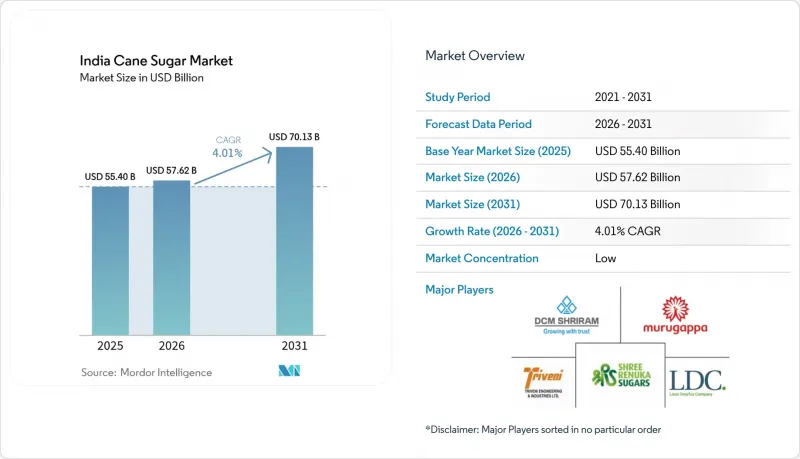
This report is Segmented by Form (Crystallized Sugar, Liquid Sugar), Category (Conventional, Organic), End-User (Food & Beverage Industries, Pharmaceuticals, Retail, Foodservice Channels, Industrial, Biofuel/Ethanol), and Geography (North India, South India, West India, East India). The Market Forecasts are Provided in Terms of Value (USD).
India Cane Sugar Market Trends and Insights
Strong government policies and abundant domestic raw materials bolster cane sugar production
The Indian government has transformed the country's cane sugar market through strategic ethanol blending mandates and production incentives. By July 2024, the ethanol blending program achieved a 13.3% blending rate, with petroleum companies procuring 3.91 billion liters from the sugar industry for the 2024-25 period. Demonstrating policy flexibility, the government lifted the ban on using sugarcane juice for ethanol production in August 2024 to balance domestic sugar supply with biofuel objectives. This shift has enabled sugar mills to diversify their revenue streams. For example, major producers like Balrampur Chini Mills have generated additional income of up to INR 25 crore from ethanol production using C-heavy molasses. Additionally, the implementation of stored syrup technology (biosyrup) facilitates year-round ethanol production, addressing the seasonal limitations of traditional sugar operations.
Expanding industrial sugar demand from beverages and processed foods
The food processing industry is expected to reach USD 700 billion by 2030, driving significant demand for industrial sugar applications beyond traditional uses, according to the India Brand Equity Foundation. This growth is particularly notable in tier II and III cities, where increasing disposable incomes are fueling demand for processed foods, beverages, and confectionery products, as reported by the U.S. Department of Agriculture. Additionally, the pharmaceutical sector's rising need for pharmaceutical-grade sugar is creating niche opportunities, with liquid sugar gaining popularity due to its superior dissolution properties and contamination control. The bakery and confectionery segments are expanding as consumer preferences shift toward premium products, while the dairy and frozen foods industries are increasing sugar usage for texture enhancement and preservation. Moreover, the development of specialty sugar grades, such as organic and raw variants, is enabling manufacturers to adopt premium positioning strategies aimed at health-conscious consumers.
Rising anti-sugar health regulations
India's Food Safety and Standards Authority (FSSAI) is reshaping the food and beverage landscape with its stringent sugar content guidelines. Manufacturers must now limit sugar to under 5g per 100g to label their products as "low sugar." This move comes in response to India's pressing diabetes crisis, which affects over 101 million citizens, underscoring the nation's urgent push for sugar reduction. The FSSAI's recent draft on high fat, sugar, salt (HFSS) foods signals a significant shift towards preventive health measures, potentially reshaping age-old sugar consumption habits. Yet, amidst these regulations, there's a silver lining: a surge in demand for specialty sugar grades and natural sweeteners. Responding to this trend, the Council of Scientific and Industrial Research has rolled out low-calorie natural sweeteners, such as Monk fruit. Furthermore, these regulations aren't just influencing domestic markets; they're also bolstering India's export competitiveness, aligning with the global demand for health-compliant products.
Other drivers and restraints analyzed in the detailed report include:
- Expansion of Agro-Processing Units
- Rising Interest in Ethanol Blending
- High Price Volatility
For complete list of drivers and restraints, kindly check the Table Of Contents.
Segment Analysis
In 2025, crystallized sugar commands a dominant 61.78% share of the market, underscoring its entrenched role in India's food processing sector. This segment's stability is attributed to its wide-ranging applications, from household use to industrial food production, bolstered by established quality standards and cost-effective production methods. Meanwhile, liquid sugar is making waves as the fastest-growing segment, boasting a 5.31% CAGR through 2031. This surge is largely fueled by the pharmaceutical sector's need for sugar solutions that demand precise dissolution and stringent contamination controls.
The pharmaceutical industry's appetite for injectable-grade sugar solutions and niche medical uses is propelling the liquid sugar segment's ascent. Furthermore, food and beverage producers are turning to liquid sugar, valuing its enhanced mixing efficiency and quicker processing times. This is especially true in beverage production, where the speed of dissolution and clarity are paramount. Technological advancements, particularly in storage and transportation, are bolstering the segment's growth. Innovations like temperature-controlled logistics ensure product integrity throughout the supply chain. Additionally, the advent of stored syrup technology is transforming liquid sugar usage, allowing for consistent year-round availability and alleviating seasonal production challenges.
Complete Report Scope:
- By Form
- Crystallized Sugar
- Liquid Sugar
- By Category
- Conventional
- Organic
- By End-User
- Food & Beverage Industries
- Bakery and Confectionery
- Beverages
- Dairy and Frozen Foods
- Others
- Pharmaceuticals
- Retail
- Foodservice Channels
- Industrial
- Biofuel / Ethanol
- Food & Beverage Industries
- By State
- North India
- South India
- West India
- East India
List of Companies Covered in this Report:
- DCM Shriram Ltd
- Triveni Engineering & Industries Ltd
- Shree Renuka Sugars Ltd
- EID Parry (India) Ltd
- Louis Dreyfus Company India
- Balrampur Chini Mills Ltd
- Bajaj Hindusthan Sugar Ltd
- Dhampur Sugar Mills Ltd
- Bannari Amman Sugars Ltd
- Mawana Sugars Ltd
- Dalmia Bharat Sugar & Industries Ltd
- Uttam Sugar Mills Ltd
- Simbhaoli Sugars Ltd
- Rajshree Sugars & Chemicals Ltd
- Andhra Sugars Ltd
- Olam Agri India
- Sakthi Sugars Ltd
- Thiru Arooran Sugars Ltd
- K M Sugar Mills Ltd
- Avadh Sugar & Energy Ltd
Additional Benefits:
- The market estimate (ME) sheet in Excel format
- 3 months of analyst support
TABLE OF CONTENTS
1 INTRODUCTION
- 1.1 Study Assumptions & Market Definition
- 1.2 Scope of the Study
2 RESEARCH METHODOLOGY
3 EXECUTIVE SUMMARY
4 MARKET LANDSCAPE
- 4.1 Market Overview
- 4.2 Market Drivers
- 4.2.1 Strong government policies and abundant domestic raw materials bolster cane sugar production.
- 4.2.2 Expanding industrial sugar demand from beverages & processed foods
- 4.2.3 Expansion of Agro-Processing Units
- 4.2.4 Rising Interest in Ethanol Blending
- 4.2.5 Micro-irrigation & high-yield cane varieties adoption
- 4.2.6 Availability of Multiple Sugar Grades
- 4.3 Market Restraints
- 4.3.1 Rising anti-sugar health regulations
- 4.3.2 Increasing Health Awareness about sugar consumption
- 4.3.3 Emergence of sugar alternatives
- 4.3.4 High Price Volatility
- 4.4 Supply Chain Analysis
- 4.5 Regulatory Outlook
- 4.6 Porter's Five Forces
- 4.6.1 Threat of New Entrants
- 4.6.2 Bargaining Power of Buyers/Consumers
- 4.6.3 Bargaining Power of Suppliers
- 4.6.4 Threat of Substitute Products
- 4.6.5 Intensity of Competitive Rivalry
5 MARKET SIZE AND GROWTH FORECAST
- 5.1 By Form
- 5.1.1 Crystallized Sugar
- 5.1.2 Liquid Sugar
- 5.2 By Category
- 5.2.1 Conventional
- 5.2.2 Organic
- 5.3 By End-User
- 5.3.1 Food & Beverage Industries
- 5.3.1.1 Bakery and Confectionery
- 5.3.1.2 Beverages
- 5.3.1.3 Dairy and Frozen Foods
- 5.3.1.4 Others
- 5.3.2 Pharmaceuticals
- 5.3.3 Retail
- 5.3.4 Foodservice Channels
- 5.3.5 Industrial
- 5.3.6 Biofuel / Ethanol
- 5.3.1 Food & Beverage Industries
- 5.4 By State
- 5.4.1 North India
- 5.4.2 South India
- 5.4.3 West India
- 5.4.4 East India
6 COMPETITIVE LANDSCAPE
- 6.1 Market Concentration
- 6.2 Strategic Moves
- 6.3 Market Ranking Analysis
- 6.4 Company Profiles (includes Global-level Overview, Market-level Overview, Core Segments, Financials (if available), Strategic Information, Market Rank/Share, Products & Services, Recent Developments)
- 6.4.1 DCM Shriram Ltd
- 6.4.2 Triveni Engineering & Industries Ltd
- 6.4.3 Shree Renuka Sugars Ltd
- 6.4.4 EID Parry (India) Ltd
- 6.4.5 Louis Dreyfus Company India
- 6.4.6 Balrampur Chini Mills Ltd
- 6.4.7 Bajaj Hindusthan Sugar Ltd
- 6.4.8 Dhampur Sugar Mills Ltd
- 6.4.9 Bannari Amman Sugars Ltd
- 6.4.10 Mawana Sugars Ltd
- 6.4.11 Dalmia Bharat Sugar & Industries Ltd
- 6.4.12 Uttam Sugar Mills Ltd
- 6.4.13 Simbhaoli Sugars Ltd
- 6.4.14 Rajshree Sugars & Chemicals Ltd
- 6.4.15 Andhra Sugars Ltd
- 6.4.16 Olam Agri India
- 6.4.17 Sakthi Sugars Ltd
- 6.4.18 Thiru Arooran Sugars Ltd
- 6.4.19 K M Sugar Mills Ltd
- 6.4.20 Avadh Sugar & Energy Ltd
7 MARKET OPPORTUNITIES AND FUTURE OUTLOOK

