PUBLISHER: Mordor Intelligence | PRODUCT CODE: 2097113

PUBLISHER: Mordor Intelligence | PRODUCT CODE: 2097113
Prenatal Supplements - Market Share Analysis, Industry Trends & Statistics, Growth Forecasts (2026 - 2031)
According to Mordor Intelligence, the prenatal supplements market size was valued at USD 4.01 billion in 2025 and estimated to grow from USD 4.44 billion in 2026 to reach USD 7.51 billion by 2031, at a CAGR of 11.07% during the forecast period (2026-2031).
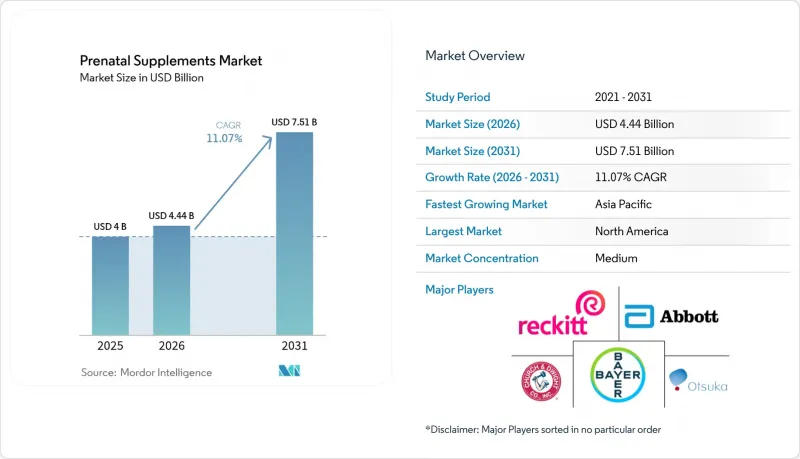
This report is Segmented by Type (Vitamins and Minerals, Essential Fatty Acids, and Other Types), Form (Capsules and Softgels, Tablets, and More), Distribution Channel (Supermarkets/Hypermarkets, Specialty and Health Stores, and More), and Geography (North America, Europe, Asia-Pacific, South America, and Middle East and Africa). The Market Forecasts are Provided in Terms of Value (USD).
Global Prenatal Supplements Market Trends and Insights
Medical Community Support Strengthening Market Position
Healthcare professionals are increasingly endorsing prenatal supplements, reshaping the market landscape. This shift in professional sentiment is elevating prenatal supplements from mere options to essential elements of maternal care. Reinforcing this trend, the National Institutes of Health has advised that women who are pregnant or may become pregnant should consume 400-800 micrograms of folic acid daily, ramping up to 600 micrograms during pregnancy to ward off neural tube defects . Such a unified medical stance is not only bolstering market growth but also fostering trust, drawing in health-conscious expectant mothers who might have previously shunned supplementation. Highlighting the industry's proactive stance, the Council for Responsible Nutrition successfully challenged and retracted misleading studies on prenatal vitamin safety in 2024, underscoring the collaborative efforts between the medical community and the industry to safeguard and expand the market.
Advanced Maternal Age Intensifying Focus on Fetal Development
As women increasingly delay pregnancies, especially those over 35, there's a growing demand for specialized prenatal nutrition, underscoring heightened concerns for fetal development. This trend is most evident in developed nations, where career pursuits have led to older average maternal ages. According to data from the Centers for Disease Control and Prevention (CDC), the average maternal age at first birth in the United States has steadily increased over the past decade . In response, the scientific community has intensified research on nutritional needs for pregnancies at advanced maternal ages, pinpointing distinct micronutrient requirements compared to younger mothers. Recent studies, including those published by the World Health Organization (WHO), reveal that multiple micronutrient supplements can notably diminish adverse birth outcomes, like low birth weight and preterm births, especially benefiting higher-risk pregnancies. Such evidence is steering product innovation towards comprehensive formulations tailored to age-specific nutritional needs. Manufacturers, as highlighted in annual reports from leading companies like Abbott Laboratories and Nestle, are now marketing their premium products as tools for risk mitigation, rather than mere supplements, justifying a price premium while genuinely addressing maternal health concerns.
High Cost of Premium Prenatal Supplements Limiting Affordability
Advanced prenatal formulations, often priced at a premium, are becoming increasingly inaccessible, especially in price-sensitive markets and among lower-income groups. This affordability challenge is most evident with specialized supplements, especially those featuring patented ingredients or innovative delivery systems, which can be priced 3-5 times higher than their basic counterparts. These supplements, often marketed as superior in quality and enriched with additional nutrients, are priced at a level that makes them inaccessible to a large segment of the population, particularly in developing and underdeveloped regions. For instance, organic or specialized prenatal vitamins containing DHA, folate, and probiotics are often priced significantly higher than standard supplements, limiting their adoption among cost-sensitive consumers. Additionally, the lack of insurance coverage for such supplements in many countries further exacerbates the affordability issue. For example, in the United States, while some insurance plans may cover basic prenatal vitamins, premium options are often excluded, leaving expectant mothers to bear the full cost. This financial burden discourages many from opting for these high-cost alternatives, despite their perceived benefits. Addressing this issue through strategies like price reductions, subsidies, or insurance coverage could help mitigate the impact of this restraint on the global prenatal supplements market.
Other drivers and restraints analyzed in the detailed report include:
- Digital Marketing Campaigns Expanding Market Reach
- Increased Preference for Natural, Organic, And Plant-Based Prenatal Supplements
- Presence of Counterfeit Products Undermining Consumer Trust
For complete list of drivers and restraints, kindly check the Table Of Contents.
Segment Analysis
The vitamins and minerals segment maintains its dominant position with 63.58% market share in 2025, driven by established clinical guidelines and decades of research supporting folic acid, iron, and calcium supplementation during pregnancy. Recent innovations in this segment focus on bioavailability and targeted delivery, with particular attention to folate forms that address genetic variations affecting metabolism. The introduction of L-5-MTHF and choline-enriched folate represents a significant advancement, offering greater stability and efficacy compared to traditional folic acid. The "Others" segment, encompassing probiotics, enzymes, and specialty nutrients, remains relatively small but is gaining traction as research on the maternal microbiome and its influence on fetal development expands, creating opportunities for differentiated product offerings that address emerging nutritional science.
Essential fatty acids are emerging as the fastest-growing segment in the prenatal supplements market, projected to expand at 15.88% CAGR from 2026 to 2031, significantly outpacing the overall market growth. This accelerated adoption reflects mounting scientific evidence linking omega-3 fatty acids, particularly DHA, to critical aspects of fetal brain and eye development. The European Food Safety Authority specifically recommends additional DHA intake for pregnant women, underscoring its importance in maternal nutrition protocols. Regulatory compliance for health claims on omega-3 supplements is highest for products targeting pregnant women (scoring 1.0 on compliance scales), indicating manufacturers' recognition of the heightened scrutiny and responsibility associated with this demographic.
Complete Report Scope:
- By Type
- Vitamins and Minerals
- Essential Fatty Acids
- Others
- By Form
- Capsules and Softgels
- Tablets
- Gummies
- Powders
- Others
- By Distribution Channel
- Supermarkets/Hypermarkets
- Specialty and Health Stores
- Online Retailers
- Other Distribution Channels
- By Geography
- North America
- United States
- Canada
- Mexico
- Rest of North America
- Europe
- United Kingdom
- Germany
- France
- Spain
- Italy
- Netherlands
- Sweden
- Poland
- Belgium
- Rest of Europe
- Asia-Pacific
- China
- Japan
- India
- South Korea
- Australia
- Indonesia
- Thailand
- Singapore
- Rest of Asia-Pacific
- South America
- Brazil
- Argentina
- Chile
- Columbia
- Peru
- Rest of South America
- Middle East and Africa
- South Africa
- Saudi Arabia
- United Arab Emirates
- Nigeria
- Egypt
- Morocco
- Turkey
- Rest of Middle East and Africa
- North America
Geography Analysis
In 2025, North America commands a 30.86% share of the prenatal supplements market, bolstered by heightened health awareness, a robust healthcare infrastructure, and strong endorsements from the medical community. While the region's leadership is underscored by stringent regulatory oversight, recent GAO findings spotlight quality control challenges in this mature market. Such regulatory scrutiny, though a hurdle for compliance, ultimately bolsters consumer trust in authentic products. The region is at the forefront of innovations in personalized nutrition, with digital health facilitating tailored supplements based on individual health profiles and genetics. Highlighting this trend towards transparency and quality assurance, California's proposed Senate Bill 646 mandates prenatal vitamin manufacturers to test for and disclose heavy metals. This legislation has the potential to set new industry benchmarks, influencing global manufacturing practices, especially as multinational firms adapt to the demands of their most stringent markets.
Asia-Pacific is poised to be the fastest-growing region, with a projected CAGR of 8.96% from 2026 to 2031. This growth is fueled by rising disposable incomes, heightened health awareness, and a vast population base. In a move reshaping the regional market, Indonesia's Ministry of Health announced in October 2024 a shift from iron and folic acid supplements to multiple micronutrient supplements (MMS) for pregnant women. Backed by Vitamin Angels, this initiative aims to combat the country's high anemia rates among pregnant women, opening multi-billion dollar opportunities for consumer healthcare firms. Research in Australia, China, and Vietnam has unearthed significant gaps in nutritional awareness among preconception and pregnant women, underscoring the need for enhanced maternal health literacy and focused educational drives. The region's market also sees a blend of traditional remedies and modern nutritional science, crafting unique product formulations that resonate with local preferences and cultural nuances.
Europe holds a notable position in the market, with its landscape shaped by stringent regulatory frameworks, especially concerning health claims and ingredient safety. The European Food Safety Authority (EFSA) is pivotal in assessing supplement safety and bioavailability, recently updating its guidance on micronutrient sources. European consumers lean towards products that are scientifically validated, transparently sourced, and boast sustainability credentials. Middle East and Africa and South America, while smaller markets, are on the rise. Both regions are increasingly addressing maternal nutrition gaps, leveraging commercial products alongside public health initiatives.
- Bayer AG
- Church & Dwight Co., Inc.
- Abbott Laboratories
- Reckitt Benckiser Group plc
- Otsuka Holdings Co., Ltd.
- Nestle S.A.
- Piping Rock Health Products, LLC
- Sundance Vitamins
- Pharmavite LLC
- Nordic Naturals, Inc.
- Rainbow Light Nutritional Systems
- Perelel
- Country Life LLC
- MegaFood (FoodState Inc.)
- SilverOnyx, LLC
- MamaBird (Best Nest Wellness)
- Thorne HealthTech Inc.
- NOW Foods
- Perrigo Company plc
- Vitabiotics Ltd.
- Pharma Nord
- Maxi Health Research LLC
- Pink Stork
Additional Benefits:
- The market estimate (ME) sheet in Excel format
- 3 months of analyst support
TABLE OF CONTENTS
1 INTRODUCTION
- 1.1 Study Assumptions and Market Definition
- 1.2 Scope of the Study
2 RESERACH METHODOLOGY
3 EXECUTIVE SUMMARY
4 MARKET LANDSCAPE
- 4.1 Market Overview
- 4.2 Market Drivers
- 4.2.1 Medical Community Support Strengthening Market Position
- 4.2.2 Advanced Maternal Age Intensifying Focus on Fetal Development
- 4.2.3 Digital Marketing Campaigns Expanding Market Reach
- 4.2.4 Increased Preference for Natural, Organic, And Plant-Based Prenatal Supplements.
- 4.2.5 Government and NGO Initiatives Promoting Maternal Health
- 4.2.6 Advancements in Supplement Formulations Improving Efficacy
- 4.3 Market Restraints
- 4.3.1 High Cost of Premium Prenatal Supplements Limiting Affordability
- 4.3.2 Presence of Counterfeit Products Undermining Consumer Trust
- 4.3.3 Potential Side Effects Like Nausea and Constipation Deterring Usage
- 4.3.4 Lack of Standardized Regulations Causing Quality Inconsistencies
- 4.4 Consumer Behavior Analysis
- 4.5 Regulatory Outlook
- 4.6 Porter's Five Forces
- 4.6.1 Threat of New Entrants
- 4.6.2 Bargaining Power of Buyers
- 4.6.3 Bargaining Power of Suppliers
- 4.6.4 Threat of Substitutes
- 4.6.5 Intensity of Competitive Rivalry
5 MARKET SIZE AND GROWTH FORECASTS
- 5.1 By Type
- 5.1.1 Vitamins and Minerals
- 5.1.2 Essential Fatty Acids
- 5.1.3 Others
- 5.2 By Form
- 5.2.1 Capsules and Softgels
- 5.2.2 Tablets
- 5.2.3 Gummies
- 5.2.4 Powders
- 5.2.5 Others
- 5.3 By Distribution Channel
- 5.3.1 Supermarkets/Hypermarkets
- 5.3.2 Specialty and Health Stores
- 5.3.3 Online Retailers
- 5.3.4 Other Distribution Channels
- 5.4 By Geography
- 5.4.1 North America
- 5.4.1.1 United States
- 5.4.1.2 Canada
- 5.4.1.3 Mexico
- 5.4.1.4 Rest of North America
- 5.4.2 Europe
- 5.4.2.1 United Kingdom
- 5.4.2.2 Germany
- 5.4.2.3 France
- 5.4.2.4 Spain
- 5.4.2.5 Italy
- 5.4.2.6 Netherlands
- 5.4.2.7 Sweden
- 5.4.2.8 Poland
- 5.4.2.9 Belgium
- 5.4.2.10 Rest of Europe
- 5.4.3 Asia-Pacific
- 5.4.3.1 China
- 5.4.3.2 Japan
- 5.4.3.3 India
- 5.4.3.4 South Korea
- 5.4.3.5 Australia
- 5.4.3.6 Indonesia
- 5.4.3.7 Thailand
- 5.4.3.8 Singapore
- 5.4.3.9 Rest of Asia-Pacific
- 5.4.4 South America
- 5.4.4.1 Brazil
- 5.4.4.2 Argentina
- 5.4.4.3 Chile
- 5.4.4.4 Columbia
- 5.4.4.5 Peru
- 5.4.4.6 Rest of South America
- 5.4.5 Middle East and Africa
- 5.4.5.1 South Africa
- 5.4.5.2 Saudi Arabia
- 5.4.5.3 United Arab Emirates
- 5.4.5.4 Nigeria
- 5.4.5.5 Egypt
- 5.4.5.6 Morocco
- 5.4.5.7 Turkey
- 5.4.5.8 Rest of Middle East and Africa
- 5.4.1 North America
6 COMPETITIVE LANDSCAPE
- 6.1 Market Concentration
- 6.2 Strategic Moves
- 6.3 Market Ranking
- 6.4 Company Profiles (includes Global level Overview, Market level overview, Core Segments, Financials (if available), Strategic Information, Market Rank/Share for key companies, Products and Services, and Recent Developments)
- 6.4.1 Bayer AG
- 6.4.2 Church & Dwight Co., Inc.
- 6.4.3 Abbott Laboratories
- 6.4.4 Reckitt Benckiser Group plc
- 6.4.5 Otsuka Holdings Co., Ltd.
- 6.4.6 Nestle S.A.
- 6.4.7 Piping Rock Health Products, LLC
- 6.4.8 Sundance Vitamins
- 6.4.9 Pharmavite LLC
- 6.4.10 Nordic Naturals, Inc.
- 6.4.11 Rainbow Light Nutritional Systems
- 6.4.12 Perelel
- 6.4.13 Country Life LLC
- 6.4.14 MegaFood (FoodState Inc.)
- 6.4.15 SilverOnyx, LLC
- 6.4.16 MamaBird (Best Nest Wellness)
- 6.4.17 Thorne HealthTech Inc.
- 6.4.18 NOW Foods
- 6.4.19 Perrigo Company plc
- 6.4.20 Vitabiotics Ltd.
- 6.4.21 Pharma Nord
- 6.4.22 Maxi Health Research LLC
- 6.4.23 Pink Stork
7 MARKET OPPORTUNITIES AND FUTURE OUTLOOK

