PUBLISHER: Mordor Intelligence | PRODUCT CODE: 2115120

PUBLISHER: Mordor Intelligence | PRODUCT CODE: 2115120
North America Prenatal Supplements - Market Share Analysis, Industry Trends & Statistics, Growth Forecasts (2026 - 2031)
According to Mordor Intelligence, the north american prenatal supplements market size is expected to grow from USD 1.25 billion in 2025 to USD 1.36 billion in 2026 and is forecast to reach USD 2.12 billion by 2031 at 9.19% CAGR over 2026-2031.
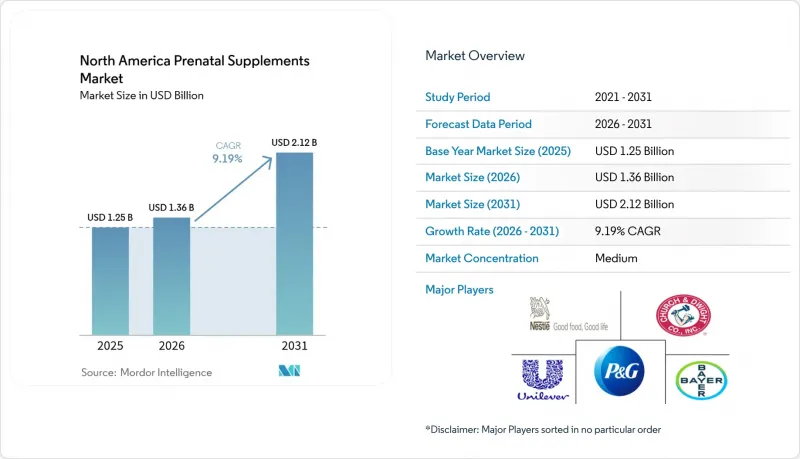
This report is Segmented by Type (Vitamins and Minerals, Essential Fatty Acids, and Others), Form (Capsules and Softgels, Tablets, and More), Distribution Channel (Supermarkets/Hypermarkets, Specialty and Health Stores, and More), and Geography (United States, Canada, Mexico, and Rest of North America). The Market Forecasts are Provided in Terms of Value (USD).
North America Prenatal Supplements Market Trends and Insights
High awareness of prenatal nutrition benefits among expectant mothers
The Centers for Disease Control and Prevention's 2025 guidance recommends that women of reproductive age consume 400 micrograms of folic acid daily, expanding beyond pregnancy planning to include preconception health management . This recommendation aligns with the first 1,000 days concept, which recognizes that maternal nutrition during pregnancy and early infancy influences long-term health outcomes for both mother and child. The American College of Obstetricians and Gynecologists supports healthcare provider education programs that incorporate nutritional supplementation into standard prenatal care protocols as a preventive measure. Public health campaigns now highlight the importance of multiple nutrients, including choline for cognitive development and DHA for neurological function, leading to increased demand for comprehensive prenatal supplements.
Strong endorsements from healthcare providers and organizations
Medical professional organizations significantly influence prenatal vitamin demand through clinical guidelines and recommendations. The American College of Obstetricians and Gynecologists has established prenatal vitamin supplementation as a standard care protocol in obstetric practices. The Office of Dietary Supplements' 2025 guidelines recommend that women of childbearing age consume a minimum of 250 mg daily of DHA plus EPA omega-3 fatty acids, with pregnant women needing an additional 100-200 mg of DHA daily. Healthcare systems incorporate specific prenatal supplement brands into their care protocols after clinical validation, creating stable revenue opportunities for manufacturers. The integration of prenatal nutrition recommendations into electronic health records and clinical support systems enables healthcare providers to generate automated supplement recommendations based on patient profiles and pregnancy stages.
Regulatory challenges due to varying supplement standards
The regulatory landscape for dietary supplements is becoming increasingly complex due to varying safety standards across jurisdictions. California's Senate Bill 646 mandates prenatal vitamin manufacturers to test and publicly disclose heavy metal levels, creating compliance costs that may be prohibitive for smaller manufacturers. The lack of complete regulatory harmonization between the United States and Canada adds further complexity, as Health Canada's Natural Health Products Regulations require separate documentation and testing protocols from FDA requirements . This creates dual compliance obligations for manufacturers operating in both markets. The rise of state-level regulations beyond federal oversight has established a fragmented compliance environment, giving large manufacturers with dedicated regulatory teams an advantage over smaller companies with limited compliance management resources. The FDA's 75-day review process for new dietary ingredient notifications causes market entry delays, affecting companies' ability to capitalize on emerging consumer trends.
Other drivers and restraints analyzed in the detailed report include:
- Rising maternal age leading to increased focus on foetal health
- Growing demand for personalized and trimester-specific supplement formulations
- High cost of premium prenatal supplements limiting affordability
For complete list of drivers and restraints, kindly check the Table Of Contents.
Segment Analysis
Vitamins and minerals maintained 61.74% market share in the North America prenatal supplements market in 2025, driven by mandatory folic acid recommendations, economical formulations, and established pharmacy distribution. Product development focuses on chelated iron, methylfolate, and time-release B-complex formulations to minimize pregnancy-related nausea. The "other nutrients" segment, including probiotics and botanicals, remains small but attracts consumers seeking digestive benefits and antioxidant support. Balchem increased its VitaCholine production capacity by 50% in anticipation of new prenatal formulations incorporating choline, supported by perinatal neurological development research.
Essential fatty acids are projected to grow at 9.41% CAGR, the highest growth rate in the North America prenatal supplements market. Medical recommendations for 600-1,000 mg DHA supplementation in women with insufficient intake have driven demand for premium DHA/EPA formulations from algae sources, which command prices twice that of standard vitamin-mineral combinations. Manufacturers emphasize triglyceride forms for enhanced absorption, while regulatory support facilitates structure-function claims. New products combine DHA with choline to support fetal brain development, and plant-based omega-3 options expand the market among vegetarian consumers.
Complete Report Scope:
- By Type
- Vitamins and Minerals
- Essential Fatty Acids
- Other Types
- By Form
- Capsules and Softgels
- Tablets
- Gummies
- Powders
- Other Forms
- By Distribution Channel
- Supermarkets/Hypermarkets
- Specialty and Health Stores
- Online Retailers
- Other Distribution Channels
- By Geography
- United States
- Canada
- Mexico
- Rest of North America
List of Companies Covered in this Report:
- Bayer AG
- Church & Dwight Co., Inc.
- Nestle S.A.
- Otsuka Holdings Co., Ltd.
- Abbott Laboratories
- PipingRock Health Products, Inc.
- Thorne HealthTech Inc.
- Mason Vitamins, Inc.
- Rainbow Light Nutritional Systems, LLC
- 21st Century HealthCare, Inc.
- Unilever plc
- Nordic Naturals
- The Procter & Gamble Company
- Arcadia Consumer Healthcare
- Pink Stork
- Haleon plc
- Life Extension Foundation Buyers Club, Inc.
- Harbin Pharmaceutical Group Co., Ltd.
- Dr. Willmar Schwabe GmbH & Co. KG
- Bluebonnet Nutrition Corporation
Additional Benefits:
- The market estimate (ME) sheet in Excel format
- 3 months of analyst support
TABLE OF CONTENTS
1 INTRODUCTION
- 1.1 Study Assumptions and Market Definition
- 1.2 Scope of the Study
2 RESEARCH METHODOLOGY
3 EXECUTIVE SUMMARY
4 MARKET LANDSCAPE
- 4.1 Market Overview
- 4.2 Market Drivers
- 4.2.1 High awareness of prenatal nutrition benefits among expectant mothers
- 4.2.2 Strong endorsements from healthcare providers and organizations
- 4.2.3 Rising maternal age leading to increased focus on foetal health
- 4.2.4 Growing demand for personalized and trimester-specific supplement formulations
- 4.2.5 Increased preference for natural, organic, and plant-based prenatal supplements
- 4.2.6 Influencer-led awareness campaigns boosting product visibility
- 4.3 Market Restraints
- 4.3.1 Regulatory challenges due to varying supplement standards
- 4.3.2 High cost of premium prenatal supplements limiting affordability
- 4.3.3 Presence of counterfeit products undermining consumer trust
- 4.3.4 Potential side effects like nausea and constipation deterring usage
- 4.4 Supply Chain Analysis
- 4.5 Regulatory or Technological Outlook
- 4.6 Porter's Five Forces
- 4.6.1 Threat of New Entrants
- 4.6.2 Bargaining Power of Buyers
- 4.6.3 Bargaining Power of Suppliers
- 4.6.4 Threat of Substitutes
- 4.6.5 Intensity of Competitive Rivalry
5 MARKET SIZE AND GROWTH FORECASTS (VALUE)
- 5.1 By Type
- 5.1.1 Vitamins and Minerals
- 5.1.2 Essential Fatty Acids
- 5.1.3 Other Types
- 5.2 By Form
- 5.2.1 Capsules and Softgels
- 5.2.2 Tablets
- 5.2.3 Gummies
- 5.2.4 Powders
- 5.2.5 Other Forms
- 5.3 By Distribution Channel
- 5.3.1 Supermarkets/Hypermarkets
- 5.3.2 Specialty and Health Stores
- 5.3.3 Online Retailers
- 5.3.4 Other Distribution Channels
- 5.4 By Geography
- 5.4.1 United States
- 5.4.2 Canada
- 5.4.3 Mexico
- 5.4.4 Rest of North America
6 COMPETITIVE LANDSCAPE
- 6.1 Market Concentration
- 6.2 Strategic Moves
- 6.3 Market Ranking
- 6.4 Company Profiles (includes Global level Overview, Market level overview, Core Segments, Financials as available, Strategic Information, Market Rank/Share for key companies, Products and Services, and Recent Developments)
- 6.4.1 Bayer AG
- 6.4.2 Church & Dwight Co., Inc.
- 6.4.3 Nestle S.A.
- 6.4.4 Otsuka Holdings Co., Ltd.
- 6.4.5 Abbott Laboratories
- 6.4.6 PipingRock Health Products, Inc.
- 6.4.7 Thorne HealthTech Inc.
- 6.4.8 Mason Vitamins, Inc.
- 6.4.9 Rainbow Light Nutritional Systems, LLC
- 6.4.10 21st Century HealthCare, Inc.
- 6.4.11 Unilever plc
- 6.4.12 Nordic Naturals
- 6.4.13 The Procter & Gamble Company
- 6.4.14 Arcadia Consumer Healthcare
- 6.4.15 Pink Stork
- 6.4.16 Haleon plc
- 6.4.17 Life Extension Foundation Buyers Club, Inc.
- 6.4.18 Harbin Pharmaceutical Group Co., Ltd.
- 6.4.19 Dr. Willmar Schwabe GmbH & Co. KG
- 6.4.20 Bluebonnet Nutrition Corporation
7 MARKET OPPORTUNITIES AND FUTURE OUTLOOK

