PUBLISHER: Mordor Intelligence | PRODUCT CODE: 2097119

PUBLISHER: Mordor Intelligence | PRODUCT CODE: 2097119
Japan Whey Protein - Market Share Analysis, Industry Trends & Statistics, Growth Forecasts (2026 - 2031)
According to Mordor Intelligence, Japan whey protein market size in 2026 is estimated at USD 129.18 million, growing from 2025 value of USD 125.23 million with 2031 projections showing USD 150.88 million, growing at 3.16% CAGR over 2026-2031.
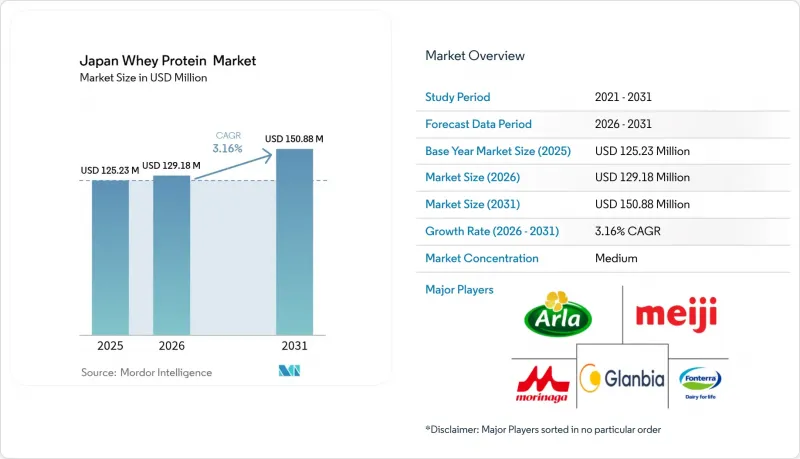
This report is Segmented by Product Type (Whey Protein Concentrate, Whey Protein Isolate, Hydrolyzed Whey Protein), Application (Animal Feed, Food and Beverages, Supplements, Personal Care and Cosmetics, Others), and Geography (Japan). The Market Forecasts are Provided in Terms of Value (USD) and Volume (Tons).
Japan Whey Protein Market Trends and Insights
Growing demand for high-protein ingredients in end products
Protein fortification has expanded from niche sports supplements to mainstream food categories, such as ready-to-eat meals, breakfast cereals, and snack bars. Whey's neutral flavor and heat stability make it the top choice for savory applications, including protein-enriched ramen and miso soup bases, where soy protein's beany notes can interfere with traditional taste profiles. The Ministry of Health, Labour and Welfare's 2024 update to nutrition labeling rules has reduced the requirement for "high protein" claims from 15 grams to 12 grams per 100 grams, effectively lowering formulation costs for mid-tier brands. Bakery applications remain underutilized, as whey protein concentrate can replace wheat flour in bread formulations without affecting crumb structure. However, adoption has been slow due to procurement inertia and limited technical support from ingredient distributors. With growing demand for protein-enriched products, such as high-protein yogurts, nutrition bars, ready-to-drink shakes, and fortified snacks, food and beverage manufacturers are increasingly using whey protein ingredients to meet high-protein claims. In 2024, packaged food products in Japan containing animal-derived protein ingredients recorded a total volume sales of 41.7 thousand tonnes, according to Agriculture and Agri-Food Canada .
Health and fitness trends boosting protein needs
In 2024, Japan reported 2.88 million fitness club members, as stated by the Ministry of Economy, Trade and Industry . This demographic change is transforming protein marketing strategies: brands now focus on promoting skin elasticity, hair health, and metabolic support rather than muscle growth. Meiji's "Savas for Women" line, updated in 2024 to include collagen peptides along with whey isolate, quickly captured the female sports nutrition market within six months of its launch. This success reflects a key insight: Japanese consumers regard protein supplements as a means of preventive healthcare, aligning with the cultural principle of "mibyo," which emphasizes managing health before disease onset. The increasing use of GLP-1 receptor agonists for weight management has also driven demand for high-protein, low-carbohydrate meal replacements that help preserve lean mass during calorie restriction. Whey hydrolysates have gained popularity within this segment due to their faster gastric emptying and reduced satiety effects. On the regulatory side, the Foods with Function Claims system remains supportive, allowing muscle-maintenance claims based on existing literature reviews and eliminating the need for the extensive clinical trials required for FOSHU approval.
Intensifying competition from plant-based proteins
Soy protein isolates and pea protein concentrates are gaining traction in cost-sensitive applications, where whey's functional benefits, such as solubility, neutral flavor, and a complete amino acid profile, are less critical compared to the cost per gram of protein. This trend is most evident in the USD 5-10 per kilogram price range, where whey concentrate directly competes with textured soy protein, and brand loyalty is relatively weak. Improvements in pea protein, such as reduced off-flavors through enzymatic debittering and enhanced solubility via microencapsulation, have made it a viable option for beverage applications that were previously exclusive to whey. In Japan, the environmental narrative is influential, with consumers increasingly considering carbon footprints when selecting packaged foods. Consequently, the market is experiencing a gradual decline in whey's default status in new product development, particularly among startups unencumbered by legacy formulations or supplier relationships.
Other drivers and restraints analyzed in the detailed report include:
- Expansion of sports nutrition and protein categories
- High-purity isolate differentiation by leading brands
- Lactose intolerance and dairy sensitivity
For complete list of drivers and restraints, kindly check the Table Of Contents.
Segment Analysis
In 2025, whey protein isolate accounted for 55.32% of the market value and is expected to grow at a 3.72% CAGR through 2031, surpassing both concentrate and hydrolysate variants. The isolate's market leadership is driven by its high protein purity and low lactose content. These characteristics not only support premium market positioning but also address the lactose sensitivity common among many Japanese consumers. Advances in membrane filtration, particularly cross-flow microfiltration, have enabled the preservation of bioactive fractions like lactoferrin and immunoglobulins. These components, often lost in earlier processing methods, now allow brands to substantiate immune-support claims under the Foods with Function Claims framework.
Whey protein concentrate, although less pure, remains a cost-effective option for bakery and ready-to-eat products. In these applications, functional properties such as emulsification and water binding are more critical than protein density. Hydrolyzed whey protein, which is enzymatically broken down into smaller peptides, serves niche markets like medical nutrition and infant formulas that require rapid absorption and hypoallergenicity. However, its bitter taste and higher price limit broader adoption. The varying growth rates across the segment are influenced by formulation economics: isolates offer a solubility advantage essential for clear, ready-to-drink (RTD) beverages and single-serve stick packs. While the concentrate's slower growth reflects commoditization pressures, particularly as plant-based alternatives challenge its cost-performance benefits in bulk applications, the hydrolysate's specialized market focus protects it from direct competition. Nevertheless, its volume remains restricted by its limited use cases and the complex regulatory requirements for infant formula approvals, which necessitate multi-year clinical validation under MHLW standards.
Complete Report Scope:
- By Product Type
- Whey Protein Concentrate
- Whey Protein Isolate
- Hydrolyzed Whey Protein
- By Application
- Animal Feed
- Food and Beverages
- Bakery
- Beverages
- Breakfast Cereals
- Condiments/Sauces
- Dairy and Dairy Alternative Products
- RTE/RTC Food Products
- Snacks
- Personal Care and Cosmetics
- Supplements
- Baby Food and Infant Formula
- Elderly Nutrition and Medical Nutrition
- Sport/Performance Nutrition
- Personal Care and Cosmetics
- Others
List of Companies Covered in this Report:
- Asahi Group Foods Ltd.
- Meiji Co., Ltd.
- Morinaga Milk Industry Co., Ltd.
- Ajinomoto Co., Inc.
- Fonterra Co-operative Group Ltd.
- Arla Foods amba
- Glanbia plc
- Carbery Group
- Agropur Dairy Co-operative
- Hilmar Cheese Company, Inc.
- Saputo Inc.
- Lactalis Ingredients
- Nutricia (Danone)
- Bulk Nutrients Japan
- Optimum Nutrition (ON)
- The Protein Works
- Myprotein
- Milk Specialties Global
- Valio Ltd.
- FrieslandCampina
- Dymatize Enterprises LLC
Additional Benefits:
- The market estimate (ME) sheet in Excel format
- 3 months of analyst support
TABLE OF CONTENTS
1 INTRODUCTION
- 1.1 Study Assumptions and Market Definition
- 1.2 Scope of the Study
2 RESEARCH METHODOLOGY
3 EXECUTIVE SUMMARY
4 MARKET LANDSCAPE
- 4.1 Market Overview
- 4.2 Market Drivers
- 4.2.1 Growing Demand for High-Protein Ingredients in End Products
- 4.2.2 Health and Fitness Trends Boosting Protein Needs
- 4.2.3 Expansion of sports nutrition and protein categories
- 4.2.4 High-purity isolate differentiation by leading brands
- 4.2.5 Premium and clean?label positioning
- 4.2.6 Product innovation and flavor localization
- 4.3 Market Restraints
- 4.3.1 Intensifying competition from plant-based proteins
- 4.3.2 Lactose intolerance and dairy sensitivity
- 4.3.3 Dairy price volatility
- 4.3.4 Market maturity in core sports segments
- 4.4 Supply Chain Analysis
- 4.5 Regulatory Landscape
- 4.6 Technological Outlook
- 4.7 Porter's Five Forces
- 4.7.1 Threat of New Entrants
- 4.7.2 Bargaining Power of Buyers
- 4.7.3 Bargaining Power of Suppliers
- 4.7.4 Threat of Substitutes
- 4.7.5 Intensity of Competitive Rivalry
5 MARKET SIZE AND GROWTH FORECASTS (VALUE AND VOLUME)
- 5.1 By Product Type
- 5.1.1 Whey Protein Concentrate
- 5.1.2 Whey Protein Isolate
- 5.1.3 Hydrolyzed Whey Protein
- 5.2 By Application
- 5.2.1 Animal Feed
- 5.2.2 Food and Beverages
- 5.2.2.1 Bakery
- 5.2.2.2 Beverages
- 5.2.2.3 Breakfast Cereals
- 5.2.2.4 Condiments/Sauces
- 5.2.2.5 Dairy and Dairy Alternative Products
- 5.2.2.6 RTE/RTC Food Products
- 5.2.2.7 Snacks
- 5.2.2.8 Personal Care and Cosmetics
- 5.2.3 Supplements
- 5.2.3.1 Baby Food and Infant Formula
- 5.2.3.2 Elderly Nutrition and Medical Nutrition
- 5.2.3.3 Sport/Performance Nutrition
- 5.2.4 Personal Care and Cosmetics
- 5.2.5 Others
6 COMPETITIVE LANDSCAPE
- 6.1 Market Concentration
- 6.2 Strategic Moves
- 6.3 Market Share Analysis
- 6.4 Company Profiles (includes Global level Overview, Market level overview, Core Segments, Financials as available, Strategic Information, Market Rank/Share for key companies, Products and Services, and Recent Developments)
- 6.4.1 Asahi Group Foods Ltd.
- 6.4.2 Meiji Co., Ltd.
- 6.4.3 Morinaga Milk Industry Co., Ltd.
- 6.4.4 Ajinomoto Co., Inc.
- 6.4.5 Fonterra Co-operative Group Ltd.
- 6.4.6 Arla Foods amba
- 6.4.7 Glanbia plc
- 6.4.8 Carbery Group
- 6.4.9 Agropur Dairy Co-operative
- 6.4.10 Hilmar Cheese Company, Inc.
- 6.4.11 Saputo Inc.
- 6.4.12 Lactalis Ingredients
- 6.4.13 Nutricia (Danone)
- 6.4.14 Bulk Nutrients Japan
- 6.4.15 Optimum Nutrition (ON)
- 6.4.16 The Protein Works
- 6.4.17 Myprotein
- 6.4.18 Milk Specialties Global
- 6.4.19 Valio Ltd.
- 6.4.20 FrieslandCampina
- 6.4.21 Dymatize Enterprises LLC
7 MARKET OPPORTUNITIES AND FUTURE OUTLOOK

