PUBLISHER: Mordor Intelligence | PRODUCT CODE: 2113747

PUBLISHER: Mordor Intelligence | PRODUCT CODE: 2113747
China Whey Protein - Market Share Analysis, Industry Trends & Statistics, Growth Forecasts (2026 - 2031)
According to Mordor Intelligence, the China whey protein market size is expected to grow from USD 1.03 billion in 2025 to USD 1.09 billion in 2026 and is forecast to reach USD 1.44 billion by 2031 at 5.8% CAGR over 2026-2031.
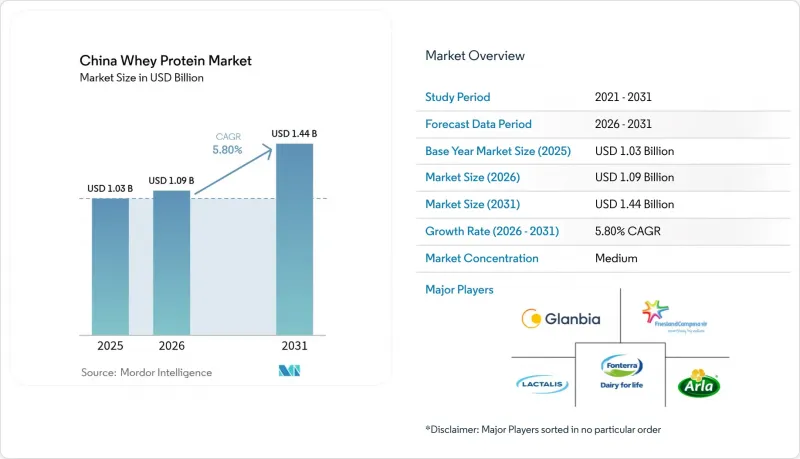
This report is Segmented by Product Type (Whey Protein Concentrate, Whey Protein Isolate, Hydrolyzed Whey Protein), Category (Mass, Premium), Distribution Channel (Online Retail, Supermarkets and Hypermarkets, Health and Wellness Stores, Other Distribution Channels), and Geography (China). The Market Forecasts are Provided in Terms of Value (USD).
China Whey Protein Market Trends and Insights
Expansion of Fitness and Gym Culture
China's fitness industry is experiencing rapid growth in memberships. By 2024, the country had over 140,000 gyms, including 28,683 fitness clubs and 43,232 fitness studios. In 2023, fitness club memberships reached 69.75 million. The National Fitness Plan (2021-2025) targets 38.5% regular physical activity participation, boosting demand for sports nutrition products like whey protein powders and ready-to-drink protein beverages. Boutique fitness studios and cross-training centers in tier-one cities are driving this trend by offering nutritional counseling with memberships, increasing demand for premium whey isolates and hydrolysates. At Food Ingredients China 2024, Glanbia Nutritionals introduced high-protein products, including High Protein Acidified Milk (12 grams whey protein) and High Protein Electrolyte Water, catering to post-workout recovery and hydration. Government fitness initiatives and gym expansions are solidifying whey protein's role in the active lifestyle market, with younger consumers (18-35 years) driving e-commerce subscriptions for repeat purchases.
Increasing Prevalence of Lifestyle Diseases
By 2030, China is expected to have around 164 million diabetics aged 20 to 79, according to the International Diabetes Federation The Global Burden of Disease study ranks China among the top three countries globally for metabolic diseases, with type 2 diabetes closely tied to high body mass index. To tackle this, healthcare providers and policymakers are emphasizing dietary protein for better blood sugar control and weight management. Whey protein, valued for its ability to boost insulin and reduce appetite, is a key focus. The China National Nutrition Plan promotes combining plant and animal proteins to fight malnutrition and chronic diseases, driving regulatory support for whey-based functional foods. Hospitals and clinics are increasingly recommending whey protein isolates for diabetic and pre-diabetic patients, while pharmaceutical-grade whey hydrolysates are being used in Food for Special Medical Purposes (FSMP). With 14% of the population aged 65 and older in 2024, the demand for easily digestible protein sources is growing, positioning hydrolyzed whey as an essential part of clinical nutrition.
Quality Control and Counterfeit Issues
Counterfeit whey protein products are flooding e-commerce platforms and tier-three cities, shaking consumer trust and diminishing the pricing power of legitimate brands. These counterfeiters are taking advantage of the State Administration for Market Regulation's (SAMR) limited enforcement reach, especially in rural areas where testing facilities are few and far between. While SAMR has ramped up its post-market surveillance-randomly inspecting imported whey protein powders and penalizing mislabeling and adulteration-the vastness of cross-border e-commerce transactions makes traceability a daunting challenge. In response, genuine brands are turning to blockchain-based provenance systems and QR-code verifications to set their products apart. However, these protective measures come with added costs and complexities. The shadow of past scandals looms large: incidents like the 2008 melamine adulteration in dairy products have tainted the domestic perception of whey protein. As a result, many affluent consumers are gravitating towards imported brands that boast third-party certifications like NSF and Informed-Sport. This trend has effectively split the market: a premium segment that prioritizes and pays for verified quality, and a mass segment that remains susceptible to counterfeit threats.
Other drivers and restraints analyzed in the detailed report include:
- Increasing Adoption of Whey in Infant-Nutrition Formulas
- Government Initiatives Supporting Dairy Industry
- Heavy Reliance on Imports
For complete list of drivers and restraints, kindly check the Table Of Contents.
Segment Analysis
In 2025, Whey Protein Concentrate (WPC) commanded a 55.02% market share, primarily due to its cost-effectiveness. WPC is favored in mass-market protein powders, bakery fortification, and beverages, where a moderate protein purity of 35-80% is adequate. Its processing, typically through ultrafiltration and not ion exchange, is less intensive, leading to competitive pricing. This makes WPC the go-to for domestic brands, especially those catering to price-sensitive consumers in tier-two and tier-three cities. Food manufacturers incorporate WPC into high-protein biscuits, noodles, and dairy drinks.
From 2026 to 2031, Hydrolyzed Whey Protein is projected to grow at a 6.93% CAGR, outpacing both WPC and WPI. Its enzymatic pre-digestion shortens peptide chains, hastening amino acid absorption. This rapid absorption is vital for infant formulas, especially for premature or lactose-intolerant infants. Hydrolyzed whey not only minimizes gastric distress and allergic reactions but also meets the GB 25596-2025 standards for special medical formulas. Sports nutrition brands are increasingly turning to hydrolyzed whey for post-workout recovery products, leveraging its swift leucine delivery to boost muscle protein synthesis.
Complete Report Scope:
- By Product Type
- Whey Protein Concentrate
- Whey Protein Isolate
- Hydrolyzed Whey Protein
- By Category
- Mass
- Premium
- By Distribution Channel
- Online Retail
- Supermarkets and Hypermarkets
- Health and Wellness Stores
- Other Distribution Channels
List of Companies Covered in this Report:
- Fonterra Co?operative Group Limited
- Arla Foods Ingredients Group P/S?
- Glanbia plc
- Hilmar Cheese Company, Inc.
- Royal FrieslandCampina N.V.
- Agropur Inc.
- Lactalis Ingredients
- Saputo Inc.
- Wheyco GmbH
- Carbery Group Ltd.
- Leprino Foods Company
- Meggle Group
- Davisco Foods International
- Milk Specialties Global
- Volac International Ltd
- Inner Mongolia Yili Industrial Group Co., Ltd.
- China Mengniu Dairy Co. Ltd.
- Synutra International, Inc.
- Qinghai Wondersun Dairy Co., Ltd.
- Ausnutria Dairy Corporation Ltd.
Additional Benefits:
- The market estimate (ME) sheet in Excel format
- 3 months of analyst support
TABLE OF CONTENTS
1 INTRODUCTION
- 1.1 Study Assumptions and Market Definition
- 1.2 Scope of the Study
2 RESEARCH METHODOLOGY
3 EXECUTIVE SUMMARY
4 MARKET LANDSCAPE
- 4.1 Market Overview
- 4.2 Market Drivers
- 4.2.1 Expansion of fitness and gym culture
- 4.2.2 Increasing prevalence of lifestyle diseases
- 4.2.3 Increasing adoption of whey in infant-nutrition formulas
- 4.2.4 Government initiatives supporting dairy industry
- 4.2.5 Shift toward high-protein, low-carb diets
- 4.2.6 Technological advancements in processing
- 4.3 Market Restraints
- 4.3.1 Quality control and counterfeit issues
- 4.3.2 Heavy reliance on imports
- 4.3.3 Competition from plant-based alternatives
- 4.3.4 Supply chain vulnerabilities
- 4.4 Supply Chain Analysis
- 4.5 Regulatory Landscape
- 4.6 Technological Outlook
- 4.7 Porter's Five Forces Analysis
- 4.7.1 Threat of New Entrants
- 4.7.2 Bargaining Power of Buyers
- 4.7.3 Bargaining Power of Suppliers
- 4.7.4 Threat of Substitutes
- 4.7.5 Intensity of Competitive Rivalry
5 MARKET SIZE AND GROWTH FORECASTS (VALUE)
- 5.1 By Product Type
- 5.1.1 Whey Protein Concentrate
- 5.1.2 Whey Protein Isolate
- 5.1.3 Hydrolyzed Whey Protein
- 5.2 By Category
- 5.2.1 Mass
- 5.2.2 Premium
- 5.3 By Distribution Channel
- 5.3.1 Online Retail
- 5.3.2 Supermarkets and Hypermarkets
- 5.3.3 Health and Wellness Stores
- 5.3.4 Other Distribution Channels
6 COMPETITIVE LANDSCAPE
- 6.1 Market Concentration
- 6.2 Strategic Moves
- 6.3 Market Share Analysis
- 6.4 Company Profiles (includes Global level Overview, Market level overview, Core Segments, Financials as available, Strategic Information, Market Rank/Share for key companies, Products and Services, and Recent Developments)
- 6.4.1 Fonterra Co?operative Group Limited
- 6.4.2 Arla Foods Ingredients Group P/S?
- 6.4.3 Glanbia plc
- 6.4.4 Hilmar Cheese Company, Inc.
- 6.4.5 Royal FrieslandCampina N.V.
- 6.4.6 Agropur Inc.
- 6.4.7 Lactalis Ingredients
- 6.4.8 Saputo Inc.
- 6.4.9 Wheyco GmbH
- 6.4.10 Carbery Group Ltd.
- 6.4.11 Leprino Foods Company
- 6.4.12 Meggle Group
- 6.4.13 Davisco Foods International
- 6.4.14 Milk Specialties Global
- 6.4.15 Volac International Ltd
- 6.4.16 Inner Mongolia Yili Industrial Group Co., Ltd.
- 6.4.17 China Mengniu Dairy Co. Ltd.
- 6.4.18 Synutra International, Inc.
- 6.4.19 Qinghai Wondersun Dairy Co., Ltd.
- 6.4.20 Ausnutria Dairy Corporation Ltd.
7 MARKET OPPORTUNITIES AND FUTURE OUTLOOK

